

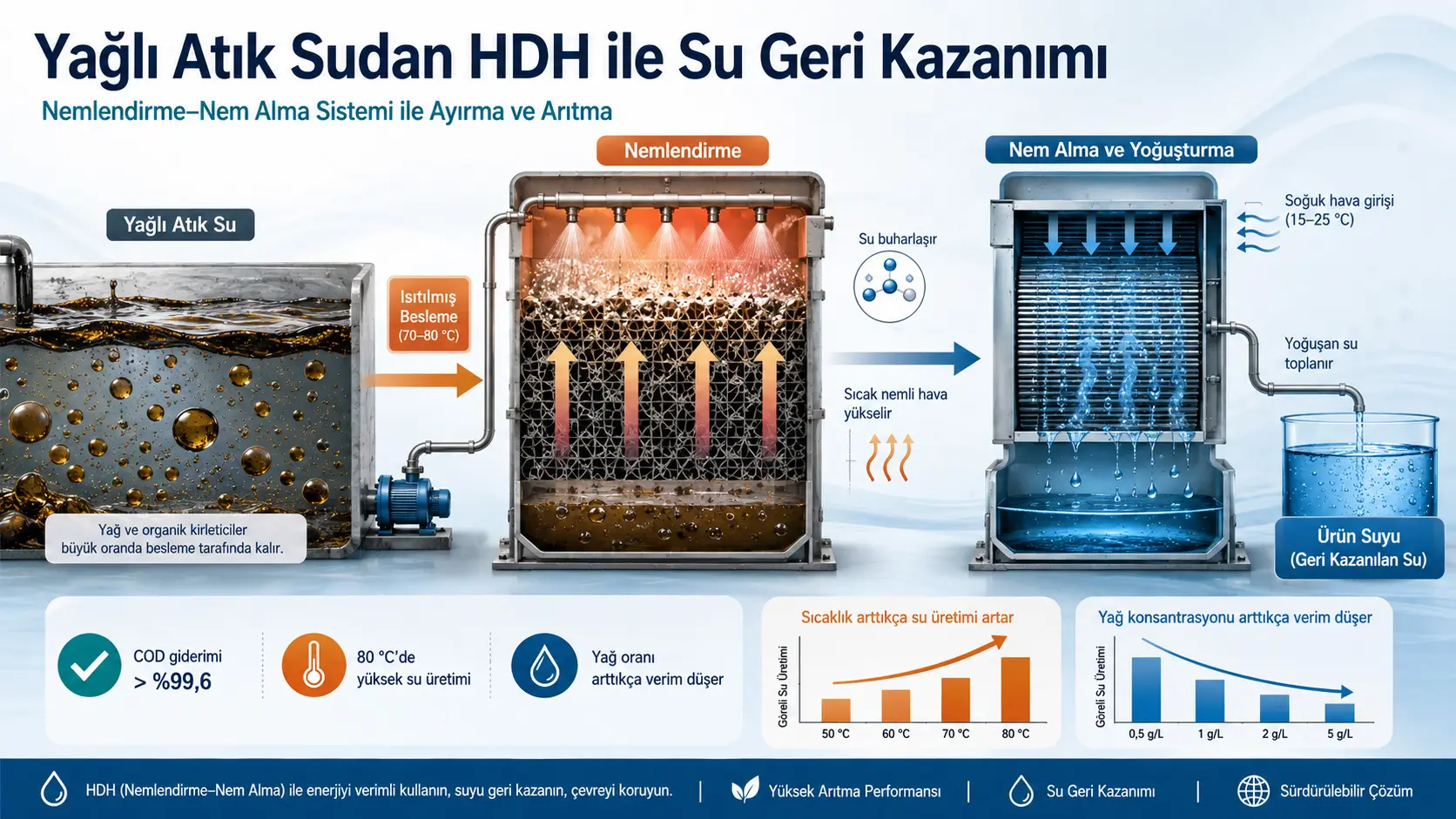
Ин таҳқиқот барои бозёфтани об аз wastewater-и равғанӣ, ки ҷудокунии он бо methods-и анъанавӣ аз сабаби oil droplets ва surfactants душвор мегардад, system-и laboratory-scale дар асоси humidification–dehumidification, яъне HDH таҳия мекунад. Дар system, heated oily water аз болои porous packing material ба поён spray мешавад, дар ҳоле ки air дар opposite direction ба боло ҳаракат мекунад. Water vapor ба air мегузарад, nonvolatile oil components дар liquid phase нигоҳ дошта мешаванд ва humid air дар section-и separate cooling шуда ба product water табдил меёбад. Вақте model wastewater containing %1 oil дар 80 °C коркард шуд, system 12 L·hour−1 product water ва 50 L·m−3·hour−1 volumetric productivity дод; COD-и product water 15 mg·L−1 ва reported COD retention rate %99,8 буд.
Вақте feed temperature аз 60 °C то 85 °C зиёд шуд, volumetric water productivity барои %1 oily water аз 25,4 то 53,8 L·m−3·hour−1 боло рафта, тақрибан %112 зиёд шуд. Баръакс, дар 80 °C афзоиши oil concentration аз %0 то %10 productivity-ро аз тақрибан 51,3 то 33,3 L·m−3·hour−1 коҳиш дод, gain output ratio-ро %41 паст кард ва reported specific thermal energy consumption-ро %72 зиёд карда то 2309 kWh·m−3 расонд. Иловаи Tween 80 emulsion-ро more stable кард ва water production-ро нисбат ба %1 oily water тақрибан %2,5 коҳиш дод.
Results-и study нишон медиҳанд, ки HDH system метавонад nonvolatile oil components-ро асосан дар concentrated liquid phase нигоҳ дорад. Аммо дар experiments ба ҷойи real refinery ё oil-field wastewater model mixtures-и prepared with food-grade soybean oil ва Tween 80 истифода шуданд. Ҳар experiment танҳо one-hour steady operating period-ро дар бар гирифт; long-term fouling, foaming, corrosion, oil accumulation, surfactant transport ва equipment durability омӯхта нашуданд. Energy calculation ҳам pump, fan, cooling water ва heat losses-ро дар full-system level пурра дар бар намегирад.
Аз нигоҳи Туркия: Approach барои refinery ва petrochemical facilities, metalworking ва machining, vegetable-oil production, food industry, ports, shipyards, maritime transport ва facilities producing oily process water дар Туркия research value дорад. Пеш аз application, mineral oil, emulsifier, detergent, salt, suspended solids, heavy metals ва volatile organic compounds дар local wastewaters бояд separately characterized шаванд. Integration with waste heat, solar heat ё cogeneration heat; mist eliminators reducing droplet carryover; management of concentrated oily residue ва advanced treatment of product water бояд якҷоя assessed шаванд. Аз ин study хулоса кардан мумкин нест, ки system дар ҳамаи oily wastewaters-и Туркия same %99,6–99,8 COD retention rate мерасад, direct-discharge ё reuse water истеҳсол мекунад ё аз existing methods economically superior аст.
Чаро oily wastewater separation душвор аст?
Дар industrial oily waters oil ҳамеша ҳамчун free layer, ки аз surface ба осонӣ ҷамъ мешавад, мавҷуд нест. Mechanical mixing, pumps, detergents ва surfactants метавонанд oil-ро ба micro- ё nano-scale droplets ҷудо кунанд. Ин droplets метавонанд муддати дароз suspended in water бимонанд ва stable emulsions ташкил кунанд.
Density-difference-based settling ва centrifugation метавонанд барои large free-oil droplets effective бошанд, аммо барои small stable droplets insufficient шаванд. Membranes метавонанд high separation precision диҳанд; вале adsorption-и oil on membrane surface, pore blocking ва hard-to-recover flux losses operational cost-ро зиёд карда метавонанд. Chemical coagulation ва emulsion-breaking methods метавонанд chemical consumption ва secondary sludge эҷод кунанд.
Researchers бар зидди ин issues thermal-separation approach-ро омӯхтаанд, ки ба ҷойи кӯшиши гузарондани oil through filter, water-ро selectively ба vapor phase мебарад. Basic assumption ин аст, ки дар experimental temperatures vapor pressure-и water strongly increases, дар ҳоле ки tendency of soybean-oil components to enter vapor phase хеле паст мемонад.
Humidification–dehumidification чӣ гуна кор мекунад?
HDH imitation-и natural water cycle дар дохили closed device мебошад. Process аз two main sections иборат аст:
- Humidification: Heated liquid ба porous packing material spray мешавад. Ҳангоме ки liquid thin film ва small droplets ташкил мекунад, counterflowing air water vapor-ро қабул мекунад.
- Dehumidification: Hot humid air ба condenser фиристода мешавад. Cooled water vapor ба liquid табдил ёфта, дар product-water tank ҷамъ мешавад.
Nonvolatile components мисли oil ва surfactant асосан дар liquid returning to feed tank мемонанд. Ҳамин тавр, system на танҳо water истеҳсол мекунад, балки volume of remaining stream-ро кам карда oil components-ро concentrate мекунад.
System дар atmospheric pressure ва feed temperatures 60–85 °C кор кардааст. Ин range метавонад истифодаи lower-temperature waste heat нисбат ба high-pressure evaporation systems имкон диҳад. Аммо дар experimental setup-и examined heat бо electric heater таъмин шуд; real waste-heat ё solar-heat source истифода нашуд.
Oil layer evaporation-ро чӣ гуна монеъ мешавад?
Вақте continuous oil film рӯи water ташкил мешавад, он physical barrier байни water molecules ва carrier air месозад. Water molecules бояд аввал аз oil layer гузаранд ё аз regions left open by film ба gas phase расанд. Бо зиёд шудани oil fraction, viscosity of liquid ва mass-transfer resistance at gas–liquid interface зиёд мешаванд.
Мувофиқи mechanism-и proposed дар Figure 4, oil film completely stationary нест. Shear force of upward-moving air, movement of liquid over packing ва surface tension oil film-ро stretch, deform ва баъзан break мекунанд. Water vapor метавонад through these temporary openings ба gas phase гузарад.
Аз ин рӯ system дар presence of oil completely stop намекунад, аммо нисбат ба pure water at same temperature lower productivity нишон медиҳад. Дар system containing %1 oil, productivity дар 80 °C тақрибан %2,5 lower than pure water буда, бо ин interfacial resistance алоқаманд дониста шудааст.
Model oily waters чӣ гуна prepared шуданд?
Дар research ба ҷойи real industrial wastewater deionized water, food-grade soybean oil ва analytical-grade Tween 80 истифода шуданд. Two feed systems prepared шуданд:
| System | Content | Concentrations |
|---|---|---|
| System I | Deionized water and soybean oil | Oil: by mass %1, %3, %5, %7 and %10 |
| System II | Deionized water, soybean oil and Tween 80 | Oil: %1–10; oil/Tween 80 mass ratio 2:1 |
Дар samples with surfactant, %0,5 Tween 80 барои %1 oil; %1,5 барои %3 oil; %2,5 барои %5 oil; %3,5 барои %7 oil ва %5 барои %10 oil истифода шуд. Ҳар feed group дар volume 200 liters prepared шуд, то continuous operation of recirculating system supported шавад.
Text дар ҳар two systems water-ро “dispersed phase” меномад. Аммо mixtures асосан аз water иборатанд, Figure 1(c) oil droplets-ро dispersed within continuous liquid нишон медиҳад ва discussion throughout mechanism-и “oil droplets in water”-ро истифода мебарад. Аз ин рӯ phase definition дар text terminologically inconsistent аст.
Main components of experimental setup
Laboratory system аз feed tank, electric heater, circulation pump, humidification tower, dehumidification tower, cooling-water tank, condenser, product-water tank ва variable-speed fan иборат аст. Humidification ва dehumidification chambers аз polypropylene сохта шуда, outer surfaces бо thermal insulation пӯшида шудаанд.
Дар towers porous polypropylene spheres with diameter 3,8 cm ҳамчун packing material истифода шуданд. Heated liquid аз боло spray шуда, ҳангоми flowing downward over packing, air аз поён ба боло ҳаракат кард. Ин countercurrent arrangement мақсад дошт contact area ва contact time байни air ва liquid-ро зиёд кунад.
Feed бо GP-125 pump with nominal capacity 2100 L·hour−1 circulated шуд; дар experiments flow rate 1000 L·hour−1 set шуд. Nominal air flow of FD-250 fan 2100 m3·hour−1 аст. Дар result experiments feed-to-air mass-flow ratio, яъне MFR at 4,8 нигоҳ дошта шуд.
Cooling-water flow in dehumidification section at 1000 L·hour−1 fixed шуд. Humid air ҳангоми contact with condenser tubes cooled шуда, condensed water дар separate tank collected шуд.
Experiments чанд вақт давом карданд?
Ҳар experiment пас аз system reaching steady state то completion of one-hour operating period идома ёфт. Ҳар condition at least three times repeated шуд. Product-water mass бо electronic balance having ±0,1 g precision measured шуд; chemical oxygen demand of feed ва product water бо full-spectrum rapid water analyzer determined шуд.
Гарчанде at least three repeats performed шуданд, result graphs error bars надоранд ва standard deviation ё confidence interval alongside mean values reported нашудааст. Statistical-significance test барои differences between groups ҳам performed нашудааст. Аз ин рӯ magnitude of small differences, especially approximately %2,5 productivity change caused by surfactant, relative to experimental scatter cannot be assessed.
Mass and energy balance
Simplified mass balance used for system:
\[ \dot{m}_{\mathrm{in}}-\dot{m}_{\mathrm{out}} = \dot{m}_{\mathrm{pw}} \]
Here \(\dot{m}_{\mathrm{in}}\) is mass flow of feed entering system, \(\dot{m}_{\mathrm{out}}\) concentrated outlet and \(\dot{m}_{\mathrm{pw}}\) product water.
Heat input in study was calculated with:
\[ Q_{\mathrm{in}} = \dot{m}_{\mathrm{in}} \left( c_{p,1}T_{\mathrm{feed},1} - c_{p,2}T_{\mathrm{feed},2} \right) \]
This equation is based on difference between inlet and outlet enthalpies of feed stream. Analysis assumes system is sealed, at steady state and atmospheric pressure; heat losses, secondary heat transfer in packing and device body, and density effects are negligible.
In real industrial system, heat losses, electricity for pump and fan, cooling-water production, motor efficiencies and auxiliary equipment affect total energy consumption. Therefore energy values in study should be read not as full-plant electricity and fuel consumption but as idealized thermal-performance indicators.
Volumetric separated-water productivity
Volumetric separated-water productivity shows product-water flow per effective volume of dehumidification section:
\[ \mathrm{VSWP} = \frac{V_{\mathrm{pw}}}{V_{\mathrm{dc}}} \]
Here \(V_{\mathrm{pw}}\) is product water obtained per unit time and \(V_{\mathrm{dc}}\) effective dehumidification volume of approximately 0,24 m3. For example 12 L·hour−1 product water gives:
\[ \frac{12\ \mathrm{L\,h^{-1}}} {0{,}24\ \mathrm{m^3}} = 50\ \mathrm{L\,m^{-3}\,h^{-1}} \]
.
COD retention rate
Transfer of organic pollutants to product water was evaluated through chemical oxygen demand:
\[ R_c = \left( 1-\frac{f_{\mathrm{COD}}}{w_{\mathrm{COD}}} \right)\times100\% \]
\(f_{\mathrm{COD}}\) is COD of product water, \(w_{\mathrm{COD}}\) COD of feed. This ratio indicates retention of organic matter on feed side; it is not directly an oil-mass separation percentage. Dissolved organic components such as Tween 80 also contribute to COD measurement.
Gain output ratio
Gain output ratio is ratio of latent heat recovered by condensation of product water to heat supplied to system:
\[ \mathrm{GOR} = \frac{ \rho_{\mathrm{pw}} V_{\mathrm{pw}} h_{\mathrm{pw}} }{ Q_{\mathrm{in}} } \]
As GOR increases, supplied heat is considered more effectively used in producing product water. Study gives GOR 0,50 for pure water and 0,47 for %1 oily water at 80 °C. Both values are below one; system operates without multi-stage heat recovery.
Specific thermal energy consumption
STEC equation in study is:
\[ \mathrm{STEC} = \frac{ Q_{\mathrm{in}} }{ 3600V_{\mathrm{pw}} } \]
STEC aims to express thermal-energy consumption per cubic meter of product water in kWh·m−3. However, in nomenclature section \(V_{\mathrm{pw}}\) is defined in L·hour−1. Because factor 1000 converting liters to cubic meters is not explicitly shown in equation, there is unexplained unit conversion between formula and reported unit.
Reported values at 80 °C are 1345 for pure water and 1410 kWh·m−3 for %1 oily water. At %10 oil value is 2309 kWh·m−3. These high values show using low-cost or waste heat would be critical for economic feasibility.
What happened when oil concentration increased?
When feed temperature was 80 °C, liquid flow 1 m3·hour−1 and MFR 4,8, increasing oil concentration negatively affected all major performance indicators.
| Oil-concentration change | Initial or low concentration | %10 oil | Change |
|---|---|---|---|
| VSWP | Approximately 51,3 L·m−3·hour−1 | 33,3 L·m−3·hour−1 | Approximately %35 decrease |
| Product-water COD | 15 mg·L−1 at %1 oil | 110 mg·L−1 | Increase due to microdroplet carryover |
| COD retention rate | Approximately %99,8 | Above %99,8 | Fractional retention largely maintained |
| GOR | 0,49 near pure-water reference | 0,29 | Approximately %41 decrease |
| STEC | Approximately 1345 kWh·m−3 | 2309 kWh·m−3 | Approximately %72 increase |
As oil fraction increased, viscosity of liquid film formed on packing rose, spreading of liquid and effective contact area with air decreased. At same time accumulation of oil at gas–liquid interface created additional resistance to transfer of water molecules into vapor phase.
Evaporation of oil components themselves into product was assumed low. Increase of COD in product water was attributed to small liquid droplets carried with humid air. This interpretation suggests adding suitable demister or mist eliminator at humidifier outlet could improve product-water quality; however no such equipment comparison was performed.
What happened when feed temperature increased?
For %1 oily feed, increasing temperature from 60 °C to 85 °C increased vapor pressure of water and amount of moisture air could carry. Results are:
| Indicator | 60 °C | 85 °C | Change |
|---|---|---|---|
| VSWP | 25,4 L·m−3·hour−1 | 53,8 L·m−3·hour−1 | Approximately %112 increase |
| GOR | Approximately 0,31 in graph | Approximately 0,49 | Approximately %60 increase |
| STEC | Approximately 2180 kWh·m−3 in graph | Approximately 1350 kWh·m−3 | Approximately %38 decrease |
| COD retention | Above %99,7 | No marked decrease with temperature | |
Although more heat was supplied at higher temperature, reported thermal energy consumption per unit product decreased because product-water quantity increased faster. However temperatures above 85 °C were not examined and limits such as material durability and foaming were not studied.
Why did surfactant reduce performance?
Tween 80 reduced oil–water interfacial tension, forming smaller and more stable oil droplets. Surfactant layer around droplet created steric barrier, making coalescence of droplets and separation into larger phases more difficult.
At 80 °C, water production for feed containing %1 oil and %0,5 Tween 80 was approximately %2,5 lower than surfactant-free %1 oily feed. Product-water COD increased from 15 to 28 mg·L−1, and retention rate decreased from approximately %99,8 to %99,7.
Researchers suggest smaller droplets have stronger Brownian motion and may be more susceptible to entrainment by upward vapor–air flow. In addition, free Tween 80 dissolved in water may contribute to COD measurement in product water.
Figure 7 compares only VSWP and COD retention between systems with and without surfactant. Although conclusion section states surfactant also worsened energy-use efficiency, separate GOR or STEC numbers are not presented in main text.
How should product-water quality be evaluated?
COD of 15 mg·L−1 was measured in product water from %1 oily feed and 110 mg·L−1 from %10 oily feed. Because feed concentration is high, fractional retention can remain above %99,8; however absolute COD of product water rises.
High removal percentage does not automatically mean product water is suitable for drinking, process reuse or direct environmental discharge. Study did not measure:
- Oil and grease concentration,
- Total organic carbon,
- Turbidity and suspended solids,
- Tween 80 or other surfactants,
- Volatile organic compounds,
- pH, conductivity and salinity,
- Heavy metals,
- Toxicity and biodegradability.
Therefore expression “deep treatment” should be evaluated only within COD-retention performance measured in study.
Main conclusions supported by study
- Laboratory-scale HDH system could obtain condensed product water from model oily waters prepared with soybean oil.
- At %1 oil and 80 °C, product-water flow was 12 L·hour−1 and VSWP 50 L·m−3·hour−1.
- Under same condition product-water COD was 15 mg·L−1 and calculated COD retention rate %99,8.
- Increasing feed temperature raised water productivity and GOR while lowering reported STEC.
- Increasing oil concentration increased interfacial mass-transfer resistance and reduced water production.
- Surfactant stabilized emulsion, slightly reduced water production and increased product-water COD.
- Even at feed containing %10 oil, calculated COD retention remained above %99,8.
Study чиро нишон намедиҳад?
- Real refinery, oil-field, metalworking or maritime wastewater was not tested.
- Soybean oil was used instead of petroleum hydrocarbons; transfer of volatile and semivolatile petroleum components into product was not evaluated.
- Continuous operation longer than one hour, weekly or monthly stability was not investigated.
- Oil accumulation on packing, biofouling, foaming and cleaning requirement were not measured.
- Actual total energy consumption of pumps, fan, cooling circuit and electric heater was not provided.
- No experimental integration with waste heat or solar energy was performed.
- Disposal or recovery method for concentrated oily liquid was not assessed.
- Comprehensive analyses did not show product water meets any official discharge or reuse standard.
- System was not compared on same feed with membrane, centrifuge, dissolved-air flotation or chemical emulsion breaking.
- No capital cost, operating cost, cost per water and life-cycle analysis were performed.
Important ambiguities and inconsistencies in text
| Issue | Information given in source | Assessment |
|---|---|---|
| Emulsion phase | Water is defined as “dispersed phase” | Formulation, micrograph and discussion show oil dispersed in water |
| STEC unit | \(V_{\mathrm{pw}}\) in L·hour−1, STEC in kWh·m−3 | Liter-to-cubic-meter conversion not shown explicitly in formula |
| Figure 6 description | States it covers pure water, oily water and surfactant-containing water | Visible GOR and STEC series contain only pure water and oily water |
| Energy effect of surfactant | Concludes energy-use efficiency worsened | No separate numerical GOR or STEC results provided |
| Water quality | Claims product water meets basic quality requirements | Only COD measured and no standard limit specified |
| Replicates | Each condition repeated at least three times | No standard deviation, error bar or statistical test presented |
| Heat loss | Heat losses neglected | Although laboratory device insulated, actual loss amount not experimentally verified |
| Concentration assumption | States concentration effect neglected in theoretical model | Oil concentration is one of main experimental variables; scope of assumption not explained |
Усул ва бозёфтҳои таҳқиқот
Source chemicals and feed composition
| Component | Property or source | Function |
|---|---|---|
| Deionized water | Pure-water feed | Continuous liquid phase and recovered water |
| Soybean oil | Food grade, Qingdao Tianshang Food Group | Model oil contaminant |
| Tween 80 | Analytical purity | Surfactant producing stable emulsion |
| Feed volume | 200 L for each composition | Liquid reserve for recirculating continuous experiment |
HDH setup
| Component | Property | Task |
|---|---|---|
| Humidification chamber | Polypropylene, insulated | Contact between heated feed and air |
| Dehumidification chamber | Polypropylene, effective volume approximately 0,24 m3 | Condense water from humid air |
| Packing | PP porous spheres 3,8 cm diameter | Increase gas–liquid contact area |
| Circulation pump | GP-125, nominal 2100 L·hour−1 | Transport feed to humidification tower |
| Rotor flowmeter | LZB-25F, 1000 L·hour−1 range | Control liquid flow rate |
| Fan | FD-250, nominal 2100 m3·hour−1 | Circulate carrier air |
| Cooling water | 1000 L·hour−1 | Condense water vapor |
| Heating | Electric heater and temperature controller | Bring feed to 60–85 °C |
Measurement instruments
| Measurement | Instrument | Specified precision |
|---|---|---|
| Air velocity | HT-9829 anemometer | ±0,01 m·s−1 |
| Product-water mass | TSC-150 electronic balance | ±0,1 g |
| COD | MDS-30QUI full-spectrum analyzer | Wavelength resolution ±0,8 nm |
| Temperature | Thermocouple and temperature-control system | Numerical precision not specified |
Basic experimental conditions
| Parameter | Value or range |
|---|---|
| Pressure | Atmospheric pressure |
| Feed temperature | 60, 65, 70, 75, 80 and 85 °C |
| Oil concentration | %0–10 by mass |
| Oil/Tween 80 ratio | 2:1 |
| Feed flow rate | 1 m3·hour−1 |
| MFR | 4,8 |
| Cooling-water flow | 1000 L·hour−1 |
| Steady experiment duration | 1 hour |
| Number of repeats | At least 3 for each condition |
Main performance indicators
| Indicator | Meaning | Better direction |
|---|---|---|
| VSWP | Product water per dehumidification volume | High |
| COD retention rate | Organic content retained in feed without transferring to product water | High |
| GOR | Ratio of latent heat of product water to supplied heat | High |
| STEC | Thermal-energy consumption per product-water volume | Low |
| MFR | Ratio of feed mass flow to air mass flow | Optimized according to experiment |
Results under reference condition
| Condition | Result |
|---|---|
| Feed | %99 water + %1 soybean oil |
| Temperature | 80 °C |
| Product water | 12 L·hour−1 |
| VSWP | 50 L·m−3·hour−1 |
| Feed outlet | Approximately 988 L·hour−1 |
| Product-water COD | 15 mg·L−1 |
| COD retention rate | %99,8 |
| GOR | 0,47 |
| STEC | 1410 kWh·m−3 |
Effect of oil concentration
| Indicator | Low or zero oil | %10 oil |
|---|---|---|
| VSWP | 51,3 L·m−3·hour−1 | 33,3 L·m−3·hour−1 |
| Product-water COD | 15 mg·L−1 at %1 oil | 110 mg·L−1 |
| COD retention | %99,8 or above | |
| GOR | Approximately 0,49 | 0,29 |
| STEC | Approximately 1345 kWh·m−3 | 2309 kWh·m−3 |
Effect of temperature
| Indicator | 60 °C | 85 °C |
|---|---|---|
| VSWP | 25,4 L·m−3·hour−1 | 53,8 L·m−3·hour−1 |
| GOR | Approximately 0,31 | Approximately 0,49 |
| STEC | Approximately 2180 kWh·m−3 | Approximately 1350 kWh·m−3 |
| COD retention | Above %99,7 | |
Effect of surfactant
| Condition | %1 oil | %1 oil + %0,5 Tween 80 |
|---|---|---|
| Feed temperature | 80 °C | |
| Water productivity | Reference | Approximately %2,5 lower |
| Product-water COD | 15 mg·L−1 | 28 mg·L−1 |
| COD retention | Approximately %99,8 | Approximately %99,7 |
Reproducibility and scale-up requirements
Repeating experiments at least three times is a positive methodological feature. However, because standard deviations are not provided with mean results, scatter of productivity, COD, GOR and STEC measurements is unknown. Whether device gives same result on different days or with separately prepared emulsion batches was also not shown by separate analysis.
For industrial scale-up, following studies are required:
- Long-term continuous experiments with real oily wastewaters,
- Packing fouling and cleaning procedures,
- Mist eliminator and droplet separator design,
- Heat-exchanger and heat-recovery optimization,
- Integration with waste heat and solar thermal system,
- Transfer of volatile organic substances to product water,
- Recovery or disposal of concentrated oily residue,
- Total electricity and fuel consumption,
- Technoeconomic and life-cycle assessment.
Ёддошти манбаъ ва усул
Full original title of study: Experimental Investigation of Reduction and Separation Treatment of Oily Wastewater via Humidification-Dehumidification System
Authors and order: Huiwen Chen, Jingcheng Cai, Fei Guo.
Equal contribution or co-first authorship: No equal-contribution or co-first-authorship statement appears in study.
Corresponding author: Fei Guo. Marked with star as corresponding author; email address is not included in text.
Institution: School of Energy and Power Engineering, Dalian University of Technology, Dalian, Liaoning 116024, China.
DOI: 10.2139/ssrn.7197880. This DOI belongs to SSRN preprint record and is not DOI of peer-reviewed journal article.
Journal or conference: No verified peer-reviewed journal or conference publication exists for reviewed version.
Publication platform: SSRN.
Original publisher: No verified final journal publisher exists for study. SSRN is platform where preprint is distributed.
Publication year: 2026.
Source type: Research preprint in experimental environmental and energy engineering, thermal separation, mass transfer and oily-wastewater treatment.
Peer-review status: Study has not undergone peer review. Every page contains warning “This preprint research paper has not been peer reviewed”.
Official links:Official SSRN record page and SSRN DOI link.
Funding: No funding information appears in reviewed text.
Conflict of interest: No separate conflict-of-interest statement appears in reviewed text.
Author contributions: No CRediT or detailed author-contribution statement appears in reviewed text.
Data access: No open-data repository or access link is provided for raw experimental data, repeat measurements, error calculations or device records.
Ин мақолаи тоҷикӣ бар асоси oily-water preparation protocol, laboratory device, system photographs, emulsion micrograph, mass and energy balances, performance formulas, oil-concentration, temperature and surfactant experiments ва numerical results in Figures 1–7 of uploaded 17-page study омода шудааст. No new experimental result absent from study or scientific-performance finding from external source has been added. External verification was limited to bibliographic identity of authors, DOI, publication platform and publication status.
Main limitations of study are lack of peer review, use of soybean oil and Tween 80 instead of real industrial wastewater, experiments limited to one-hour steady period, absence of error bars and statistical analyses, assessment of product-water quality only by COD, no calculation of total system energy consumption, unclear unit conversion in STEC formula, and absence of long-term fouling and scale-up experiments.
Results show that under laboratory conditions HDH process can selectively separate water vapor from model oily water and retain most organic content on feed side. Findings are not evidence of validated energy efficiency in real industrial plants, direct-discharge-quality water, commercial economic superiority or performance generalizable to all oily-wastewater types.
Шарҳ гузоред
Нишонии почтаи электронии шумо нашр намешавад. Майдонҳои ҳатмӣ бо * нишон дода шудаанд