

Деменсия танҳо бо заиф шудани хотира маҳдуд намешавад. Бо пешрафти деменсия шахс метавонад дар идора кардани фаъолияти ҳаррӯза душворӣ кашад, таъсирҳои номатлуби доруҳоро пай набарад, дард ё нороҳатии худро дуруст баён карда натавонад ва нишонаҳои рафторӣ пайдо кунад. Ин ҳолат бехатарии доруҳоро дар беморони солхӯрда хеле мураккабтар мекунад.
Масъалаи марказии таҳқиқот чунин аст: Дар калонсолони солхӯрдае, ки нав ташхиси деменсия гирифтаанд, чаро дар давоми як соли баъди ташхис доруҳое оғоз карда мешаванд, ки хатарнок ҳисоб мешаванд? Ба ибораи дигар, кадом хусусиятҳои бемор ё вазъиятҳои клиникӣ афроди гирифтори деменсияро ба доруҳои эҳтимолан номуносиб бештар дучор мекунанд?
Ин савол муҳим аст, зеро дар калонсолони солхӯрдаи гирифтори деменсия доруҳо ба монанди антихолинергикҳо, бензодиазепинҳо, гипнотикҳо ва антипсихотикҳо метавонанд бо хавфҳои ҷиддӣ, аз ҷумла бадшавии маърифат, седатсия, афтидан, шикастагӣ, бистарӣ шудан ва фавт алоқаманд бошанд. Яъне масъала танҳо “дору навишта шуд ё не?” нест. Масъала ин аст, ки тавозуни фоида ва зарари дору дар гурӯҳи осебпазири беморон кай вайрон мешавад.
PIM чӣ маъно дорад?
Potentially Inappropriate Medication, яъне PIM, маънои доруи эҳтимолан номуносиб дар калонсолони солхӯрдаро дорад. Ин мафҳум маънои онро надорад, ки дору дар ҳама ҳолат манъ аст. Таърифи дақиқтар чунин аст: Дар баъзе шароити синну сол, беморӣ, осебпазирӣ ё контексти клиникӣ, зарари он дору метавонад аз фоидаи интизоршаванда зиёдтар бошад ва агар алтернативаҳои бехатартар мавҷуд бошанд, истифода накардани он афзал дониста шавад.
Дар ин таҳқиқот таърифи PIM бар асоси 2023 American Geriatrics Society Beers Criteria дода шудааст. Beers Criteria дастури васеъ истифодашавандаест, ки доруҳои барои калонсолони солхӯрда номуносиб ё доруҳои ниёзманди эҳтиётро муайян мекунад. Дар беморони гирифтори деменсия гурӯҳҳои зерин махсусан муҳиманд:
- Доруҳои пурқуввати антихолинергикӣ: метавонанд маърифатро бад карда, сардаргумӣ ва седатсия ба вуҷуд оранд.
- Бензодиазепинҳо: метавонанд хавфи афтидан, седатсия, вобастагӣ, делирий ва бадшавии маърифатро зиёд кунанд.
- Гипнотикҳои агонисти ретсептори бензодиазепин: гарчанде барои хоб истифода мешаванд, дар калонсолони солхӯрда метавонанд хавфи афтидан ва тирагии ҳушро зиёд кунанд.
- Антипсихотикҳо: дар баъзе вазъиятҳои вазнини рафторӣ метавонанд кӯтоҳмуддат ва бо эҳтиёт истифода шаванд; аммо дар деменсия бо хавфҳои ҷиддӣ ба монанди фавт, сактаи мағзӣ, седатсия ва ихтилоли ҳаракат алоқаманданд.
Аз ин рӯ мафҳуми PIM барои бемори солхӯрдаи гирифтори деменсия танҳо рӯйхати фармакологӣ нест; он масъалаи бехатарии бемор, қарори клиникӣ ва ташкили нигоҳубин мебошад.
Чаро study ба “incident PIM exposure” тамаркуз кардааст?
Яке аз ҷиҳатҳои қавии таҳқиқот ин аст, ки он танҳо паҳншавии истифодаи PIM-ро намесанҷад. Муҳаққиқон махсусан ба incident PIM exposure, яъне марбутияти нави PIM тамаркуз кардаанд. Барои ин бемороне, ки дар давраи baseline PIM истифода мекарданд, хориҷ карда шуданд ва оғози нави доруҳо дар давраи follow-up таҳлил шуд.
Ин фарқият хеле муҳим аст. Донистани он ки дар як ҷомеа чанд нафар доруи хатарнок истифода мекунанд арзишманд аст; аммо донистани он ки кадом шароитҳо ба оғози нави доруи хатарнок меоранд, барои intervention муҳимтар аст. Агар доруҳои хатарнок махсусан пас аз agitation, psychosis ё delirium оғоз шаванд, strategy-и пешгирӣ бояд ба behavioral management ва care planning пеш аз crisis равона шавад.
Study кадом data source-ро истифода бурд?
Таҳқиқот data-и Merative MarketScan Medicare Supplemental Claims Database-ро истифода кардааст. Ин database маълумоти enrollment, health services ва pharmacy claims-и Medicare beneficiaries-ро бо employer-sponsored supplemental insurance дар бар мегирад. Давраи истифодашуда 1 January 2017 – 31 December 2019 буд.
Study design ба three main time sections тақсим шуд:
- 12-month baseline period: давраи пеш аз ташхиси деменсия; comorbidities, medication burden, neuropsychiatric symptoms ва previous PIM use дар ин ҷо assessed шуданд.
- Index window: даврае, ки new dementia diagnosis дар соли 2018 identified шуд.
- 12-month follow-up period: давраи пас аз diagnosis; new PIM exposure дар ҳамин period measured шуд.
Figure 1 study design-ро визуалӣ нишон медиҳад. Observation-и 2017 baseline, diagnosis window-и 2018 ва follow-up period-и 2019 якҷо истифода шуданд, то medication exposure баъд аз new dementia diagnosis пайгирӣ карда шавад.
Study population чӣ гуна интихоб шуд?
Ба study шахсони 65 years and older, ки дар 2018 new dementia diagnosis доштанд, дохил шуданд. Dementia diagnosis бо ICD-10-CM codes муайян шуд. Codes барои Alzheimer disease, vascular dementia, Lewy body dementia, frontotemporal dementia, dementia secondary to other diseases ва unspecified dementia истифода шуданд.
Барои воқеан new dementia diagnosis гирифтан, шахсоне, ки дар 12 months before index date dementia diagnosis доштанд, excluded шуданд. Continuous enrollment барои both medical and pharmacy benefits дар baseline ва follow-up required буд.
Study баъзе conditions-ро махсусан хориҷ кард: schizophrenia-spectrum disorders, bipolar disorder, Huntington disease ва Tourette syndrome. Сабаб ин буд, ки ин conditions метавонанд chronic psychotropic medication use-ро independent of dementia justify кунанд. Ҳамин тавр researchers кӯшиш карданд dementia-related inappropriate medication initiation-ро more specifically examine кунанд.
Figure 2 cohort attrition-ро нишон медиҳад. Initially 192.324 dementia patients дар MarketScan 2017–2019 identified шуданд; дар 2018 index window number 108.770 буд. Пас аз continuous enrollment, neuropsychiatric exclusions, new dementia definition, baseline PIM exclusion, age and region criteria, final analytic cohort ба 12.935 нафар расид.
Outcome variable чӣ гуна defined шуд?
Барои он ки patient дар follow-up period PIM user ҳисоб шавад, single prescription sufficient набуд. Researchers барои зиёд кардани specificity definition-и stricter истифода карданд:
- Дар follow-up ҳадди ақал two outpatient prescription fills барои same drug ingredient бошад,
- Total days supply ҳадди ақал 90 days бошад,
- Topical and ophthalmic formulations excluded шаванд,
- Patients with baseline PIM use excluded бошанд.
Ин definition кӯшиш мекунад single short prescriptions-ро не, балки more persistent and clinically meaningful PIM exposure-ро capture кунад.
Neuropsychiatric symptoms чӣ гуна classified шуданд?
Дар study dementia-related neuropsychiatric symptoms дар baseline бо ICD-10-CM codes identified шуданд. Symptoms examined:
- Psychosis
- Delirium
- Agitation
- Aggression
- Wandering, яъне aimless roaming / tendency to get lost
Wandering хеле нодир буд, барои ҳамин аз final neuropsychiatric profile variable хориҷ шуд. Remaining symptoms ба mutually exclusive groups тақсим шуданд: no symptom, psychosis, delirium, agitation, aggression ва multiple symptoms. Ин approach пешгирӣ кард, ки same patient дар multiple symptom categories repeated шавад ва имкон дод profiles directly compared шаванд.
General characteristics of cohort чӣ гуна буданд?
Final cohort аз 12.935 older adults иборат буд. Mean age 81,84 years, standard deviation 7,40 years. %54,1 women ва %45,9 men. Largest geographic group North Central region буд, %41,2 of total cohort.
Among dementia subtypes largest category unspecified dementia with %67,7. Alzheimer disease %23,7, vascular dementia %7,7, and other dementia including Lewy body dementia and frontotemporal dementia %0,9.
Mean baseline medication count was 7,92, indicating polypharmacy already common in older adults with dementia. Hypertension was %74,0, diabetes %31,1, congestive heart failure %16,1, pulmonary disease %18,2, renal failure %18,3, cancer %17,5 and depression %14,2.
New PIM exposure чӣ қадар common буд?
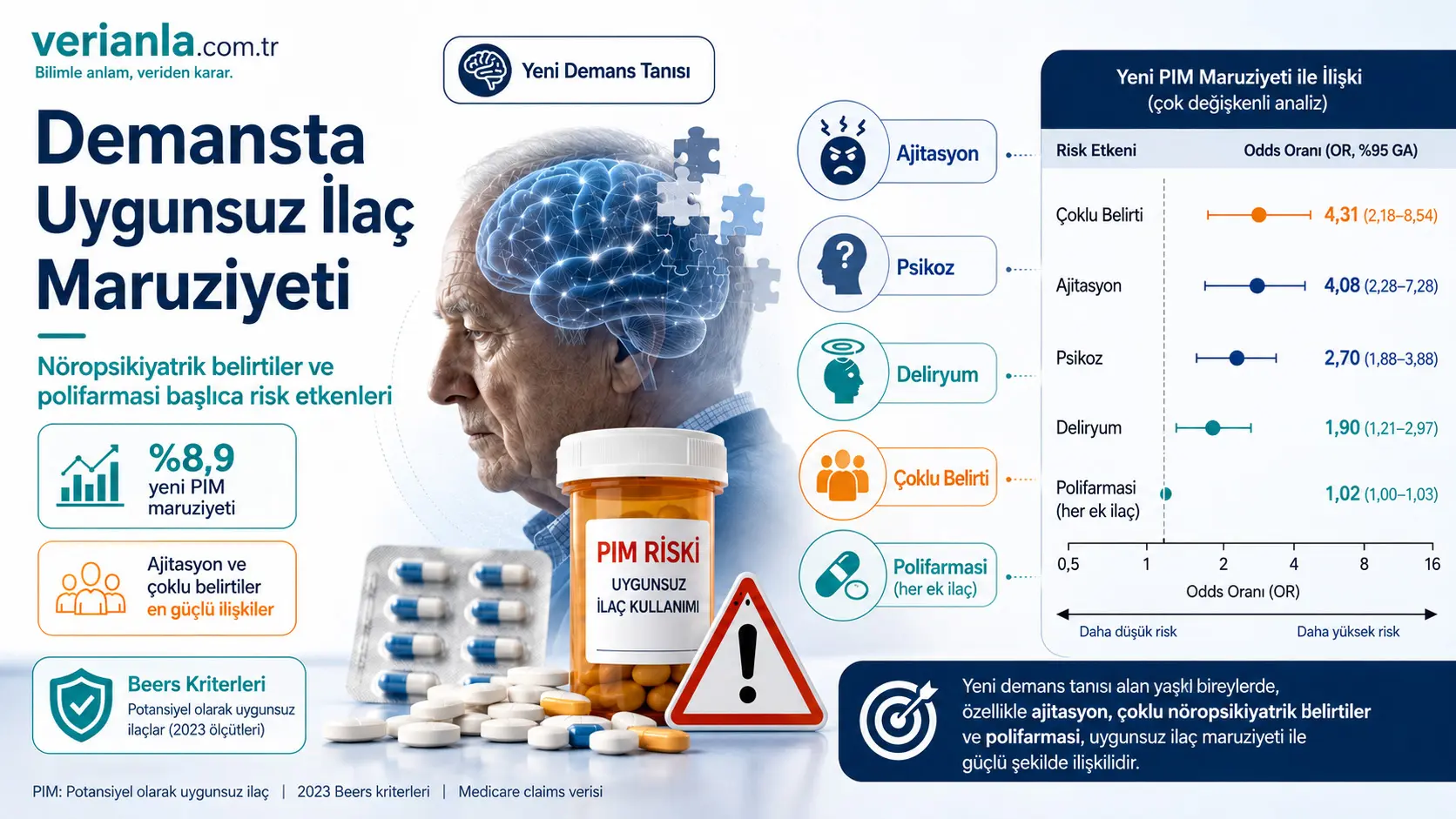
Дар follow-up 1.146 patients developed new PIM exposure, corresponding to %8,9 of total cohort. In other words, approximately 1 in every 11 newly diagnosed dementia patients who were PIM-naive at baseline had persistent-level exposure to a medication considered risky in dementia by Beers Criteria within next 12 months.
PIM users were slightly younger: mean age 81,39 compared with 81,88 among nonusers. Difference statistically significant but clinically small. No significant sex difference was found.
Кадом differences дар PIM users дида шуданд?
Baseline characteristics showed several notable differences. Other dementia subtypes, namely Lewy body dementia and frontotemporal dementia, occurred in %1,7 of PIM users and %0,8 of nonusers. Difference statistically significant.
Neuropsychiatric symptoms showed stronger differences. Among PIM users psychosis occurred in %3,4, delirium %2,1, agitation %1,4. Among nonusers rates were psychosis %1,3, delirium %1,2, agitation %0,4. These differences suggest behavioral and psychiatric symptoms play important role in initiation of risky medications.
Depression was slightly more common among PIM users: %16,2 vs %14,0. In contrast, hypertension and congestive heart failure were less common among PIM users. This may indicate clinicians were more cautious initiating psychotropic or sedative medications in patients with cardiovascular frailty.
Logistic regression чиро measured кард?
Study multivariable logistic regression истифода кард. Ин method меомӯзад, вақте many variables simultaneously accounted мешаванд, кадом factors independently associated with PIM exposure мебошанд. Results ҳамчун adjusted odds ratio, яъне adjusted likelihood ratio дода шуданд.
Барои фаҳмондани concept basic relationship чунин аст:
\[ OR = \frac{p_1/(1-p_1)}{p_0/(1-p_0)} \]
Ин formula дар study explicit математикӣ дода нашудааст; here it is added only to explain odds-ratio logic. p₁ probability of event in group with risk factor, p₀ probability in comparison group. OR above 1 indicates higher odds associated with factor; below 1 lower odds. “Adjusted” means value obtained after accounting for age, sex, region, plan type, dementia subtype, comorbidities, medication burden and other variables.
Strongest risk factor: Neuropsychiatric symptoms
Clear and clinically most important result was that neuropsychiatric symptoms had strongest association with PIM initiation. Compared with patients with no symptoms:
- Multiple neuropsychiatric symptoms: aOR 4,311, %95 CI 2,177–8,536
- Agitation: aOR 4,076, %95 CI 2,284–7,275
- Psychosis: aOR 2,699, %95 CI 1,878–3,881
- Delirium: aOR 1,896, %95 CI 1,211–2,970
- Aggression: aOR 2,389, %95 CI 0,903–6,320; p-value 0,0793, therefore not statistically significant.
These results suggest risky medication initiation in dementia is often connected to management of behavioral crises. Agitation and multiple neuropsychiatric symptoms in particular may push clinicians toward antipsychotic, benzodiazepine or sedative-hypnotic medications. This is clinically understandable pressure, but can create dangerous cycle for patient safety.
Чаро agitation чунин strong trigger аст?
Agitation яке аз difficult behavioral symptoms in dementia management мебошад. Patient may be restless, resistant, repetitive, near-aggressive or demonstrate behaviors challenging caregivers. This can produce burnout among family caregivers at home and urgent pressure in nursing facilities related to staff safety, institutional order and patient safety.
Discussion emphasizes practical reality: when behaviors exceed caregiver capacity, prescribing pressure rises. This can make antipsychotic or sedative medications appear as rapid solution. Yet these medications carry serious risks in older adults with dementia.
Therefore finding that agitation aOR exceeds 4 is not only statistical. It demonstrates how critical safe, nonpharmacologic strategies for behavioral symptoms are in dementia care.
Psychosis ва delirium чӣ маъно доранд?
Psychosis метавонад hallucinations, delusions ё impaired reality testing-ро дар бар гирад. In older adults with dementia psychosis is challenging for both patient and caregiver. Study found psychosis associated with roughly 2,7-fold higher odds of new PIM exposure, suggesting clinicians may turn to antipsychotic initiation.
Delirium is acute disturbance of attention, consciousness and cognition. In patients with dementia it may arise from reversible causes such as infection, pain, dehydration, sleep disturbance, medication adverse effects or metabolic imbalance. Increased PIM risk with delirium is especially important because delirium itself can be misinterpreted as “behavioral dementia worsening” and trigger sedative or antipsychotic initiation.
Thus study is consistent with literature emphasizing that when behavioral symptoms arise, first response should be searching for reversible underlying causes rather than automatically adding medication.
Чаро polypharmacy PIM risk-ро зиёд мекунад?
Baseline number of medications independently associated with new PIM exposure. For every additional baseline medication aOR was 1,018. This value may appear small, but cumulative effect grows as medication count rises.
Polypharmacy is more than “taking many medications.” In an older adult with dementia, each new drug can cause new problems such as adverse effects, drug-drug interactions, somnolence, falls, confusion, constipation, urinary retention or behavioral change. These problems can be misread as new disease and trigger another medication. This is called prescribing cascade, яъне каскади дорунависӣ.
For example, insomnia or restlessness caused by one drug may be interpreted as new psychiatric symptom, leading to sedative or antipsychotic use. Medication burden becomes self-reinforcing cycle. Study’s polypharmacy finding shows why deprescribing and routine medication reconciliation are fundamental safety tools in dementia care.
Чаро dementia subtype important аст?
Using Alzheimer disease as reference, other dementia category including Lewy body dementia and frontotemporal dementia had higher odds of new PIM exposure: aOR 1,788, %95 CI 1,069–2,991.
This is clinically important. Lewy body dementia is well known for pronounced sensitivity to antipsychotics; such drugs can cause severe sedation, worsening Parkinsonism and serious adverse reactions. Frontotemporal dementia often presents early with behavioral disinhibition, impulsivity and socially inappropriate behavior, which may increase pressure for pharmacologic intervention.
Study therefore supports subtype-sensitive dementia care. Dementias are not identical; Alzheimer, Lewy body dementia and frontotemporal dementia have different behavioral patterns and medication-risk profiles.
Regional difference чӣ нишон дод?
Patients living in Western region had lower odds of new PIM exposure than North Central: aOR 0,670, %95 CI 0,496–0,905. This suggests geographic region may be associated with prescribing practices in dementia care.
Regional differences may reflect specialist access, geriatric services, nursing-home policies, multidisciplinary behavioral-management resources, local prescribing culture and health infrastructure. Study does not determine exact cause, but indicates system-level practice differences may influence PIM initiation.
Чаро hypertension ва heart failure бо lower PIM risk associated шуданд?
Study found inverse association between hypertension/congestive heart failure and new PIM exposure. aOR 0,780 for hypertension and 0,706 for congestive heart failure.
At first this may seem surprising, since medically complex older adults might be expected to have more medication risk. Researchers suggest clinicians may be more cautious initiating psychotropic or sedative drugs in cardiovascularly frail patients. Antipsychotics and some psychoactive drugs can increase orthostatic hypotension, arrhythmia, syncope and cardiovascular instability, so prescribing may be more cautious.
This suggests not total comorbidity burden but specific clinical vulnerabilities can alter prescribing decisions.
Forest plot чӣ мегӯяд?
Forest plot summarizes multivariable logistic regression results visually. Blue points represent adjusted odds ratio estimates, horizontal orange lines %95 confidence intervals. Vertical dashed line is aOR = 1; values right of line indicate increased odds, left indicate decreased odds.
Variables most shifted to right are neuropsychiatric symptom groups. Multiple symptoms and agitation stand out with substantially higher aORs than other variables. This graphic clarifies central message: strongest clinical triggers of PIM initiation are behavioral and neuropsychiatric symptoms.
Hypertension, congestive heart failure and West region appear left of 1, indicating associations with lower PIM odds. Forest plot thus shows both risk-increasing and risk-reducing associations at a glance.
Таъсири study ба daily life чӣ аст?
Everyday implications are very concrete. When a person with dementia becomes agitated, cannot sleep, hallucinates or demonstrates behavior challenging caregivers, family and health staff often seek rapid solution. That solution may be sedative, antipsychotic or benzodiazepine prescription.
Study suggests this decision point is among highest-risk moments. A drug initiated during behavioral symptoms can expose patient to falls, fractures, confusion, excessive sedation, cognitive decline and even mortality. Therefore dementia care must support caregivers as well as patient.
Critical questions in daily care include:
- Could patient be in pain?
- Is there infection or delirium?
- Could sleep, hunger, dehydration, constipation or environmental stress trigger behavior?
- Could current medication be causing restlessness, confusion or sedation?
- Is risky medication being started before nonpharmacologic approaches are attempted?
These questions translate study’s clinical message into daily care. Behavioral management includes environmental adjustments, caregiver education, pain/infection screening, sleep routines, activity planning and safe communication strategies, not merely prescriptions.
Чаро nonpharmacologic interventions муҳиманд?
Discussion relies on literature emphasizing nonpharmacologic approaches for neuropsychiatric symptoms. Music therapy, exercise, caregiver-support strategies, environmental modification, structured activities and individualized behavior management should be considered before high-risk medications.
This does not mean medication is never used. In severe situations with danger to patient or others, pharmacologic intervention may be necessary. But study shows making medication the easy first option can create serious safety problems.
Cautious interpretation of brexpiprazole
Discussion mentions FDA approval in 2023 of brexpiprazole for agitation associated with dementia due to Alzheimer disease. This indicates emergence of more targeted pharmacologic option.
Study does not present this as “problem solved.” Rather, even targeted options should be used in carefully selected patients, with multidisciplinary care, caregiver education and nonpharmacologic strategies, not instead of them.
Ҷиҳатҳои қавии study
One strength is use of a large national Medicare supplemental claims cohort. 12.935 newly diagnosed dementia older adults provide valuable real-world data on PIM initiation.
Second strength is focus on incident PIM use by excluding baseline PIM users. This distinguishes new initiation after diagnosis from existing medication burden.
Third strength is evaluating neuropsychiatric symptoms, dementia subtype, medication burden, comorbidities, region and prior dementia-drug history in same model, producing more comprehensive risk profile than simple univariate comparison.
Fourth strength is use of widely recognized Beers Criteria framework for geriatric medication safety, making findings meaningful to geriatrics and clinical pharmacy.
Маҳдудиятҳои study
Main limitation is reliance on administrative claims. Such data allow large-scale real-world analysis but lack detailed clinical information. Cognitive-test scores, functional status, caregiver characteristics, nursing-home status, behavioral severity and indication for prescribing are not directly visible.
Second limitation is identifying neuropsychiatric symptoms through diagnosis codes. Mild or undocumented symptoms may be missed. Claims codes tend to capture symptoms that attract clinical attention or generate healthcare use, so true burden may be underestimated.
Third limitation is observational design. Study shows associations but not definitive causality. Agitation strongly associates with PIM initiation, but claims data do not directly reveal decision-making process.
Fourth limitation is inability to capture over-the-counter medications. Some antihistamines and sleep aids with anticholinergic effects can be obtained without prescription, so actual inappropriate-medication exposure may be underestimated.
Fifth limitation is population enrolled in Medicare supplemental plans. Findings may not directly generalize to uninsured older adults, traditional Medicare-only beneficiaries or healthcare systems outside U.S.
Sixth limitation is preprint status without peer review. Analysis approach, variable definitions and interpretations may change or strengthen after independent review.
Study чӣ мегӯяд ва чӣ намегӯяд?
Study says PIM initiation among newly diagnosed dementia older adults is most strongly associated with neuropsychiatric symptoms. Agitation and multiple behavioral symptoms are particularly strong risk indicators. Polypharmacy and some non-Alzheimer dementia subtypes also increase risk. Regional differences and lower PIM odds in some cardiovascular conditions suggest prescribing is shaped by both clinical and system-level factors.
Study does not say every PIM use is definitely wrong or that antipsychotics, benzodiazepines or hypnotics should never be used in dementia. In some severe clinical situations short-term, carefully monitored pharmacologic treatment may be necessary. Study also cannot directly show which symptom prompted each medication or how appropriate the risk assessment was. Findings do not replace individual clinical judgment; they provide strong warning for systematic medication safety in dementia care.
Усул ва Натиҷаҳои Таҳқиқот
Тарҳи study
| Ҷузъи усул | Истифода дар study | Маъно |
|---|---|---|
| Study type | Retrospective cohort study | Existing Medicare supplemental claims analyzed retrospectively. |
| Data source | Merative MarketScan Medicare Supplemental Claims Database, 2017–2019 | Medical and pharmacy claims among Medicare beneficiaries with supplemental coverage used. |
| Index window | 1 January 2018 – 31 December 2018 | New dementia diagnosis identified during this period. |
| Baseline period | 12 months before dementia index date | Comorbidities, medication burden, neuropsychiatric symptoms and baseline PIM status determined. |
| Follow-up period | 12 months after dementia index date | New PIM exposure evaluated. |
| Analytic cohort | 12.935 patients | Age 65+, newly diagnosed with dementia and PIM-naive at baseline. |
| Statistical method | Multivariable logistic regression | Independent factors associated with PIM exposure assessed using aOR and %95 CI. |
Cohort-selection flow
| Stage | Number of patients | Interpretation |
|---|---|---|
| Dementia patients in 2017–2019 MarketScan data | 192.324 | Initial pool |
| Dementia patients in 2018 index window | 108.770 | Entered new-diagnosis window |
| After continuous enrollment for 365-day baseline and follow-up | 46.651 | Data continuity ensured |
| After neuropsychiatric exclusion diagnoses | 45.205 | Bipolar disorder, schizophrenia, Tourette and Huntington conditions excluded. |
| New-dementia cohort | 20.236 | Those with dementia diagnosis during baseline excluded. |
| After excluding baseline PIM use | 13.005 | Only PIM-naive individuals retained. |
| Final analytic cohort | 12.935 | Final group after age and region criteria |
General patient characteristics
| Characteristic | Total cohort | Non-PIM users | PIM users | p value |
|---|---|---|---|---|
| Patient count | 12.935 | 11.789 | 1.146 | - |
| Mean age | 81,84 | 81,88 | 81,39 | 0,033 |
| Women | 6.998 (%54,1) | 6.361 (%54,0) | 637 (%55,6) | 0,291 |
| Men | 5.937 (%45,9) | 5.428 (%46,0) | 509 (%44,4) | 0,291 |
| Mean baseline medication count | 7,92 | 7,90 | 8,16 | 0,132 |
| Elixhauser comorbidity index | 4,59 | 4,58 | 4,68 | 0,622 |
Dementia profile and baseline symptoms
| Variable | Total cohort | Non-PIM users | PIM users | p value |
|---|---|---|---|---|
| Unspecified dementia | 8.752 (%67,7) | 8.001 (%67,9) | 751 (%65,5) | 0,022 |
| Alzheimer disease | 3.065 (%23,7) | 2.779 (%23,6) | 286 (%25,0) | 0,022 |
| Vascular dementia | 1.001 (%7,7) | 911 (%7,7) | 90 (%7,9) | 0,022 |
| Other dementia, LBD/FTD | 117 (%0,9) | 98 (%0,8) | 19 (%1,7) | 0,022 |
| No neuropsychiatric symptom | 12.438 (%96,2) | 11.388 (%96,6) | 1.050 (%91,6) | <0,001 |
| Psychosis | 192 (%1,5) | 153 (%1,3) | 39 (%3,4) | <0,001 |
| Delirium | 169 (%1,3) | 145 (%1,2) | 24 (%2,1) | <0,001 |
| Agitation | 61 (%0,5) | 45 (%0,4) | 16 (%1,4) | <0,001 |
| Multiple symptoms | 44 (%0,3) | 32 (%0,3) | 12 (%1,1) | <0,001 |
Main factors associated with PIM exposure in multivariable model
| Factor | Adjusted odds ratio | %95 confidence interval | p value | Interpretation |
|---|---|---|---|---|
| Multiple neuropsychiatric symptoms | 4,311 | 2,177–8,536 | <0,0001 | One of strongest risk indicators. |
| Agitation | 4,076 | 2,284–7,275 | <0,0001 | Behavioral crises strongly trigger risky medication initiation. |
| Psychosis | 2,699 | 1,878–3,881 | <0,0001 | May reflect clinical pressure toward antipsychotic initiation. |
| Delirium | 1,896 | 1,211–2,970 | 0,0052 | Acute cognitive/behavioral disturbance raises PIM risk. |
| Aggression | 2,389 | 0,903–6,320 | 0,0793 | Direction suggests increased risk but not statistically significant. |
| Baseline medication count | 1,018 | 1,004–1,031 | 0,0089 | Each additional medication raises PIM odds by approximately %1,8. |
| Other dementia, LBD/FTD | 1,788 | 1,069–2,991 | 0,0269 | Risk higher in some non-Alzheimer subtypes. |
| West region | 0,670 | 0,496–0,905 | 0,009 | Associated with lower PIM odds than North Central. |
| Hypertension | 0,780 | 0,672–0,905 | 0,0011 | Associated with lower PIM odds. |
| Congestive heart failure | 0,706 | 0,568–0,878 | 0,0018 | Cardiovascular frailty may encourage prescribing caution. |
Main messages from figures
| Figure | What it shows | Contribution to main conclusion |
|---|---|---|
| Figure 1 | Study design with 12-month baseline, 2018 index window and 12-month follow-up | Explains how incident PIM exposure was followed after new dementia diagnosis. |
| Figure 2 | Attrition from initial 192.324 people to final cohort of 12.935 | Shows why study focuses on newly diagnosed and baseline PIM-naive individuals. |
| Figure 3 | Forest plot of adjusted odds ratios | Visualizes neuropsychiatric symptoms as far stronger drivers of PIM initiation than other factors. |
Clinical implications
| Clinical problem | Risk shown by study | Implication for safer care |
|---|---|---|
| Agitation and multiple behavioral symptoms | Increase odds of new PIM exposure roughly 4-fold. | Prioritize nonpharmacologic behavior management, caregiver education and search for triggers. |
| Psychosis | Strongly associated with PIM initiation. | Antipsychotic decisions should be short-term, targeted and risk-assessed. |
| Delirium | Raises PIM risk. | Search for reversible causes such as infection, pain, metabolic disturbance and medication effects. |
| Polypharmacy | Each additional medication raises new PIM risk. | Routine medication reconciliation and deprescribing roadmap required. |
| Subtypes such as LBD/FTD | Associated with greater PIM exposure. | Subtype-specific behavior management and antipsychotic sensitivity should be considered. |
Умумии technical conclusion
Technical conclusion is that incident inappropriate-medication initiation in newly diagnosed dementia older adults is driven especially by neuropsychiatric symptoms. Agitation, psychosis, delirium and multiple behavioral symptoms can create pressure for rapid pharmacologic response. Yet these medications carry serious safety concerns for older adults with dementia under Beers Criteria. Dementia care should therefore emphasize early recognition of behavioral symptoms, search for reversible causes, caregiver support, stronger nonpharmacologic interventions and systematic deprescribing strategies against polypharmacy.
Ёддошт оид ба Манбаъ ва Усул
Ин мақола бар таҳқиқоти Samuel C. Ofili, Jieni Li, Jannah Abdulmawjood, Anirudh Guddeti, Isaiah Olumeko, Sai S. Cheruvu ва Susan Abughosh бо унвони “Drivers of Incident Potentially Inappropriate Medication Exposure in Dementia: A National Medicare Claims Study” асос ёфтааст. Study examines factors associated with new exposure to potentially inappropriate medications after new dementia diagnosis using Medicare supplemental claims.
Source text is a preprint research article and explicitly states “This preprint research paper has not been peer reviewed”. Therefore study has not undergone peer review. Findings do not replace clinical guidelines, prescribing prohibitions or individual patient-treatment decisions; they should be considered observational real-world evidence requiring careful interpretation.
This content is based only on study design, cohort selection, methods, tables, forest plot, multivariable logistic-regression results, discussion and limitations in PDF. No unsupported claims of clinical causality, universal harm of all medications, superiority of one treatment in all patients or direct generalizability beyond Medicare population have been added.
Study relies on administrative claims. Therefore cognitive-test scores, behavioral severity, caregiver characteristics, indication for prescribing, use of nonpharmacologic interventions and over-the-counter medication exposure are not directly observed. Observational design also does not prove causality. Nevertheless, large national cohort, focus on baseline PIM-naive patients and Beers-Criteria-based outcome definition provide important medication-safety warning for dementia care.
Шарҳ гузоред
Нишонии почтаи электронии шумо нашр намешавад. Майдонҳои ҳатмӣ бо * нишон дода шудаанд