

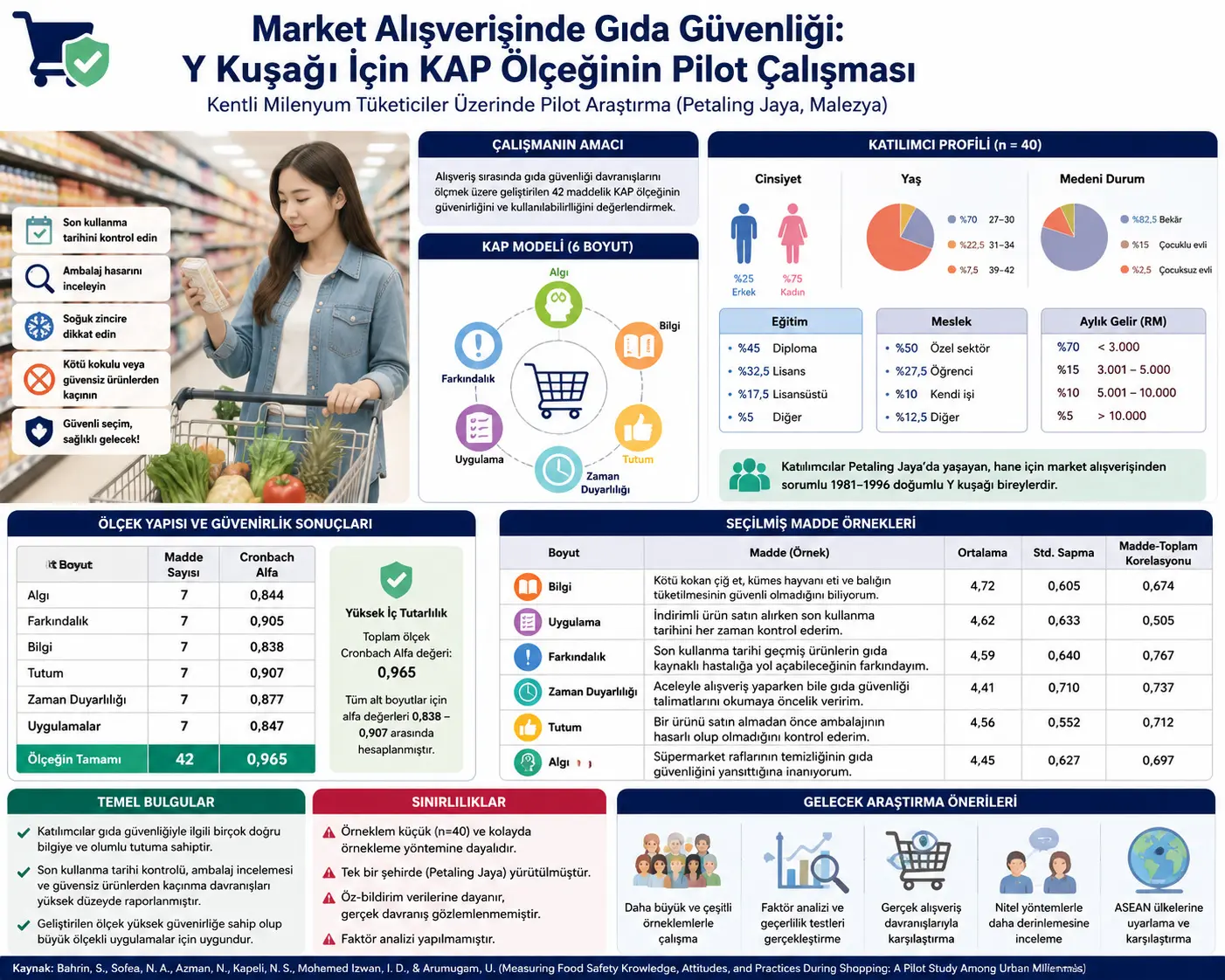
Амнияти ғизо аксар вақт танҳо бо cooking, storage ва cleaning дар ошхона алоқаманд карда мешавад. Аммо яке аз аввалин қарорҳои муҳими consumer оид ба food дар supermarket қабул мешавад.
Expiration date, package integrity, whether cold chain is maintained, shelf cleanliness, smell, color ва physical appearance of product метавонанд purchase decision-ро таъсир диҳанд.
Агар consumer дар store unsafe product интихоб кунад, ҳатто correct storage ё correct cooking at home ҳам risk-ро пурра бартараф накунад.
Аз ин рӯ behavior during shopping метавонад ҳамчун first consumer step in food-safety chain арзёбӣ шавад.
Public-Health Burden of Foodborne Disease
Introduction-и study таъкид мекунад, ки foodborne diseases worldwide important public-health problem мебошанд.
Researchers бо такя ба World Health Organization data мегӯянд, ки ҳар сол approximately 600 million people аз consuming contaminated food бемор мешаванд, approximately 420 thousand people die ва burden in healthy life years lost significant аст.
Study ҳамчунин мегӯяд children under five years old disproportionally affected by mortality burden related to foodborne disease.
Дар Malaysia ҳам food-poisoning incidents дар recent years increased гуфта шудааст. Researchers citing Ministry of Health data state food-poisoning incidence in 2022 rose to 51 per 100 thousand people, far above 18,4 in 2021.
These figures were not generated from pilot sample itself; they were taken from literature to establish public-health rationale.
Чаро Generation Y Махсус Омӯхта Шуд?
Study defines individuals born between 1981 and 1996 as Generation Y or millennials.
According to researchers, this generation increasingly participates in household grocery-purchasing decisions. They also often have fast-paced lifestyle, job intensity, time pressure, ready/processed-food consumption and high dependence on digital information sources.
These characteristics can create two-sided food-safety picture:
- Easier access to food-safety information through digital platforms,
- Failure to apply that information consistently during shopping because of time pressure.
One starting point is that awareness and actual behavior do not always directly match.
KAP Model Чист?
KAP comes from initials of Knowledge, Attitude and Practice ва ҳамчун модели Knowledge-Attitude-Practice ифода мешавад.
Ин approach health behavior-ро through three basic stages evaluates мекунад:
- Knowledge: What a person knows about a health issue,
- Attitude: Beliefs, evaluations and tendencies regarding that issue,
- Practice: What a person actually does in real life.
In food-safety context, knowledge can mean knowing raw meat and ready-to-eat foods should be kept separate.
Attitude can mean considering food safety important during shopping.
Practice includes actual behaviors such as checking expiration date or refusing a damaged package.
Study Чӣ Гуна Classical KAP Model-ро Васеъ Кард?
Researchers did not measure only knowledge, attitude and practice. They added three constructs:
- Perception,
- Awareness,
- Time sensitivity.
This extension is based on idea that shopping behavior cannot be explained only by knowledge.
Perception
Perception refers to how consumer interprets store environment and product safety.
For example, seeing clean supermarket shelves as indicator of food safety is a perception item.
Awareness
Awareness relates to knowing a risk exists and remembering it during shopping.
Being aware that expired products can cause foodborne illness is an example.
Time Sensitivity
Time sensitivity evaluates whether person applies food-safety knowledge even when shopping in a hurry.
This dimension is one of most original parts of study. Urban consumers may consider food safety important but under time pressure skip reading labels, examining packages or checking storage instructions.
Main Aim of Research
Aim of this pilot study is not to definitively measure food-safety level of Generation Y in Malaysia.
Main aim is to test whether developed questionnaire is reliable enough to answer:
- Do items consistently measure same construct?
- Can participants understand questions?
- Is online survey design usable?
- Does each item contribute to its intended subscale?
- What should change before large-scale study?
Therefore study is primarily scale-development and psychometric pretesting rather than behavioral epidemiology.
Research Design
Study uses quantitative, cross-sectional and pilot research design.
Cross-sectional means data collected at one time point; participants’ behavior changes over time were not followed.
Pilot study means testing measurement instrument on small sample before main study.
Pilot research is especially used to:
- Identify unclear questions,
- Find repetitive or weak items,
- Evaluate scale reliability,
- Measure survey duration and usability,
- Anticipate problems before large study.
Research Дар Куҷо Ва Бо Кӣ Гузаронида Шуд?
Study was conducted in Petaling Jaya, Selangor, Malaysia.
40 people participated in pilot study.
Eligibility criteria:
- Being Malaysian citizen,
- Born between 1981–1996,
- Responsible for household grocery shopping,
- Living in Petaling Jaya.
Participants selected by convenience sampling. Survey distributed via Google Forms, with link shared through social-media channels associated with supermarkets/hypermarkets.
Convenience Sampling Чӣ Маъно Дорад?
Convenience sampling is nonprobability method including people researcher can reach and who volunteer.
It is fast and practical for pilot studies, but not everyone in population has equal chance of selection.
For example, people who access an online survey, use social media and are engaged in grocery shopping may not represent all Malaysian millennials.
Demographic Profile of Participants
| Хусусият | Category | Шумора | Rate |
|---|---|---|---|
| Gender | Male | 10 | %25 |
| Female | 30 | %75 | |
| Age | 27–30 | 28 | %70 |
| 31–34 | 9 | %22,5 | |
| 39–42 | 3 | %7,5 | |
| Marital status | Single | 33 | %82,5 |
| Married without children | 1 | %2,5 | |
| Married with children | 6 | %15 |
Sample is dominated by women, younger Generation Y participants and single individuals.
This is not necessarily problem for pilot study, but later validation should include men, older millennials, families with children and rural consumers.
Education, Occupation Ва Income Distribution
| Хусусият | Category | Rate |
|---|---|---|
| Education | Diploma | %45 |
| Bachelor’s | %32,5 | |
| Postgraduate | %17,5 | |
| Other | %5 | |
| Occupation | Private sector | %50 |
| Student | %27,5 | |
| Self-employed | %10 | |
| Other | %12,5 | |
| Monthly income | Below 3.000 RM | %70 |
| 3.001–5.000 RM | %15 | |
| 5.001–10.000 RM | %10 | |
| Above 10.000 RM | %5 |
%70 of participants had monthly income below 3.000 Malaysian ringgit, showing economic concentration too.
This may be relevant in future to choices between discounted products, price and food safety. Pilot study did not test these relationships.
Questionnaire Чӣ Гуна Developed Шуд?
Questionnaire was developed using validated items from previous studies and reviewed by experts.
Total 42 items were included.
| Subdimension | Number of Items |
|---|---|
| Perception | 7 |
| Awareness | 7 |
| Knowledge | 7 |
| Attitude | 7 |
| Time sensitivity | 7 |
| Practice | 7 |
| Total | 42 |
Each item answered on five-point Likert scale:
- 1: Strongly disagree,
- 2: Disagree,
- 3: Neutral,
- 4: Agree,
- 5: Strongly agree.
Questionnaire prepared in English and Bahasa Malaysia.
Чаро Bilingual Questionnaire Муҳим Аст?
Bilingual questionnaire can help participants understand questions in preferred language.
However direct translation alone is insufficient; concepts need equivalent meaning across languages.
Study says expert review and pretesting with target participants were done. But forward-backward translation process or measurement equivalence between language versions was not detailed.
Cronbach Alpha Чист?
Cronbach alpha is statistic used to assess internal consistency of a scale.
Conceptually it asks:
Items expected to measure same construct are answered how consistently together?
General formula:
\[ \alpha = \frac{k}{k-1}\left(1-\frac{\sum_{i=1}^{k}\sigma_i^2}{\sigma_T^2}\right) \]
This formula was not explicitly given in research; it is included here as general statistical background explaining the method.
In formula:
- \(k\), number of items in scale,
- \(\sigma_i^2\), variance of each item,
- \(\sigma_T^2\), variance of total scale score.
As alpha increases, items are interpreted as moving together more consistently. But extremely high alpha does not automatically mean perfect scale; overly similar or repetitive items can also increase alpha.
Reliability Results of Subdimensions
| Subdimension | Item Count | Cronbach Alpha |
|---|---|---|
| Perception | 7 | 0,844 |
| Awareness | 7 | 0,905 |
| Knowledge | 7 | 0,838 |
| Attitude | 7 | 0,907 |
| Time sensitivity | 7 | 0,877 |
| Practices | 7 | 0,847 |
| Full scale | 42 | 0,965 |
Highest subdimension reliability was 0,907 for attitude; lowest 0,838 for knowledge.
All values exceed researcher-accepted threshold 0,70.
0,965 Alpha Чӣ Гуна Тафсир Шавад?
Very high alpha 0,965 for full 42-item scale shows items were answered with strong internal consistency.
But alone it does not prove:
- Scale truly measures six separate constructs,
- It accurately reflects actual behavior,
- It works same way in different regions,
- All items are sufficiently distinct.
These need factor analysis, criterion validity, test-retest reliability and actual behavioral observations.
Item-Total Correlation Чист?
Corrected item-total correlation shows how well one item aligns with rest of its subscale.
High correlation suggests strong relation between item and total construct.
Study says all corrected item-total correlations exceeded 0,50.
Therefore researchers removed no items.
Натиҷаҳои Selected Items
| Dimension | Item | Mean | Standard Deviation | Item-Total Correlation |
|---|---|---|---|---|
| Knowledge | I know it is unsafe to consume raw meat, poultry and fish that smell bad. | 4,72 | 0,605 | 0,674 |
| Practice | I always check expiration date when buying discounted products. | 4,62 | 0,633 | 0,505 |
| Awareness | I am aware expired products can cause foodborne illness. | 4,59 | 0,640 | 0,767 |
| Time sensitivity | Even when shopping in a hurry, I prioritize reading food-safety instructions. | 4,41 | 0,710 | 0,737 |
| Attitude | I check packaging for damage before buying a product. | 4,56 | 0,552 | 0,712 |
| Perception | I believe cleanliness of supermarket shelves reflects food safety. | 4,45 | 0,627 | 0,697 |
On five-point scale, means between 4,41 and 4,72 indicate strong agreement with safe behaviors.
Дар Кадом Behaviors Participants Strong Ба Назар Мерасанд?
Based on selected-item results, participants reported high scores for:
- Knowing bad-smelling raw meat and fish are unsafe,
- Checking expiration dates on discounted products,
- Knowing expired foods can cause illness,
- Checking damaged packaging,
- Reading safety information even when rushed,
- Associating shelf cleanliness with food safety.
But these are self-reported. Actual shopping behavior was not observed.
Negative Skewness Чӣ Маъно Дорад?
Selected items had negative skewness, meaning responses clustered at high scores, “agree” and “strongly agree”.
For example, skewness for bad-smelling meat item was -0,825, suggesting strong agreement by most participants.
However clustering near top can reduce ability to distinguish different levels of knowledge or behavior; this may be ceiling effect.
Study says skewness values were acceptable but did not separately analyze ceiling effect.
“Alpha If Item Deleted” Values
For each selected item study calculated Cronbach alpha if item were removed.
Values ranged from 0,812 to 0,853.
If removing an item does not markedly increase subscale reliability, keeping it may be supported.
Researchers concluded no item needed removal.
Content Ва Face Validity
Content validity was assessed through expert review.
For face validity, target-group participants provided feedback about clarity, layout and online usability.
Participants preferred matrix-format layout, with multiple items in same table and response options in rows or columns.
Based on feedback, researchers:
- Changed visual layout,
- Improved navigation,
- Simplified some technical expressions,
- Tried to improve fit with local cultural context.
Чаро Ягон Item Removed Нашуд?
All corrected item-total correlations exceeded 0,50.
Also removing no single item markedly improved subscale reliability.
Therefore all 42 items were retained after pilot.
However in larger sample, factor analysis may show some items do not load on intended factor or are redundant.
Чаро Time-Sensitivity Dimension Муҳим Аст?
One distinctive feature of study is time-sensitivity dimension.
Modern grocery shopping often requires rapid decisions. Consumer may:
- Be trying to get to work,
- Shop in crowded store,
- Not want to read long labels,
- Make rapid decision under discount pressure,
- Skip product information during online shopping.
Under these conditions, gap can emerge between having knowledge and using knowledge.
A person may know expiration date should be checked but not do so when rushed.
Therefore time sensitivity may help explain behavioral break in knowledge-attitude-practice chain.
Оё Shelf Cleanliness Воқеан Food Safety-ро Нишон Медиҳад?
Participants strongly agreed with item linking shelf cleanliness to food safety.
Clean shelves and store environment can create consumer trust. However visual cleanliness alone does not prove product is microbiologically or chemically safe.
Cold-chain maintenance, storage temperature, production conditions, package integrity and product history can differ independently of visual cleanliness.
Therefore perception dimension is important for understanding which surface cues consumers use as safety signals.
Чаро Package Damage Муҳим Аст?
Damaged packaging can reduce protection from environmental exposure. Swollen, punctured, opened or leaking packaging may signal contamination or spoilage risk.
Mean score for checking package damage was 4,56.
This shows participants see package integrity as important safety indicator.
Expiration Date Дар Discounted Products
Discounted products may be approaching expiration. Therefore price advantage and safety check should be considered together.
Mean score for “I always check expiration date when buying discounted products” was 4,62.
This is high. Since sample had many lower-income participants, future studies could examine how price pressure affects actual buying behavior.
Food-Safety Knowledge Ва Actual Behavior Як Чиз Нестанд
One problem emphasized in literature section is that high knowledge and awareness do not always translate into safe behavior.
Possible reasons include:
- Time pressure,
- False sense of safety,
- Automatically assuming branded products are safe,
- Not understanding labels,
- Prioritizing price,
- Habits,
- Social-media misinformation,
- Overtrusting store environment.
Pilot study did not test relationships among these reasons; this was left to future large-scale research.
Ҷиҳатҳои Қавии Study
- Expanded classic KAP model with perception, awareness and time sensitivity.
- Developed comprehensive 42-item instrument.
- Performed separate reliability analysis for all six subdimensions.
- Examined item-total correlations.
- Questionnaire prepared bilingually.
- Used expert assessment and target-user feedback.
- Improved online survey layout based on pilot results.
- Developed separate dimension measuring time pressure.
Маҳдудиятҳои Study
1. Sample is only 40 people
This can provide preliminary reliability information but is insufficient for robust testing of factor structure.
2. Convenience sampling used
Participants were not randomly selected, so results do not represent whole population.
3. Sample is demographically unbalanced
%75 are women, %70 are 27–30 years old and %82,5 are single.
4. Geographic scope is narrow
Research was conducted only in Petaling Jaya. Rural, semi-urban and other-state millennials were not included.
5. Self-report bias
Participants may report safer behavior than they actually perform.
6. Actual shopping behavior not observed
No in-store observation, receipt analysis, product-choice test or experimental shopping scenario used.
7. Factor analysis not performed
It has not been verified whether scale truly measures six separate constructs.
8. Test-retest reliability not given
Stability of scores across time in same people was not evaluated.
9. Very high alpha may indicate item redundancy
Alpha of 0,965 can indicate strong internal consistency but also possibly overly similar items.
10. Ceiling effect possible
Means of selected items are very high, potentially reducing ability to distinguish different risk levels.
Барои Гуфтан Ки Scale “Psychometrically Valid” Аст, Чӣ Кам Аст?
Study describes scale as psychometrically appropriate, but comprehensive validation requires more than Cronbach alpha.
Future analyses should include:
- Exploratory factor analysis,
- Confirmatory factor analysis,
- Convergent validity,
- Discriminant validity,
- Criterion validity,
- Test-retest reliability,
- Measurement invariance across groups,
- Comparison with actual behavior.
Чаро Factor Analysis Лозим Аст?
Researchers designed items under six headings, but factor analysis is needed to show items actually cluster into these six dimensions.
For example, participants might perceive “package checking” as practice rather than attitude. Likewise “shelf cleanliness” might lie between perception and awareness.
Factor analysis shows which constructs items group under based on actual responses.
Future Large-Scale Study Чӣ Гуна Бояд Бошад?
Researchers recommend larger and more diverse sample.
Large-scale study could include:
- Different Malaysian states,
- Rural, semi-urban and urban areas,
- Different income levels,
- Balanced women and men,
- Different age subgroups within Generation Y,
- Households with and without children,
- Different education levels.
Чаро Mixed-Methods Approach Тавсия Мешавад?
Surveys can show how common behavior is, but not always why people make specific choices.
Researchers therefore recommend adding qualitative interviews or focus groups in future.
Qualitative studies could answer:
- Why consumers buy discounted product even if risky?
- Which labels are not understood?
- Which checks are skipped under time pressure?
- How brand trust affects safety evaluation?
- Does social-media misinformation change buying decisions?
Contribution of Scenario-Based Questions
Researchers suggest future scenario-based questions to better measure real-life decisions.
Examples:
- Discounted yogurt one day before expiration,
- Can with small dent in packaging,
- Frozen product left outside cold cabinet,
- Food with incomplete label but familiar brand,
- Long safety instruction during rushed shopping.
Such questions may provide more realistic behavioral data than simply saying “I know what should be done”.
Оё Scale Ба ASEAN Countries Adapt Шуда Метавонад?
Study says scale could later be adapted to other Southeast Asian countries.
ASEAN countries may share similar food systems, urbanization trends and consumer profiles.
But direct translation is insufficient. Each country should reassess:
- Local food habits,
- Labeling regulations,
- Market structure,
- Food-safety inspection,
- Language and cultural perceptions,
- Income and shopping behavior
again.
Аз Нуқтаи Назари Public Health Ин Чӣ Маъно Дорад?
A validated measurement tool could help public-health institutions identify which behavior domain has problems.
For example:
- If knowledge high but practice low, behavioral intervention may be needed.
- If awareness low, education campaign may be needed.
- If time sensitivity low, labels could be simplified.
- If perception is misleading, risk communication could be improved.
- If package checking low, in-store warnings could be used.
Thus scale may serve not only academic measurement but intervention design.
Хулосаи Умумӣ
This pilot study among 40 Generation Y participants in Petaling Jaya found high internal consistency for 42-item scale developed to assess food-safety behaviors during grocery shopping.
All subscales — perception, awareness, knowledge, attitude, time sensitivity and practice — had Cronbach alpha above 0,838. Full scale alpha was 0,965.
Participants strongly endorsed checking expiration dates, avoiding damaged packaging, viewing bad-smelling raw foods as risky and reading safety information even when rushed.
However research does not provide definitive result about food-safety level of Malaysian Generation Y. Sample is small, female-dominant, young and limited to one city.
Main contribution is preliminary reliability evidence for instrument to be used in larger studies.
Full validation requires larger sample, factor analysis, test-retest, different geographic regions and comparison with real shopping behavior.
Усул ва Натиҷаҳои Таҳқиқот
Research has quantitative, cross-sectional and pilot design. It included 40 Malaysian citizens living in Petaling Jaya, born between 1981–1996 and responsible for household grocery shopping.
Participants were selected by convenience sampling, and questionnaire administered through Google Forms.
Scale has total 42 items in six subdimensions:
- Perception: 7 items,
- Awareness: 7 items,
- Knowledge: 7 items,
- Attitude: 7 items,
- Time sensitivity: 7 items,
- Practice: 7 items.
Responses were collected on five-point Likert scale and analyzed using IBM SPSS Statistics 23.
Descriptive statistics, Cronbach alpha, corrected item-total correlations, skewness and alpha-if-item-deleted values were calculated.
| Basic Measurement | Result |
|---|---|
| Sample | 40 people |
| Female participants | %75 |
| 27–30 age group | %70 |
| Income below 3.000 RM | %70 |
| Total items | 42 |
| Number of subdimensions | 6 |
| Subdimension alpha range | 0,838–0,907 |
| Full-scale alpha | 0,965 |
| Item-total correlations | All above 0,50 |
| Items removed | None |
Based on participant feedback, online layout, readability and wording of some items were improved.
Ёддошт оид ба Манбаъ ва Усул
Ин мақола бар study-и Salasiah Bahrin, Nur Ameera Sofea, Norhidayah Azman, Nur Shafiqa Kapeli, Iylia Dayana binti Mohamed Izwan ва Umadevi Arumugam бо унвони “Measuring Food Safety Knowledge, Attitudes, and Practices During Shopping: A Pilot Study Among Urban Millennials” асос ёфтааст.
Authors work at Management & Science University in Malaysia.
Document does not clearly state journal name, volume, issue, DOI or peer-review status. Therefore in uploaded form it should be treated as pilot research manuscript, not assumed peer reviewed.
Study states institutional ethics approval was obtained and informed consent provided at start of online survey, but ethics-board name and approval number are not given.
Study evaluated only internal consistency and usability of scale. Factor structure, temporal stability, agreement with actual shopping behavior and validity in different populations have not yet been demonstrated.
Results are based on 40-person convenience sample with demographic imbalance, so cannot be generalized to all Malaysian millennials.
No causal relationships, national prevalence rates or claims of actual behavior not supported by study have been added. Findings are limited to pilot scale reliability and selected self-report items.
Шарҳ гузоред
Нишонии почтаи электронии шумо нашр намешавад. Майдонҳои ҳатмӣ бо * нишон дода шудаанд