

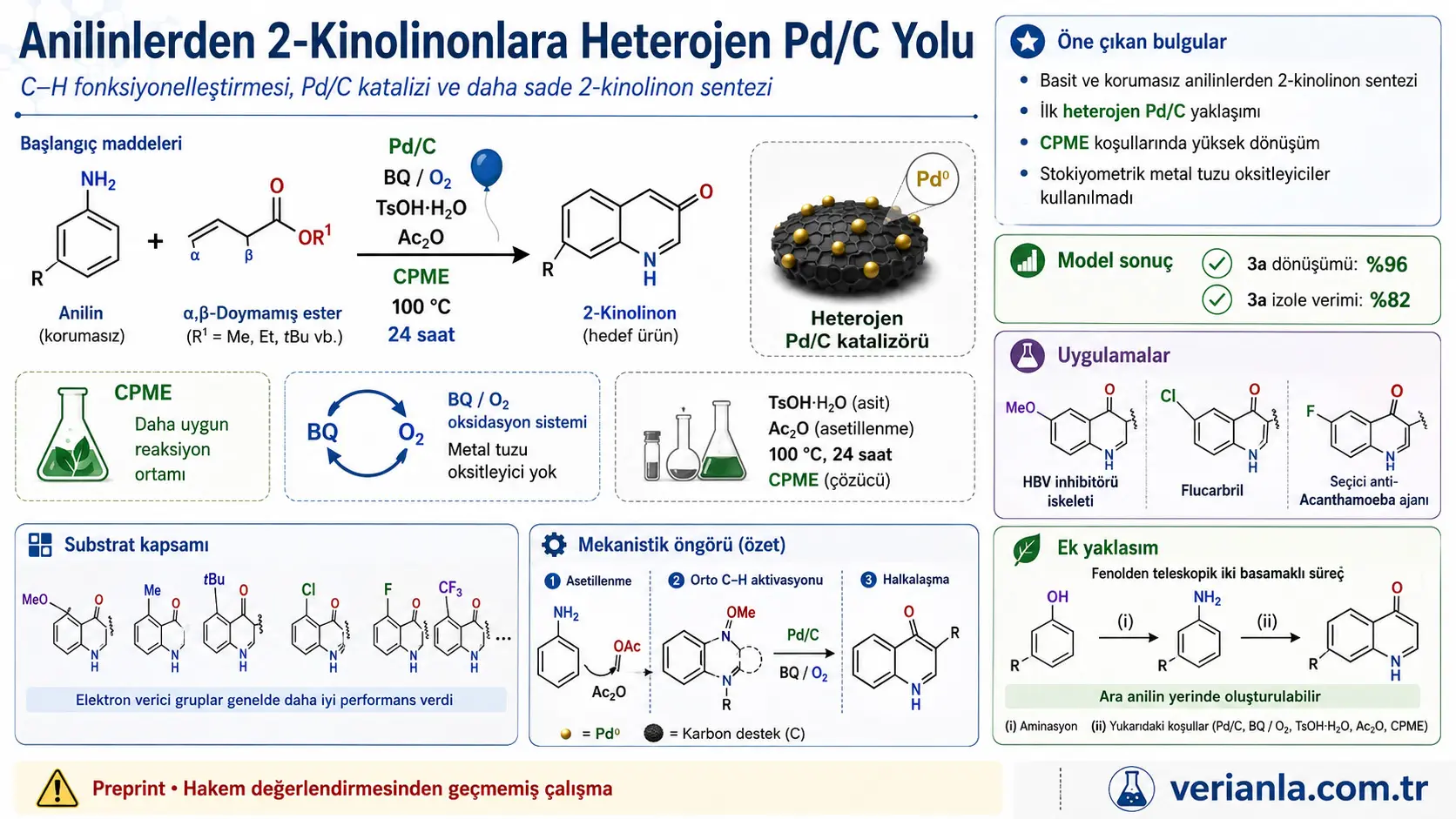
Масъалаи илмии марказии ин таҳқиқот ин аст, ки skeleton-и муҳими heterocyclic бо номи 2-quinolinone чӣ гуна бо route-и иқтисодитар, кӯтоҳтар ва аз ҷиҳати экологӣ беҳтар синтез карда шавад. 2-quinolinone core як ring-containing building block мебошад, ки дар сохтораш nitrogen ва carbonyl group дорад. Study мегӯяд ин core дар natural products ва biologically active molecules васеъ паҳн шуда, дар сохтори бисёр compounds-и вобаста ба anticancer, antibacterial ва anti-inflammatory activities мавҷуд аст. Examples мисли Roquinimex, tasquinimod ва rebamipide нишон медиҳанд, ки чаро 2-quinolinone ё quinolinone-based scaffolds барои medicinal chemistry ҷолибанд.
Дар ин ҷо distinction муҳим аст: study мегӯяд 2-quinolinone core дар biologically important molecules ҷой дорад, аммо худи research clinical effect-и new drug-ро нишон намедиҳад. Ин study-и synthetic-method development мебошад. Applicability of method to some biologically relevant molecules demonstrated шудааст, вале efficacy, safety ё therapeutic effect in humans claimed нашудааст.
Traditional 2-quinolinone syntheses limitations-и муҳим доранд. Friedländer-type reactions, Knoevenagel-type condensations, Heck reactions ва Buchwald–Hartwig couplings истифода мешаванд, аммо баъзе methods require pre-prepared or specially functionalized starting materials. Масалан haloanilines, iodinated anilines ё protected aniline derivatives. Ин synthesis-ро дароз, waste-ро зиёд ва atom economy-ро паст карда метавонад.
Atom economy як green-chemistry metric аст, ки нишон медиҳад чӣ қадар аз atoms-и starting materials ба target product мегузаранд. Барои фаҳмидани study logic, он бо basic relation чунин шарҳ дода мешавад:
\[ \text{Atom ekonomisi} = \frac{\text{Hedef ürünün mol kütlesi}}{\text{Reaksiyona giren maddelerin toplam mol kütlesi}} \times 100 \]
Ин formula дар study бо long mathematical derivation дода нашудааст, аммо барои understanding “atom economy” comparisons basic relation мебошад. Molecular mass-и target product саҳми mass of desired main product-ро, total molar mass of reactants бошад theoretical total of all reagents-ро ифода мекунад. Higher percentage means larger fraction of used atoms ends up in target, important for reducing waste ва more efficient synthesis.
Second concept is step economy. Step economy means number of reaction steps required to reach target molecule. Fewer steps generally mean fewer isolations, purifications, solvent use and shorter operations. Аммо superiority of fewer steps also depends on yield, safety, selectivity and scalability.
Basic transformation proposed in this study is reaction of simple aniline with α,β-unsaturated ester to form 2-quinolinone skeleton. General concept:
\[ \text{Anilin} + \alpha,\beta\text{-doymamış ester} \xrightarrow[\text{O}_{2},\,BQ]{\text{Pd/C},\,TsOH\cdot H_{2}O,\,Ac_{2}O,\,CPME} \text{2-kinolinon} \]
Ин schematic expression simplified representation of reaction logic мебошад. Pd/C is heterogeneous catalyst; BQ p-benzoquinone, O2 oxygen, TsOH·H2O p-toluenesulfonic acid monohydrate, Ac2O acetic anhydride ва CPME reaction solvent мебошанд. Reaction reaches 2-quinolinone through C–H functionalization and annulation.
Distinctive feature is use of heterogeneous Pd/C instead of homogeneous palladium or ruthenium catalysts. Homogeneous catalysts are dissolved in reaction medium, which can give high activity but difficult recovery and separation. In heterogeneous catalysis catalyst is solid; in Pd/C palladium is supported on carbon. Such catalyst can be easier to separate and recover, although recycling tests in this study showed serious activity decline after reuse.
Scheme 1 summarizes entire motivation. First section shows biologically important 2-quinolinone-containing molecules such as roquinimex, tasquinimod and rebamipide. Later sections compare previous Ru-catalyzed and Pd-catalyzed C–H functionalization strategies with this approach. Proposed method is presented with broad aniline applicability, CPME as more sustainable/waste-derived solvent context, simple heterogeneous Pd/C catalyst, oxidation without stoichiometric metal-salt oxidant, and applicability to API syntheses.
Model reaction uses aniline and ethyl acrylate. Initially high conversion to 3a was achieved with Pd/C in toluene. However due to flammability and toxicity concerns of toluene, alternative solvents were searched. Ethanol, GVL, 1,4-dioxane, 2-MeTHF and CPME were tested. CPME at low concentration initially gave limited conversion, but when reaction concentration increased conversion to target rose markedly.
Table 1 shows core optimization data. With Pd/C in toluene at 0,15 M, 3a conversion was %98. In CPME at 0,15 M conversion was %34, while at CPME concentration 1,0 M conversion reached %96. This shows reaction medium is critical not only as “solvent choice” but also in concentration and mass-transfer parameters. In same table homogeneous Pd(OAc)2 in CPME gave %37 conversion, supporting better performance of Pd/C under these conditions.
Optimized conditions:
- Aniline: 0,3 mmol
- Ethyl acrylate: 1,5 mmol, 5,0 equivalents
- Pd/C: 10 wt% loading, 10 mol%
- TsOH·H2O: 1,5 equivalents
- Acetic anhydride: 2,0 equivalents
- p-Benzoquinone, BQ: 3,0 equivalents
- Solvent: CPME, 1 M
- Temperature: 100 °C
- Oxygen: O2 provided by balloon
- Time: 24 hours
Table 2 shows deviations from standard conditions. Reducing BQ to 2,0 equivalents lowered target conversion to %39. Reducing TsOH·H2O or Ac2O also reduced conversion. Without oxygen product still formed but conversion lower than standard. Shortening time to 20 hours or lowering temperature to 80 °C reduced efficiency. These observations show sensitivity to oxidation system, acid, acetylating component, temperature and time.
Substrate-scope study examined various aniline derivatives. Scheme 2 compares electron-donating and electron-withdrawing substituents. Electron-donating anilines generally gave better yields, interpreted as higher nucleophilicity facilitating reaction. Para tert-butyl, n-butyl and isopropyl substituents gave products in good yields. Meta methyl or methoxy anilines also reacted but with lower yields, discussed in terms of regioselectivity and steric effects during C–H activation.
Electron-withdrawing anilines had more limited applicability. Para-trifluoromethyl aniline reacted under standard conditions, while para-halogenated anilines required toluene-based conditions. This is important: method has broad scope but same greener-solvent conditions do not work equally for every aniline.
Scheme 3 covers α,β-unsaturated carboxylate esters. Ethyl methacrylate and ethyl crotonate were tolerated with moderate yields. 7-methoxy-4-methylquinolin-2(1H)-one, highlighted as fluorescent scaffold useful in fluorescent-probe design, was isolated in %41 yield. Ethyl cinnamate gave 4-phenyl-substituted 2-quinolinone. Some para-substituted ethyl cinnamates required toluene due to limited solubility in CPME, another practical limitation.
Application was made more concrete by synthesis of 6-chloro-4-phenylquinolin-2(1H)-one reported in literature as HBV inhibitor. Traditional methods may require multistep routes, prefunctionalized starting materials, iodination, protecting groups, strong bases or more operations. According to comparison, new method reaches target in one step from commercially available 4-chloroaniline and ethyl cinnamate. Figure 1 compares methods by number of steps, atom economy and yield. This study reports 1 step, %70 atom economy and %58 yield for HBV-inhibitor synthesis, whereas conventional examples use 2–5 steps with varied atom economies/yields.
Caution is needed clinically. Mentioned HBV inhibitor belongs to a compound class previously associated with moderate inhibition of HBV surface-antigen production. This research only demonstrates synthetic access; it does not test clinical efficacy for HBV treatment.
Scheme 4 shows two-step access from 2-quinolinones to two biologically relevant molecules. 1-acetylquinolin-2(1H)-one, known in literature as selective anti-Acanthamoeba agent, was obtained from 3a framework in total %52,5 yield. Flucarbril was obtained by N-methylation of 6-(trifluoromethyl)quinolin-2(1H)-one with yield up to %99, total %44,5. These examples show method provides 2-quinolinone intermediates suitable for further functionalization.
Mechanistically, study proposes pathway consistent with kinetic observations and literature. First aniline rapidly reacts with acetic anhydride to form N-acetylaniline 5a. In kinetic study 5a is nearly completely formed within about 5 minutes. Then ethyl (E)-3-(2-acetamidophenyl)acrylate 4a forms and reaches maximum around %95 conversion at about 30 minutes. Over time 4a decreases while target 2-quinolinone product rises. At 24 hours 5a is fully consumed, 4a minimized and 3a reaches %96 maximum conversion.
Proposed mechanism steps:
- Aniline rapidly acetylates with acetic anhydride to form N-acetylaniline 5a.
- Acetyl group in 5a coordinates Pd(II) and facilitates ortho C–H activation.
- Resulting palladacyclic intermediate interacts with ethyl acrylate.
- After migratory insertion, β-hydride elimination forms 4a intermediate.
- Pd(0) is reoxidized to Pd(II) by p-benzoquinone.
- Reduced hydroquinone can be oxidized back to benzoquinone in presence of oxygen.
- With TsOH, ester carbonyl is protonated and intramolecular nucleophilic attack initiates cyclization.
- Finally hydrolysis and tautomerization yield 2-quinolinone.
BQ/O2 system is especially important. Oxidation cycle can be viewed schematically:
\[ Pd^{0} \xrightarrow{BQ} Pd^{II} \]
\[ HQ \xrightarrow{O_{2}} BQ \]
Here Pd0 is reduced palladium, PdII active oxidation state returned to catalytic cycle, BQ p-benzoquinone and HQ hydroquinone. This relation explains use of organic oxidant plus oxygen instead of metal-salt oxidants. It does not mean system is waste-free; BQ, acetic anhydride, TsOH and excess ester are still used.
Catalyst recycling reveals an important limitation. Pd/C is heterogeneous and theoretically easy to separate/reuse, but after two catalytic cycles selectivity to 2-quinolinone dropped from %96 to %44. Palladium leaching measured only %0,38 after first cycle and %0,78 after second. Low leaching suggests activity loss not mainly due to palladium loss. Researchers propose sulfur-containing species from TsOH adsorb strongly to Pd active sites and poison catalyst. CHNS elemental analysis found %1,046 sulfur on recovered Pd/C after two cycles, supporting this interpretation.
Final important aspect is telescopic synthesis from phenol to 2-quinolinone. Industrial aniline is commonly made by catalytic hydrogenation of nitrobenzene, which can require high-pressure hydrogen. Phenol can be viewed as important motif from lignin biomass and renewable aromatic building block. Study reports phenol converted to aniline in reaction medium with hydrazine monohydrate, then crude mixture subjected to 2-quinolinone synthesis reagents to obtain 3a in %41 yield. This is two-step telescopic process without isolating intermediate.
Value of telescopic approach is carrying crude aniline directly to next reaction, potentially reducing purification steps. However example uses toluene and yields %41. Thus study shows that conversion from phenol to 2-quinolinone is feasible but does not prove industrial readiness or absolute superiority. Further optimization, scale-up, life-cycle analysis and process-safety evaluation are required.
Historically, study tries to move C–H functionalization for 2-quinolinone synthesis toward more practical heterogeneous catalysis. Today it offers methodology based on common Pd/C, reduced reliance on metal-salt oxidants and improved solvent selection. Future work may build on recyclable catalysts, biomass-derived aromatic starting materials, safer solvents and shorter routes.
Everyday impact is not “a new drug was found”. More accurate impact is possibility of making heterocyclic building blocks needed in drug research and fine-chemical manufacturing by shorter, more selective and more sustainable methods. Long term this could mean less hazardous solvent use, less metal-salt waste, simpler operations and better resource efficiency. However study is a preprint and has not completed peer review.
Усул ва Натиҷаҳои Таҳқиқот
Method consists of model-reaction optimization, substrate-scope investigation, application to biologically relevant targets, mechanistic evaluation, catalyst-recycling study and telescopic synthesis from phenol.
| Марҳила | Approach used | Meaning in study |
|---|---|---|
| Model reaction | Aniline 1a and ethyl acrylate 2a used. | Tests basic C–H functionalization/annulation capacity of method. |
| Catalyst | Heterogeneous Pd/C, 10 wt% loading, 10 mol%. | Provides easier-to-separate alternative to homogeneous catalyst systems. |
| Oxidation system | BQ/O2; O2 supplied by balloon. | Aims to avoid stoichiometric metal-salt oxidants. |
| Solvent optimization | Toluene, EtOH, GVL, 1,4-dioxane, 2-MeTHF and CPME tested. | CPME at 1 M selected as suitable high-conversion medium. |
| Substrate scope | Different anilines and α,β-unsaturated esters tested. | Shows functional-group tolerance and limits. |
| Application examples | HBV inhibitor, anti-Acanthamoeba agent and flucarbril syntheses demonstrated. | Illustrates access to biologically relevant molecules. |
| Mechanism | Kinetic observations and proposed Pd(II)/Pd(0) cycle. | Explains possible progression through intermediates. |
| Catalyst recycling | Pd leaching, selectivity loss and sulfur content evaluated. | Shows possible TsOH-derived sulfur poisoning during reuse. |
| Telescopic synthesis from phenol | Aniline intermediate formed in situ from phenol and converted to 2-quinolinone. | Explores extension toward renewable aromatic building blocks. |
Optimized standard reaction conditions:
| Parameter | Standard condition |
|---|---|
| Aniline | 0,3 mmol |
| Ethyl acrylate | 1,5 mmol, 5,0 equivalents |
| Catalyst | Pd/C, 10 wt% loading, 10 mol% |
| Acid | TsOH·H2O, 1,5 equivalents |
| Acetylating component | Ac2O, 2,0 equivalents |
| Oxidation system | BQ, 3,0 equivalents; O2 balloon |
| Solvent | CPME, 1 M |
| Temperature and time | 100 °C, 24 hours |
Main results of solvent and catalyst optimization in Table 1:
| Condition | 3a conversion | Interpretation |
|---|---|---|
| Pd/C, toluene, 0,15 M | %98 | High conversion, but toluene not considered ideal because of safety/environmental concerns. |
| Pd/C, EtOH, 0,15 M | No product observed | Ethanol may reduce aniline nucleophilicity and interfere with formation of acetamide directing group through ethyl acetate formation. |
| Pd/C, GVL, 0,15 M | No 3a; 5a %100 | GVL may coordinate Pd and trap system in less reactive intermediates. |
| Pd/C, CPME, 0,15 M | %34 | Initially limited conversion. |
| Pd/C, CPME, 1 M | %96 | Selected optimized CPME condition. |
| Pd(OAc)2, CPME, 1 M | %37 | Homogeneous palladium source performed worse than Pd/C under same conditions. |
Deviations from standard conditions in Table 2 reveal reaction sensitivity:
| Change | 3a conversion | Result |
|---|---|---|
| BQ 2,0 equivalents | %39 | Lower BQ strongly decreased conversion. |
| TsOH·H2O 1,0 equivalent | %32 | Acid amount appears critical. |
| Ac2O 1,0 equivalent | %57 | Reducing acetylating component lowered conversion. |
| Without O2 | %72 | Oxygen important for optimum reaction. |
| 20 hours | %61 | Shorter reaction time reduced conversion. |
| 80 °C | %51 | Lower temperature reduced efficiency. |
Substrate scope is one of main practical sections. Scheme 2 tests anilines with different substituents. Important isolated yields:
| Product | Structural feature | Isolated yield |
|---|---|---|
| 3a | Basic 2-quinolinone | %82 |
| 3b | Methyl-substituted product | %77 |
| 3c | Meta-methyl derivative | %59 |
| 3d | tert-Butyl-substituted product | %70 |
| 3e | n-Butyl-substituted product | %60 |
| 3f | Isopropyl-substituted product | %61 |
| 3g | Methoxy-substituted product | %72 |
| 3h | Meta-methoxy derivative | %53 |
| 3i | 3,5-dimethyl derivative | %58 |
| 3j | Trifluoromethyl-substituted product | %45 |
| 3k | Fluoro-substituted product | %66, under toluene conditions |
| 3l | Chloro-substituted product | %46, under toluene conditions |
| 3m | Bromo-substituted product | %44, under toluene conditions |
Table shows method works especially well with electron-donating anilines and is more limited with electron-withdrawing groups. This usefully reveals both strengths and boundaries.
α,β-unsaturated ester scope was evaluated in Scheme 3:
| Product | Feature | Isolated yield |
|---|---|---|
| 7a | Product from ethyl methacrylate derivative | %40 |
| 7b | Product from ethyl crotonate derivative | %51, under toluene conditions |
| 7c | 7-methoxy-4-methylquinolin-2(1H)-one; fluorescent-marker scaffold | %41 |
| 7d | 4-phenyl-substituted 2-quinolinone | %49 |
| 7e | Para-methyl-substituted ethyl cinnamate derivative | %67, under toluene conditions |
| 7f | Para-fluoro-substituted ethyl cinnamate derivative | %62, under toluene conditions and with 2,5 equivalents ester |
HBV-inhibitor synthesis comparison emphasizes application strength. Figure 1 compares conventional methods with this study. Proposed method gives 6-chloro-4-phenylquinolin-2(1H)-one from commercial 4-chloroaniline and ethyl cinnamate in one step. Comparison reports %70 atom economy, %58 yield and 1 step for this study; other examples use 2, 3 or 5 steps with different atom economies and yields. This is a strong step-economy example.
API and biologically relevant molecule examples in Scheme 4:
| Target molecule | Starting / intermediate | Operation | Yield information |
|---|---|---|---|
| 1-acetylquinolin-2(1H)-one, selective anti-Acanthamoeba agent | 3a scaffold | Acetylation/functionalization using NaH and DMF | Step yield %64; total yield %52,5 |
| Flucarbril | 6-(trifluoromethyl)quinolin-2(1H)-one, 3j | N-methylation with MeI and K2CO3 | Step yield up to %99; total yield %44,5 |
Proposed mechanism in Scheme 5 can be understood as:
\[ \text{Anilin} \xrightarrow{Ac_{2}O} \text{N-asetilanilin} \]
This indicates rapid acetylation of aniline with acetic anhydride to N-acetylaniline. N-acetyl acts as transient directing group in C–H activation.
\[ Pd^{II} + \text{N-asetilanilin} \rightarrow \text{orto C-H aktivasyon ara türü} \]
Here Pd(II), assisted by acetyl group, facilitates activation of ortho C–H bond.
\[ Pd^{0} \xrightarrow{BQ/O_{2}} Pd^{II} \]
This shows reduced palladium being returned to active Pd(II) form in catalytic cycle. BQ is direct oxidant; oxygen can help reoxidize hydroquinone back to BQ.
Kinetic observations support mechanism:
- N-acetylaniline 5a forms nearly completely within about 5 minutes.
- 4a intermediate reaches about %95 conversion maximum around 30 minutes.
- Over time 4a decreases while 3a increases.
- At 24 hours 5a is fully consumed, 4a falls to %4 and 3a reaches %96 conversion.
Catalyst recycling and deactivation is a major limitation:
| Observation | Numeric value | Interpretation |
|---|---|---|
| Selectivity to 2-quinolinone | After two cycles dropped from %96 to %44. | Serious activity/selectivity loss upon reuse. |
| Pd leaching, 1. cycle | %0,38 | Palladium loss remained low. |
| Pd leaching, 2. cycle | %0,78 | Leaching increased slightly but seemed insufficient to explain deactivation. |
| Sulfur content | %1,046 | Supports hypothesis of sulfur species from TsOH poisoning Pd surface. |
Telescopic two-step synthesis from phenol in Scheme 6 converts phenol first to aniline intermediate under hydrazine monohydrate, Pd/C, sodium formate, 4 Å molecular sieves and toluene; crude mixture then receives ethyl acrylate, Pd/C, TsOH·H2O, Ac2O, BQ and O2 conditions to give 3a in %41 yield.
Main findings:
- First heterogeneous Pd/C-catalyzed approach reported for 2-quinolinone synthesis from simple unprotected anilines.
- BQ/O2 oxidation system used to avoid stoichiometric metal-salt oxidants.
- CPME under optimized conditions gave %96 conversion to 3a.
- Various functionalized 2-quinolinones synthesized; study states 20 different 2-quinolinones produced.
- Electron-donating substituents generally gave better yields.
- Some electron-withdrawing and halogenated anilines required toluene rather than CPME, limiting uniform green-solvent advantage.
- Single-step access to a literature HBV-inhibitor 2-quinolinone derivative shown and compared for atom/step economy.
- Two-step syntheses to flucarbril and selective anti-Acanthamoeba agent demonstrated.
- Catalyst recycling showed clear deactivation, associated with TsOH-derived sulfur poisoning.
- Telescopic two-step process from phenol reached 3a in %41 yield.
Ёддошт оид ба Манбаъ ва Усул
Ин мундариҷа дар асоси таҳқиқоти Fan Huang, Giulia Brufani, Alireza Nazari Khodadadi, Dario Marchionni, Ejdi Cela, Daniela Lanari ва Luigi Vaccaro бо унвони “Heterogeneous Pd/C-Catalyzed Oxidative Annulation of Anilines toward 2-Quinolinones” таҳия шудааст.
Source is preprint research paper and explicitly states “This preprint research paper has not been peer reviewed”. Therefore it has not undergone peer review. DOI, final journal acceptance or completion of peer-review process cannot be verified from text.
Narrative is based on reaction optimization, tables, schemes, proposed mechanism, substrate scope, application examples and results reported in study. No claims not present in PDF about clinical efficacy, treatment success, commercial scalability, certain industrial superiority, safety guarantee or drug-development success have been added.
This is not clinical research. It includes no human patient group, clinical trial, treatment protocol or safety assessment. Biologically relevant targets are examples of synthetic-method applicability. HBV inhibitor, anti-Acanthamoeba agent and flucarbril were discussed within synthesis context; their clinical effects were not tested.
Study is experimental organic synthesis/method development. It should be evaluated around heterogeneous Pd/C catalysis, BQ/O2 oxidation, CPME solvent, C–H functionalization, 2-quinolinone synthesis, substrate scope, proposed mechanism, catalyst recycling and telescopic synthesis from phenol. Because it is preprint, findings may change or require additional validation after peer review.
Шарҳ гузоред
Нишонии почтаи электронии шумо нашр намешавад. Майдонҳои ҳатмӣ бо * нишон дода шудаанд