

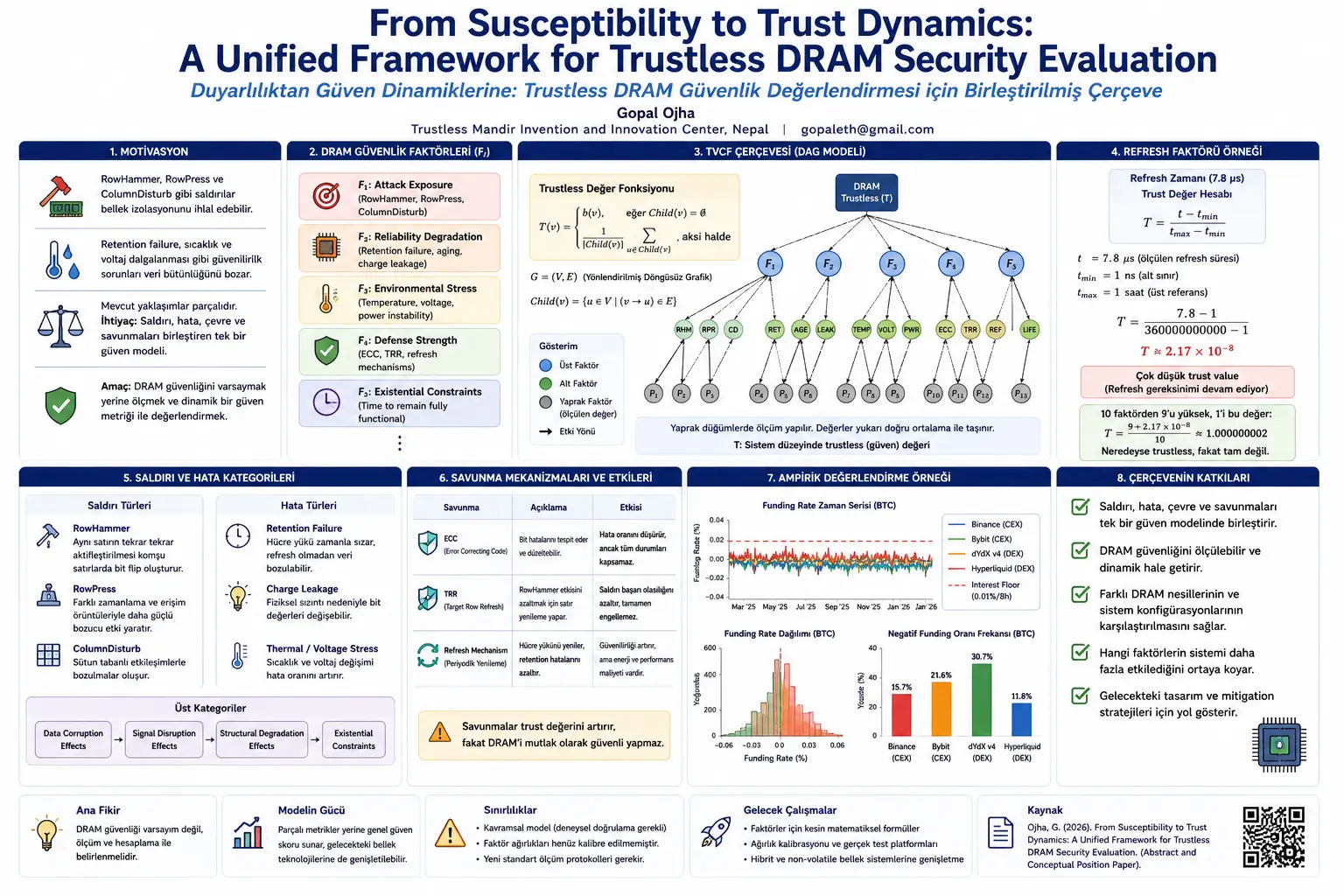
DRAM technology-и main memory мебошад, ки data-и фаъолона истифодашавандаи processor-ро дар modern computer systems нигоҳ медорад. Аз нуқтаи назари user, DRAM invisible аст; computer boot мешавад, programs кор мекунанд, data ба memory навишта ва аз он хонда мешавад. Аммо дар hardware level DRAM аз sensitive cells иборат аст, ки бо electric charge кор мекунанд. Ҳар cell барои ифодаи bit value муайян charge нигоҳ медорад. Ин charge метавонад бо мурури вақт leak шавад, аз environmental conditions таъсир гирад ва аз сабаби electrical behavior-и neighboring cells вайрон шавад.
Дар гузашта main memory аксаран ҳамчун reliable infrastructure component тасаввур мешуд. Вақте software, operating system ва processor security баҳс мешуд, дуруст кор кардани DRAM assumed буд. Аммо RowHammer attack ин assumption-ро ҷиддӣ вайрон кард. RowHammer нишон дод, ки repeated activation-и як memory row метавонад дар neighboring rows bit flip ба вуҷуд орад. Яъне attacker метавонад бидуни direct write ба target bit, тавассути physical interaction memory contents-ро тағйир диҳад.
Ин нуқта хеле муҳим аст, зеро memory isolation яке аз basic assumptions-и computer security мебошад. Як process набояд memory-и process-и дигарро тағйир диҳад. Як virtual machine набояд data-и virtual machine-и дигарро manipulate кунад. Аммо attacks мисли RowHammer нишон медиҳанд, ки ин isolation дар physical layer шикаста метавонад. Ҳамин тавр DRAM на танҳо reliability problem, балки direct security problem мешавад.
Таҳқиқот таъкид мекунад, ки RowHammer танҳо як мисол нест. RowPress ҳамчун attack class баррасӣ мешавад, ки disturbance effect-ро бо different access patterns ва timing behaviors зиёд карда метавонад. ColumnDisturb бошад нишон медиҳад, ки disturbances на танҳо row level, балки through column ва broader architectural dependencies ҳам ба вуҷуд меоянд. Вақте ин attacks якҷо баррасӣ мешаванд, physical properties-и modern DRAM direct part-и system security мегарданд.
Соҳаи дуюме, ки DRAM security-ро душвор мекунад, reliability мебошад. Retention failure ҳангоми он ба вуҷуд меояд, ки DRAM cell charge-ро ба қадри кофӣ дароз нигоҳ дошта наметавонад. Аз ҳамин сабаб DRAM cells periodically refresh мешаванд. Charge leakage, aging, thermal instability ва voltage fluctuation ҳам data integrity-ро вайрон карда метавонанд. Бо зиёд шудани temperature leakage behavior метавонад тағйир ёбад; voltage fluctuation correct reading of cells-ро душвор карда метавонад; aging effects бо мурури вақт probability of error-ро зиёд мекунанд.
Common feature-и ин attack ва fault mechanisms он аст, ки онҳо аз physical nature-и DRAM бармеоянд. RowHammer як security attack менамояд, retention failure як reliability problem. Аммо ҳар ду ба cell charge, electrical coupling, timing, temperature ва voltage-related hardware properties вобастаанд. Important starting point-и paper ҳамин аст: Агар security ва reliability ба same physical roots вобаста бошанд, баҳодиҳии онҳо бо completely separate metrics incomplete хоҳад буд.
Дар current literature барои RowHammer attack success rate, барои retention failure bit error rate ва барои hardware reliability metrics мисли FIT истифода мешаванд. Ин metrics дар contexts-и худ арзишманданд, аммо барои як system-level question ҷавоби ягона додан душвор аст: Ин DRAM system дар attack, environment ва defense conditions муайян то чӣ андоза reliable ва secure аст?
Change-и пешниҳодшуда аз susceptibility-based characterization ба dynamic trust modeling аст. Susceptibility-based characterization sensitivity ба attack ё fault муайянро чен мекунад. Масалан, sensitivity-и DRAM chip ба RowHammer test шуда метавонад. Аммо dynamic trust model на танҳо single attack, балки attack exposure, fault tendency, temperature, voltage, defense mechanism ва system operating duration-ро якҷо арзёбӣ мекунад.
Дар ин framework trust fixed property не, балки time-varying trust metric мебошад. Агар system under attack more errors нишон диҳад, trust паст мешавад. Агар ECC, TRR ё refresh policies errors-ро кам кунанд, trust боло меравад. Агар temperature increase, voltage instability ё cell aging зиёд шавад, trust value бояд updated шавад. Яъне trust ҳамчун one-time certificate не, балки continuously computed system state дида мешавад.
Main formula-и paper idea-и зеринро медиҳад:
\[ Trustless\;T = f(F_1,F_2,F_3,\ldots,F_n) \]
Дар ин formula Trustless T system trustless evaluation value-ро; F1, F2, F3, ..., Fn бошад trustless factors-и таъсиркунанда ба DRAM system-ро ифода мекунанд. Example factors дар study чунинанд:
- F1: Attack exposure. Exposure ба RowHammer, RowPress, ColumnDisturb ва similar attacks.
- F2: Reliability degradation. Degradation чун retention failure, aging ва charge leakage.
- F3: Environmental stress. Environmental stresses мисли temperature, voltage ва power instability.
- F4: Defense strength. Strength-и defense mechanisms чун ECC, TRR ва refresh.
- F4: Existential constraints. Existential constraints мисли duration-и fully functional remaining. Дар source ин item бори дуюм ҳамчун F4 label шудааст; content-wise онро separate factor class бояд ҳисоб кард.
Ин factors ҳама як type нестанд. Attack exposure ба adversarial behavior, reliability degradation ба physical weakening of hardware, environmental stress ба external conditions ва defense strength ба protection mechanisms ишора мекунанд. Ҳадафи model ин аст, ки ҳамаи онҳоро дар same abstraction level ҷамъ кунад.
Study ин computation-ро бо framework-и TVCF мепайвандад. TVCF trust factors-ро hierarchically дар як DAG ифода мекунад. DAG, Directed Acyclic Graph ё directed graph бе cycle аст. Дар ин structure nodes factors-ро, edges hierarchical relations байни factors-ро нишон медиҳанд. Absence of cycle муҳим аст, зеро values аз child factors ба parent factors ҳисоб мешаванд.
DAG дар study чунин define мешавад:
[ G = (V,E) ]
Дар ин ҷо G graph, V set of nodes ва E set of directed edges мебошанд. Барои ҳар node v ∈ V, агар node leaf node бошад, base value b(v) дорад. Дар non-leaf nodes value аз values-и child nodes ҳисоб мешавад.
Child set-и node чунин дода мешавад:
\[ Child(v) = \{u \in V \mid (v \rightarrow u) \in E\} \]
Дар ин formula Child(v) subfactors-и downstream connected аз v node-ро нишон медиҳад. Масалан, children-и parent factor “defense strength” метавонанд ECC effectiveness, TRR effectiveness ва refresh policy effectiveness бошанд. Ин examples барои шарҳи logic-и study мебошанд; paper model-ро дар general level define мекунад.
Node-value function дар TVCF чунин define мешавад:
\[ T(v) = \begin{cases} b(v), & \text{eğer } Child(v)=\emptyset \\ \frac{1}{|Child(v)|}\sum_{u\in Child(v)}T(u), & \text{aksi halde} \end{cases} \]
Дар ин formula T(v) trust/trustless value-и node v мебошад. Агар node child надошта бошад, яъне leaf бошад, value бевосита measured b(v) аст. Агар children дошта бошад, parent value average-и child values ҳисоб мешавад. |Child(v)| number of children-ро нишон медиҳад.
Simplicity-и approach ҳам advantage ва ҳам limitation аст. Advantage ин аст, ки different trust factors hierarchically combine мешаванд. DRAM security model метавонад attack, fault, environment ва defense subdomains-ро дар single tree/graph structure ҷамъ кунад. Limitation ин аст, ки ҳамаи child factors equal weight мегиранд. Дар real systems RowHammer exposure ва low-voltage stress шояд same weight надошта бошанд. Аз ҳамин сабаб future weightage calibration муҳим аст.
Refresh-factor example барои нишон додани numerical operation-и model истифода мешавад. DRAM бояд барои нигоҳ доштани data periodically refresh кунад. Study 7.8 microsecond refresh time-ро ҳамчун indicator-и practical DRAM behavior баррасӣ мекунад. Агар DRAM метавонист data-ро бе refresh forever нигоҳ дорад, барои ин factor fully secure ҳисоб мешуд. Аммо infinite duration дар real systems impossible аст, therefore study demonstratively 1-hour upper limit истифода мекунад.
Simple trust score барои trust value чунин дода мешавад:
\[ T = \frac{t - t_{min}}{t_{max} - t_{min}} \]
Дар ин formula T relevant trust factor value аст. t measured ё considered time value мебошад. tmin lower reference bound ва tmax upper reference bound мебошанд. Study барои tmin 1 ns, барои t 7.8 µs refresh example ва барои tmax demonstratively 1 hour истифода мекунад.
Calculation дар text чунин пешниҳод мешавад:
\[ T = \frac{7.8 - 1}{360000000000 - 1} \approx 2.17 \times 10^{-8} \]
Interpretation-и result ин аст, ки refresh factor дар [0,1] range very low trust value медиҳад. Яъне аз perspective-и ин factor DRAM ҳанӯз strongly refresh-dependent аст; refresh requirement eliminated нашудааст, therefore fully secure ё fully trustless ҳисоб намешавад. Ҳадафи study дар ин ҷо industrial measurement standard-и final додан не, балки нишон додани он аст, ки trust-factor values чӣ гуна normalize ва ба system дохил мешаванд.
Сипас study фарз мекунад, ки 10 different trust factors equal weight доранд. Агар 9 factors high values дошта бошанд ва one factor refresh example-и low value дошта бошад, total value чунин навишта мешавад:
\[ T = \frac{9 + 2.17 \times 10^{-8}}{10} \]
Ин value close to 1 аст. Text инро ҳамчун system almost trustless but not fully trustless interpretation мекунад. Example нишон медиҳад, ки model ҳатто single weak factor-ро visible карда метавонад. Аммо дар айни вақт нишон медиҳад, ки equal-weight average бояд carefully calibrated шавад, зеро critical security factors метавонанд дар average too much softened шаванд.
Attack and fault modeling section attacks ва faults-ро ба common categories ҷудо мекунад. Disturbance-based attacks category RowHammer, RowPress ва ColumnDisturb-ро дар бар мегирад. Онҳо бо repeated access patterns unwanted effects дар neighboring ё related memory cells ба вуҷуд меоранд. Reliability-induced faults category retention failures, charge leakage, voltage stress ва thermal stress-ро дар бар мегирад. Инҳо ҳатто бе attacker behavior data integrity-ро вайрон карда метавонанд.
Дар higher abstraction level, study ин mechanisms-ро ба four general categories мебарад: data corruption effects, signal disruption effects, structural degradation effects ва existential constraints. Data corruption effects corruption-и stored bits-ро ифода мекунанд. Signal disruption effects disturbance дар read-write ё sensing processes-ро. Structural degradation effects weakening of memory structure via aging ва physical wear. Existential constraints бошад fundamental conditions чун how long system can remain fully functional-ро фаро мегирад.
Ин abstraction муҳим аст, зеро вақте new attacks ё new memory technologies пайдо мешаванд, model need not be rebuilt from scratch. Масалан, агар future disturbance attack different from RowHammer discover шавад, ҳамчун new trust factor under attack exposure илова мешавад. Ба ҳамин монанд, retention issue дар new non-volatile memory technology under reliability degradation modeled мешавад.
Trust dynamics section шарҳ медиҳад, ки model static нест. Trust value мувофиқи system behavior кам ё зиёд мешавад. Агар DRAM from expected reliability deviates, under attack bit flips produces, temperature retention time-ро reduce мекунад ё voltage instability errors-ро зиёд мекунад, trust decreases. Агар defense mechanisms ин effects-ро suppress кунанд, trust increases.
Defense mechanisms ҳамчун modifiers, ки effect-и attacks ва faults-ро reduce мекунанд, баррасӣ мешаванд. ECC, Error Correction Codes, bit-level errors-ро detect ва correct карда метавонад. TRR, Target Row Refresh, success probability-и disturbance attacks мисли RowHammer-ро reduce мекунад. Periodic refresh retention-related errors-ро reduce мекунад. Аммо study limitation-и clear медиҳад: ҳеҷ яке security problems-ро fully eliminate намекунад; only probabilistically reduce their effects.
Ин perspective realistic аст. Hardware security одатан absolute protection намедиҳад. ECC баъзе bit errors-ро correct карда метавонад, аммо multiple-bit errors ё certain attack patterns-ро handle карда натавонад. TRR RowHammer effect-ро reduce карда метавонад, вале research нишон додааст, ки TRR mechanisms reverse-engineered ва bypass мешаванд. Refresh retention failures-ро кам мекунад, аммо increasing refresh frequency energy consumption ва performance cost-ро таъсир медиҳад. Therefore defense mechanisms system trust-ро increase мекунанд, аммо automatically 1 намекунанд.
Discussion section paradigm shift-ро равшантар мекунад. DRAM security бо questions мисли “RowHammer-vulnerable аст?” ё “ECC ҳаст?” alone арзёбӣ намешавад. Instead security, reliability ва environmental robustness бояд combined барои DRAM system чен шаванд. Бе чунин measurement, quantitatively comparing systems under adversarial ва environmental conditions душвор аст.
Potential benefit-и framework ин comparison-и different DRAM generations мебошад. Масалан, new DRAM design метавонад against RowHammer more robust бошад, вале retention behavior worse бошад. Another design метавонад better refresh policy дошта бошад, вале more sensitive to voltage fluctuation. Separate metrics ин differences-ро fragmentary нишон медиҳанд. Trust-factor model метавонад ин effects-ро ба higher-level security/trustless metric табдил дода more holistic comparison диҳад.
Potential benefit-и дуюм prediction of future mitigation strategies аст. Агар model нишон диҳад, ки certain factors total trust-ро more strongly reduce мекунанд, designers метавонанд defense priorities-ро more systematically choose кунанд. Масалан, temperature stress агар under some conditions both retention failure ва disturbance susceptibility-ро strongly influence кунад, thermal management part of security design мешавад.
Benefit-и сеюм combining security ва reliability analyses аст. Traditionally security research attack models-ро, reliability research error rates-ро focus мекунад. Дар DRAM ин two domains physically intertwined мебошанд. Study пешниҳод мекунад common trust-factor language байни онҳо сохта шавад. Чунин language метавонад comparisons байни hardware manufacturers, security researchers ва system architects-ро more systematic кунад.
Аз perspective-и daily life, subject invisible менамояд, вале impact калон аст. Cloud servers, banking systems, health records, AI infrastructures, scientific computing centers ва personal computers аз DRAM вобастаанд. Агар memory security weak бошад, data corrupted, privilege boundaries crossed ё system stability damaged шуда метавонанд. Therefore DRAM security-ро танҳо laboratory attack не, балки digital infrastructure reliability issue донистан лозим.
Historical significance: study response ба changing nature of memory security after RowHammer мебошад. Пеш DRAM reliability tests mainly error rate ва refresh behavior-ро target мекарданд; ҳоло physical memory attacks part of microarchitectural security agenda мебошанд. Current significance: single-attack analyses enough нестанд ва unified measurements лозиманд. Future significance: similar trustless evaluation frameworks барои new memory technologies, hybrid memory structures ва non-volatile systems лозим шуда метавонанд.
Strength-и study ин аст, ки different literatures-ро under one conceptual umbrella меорад. RowHammer, RowPress, ColumnDisturb, retention failure, thermal stress, voltage fluctuation, ECC, TRR ва refresh mechanisms separate topics менамоянд. Paper пешниҳод мекунад онҳоро factors of single trust model бинем. Treating trust as dynamic ва measurable variable rather than static label valuable hardware-security perspective медиҳад.
Limitations бояд равшан дида шаванд. Paper conceptual аст; new experimental DRAM chip tests пешниҳод намекунад. New measurement data барои RowHammer success rate, retention error rate ё ECC effectiveness надорад. Trust-factor weights ҳанӯз calibrated нестанд. Equal averaging дар TVCF метавонад critical-importance differences байни factors-ро fully capture накунад. Refresh trust-value example demonstrative аст; барои real standardization unit conversions, reference ranges, normalization logic ва measurement protocols бояд detailed defined шаванд.
Future work section ин gaps-ро қабул мекунад. Future studies бояд more precise mathematical formulas барои trust factors define кунанд, weights of each factor calibrate кунанд ва model-ро бо real DRAM test platforms validate кунанд. Extension ба hybrid ва non-volatile memory systems ҳам proposed аст. Ин test мекунад, ки framework beyond classic DRAM usable аст ё не.
Он чизе, ки study мегӯяд ва намегӯяд, бояд separated бошад. Study proof намекунад, ки particular DRAM chip secure аст. New RowHammer defense таҳия намекунад. Claim намекунад, ки ECC ё TRR all attacks-ро prevent мекунанд. Trust-value example standardized industrial measurement result нест. Main claim ин аст: DRAM security бояд ҳамчун combined, dynamic ва measurable function of attack, fault, environment ва defense factors modeled шавад.
Усул ва Натиҷаҳои Таҳқиқот
Ин study experimental benchmark нест, балки conceptual ва model-proposing position paper мебошад. Method fragmented metrics-и existing DRAM security ва reliability literature-ро дар як trust-factor model муттаҳид мекунад. Findings бештар нишон медиҳанд, ки proposed framework кадом factors-ро чӣ гуна represent мекунад ва DRAM security evaluation-ро чӣ гуна reorganize карда метавонад, на new measurement results.
1. Ҳадафи асосии model
| Current approach | Proposed approach | Scientific meaning |
|---|---|---|
| Risks мисли RowHammer, RowPress, retention failure separately analyzed мешаванд. | Attack, fault, environment ва defense factors дар single trust model combined мешаванд. | DRAM security кӯшиш мешавад system-level measurable гардад. |
| Security аксаран тавассути one vulnerability ё defense discussed мешавад. | Trust ҳамчун dynamic ва numeric system property баррасӣ мешавад. | Trust value метавонад бо changing conditions тағйир ёбад. |
| Metrics мисли BER, FIT ва attack success rate fragmented мемонанд. | Global security trust measure ҳадаф гирифта мешавад. | Different DRAM systems дар same framework муқоиса мешаванд. |
2. Trustless DRAM model
Basic model:
\[ Trustless\;T = f(F_1,F_2,F_3,\ldots,F_n) \]
| Factor | Content дар study | Role дар DRAM security |
|---|---|---|
| F1: Attack exposure | RowHammer, RowPress, ColumnDisturb | Exposure-и system ба physical/microarchitectural attacks-ро ифода мекунад. |
| F2: Reliability degradation | Retention failures, aging, charge leakage | Probability-и data corruption бе attack-ро ифода мекунад. |
| F3: Environmental stress | Temperature, voltage, power instability | Effect-и environmental conditions ба security ва reliability. |
| F4: Defense strength | ECC, TRR, refresh mechanisms | Defenses-и reducing attack/fault effects-ро ифода мекунад. |
| F4: Existential constraints | Time to remain fully functional | Fundamental constraints чун duration-и full functionality. Numbering дар source repeat шудааст. |
3. DAG ва TVCF computation structure
Graph definition:
[ G = (V,E) ]
Child node set:
\[ Child(v) = \{u \in V \mid (v \rightarrow u) \in E\} \]
TVCF node value:
\[ T(v) = \begin{cases} b(v), & \text{eğer } Child(v)=\emptyset \\ \frac{1}{|Child(v)|}\sum_{u\in Child(v)}T(u), & \text{aksi halde} \end{cases} \]
| Term | Meaning | Interpretation дар DRAM model |
|---|---|---|
| V | Set of nodes | Trust/trustless factors-ро represent мекунад. |
| E | Directed edges | Parent-factor ва subfactor relationships-ро нишон медиҳад. |
| b(v) | Base value of leaf node | Measured ё normalized low-level trust factor value. |
| T(v) | Computed node value | Trust value, ки аз subfactors ба parent factor aggregate мешавад. |
| Child(v) | Children of node v | Subfactors, ки higher trust category-ро ташкил медиҳанд. |
4. Refresh-factor example
Trust-value formula:
\[ T = \frac{t - t_{min}}{t_{max} - t_{min}} \]
Demonstrative calculation:
\[ T = \frac{7.8 - 1}{360000000000 - 1} \approx 2.17 \times 10^{-8} \]
| Quantity | Role in study | Interpretation |
|---|---|---|
| t | 7.8 µs refresh example | Practical DRAM refresh requirement-ро represent мекунад. |
| tmin | 1 ns lower-bound assumption | Demonstrative lower reference for sensing/amplify/restore. |
| tmax | 1-hour upper-bound assumption | Finite reference because infinite time is unrealistic. |
| T | Approximately 2.17 × 10⁻⁸ | Very low trust value for refresh factor. |
Under assumption of 10 equally weighted trust factors, total example:
\[ T = \frac{9 + 2.17 \times 10^{-8}}{10} \]
Value close to 1 аст. Study истифода мекунад, то нишон диҳад system nearly trustless but not fully trustless шуда метавонад.
5. Attack and fault modeling categories
| Category | Examples | Contribution to model |
|---|---|---|
| Disturbance-based attacks | RowHammer, RowPress, ColumnDisturb | Core components of attack-exposure factor. |
| Reliability-induced faults | Retention failures, charge leakage | Data corruption without attacker behavior. |
| Environmental stress | Temperature, voltage, power instability | Can affect both attack susceptibility and fault rates. |
| Generalized fault categories | Data corruption, signal disruption, structural degradation, existential constraints | Maps mechanisms to scalable higher abstractions. |
6. Role of defenses in model
| Defense | Function in study | Limitation |
|---|---|---|
| ECC | Detects/corrects bit-level errors and reduces effective error rate. | Does not eliminate all multi-bit error patterns or attacks. |
| TRR | Reduces success probability of disturbance attacks like RowHammer. | Does not completely eliminate attack; gives probabilistic mitigation. |
| Refresh mechanisms | Renew cell charge to reduce retention-related errors. | Refresh requirement creates energy, performance and trust dependence. |
7. Trust dynamics
| System behavior | Effect on trust | Example interpretation |
|---|---|---|
| Increase in bit flips under attack | Trust decreases. | RowHammer or RowPress effects reduce system trust. |
| Increase in retention failure | Trust decreases. | If data cannot be stored correctly for long, trust dependence increases. |
| Temperature and voltage stress | Trust may decrease. | Environmental stress affects reliability and attack susceptibility. |
| If ECC/TRR/refresh successfully reduce effects | Trust increases. | Defenses reduce risk, but do not automatically eliminate it. |
8. Main conceptual findings
- DRAM security should be measured, not assumed.
- RowHammer, RowPress, ColumnDisturb, retention failure ва environmental stresses can be handled in same security/reliability model.
- Trust is not static label but dynamic metric changing with system behavior.
- TVCF can hierarchically compute DRAM trust factors on a DAG.
- ECC, TRR ва refresh mechanisms can be modeled as defense modifiers increasing trust.
- Defenses do not guarantee security; they probabilistically reduce attack/fault effects.
- Model has potential to compare DRAM generations and system configurations through common trustless-security metric.
- Study aims to create common abstraction layer between reliability and security analyses.
9. Limitations
- Model is conceptual and requires experimental calibration.
- Study does not provide new measurements from real DRAM test platforms.
- Exact mathematical formulas for trust factors are not fully defined.
- Factor weights are assumed equal; real systems require weight calibration.
- Refresh example is demonstrative and should not be interpreted as industrial standard measurement.
- How BER, FIT, attack success rate and environmental stress metrics should be standardized into one model remains future work.
- Framework has not yet been tested for hybrid and non-volatile memory systems.
10. Future work areas
| Future work | Why necessary? |
|---|---|
| Exact mathematical formulas for trust factors | Needed for measurable and reproducible practical model. |
| Weight calibration | Each factor may not affect system security equally. |
| Experimental validation with DRAM test platforms | Conceptual model should be tested against real fault and attack behavior. |
| Extension to emerging memory technologies | Generality should be tested in hybrid and non-volatile systems. |
| Prediction of mitigation strategies | Model may identify which defenses deserve priority. |
Ёддошт оид ба Манбаъ ва Усул
Ин мақола дар асоси таҳқиқоти Gopal Ojha бо унвони “From Susceptibility to Trust Dynamics: A Unified Framework for Trustless DRAM Security Evaluation” таҳия шудааст. Author affiliation Trustless Mandir Invention and Innovation Center, Nepal мебошад.
Source, бо terminology-и худаш, abstract and conceptual position paper мебошад. Аз ин рӯ ҳамчун conceptual position paper / research draft арзёбӣ мешавад. Азбаски journal acceptance, DOI, conference acceptance ё completed peer-review information дар text verify намешавад, бояд онро коре, ки peer review-и он аз рӯи матн тасдиқ намешавад номид.
Дар омода кардани ин content DRAM security problem, RowHammer, RowPress, ColumnDisturb, retention failure, thermal instability, voltage fluctuation, ECC, TRR, refresh mechanisms, trustless DRAM definition, TVCF/DAG model, trust-factor formulas, refresh-factor example, attack-and-fault-modeling section, trust dynamics, discussion, conclusion ва limitations-и study истифода шудаанд.
Иддаоҳои дар text набуда, чун real DRAM experimental result, security guarantee for a chip family, definitive RowHammer defense, claim that ECC/TRR stop all attacks, industrially validated trust score ё peer-reviewed publication acceptance илова нашудаанд. Азбаски study conceptual аст, practical validity of proposed model experimental calibration, factor weighting ва validation with real DRAM test platforms талаб мекунад.
Main contribution-и study ин аст, ки DRAM security-ро на тавассути single-attack susceptibility, балки ҳамчун dynamic security/trustless system metric, ки attack, fault, environmental stress ва defense factors-ро combine мекунад, фикр кардан пешниҳод мекунад. Ин approach метавонад basis барои more systematic evaluation-и future secure and reliable memory systems шавад.
Шарҳ гузоред
Нишонии почтаи электронии шумо нашр намешавад. Майдонҳои ҳатмӣ бо * нишон дода шудаанд