

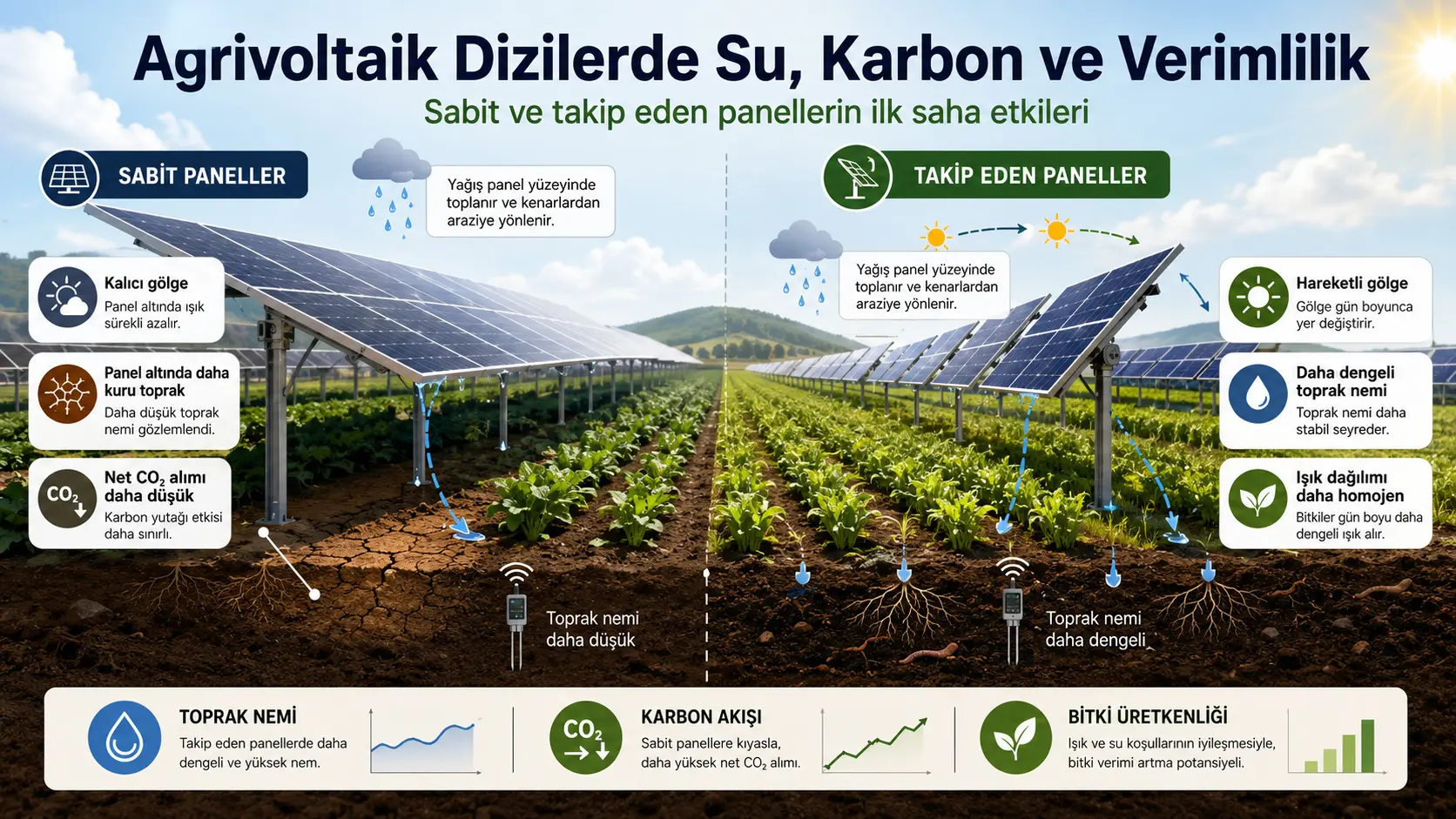
Ин таҳқиқот таъсири тарҳи панелро ба рӯшноӣ, оби хок, ҳарорат, фаъолияти растанӣ, evapotranspiration ва гирифтани карбон дар системаҳои agrivoltaic, ки истеҳсоли энергияи офтобӣ ва истифодаи кишоварзии заминро дар як майдон муттаҳид мекунанд, омӯхтааст. Дар майдони тадқиқотии 2,25 MWAC дар Wisconsin, минтақаи назоратии осмони кушода бо массиви photovoltaic-и кунҷи собит ва системаи якмеҳвари пайгирии офтоб муқоиса шудааст. Муҳаққиқон сенсорҳои radiation, ченкуниҳои намӣ ва ҳарорат дар чор чуқурии гуногуни хок, манораҳои eddy covariance, камераи phenology, ченкуниҳои leaf area ва stomatal conductance-ро якҷо истифода кардаанд.
Натиҷаҳо нишон доданд, ки панелҳои офтобӣ заминро ба таври яксон сардтар ё намноктар намекунанд. Дар зери панелҳои кунҷи собит минтақаҳои сояи доимӣ ба вуҷуд омаданд; баъзе хокҳои зери панел бо вуҷуди сардтар будан, аз сабаби он ки бориш мустақиман ба хок намерасид, хушктар монданд. Дар хатҳои қатрарезии канори панел об дар чуқуриҳои муайян ҷамъ шуд. Системаи якмеҳвари пайгирӣ бошад сояро дар тӯли рӯз ҳаракат дода, рӯшноии ба зери панел мерасидаро зиёд кард ва махсусан дар қабатҳои чуқури хок намии баландтар ва яксонтарро нигоҳ дошт.
Дар давраи 1 Haziran–1 Ekim 2025, дар манораи ченкунии дохили массиви кунҷи собит нисбат ба назорати майдони кушода, cumulative net CO₂ uptake %43 ва evapotranspiration %33 пасттар, cumulative sensible heat flux бошад %74 баландтар буд. Ин муқоиса массиви якмеҳвари пайгириро дар бар намегирад; танҳо массиви кунҷи собит ва минтақаи назоратиро фаро мегирад. Бозёфтҳо ҳамчунин нишон доданд, ки пас аз mowing ва targeted herbicide application дар аввали август фарқи carbon uptake калонтар шуд. Бо вуҷуди ин, study танҳо соли аввали establishment, як site ва measurement areas-и дорои хусусиятҳои гуногунро дар бар мегирад; direct crop yield, harvest amount ё long-term agrivoltaic success чен нашудааст.
Саволи асосии таҳқиқот чист?
Ҳадафи асосии системаҳои agrivoltaic ин аст, ки истеҳсоли solar electricity ва истифодаи agricultural ё ecological land дар як майдон идома ёбанд. Аммо panels танҳо passive structures барои тавлиди electricity нестанд. Онҳо тарзи расидани sunlight ба хок, ҷойи фуруд омадани rainwater, surface temperature, air movement ва миқдори обе, ки растаниҳо истифода бурда метавонанд, тағйир медиҳанд.
Аз ин рӯ муҳаққиқон ба ҷойи саволи яксамта, мисли “Оё майдони дорои solar panels сардтар ва намноктар мешавад?”, ба чор саволи муфассалтар диққат доданд:
- Панелҳои fixed-tilt ва sun-tracking тақсимоти direct ва diffuse light-ро дар тӯли рӯз чӣ гуна тағйир медиҳанд?
- Shading ва redistribution-и rainfall аз ҷониби panels намӣ ва ҳароратро дар чуқуриҳои гуногуни хок чӣ гуна тағйир медиҳад?
- Vegetation cover, stomatal conductance ва leaf area дар microhabitats-и panel underside, inter-row ва drip line чӣ гуна тағйир меёбанд?
- Ин фарқиятҳои small-scale дар land-scale carbon uptake ва evapotranspiration чӣ гуна инъикос мешаванд?
Ҷиҳати фарқкунандаи study ин аст, ки он танҳо panel underside-ро бо open field муқоиса намекунад; балки panel underside, panel edge, drip line ва inter-row corridors-ро ҳамчун microhabitats-и алоҳида пайгирӣ мекунад. Ҳамин тавр нишон дода шудааст, ки agrivoltaic land як environmental condition-и ягона надорад, балки аз mosaic-и light ва water regimes-и гуногун иборат аст.
Майдони таҳқиқот ва тарҳҳои панел
Kegonsa Research Campus agrivoltaic site дар Wisconsin дар майдони тақрибан 6,7 hectare сохта шудааст. Иншоот аз 5.424 адад 530 W bifacial photovoltaic modules иборат буда, 2,87 MWDC ва 2,25 MWAC nominal capacity дорад. Flat projection-и panel surfaces тақрибан %21-и site area-ро мепӯшонад.
| Тарҳ | Сохтори техникӣ | Нақш дар таҳқиқот |
|---|---|---|
| Назорати осмони кушода | Майдони растанидори reference бе panel | Базаи муқоиса барои light, soil, microclimate ва land-atmosphere fluxes |
| Массиви кунҷи собит | 4.800 module; 2,54 MWDC ва 2,0 MWAC; 25° tilt ба самти ҷануб; east-west rows; row spacing 5,3–9,7 m | Омӯзиши permanent ва spatially fixed shading regime |
| Массиви якмеҳвари пайгирӣ | 480 module; 254,4 kWDC; north-south rows; 200 kW inverter | Омӯзиши он ки panel movement соя, light ва soil water-ро дар тӯли рӯз чӣ гуна redistribute мекунад |
| Массиви баландшудаи собит | 144 module; 76,32 kWDC; ground clearance тақрибан 2,3 m | Demonstration ва research infrastructure; дар ин study actively monitored нашудааст |
Center axis-и fixed-tilt panels тақрибан 0,76 m аз замин баланд аст. Ин low clearance дастрасӣ ба vegetation-и зери panel ва mowing-ро душвор кардааст. Дар single-axis system, panels мувофиқи position-и Sun гардида, location-и shade-ро дар east ва west sides дар тӯли рӯз тағйир доданд.
Дар дохили panel rows кадом microhabitats пайгирӣ шуданд?
Дар single-axis tracking array panel underside, inter-row corridor, east drip line ва west drip line monitored шуданд. Дар fixed-tilt array бошад panel underside, inter-row corridor, panel drip line ва north edge ҳамчун separate measurement points муайян шуданд.
Ин locations барои ҷудо кардани ду main physical process кӯмак карданд:
- Тақсимоти рӯшноӣ: Бастани direct sunlight аз ҷониби panels ва табдил додани area ба regions бо diffuse-light dominance.
- Тақсимоти бориш: Нигоҳ доштани rain дар panel surface, камтар расидани water ба panel underside ва concentration-и water дар panel edges.
Дар field-layout map-и study fixed, tracking ва elevated panel areas; measurement towers, weather stations, soil tests ва continuous-monitoring transects якҷо нишон дода шудаанд. Experimental-design diagram бошад нишон медиҳад, ки light, plant, soil ва atmospheric measurements ба same microhabitat structure пайваст шудаанд.
Fixed ва moving panels рӯшноиро чӣ гуна тағйир доданд?
Open-sky measurements дар 14 Temmuz 2025 нишон доданд, ки two panel systems shading regimes-и гуногун ба вуҷуд меоранд. Дар fixed-tilt array, inter-row corridor ва drip line қисми зиёди рӯз light-и наздик ба open field гирифтанд, дар ҳоле ки panel underside ва north edge муддати дароз дар low ва diffuse-light conditions монданд.
| Ҷой | Daily PPFD (mol m-2 gün-1) | Муқоиса бо open field |
|---|---|---|
| Open-field control | 53,3 | Reference |
| Fixed-array drip line | 54,2 | %102-и control |
| Fixed-array inter-row | 52,6 | %99-и control |
| Fixed-array north edge | 10,3 | %19-и control |
| Fixed-array panel underside | 3,63 | %7-и control |
| Tracking-array inter-row | 43,2 | Баландтарин value-и tracking array |
| Tracking-array east drip line | 40,0 | Бо shade position дар тӯли рӯз тағйир ёфт |
| Tracking-array west drip line | 29,9 | Бо shade position дар тӯли рӯз тағйир ёфт |
| Tracking-array panel underside | 16,6 | %31-и control |
Дар fixed-tilt array фарқи байни brightest ва darkest microhabitat ба 14,9 times расид. Дар tracking array ин ratio то 2,6 times кам шуд. Moving panels direct light-ро дар panel underside пурра нест накарданд; онҳо имкон доданд, ки дар intervals-и муайяни morning ва afternoon direct light ба зери panel расад.
Дар open field total PPFD дар noon ба 1.711 µmol m-2 s-1, direct light ба 1.540 µmol m-2 s-1 расид. Direct light тақрибан %90-и peak total irradiance-ро ташкил дод. Values-и тақрибан 100–200 µmol m-2 s-1 дар panel underside бошад regime-еро ифода карданд, ки direct light largely blocked ва diffuse light dominant буд.
Байни light ва ecosystem carbon uptake чӣ relation ёфт шуд?
Аз аввали июн то аввали октябр daily total ва diffuse radiation бо гузашти season кам шуданд. Multiple regression model, ки daily direct light, diffuse light, date ва tower location-ро дар бар мегирифт, %23,9-и variability дар daily net ecosystem carbon exchange-ро шарҳ дод.
| Variable | Relation бо NEE | Statistical result |
|---|---|---|
| Direct light | Барои ҳар additional 1 mol m-2 gün-1, NEE +0,148 g C m-2 gün-1 | p < 0,001 |
| Diffuse light | Барои ҳар additional 1 mol m-2 gün-1, NEE +0,461 g C m-2 gün-1 | p < 0,001 |
| Measurement date | +0,025 g C m-2 gün-1 per day | p = 0,001 |
| Control tower | +0,87 g C m-2 gün-1 relative to array tower | p = 0,02 |
Дар ин analysis positive NEE values net carbon uptake-ро нишон медиҳанд. Гарчанде coefficient-и diffuse light аз coefficient-и direct light калонтар буд, effect-и light байни towers statistically different ёфт нашуд. Researchers инчунин таъкид карданд, ки light alone қисми зиёди variability-и carbon balance-ро шарҳ дода натавонист. Plant community, phenology, temperature, atmospheric drying effect ва site management ҳам daily carbon exchange-ро таъсир доданд.
Эҳтимолияти он арзёбӣ шуд, ки Canadian wildfire smoke дар radiation declines-и late July ва early August нақш дошта бошад. Аммо азбаски cloudiness, plant development ва management operations ҳам дар same period тағйир ёфтанд, ин relation definitively separated нашудааст.
Чаро soil-и сардтар дар panel underside хушктар монд?
Яке аз муҳимтарин results ин буд, ки lower soil temperature ҳамеша маънои higher soil moisture надорад. Дар зери fixed-tilt panels shade evaporative demand-ро кам кард; аммо panel surface rain-ро intercept карда, direct water input ба soil-и panel underside-ро низ кам кард. Вақте rainfall loss аз evaporation saving-и shade зиёдтар буд, soil-и cool but dry пайдо шуд.
Mean volumetric water content дар давраи Mayıs–Kasım 2025 чунин чен шуд:
| Area | 0–15 cm VWC (m3 m-3) | 46–60 cm VWC (m3 m-3) |
|---|---|---|
| Open-field control | 0,361 | 0,370 |
| Fixed-tilt array | 0,293 | 0,206 |
| Single-axis tracking array | 0,341 | 0,409 |
Дар 46–60 cm layer-и fixed-tilt array тақрибан %45 камтар water нисбат ба control area захира шуд. Tracking array бошад дар same depth mean water content-и болотар аз control нигоҳ дошт. Дар growing season VWC дар 0–15 cm layer 0,348 дар control, 0,340 дар tracking array ва 0,280 m3 m-3 дар fixed array буд. Дар deep layer fixed array ба 0,207 ва tracking array ба 0,417 m3 m-3 расид.
Дар fixed-tilt array об ба куҷо рафт?
Panel-underside location дар fixed array бо mean 0,190 m3 m-3 дар near-surface layer яке аз driest locations буд. Дар drip line бошад rain аз panel edge ба soil concentrate шуд; дар growing season VWC дар 31–45 cm layer ба 0,437 m3 m-3 расид.
Дар inter-row corridor mean growing-season moisture дар 46–60 cm layer 0,113 m3 m-3 буд, ки lowest deep-soil value дар site мебошад. Пас аз rainfall rapid rise ва rapid decline дар баъзе deep sensors бо movement-и water тавассути macropores ба depth ва subsequent drainage мувофиқ буд.
Дар drip line, effect-и rainfall зуд ба ҳамаи depths расид, decline дар deepest layer бошад slower буд. Researchers инро бо rapid downward transport through macropores ва slowing дар lower layer, ки permeability-и камтар дошта метавонад, шарҳ доданд.
Чаро tracking system soil-water distribution-и homogeneous-тар сохт?
Дар tracking array east ва west panel edges ва inter-row locations дар deep soil similar high moisture values нишон доданд:
- East drip line: 0,454 m3 m-3
- West drip line: 0,436 m3 m-3
- Inter-row: 0,426 m3 m-3
- Panel underside: 0,321 m3 m-3
Гардиши tracking panels дар тӯли рӯз ҳам shade ва ҳам location-и water runoff аз panel edge-ро тағйир дод. Narrower panel structure ва moving orientation continuous rainfall exclusion-ро, ки дар зери fixed panels дида шуд, кам карданд. Аз ин рӯ tracking array махсусан дар 31–60 cm layer spatial variability-и камтар ва water storage-и баландтар нишон дод.
Ин finding исбот намекунад, ки moving panel system дар ҳамаи conditions аз ҷиҳати agricultural беҳтар аст. Дар study tracking array land-scale carbon ва evapotranspiration tower надошт. Results-и tracking system асосан ба light, soil-moisture ва temperature sensors такя мекунанд.
Soil temperature чӣ қадар тағйир ёфт?
Soil temperature нисбат ба moisture seasonal pattern-и regular-тар нишон дод. Дар Mayıs–Kasım period, 0–15 cm layer mean 17,7 °C дар control, 16,8 °C дар fixed array ва 16,6 °C дар tracking array буд. Дар 46–60 cm layer control боз 17,7 °C буд, дар panel areas бошад 16,1–16,3 °C монд.
Fixed-array panel underside дар ҳама depths coolest microhabitat буд. Ин location дар 46–60 cm layer то 15,2 °C поён рафт. Дар growing season panel-underside temperature дар fixed array нисбат ба control дар surface layer 2,6 °C ва дар deep layer 2,9 °C пасттар буд.
Бо вуҷуди ин, same location аз нигоҳи moisture most favorable region нест. Ин result нишон медиҳад, ки дар agrivoltaic design танҳо amount of shade кофӣ нест; rainfall аз panel surface ба кадом location равона мешавад, бояд ҳам арзёбӣ гардад.
Carbon, water ва energy fluxes чӣ гуна тағйир ёфтанд?
Land-atmosphere exchange бо two eddy-covariance towers дар fixed-tilt array ва open control area чен шуд. Ин towers three-dimensional wind, CO₂ ва water-vapor density-ро бо 10 measurements per second сабт карданд. Data ба half-hourly fluxes табдил дода шуда, low-quality measurements хориҷ шуданд.
Cumulative results барои 1 Haziran–1 Ekim 2025 чунинанд:
| Metric | Fixed array–control difference | Scientific meaning |
|---|---|---|
| Net CO₂ uptake | %43 lower | Plant-soil system дар array during season less net carbon absorbed |
| Evapotranspiration | %33 lower | Less water transferred from array area to atmosphere |
| Sensible heat flux | %74 higher | Energy partitioning shifted from evaporative cooling toward flux directly heating atmosphere |
Largest differences дар midday пайдо шуданд. Control area higher carbon uptake ва evapotranspiration нишон дод, fixed-array area бошад lower latent heat ва higher sensible heat flux дошт.
Ин result маънои онро надорад, ки panel area necessarily warmer air эҷод мекунад. Daily mean air temperature байни two sites хеле similar монд. Daily temperature RMSD байни array measurement at ten-meter height ва control 0,17 °C буд. Аммо relative humidity дар array area generally lower буд; control-area humidity нисбат ба array вобаста ба measurement height mean 1,8–3,8 percentage points higher буд.
Electricity production чӣ гуна ба energy balance дохил карда шуд?
Азбаски photovoltaic panels қисми incoming solar energy-ро ба electricity табдил медиҳанд, танҳо heat fluxes-ро ҷамъ кардан energy balance-ро incomplete мегузорад. Researchers fixed-array electricity generation-ро на аз direct meter data, балки бо PVWatts relation, based on measured shortwave radiation ва air temperature, estimated карданд:
\[ P_{dc}=\left(\frac{SW_{in}}{G_{ref}}\right)P_{dc0}\left[1+\gamma\left(T_{cell}-T_{ref}\right)\right](1-L) \]
\[ T_{cell}=T_{amb}+\left(\frac{NOCT-20}{800}\right)SW_{in} \]
Дар ин ҷо \(P_{dc}\) estimated DC power; \(SW_{in}\) measured incoming shortwave radiation; \(G_{ref}=1000\) W m-2 reference irradiance; \(P_{dc0}\) system nominal DC capacity; \(\gamma=-0,0037\) °C-1 module temperature coefficient; \(T_{cell}\) cell temperature; \(T_{ref}=25\) °C reference temperature; \(L=0,1408\) system losses; ва \(NOCT=45\) °C nominal operating cell temperature мебошанд.
Бо ин method mean electrical-energy flux density дар growing season 7,1 W m-2 ҳисоб шуд. PVWatts value based on long-term climate data 7,7 W m-2 буд.
Without accounting electricity generation, mean energy-balance gap дар fixed-array area 36,1 W m-2, яъне %26,7-и net radiation буд. Вақте estimated electricity generation илова шуд, gap ба 29,1 W m-2 ва %21,5 кам шуд. Control-area gap 9,3 W m-2, ё %7,8-и net radiation буд. Higher non-closure ratio дар array area нишон медиҳад, ки heterogeneous surface ва measurement uncertainty ҳангоми interpretation бояд ба назар гирифта шаванд.
Plant community ва plant physiology чӣ нишон доданд?
Дар site total 19 taxa муайян шуданд: 13 broadleaf herbaceous plants ва 6 grass species. Plant community асосан аз broadleaf species бо C3 photosynthetic pathway иборат буд. Tarla köygöçüreni, Kanada şifaotu ва kışlık çavdar дар %55-и observations пайдо шуда, most frequent species буданд. Kırmızı yonca %40 ва sirken %35 сабт шуданд.
Дар tracking array proportion-и C3 ва broadleaf species higher буд, дар fixed array бошад contribution-и grass ва C4 species каме бештар буд. Аммо ин first-year results-и newly established vegetation мебошанд. Community ҳанӯз stable agrivoltaic vegetation-ро ифода намекунад.
Stomatal conductance махсусан дар fixed array бештар light distribution-ро пайгирӣ мекард, на soil moisture-ро. Дар leaves under permanent shade conductance lower монд. Leaf area index ҳам generally under panels lower than inter-row буд; аммо азбаски sampling dates limited буданд, spatial pattern-и ин variable мисли soil moisture ва stomatal conductance равшан набуд.
Чаро mowing ва herbicide application ба results таъсир карданд?
Site дар Ekim 2024 бо mixture-и native grasses ва herbaceous species ва winter rye seeded шуд; дар Mayıs ва Eylül 2025 reseeded гардид. Mowing дар early July ва early August анҷом шуд. Азбаски mowing equipment зери fixed panels душвор дастрас мешуд, thistle species зиёд шуданд ва targeted glyphosate application аз early то mid-August гузаронида шуд.
Strongest divergence дар cumulative carbon uptake пас аз ин management period пайдо шуд. Carbon uptake дар fixed-array area largely flattened, control area бошад то September carbon accumulation-ро идома дод.
Ин timing нишон медиҳад, ки management interventions метавонанд дар first-year carbon balance таъсирҳое бо magnitude-и comparable to microclimate ба вуҷуд оранд. Аммо mowing ва herbicide ҳамчун separate controlled experiment татбиқ нашуданд, бинобар ин fraction-и carbon difference attributable to shading ё plant management definitively separated нашудааст.
Таҳқиқот чиро нишон медиҳад?
- Agrivoltaic areas microclimate-и uniform надоранд; panel underside, inter-row ва drip line different light-water conditions эҷод мекунанд.
- Fixed-tilt panels permanent ва strong light differences ба вуҷуд меоранд.
- Sun-tracking panels метавонанд shade-ро дар time redistribute карда, daily light under panels-ро зиёд ва extreme microhabitat differences-ро кам кунанд.
- Cooler panel underside, агар rainfall input blocked бошад, necessarily higher soil moisture намедиҳад.
- Water concentrated at panel edges метавонад specific soil depths-ро нам кунад; аммо ин маънои wetter whole profile надорад.
- Дар fixed-array area lower evapotranspiration, lower net carbon uptake ва higher sensible heat flux якҷо мушоҳида шуданд.
- Mowing, weed control ва equipment access integral parts-и ecological performance-и agrivoltaic system мебошанд.
Таҳқиқот чиро нишон намедиҳад?
- Study direct food-crop yield ё harvest amount чен накардааст.
- Lower net CO₂ uptake маънои exact %43 decline-и yield-и specific crop нест.
- Land-scale carbon uptake ё evapotranspiration-и tracking array better than fixed array ёфт нашудааст; comparable flux tower дар tracking area вуҷуд надорад.
- Electricity generation between panel types directly compared нашудааст.
- One-year results long-term effects on soil water, plant community, groundwater ё agricultural production-ро исбот намекунанд.
- Observed differences cannot all be attributed solely to photovoltaic panels; control ва array areas дар vegetation, measurement height, footprint ва energy-balance closure фарқ мекунанд.
- Wisconsin results cannot be directly transferred to all climates, crops ё panel designs in Türkiye.
Чаро барои Туркия муҳим аст?
Қавитарин ҷиҳати study барои Туркия ин аст, ки ба ҷойи one-direction assumptions мисли “panels save water” ё “shade reduces yield”, measurable field-evaluation framework медиҳад. Дар agrivoltaic projects-и Türkiye истифодаи танҳо mean soil temperature ё single moisture sensor метавонад important differences within panel rows-ро пинҳон кунад.
Design-и research метавонад барои trial sites дар Türkiye чунин мутобиқ карда шавад:
- Fixed ва moving panel systems метавонанд under same soil ва plant conditions муқоиса шаванд.
- Separate moisture, temperature ва light sensors метавонанд under panels, inter-row ва drip line насб шаванд.
- Soil water метавонад на танҳо at surface, балки то at least 60 cm depth monitored шавад.
- Rainfall, evapotranspiration, carbon uptake, crop ё biomass yield ва electricity production метавонанд jointly evaluated шаванд.
- Management events мисли mowing, grazing, weed control ва machine access метавонанд бо measurement records matched шаванд.
Ин approach имкон медиҳад agrivoltaic design дар Türkiye на танҳо аз рӯйи electricity generation, балки аз рӯйи plant-available light, rainfall distribution into soil, irrigation requirement, agricultural mechanization ва long-term soil water низ арзёбӣ шавад. Аммо separate field validation барои local crop, soil, climate ва panel geometry зарур аст.
Усул ва бозёфтҳои таҳқиқот
Measurement ва data-collection setup
| Measurement group | Method ва device | Temporal ё spatial scope |
|---|---|---|
| Light environment | Shaded-band pyranometer in open field; eight LI-COR LI-191R linear quantum sensors within array | Control, panel underside, panel edge, drip line ва inter-row; sensors at about 1 m height |
| Soil moisture ва temperature | Continuous moisture ва temperature sensors at same points | 0–15, 16–30, 31–45 ва 46–60 cm; 10-minute records |
| Atmosphere ва ecosystem fluxes | Campbell Scientific IRGASON ва CR6 data logger; EddyPro processing | Wind, CO₂ ва H₂O at 10 Hz; half-hourly fluxes; fixed-array ва control towers |
| Plant phenology | StarDot NetCamLive 2 RGB phenology camera | Image every 30 minutes |
| Leaf area | LI-COR LAI-2200C | Field transects crossing panel rows |
| Stomatal conductance | Decagon Devices SC-1 porometer | Panel underside, inter-row ва drip-line locations |
| CO₂ assimilation ва H₂O flux | LI-COR LI-6400 ва LI-7810 | Leaf- ва canopy-level field campaigns |
| Near-surface moisture ва temperature | Delta-T ML2x probe, HH2 logger ва FLIR TG54 infrared thermometer | For checking sensor patterns with field measurements |
| Plant community | 0,5 m² sampling quadrats | Eight replicates in each panel type |
Flux-data processing
- Low-quality flux measurements with EddyPro quality flag 2 were removed.
- At most five consecutive missing half-hour periods were filled by linear interpolation.
- Longer data gaps were left unfilled.
- Electricity production was estimated with PVWatts equation using measured shortwave radiation and air temperature of fixed array.
- Positive values in cumulative NEE graphs indicate net ecosystem CO₂ uptake.
Асосии quantitative findings
| Finding | Numerical result | Scope |
|---|---|---|
| Daily light under fixed panel | 3,63 mol m-2 gün-1; %7 of control | 14 Temmuz 2025 clear-sky day |
| Daily light under tracking panel | 16,6 mol m-2 gün-1; %31 of control | 14 Temmuz 2025 clear-sky day |
| Microhabitat light difference | 14,9-fold in fixed array; 2,6-fold in tracking array | Brightest vs darkest location comparison |
| Deep soil moisture | Control 0,370; fixed 0,206; tracking 0,409 m3 m-3 | 46–60 cm, Mayıs–Kasım mean |
| Lowest deep moisture | 0,113 m3 m-3 | Fixed-array inter-row, growing season |
| Highest stated deep tracking moisture | 0,454 m3 m-3 | Tracking-array east drip line, 46–60 cm |
| Panel-under temperature difference | 2,6 °C and 2,9 °C lower than control | Fixed-panel underside, 0–15 and 46–60 cm respectively |
| Cumulative net CO₂ uptake | %43 lower | Fixed-array tower–control, 1 Haziran–1 Ekim |
| Cumulative evapotranspiration | %33 lower | Fixed-array tower–control, 1 Haziran–1 Ekim |
| Cumulative sensible heat | %74 higher | Fixed-array tower–control, 1 Haziran–1 Ekim |
| Energy-balance non-closure ratio | Control %7,8; fixed array %21,5 after accounting electricity | June–October mean |
Ҷиҳатҳои қавӣ
- Research дар real ва operational photovoltaic site гузаронида шудааст.
- Fixed ва moving panel geometries under similar meteorological conditions within same campus омӯхта шуданд.
- Light, soil, plant ва atmosphere measurements дар common microhabitat framework муттаҳид шуданд.
- Soil moisture дар four depths ва high temporal resolution monitored шуд.
- Land-scale carbon ва water fluxes бо leaf ва microhabitat measurements якҷо арзёбӣ шуданд.
- Management events мисли mowing ва herbicide дар time series нишон дода шуданд.
- Raw ё lightly processed data, quality-controlled products, metadata ва data dictionaries дар open-access archive пешниҳод шуданд.
Маҳдудиятҳо
- Study танҳо first establishment ва growing season-ро фаро мегирад.
- One site, one fixed array, one tracking array ва one control area истифода шуданд; independent panel-array replicates вуҷуд надоранд.
- Vegetation, tower height ва atmospheric footprint атрофи control ва fixed-array flux towers яксон нестанд.
- Tracking array land-scale carbon, water ва energy flux tower надорад.
- Elevated fixed-panel array ба active measurement comparison дохил нашудааст.
- Energy-balance closure дар fixed-array area нисбат ба control area заифтар аст.
- Electricity production аз direct site meter не, бо PVWatts model estimated шудааст.
- Plant community newly established аст ва influence-и weeds ва temporary cover species баланд аст.
- Mowing ва herbicide applications дар same period as panel ва microclimate effects рух доданд.
- Leaf area дар limited dates measured шуд ва аз tracker-malfunction periods таъсир гирифт.
- Direct agricultural crop yield, harvest quality ё economic result чен нашудааст.
- Observational field design барои all differences definitive causality proof намедиҳад.
Ёддошти манбаъ ва усул
- Номи пурраи аслии таҳқиқот: Field-Scale Impacts on Water, Carbon, and Productivity in an Agrivoltaic Array: Initial Results and Data
- Муаллифон ва тартиб: Kyungdoe Han; Hunter Mackin; Emily Mather; Steven Lawton; Jonathan Thom; Ankur R. Desai; Christopher J. Kucharik; Steven P. Loheide II
- Equal first authorship: Equal contribution ё equal first authorship information нишон дода нашудааст.
- Corresponding author: Kyungdoe Han
- Corresponding author email: khan99@wisc.edu
- Institution 1: Department of Civil and Environmental Engineering, University of Wisconsin–Madison
- Institution 2: Department of Plant and Agroecosystem Sciences, University of Wisconsin–Madison
- Institution 3: Nelson Institute for Environmental Studies, University of Wisconsin–Madison
- Institution 4: Department of Atmospheric and Oceanic Sciences, University of Wisconsin–Madison
- DOI: 10.2139/ssrn.6945141
- Target journal: Agricultural and Forest Meteorology
- Journal submission number: AGRFORMET-D-26-01785
- Target journal publisher: Elsevier
- Original preprint platform: SSRN
- Publication year: 2026
- Source type: Agrivoltaic research preprint based on continuous field observations and repeated measurements
- Peer-review status: Ин study preprint аст ва аз peer review нагузаштааст.
- Official preprint link:SSRN study page
- DOI link:10.2139/ssrn.6945141
- Open data archive:Kegonsa Research Campus Agrivoltaics Observatory data resource
Field data-и study дар HydroShare archive зери headings-и eddy covariance, radiation, soil moisture ва temperature, ва field campaigns пешниҳод шудаанд. Archive raw ё lightly processed files, quality-controlled analysis data, machine-readable metadata ва data dictionaries-ро дар бар мегирад. Барои flux-tower data гуфта шудааст, ки AmeriFlux repositories низ истифода шудаанд.
Research аз Wisconsin Department of Natural Resources Project #244, Wisconsin Groundwater Research and Monitoring Program, University of Wisconsin–Madison research support ва U.S. Department of Energy AmeriFlux Management Project Award #7544821 дастгирӣ шудааст. Authors изҳор кардаанд, ки known financial conflict of interest ё personal-interest relationship вуҷуд надорад.
Ин шарҳи тоҷикӣ танҳо ба text, tables, equations, field maps ва graphs-и examined study асос ёфтааст. External sources танҳо барои verification-и authors, DOI, publication platform, target journal ва publication status истифода шудаанд. Ягон new crop yield, electricity-production advantage, economic result ё field result from Türkiye, ки article пешниҳод намекунад, илова нашудааст.
Main results first-year observations-ро ифода мекунанд. %43 lower net CO₂ uptake ва %33 lower evapotranspiration, ки study барои fixed array report мекунад, ба specific control-array tower comparison тааллуқ доранд. Ин ratios набояд ҳамчун general effect sizes барои all agrivoltaic systems, all crops ё tracking systems interpretation шаванд.
Шарҳ гузоред
Нишонии почтаи электронии шумо нашр намешавад. Майдонҳои ҳатмӣ бо * нишон дода шудаанд