

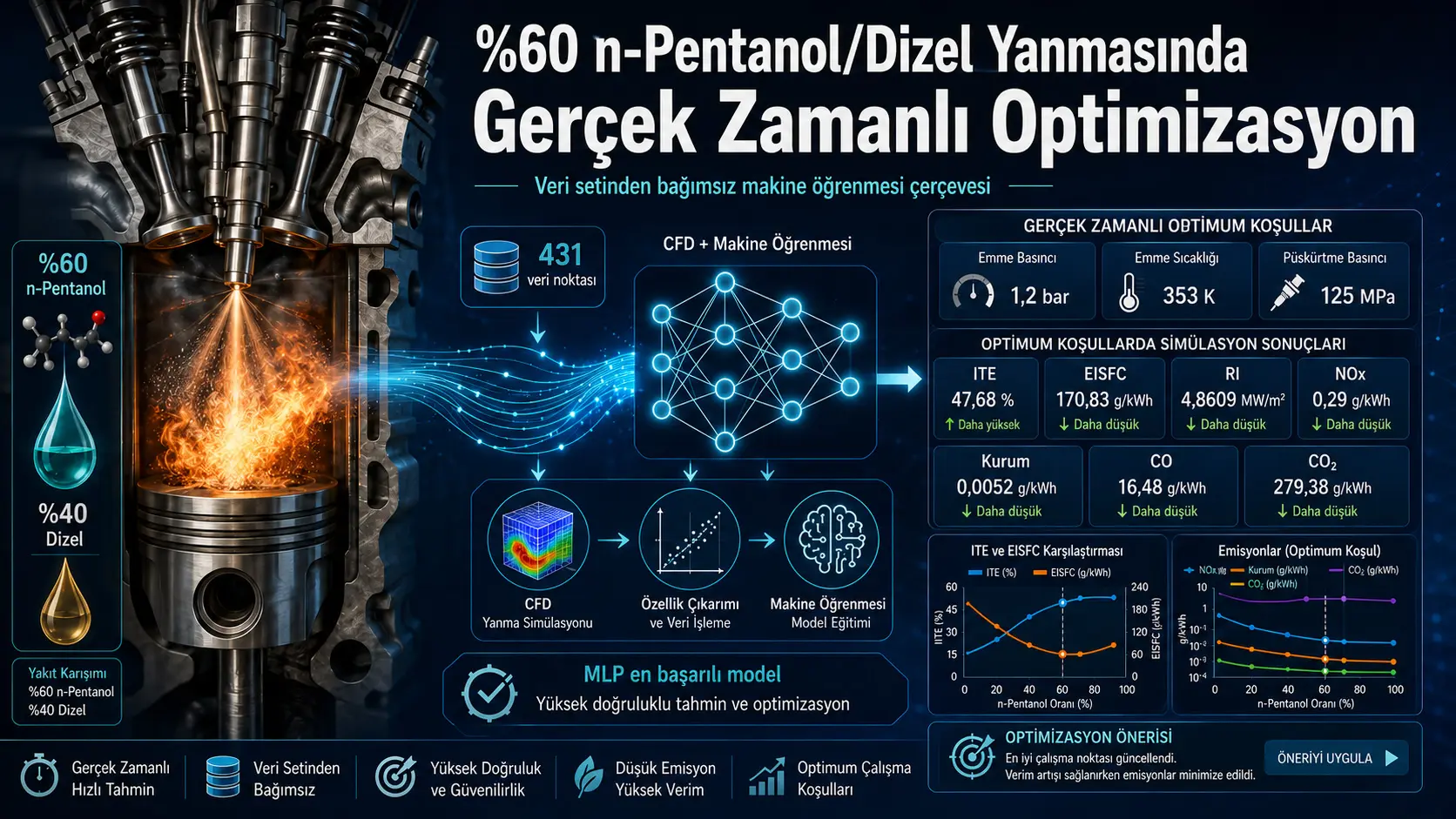
Ин таҳқиқот як machine-learning framework-и аз dataset мустақилро таҳия кардааст, то performance, combustion intensity ва exhaust emissions-и compression-ignition engine-и бо mixture-и %60 n-pentanol ва %40 diesel коркунанда аз се engine-control variable пешгӯӣ кунад. Дар таҳқиқот 431 data sample, ки бо validated three-dimensional computational fluid dynamics model тавлид шудаанд, истифода шуданд; аз intake pressure, intake temperature ва injection pressure indicated thermal efficiency, equivalent indicated specific fuel consumption, ringing intensity, NOx, soot, CO ва CO2 пешгӯӣ шуданд. Multilayer perceptron neural network дар маҷмӯъ successful model буд, дар ҳоле ки support vector machine барои ringing intensity ва NOx дар баъзе metrics бартарии хурд нишон дод. Бо вуҷуди ин, study аз peer review нагузаштааст; training data аз new independent engine experiments не, балки аз previously validated CFD model тавлид шудаанд ва generalizability-и system дар different independent datasets бевосита нишон дода нашудааст.
Панҷ supervised-learning model муқоиса шуданд: multilayer perceptron (MLP), random forest (RF), extreme gradient boosting (XGBoost), support vector machine (SVM) ва k-nearest neighbors (KNN). %80-и data samples барои training, %20 барои test ҷудо шуданд; scaler танҳо ба training data fit карда шуд, то data leakage кам шавад.
MLP model дар indicated thermal efficiency ба R² = 0,9491, дар equivalent indicated specific fuel consumption ба R² = 0,9439, дар soot ба R² = 0,9513, дар CO ба R² = 0,9612 ва дар CO2 ба R² = 0,8983 расид. Барои ringing intensity R²-и SVM 0,8959 ва MLP 0,8953 буд. Барои NOx SVM бо R² = 0,8856 аз MLP value-и 0,8791 каме баландтар монд.
Input conditions, ки дар study ҳамчун optimum пешниҳод шудаанд, 1,2 bar intake pressure, 353 K intake temperature ва 125 MPa injection pressure мебошанд. Дар ин point CFD simulation %47,68 indicated thermal efficiency, 170,83 g/kWh equivalent indicated specific fuel consumption, 4,8609 MW/m² ringing intensity, 0,29 g/kWh NOx, 0,0052 g/kWh soot, 16,48 g/kWh CO ва 279,38 g/kWh CO2 дод. MLP predictions барои efficiency, fuel consumption, CO ва CO2 ба simulation хеле наздик буданд, дар ҳоле ки differences барои NOx ва ringing intensity калонтар буданд.
Python/Django interface-и таҳияшуда ба users имкон медиҳад CSV ё XLSX files upload кунанд, input ва target columns интихоб кунанд, models-ро retrain кунанд, R², MAE ва RMSE results-ро бинанд ва барои specified engine conditions instant prediction тавлид кунанд. Ифодаи “real-time” дар ин ҷо маънои fast prediction by trained model дорад; study closed-loop real-time engine control connected to engine control unit-ро нишон намедиҳад.
Саволи асосии таҳқиқот чист?
Саволи асосии таҳқиқот ин аст, ки performance ва emissions-и engine-и low-load бо high-ratio n-pentanol/diesel mixture containing %60 n-pentanol метавонад бе time-consuming new experiments ё repeated CFD calculations for every operating point бо adequate accuracy predicted шавад ё не.
Study specifically ба questions-и зерин ҷавоб меҷӯяд:
- Оё seven engine outputs-ро simultaneously бо intake pressure, intake temperature ва injection pressure пешгӯӣ кардан мумкин аст?
- Аз панҷ different machine-learning algorithms кадомаш overall best result медиҳад?
- Оё trained model метавонад ҳамчун faster surrogate model ба ҷойи CFD истифода шавад?
- Оё interface сохтан мумкин аст, ки data ва target columns hard-coded набошанд ва different researchers own datasets-ро upload карда тавонанд?
- Оё дар specified engine conditions efficiency, consumption, ringing ва emissions together дар acceptable levels нигоҳ дошта мешаванд?
Чаро study муҳим аст?
Intake pressure, intake temperature, injection pressure, injection timing, load ва fuel composition-и compression-ignition engine many interdependent variables эҷод мекунанд. Measuring every combination experimentally requires engine to reach steady state, recording fuel consumption and pressure data, and analyzing exhaust samples. High-resolution CFD simulations низ ба сабаби combustion chemistry, spray breakup ва emission models significant computation time талаб мекунанд.
Machine learning relationship дар pre-generated dataset-ро learned карда, outcome-и new input combination-ро much faster ҳисоб карда метавонад. Ин approach aims not to replace physical engine or CFD model, but to build surrogate model operating within previously validated data domain.
Чаро n-pentanol омӯхта шудааст?
n-Pentanol oxygenated higher alcohol аст, ки бо diesel miscible мебошад. Дар introduction-и study гуфта мешавад, ки energy density-и n-pentanol нисбат ба lower alcohols мисли ethanol ва butanol ба diesel fuel наздиктар аст, бо diesel хуб mixing мешавад ва нисбат ба phase separation during storage relatively resistant аст.
Presence of oxygen in fuel molecule ҳамчун property considered мешавад, ки метавонад soot formation дар fuel-rich regions-ро кам кунад. Аммо high n-pentanol ratios ҳам ignition behavior, evaporation, cylinder pressure rise ва fuel consumption-ро тағйир дода метавонанд. Аз ин рӯ improving single output кофӣ нест; efficiency, consumption, combustion intensity ва different emissions бояд together evaluated шаванд.
Кадом literature gap ҳадаф гирифта шудааст?
Мувофиқи literature review-и paper, although machine-learning applications exist for lower n-pentanol ratios or other biofuel blends, comprehensive modeling of P60D40 mixture containing %60 n-pentanol under low-load conditions by simultaneously varying intake pressure, intake temperature and injection pressure is limited.
Researchers two main gaps-ро defined карданд:
- Lack of broad low-load dataset for %60 n-pentanol mixture including three control variables and seven engine outputs together.
- Lack of real-time decision-support interface not tied to a single fixed dataset, offering model training, comparison, prediction and data export in same environment.
Гарчанде дар як section-и paper phrase “six machine-learning models” истифода шудааст, methods, tables, graphs ва software interface only five models-ро define мекунанд. Name, hyperparameter or result of sixth algorithm given нашудааст. Аз ин рӯ study effectively five models compare кардааст.
CFD dataset чӣ гуна сохта шуд?
Training data for machine-learning models directly from new engine test campaign не, балки аз three-dimensional CFD model created with CONVERGE v3.0 obtained шуданд. Model four-cylinder, four-stroke, electronically controlled diesel engine-ро represents мекунад.
Барои reduce computational cost, 45-degree sector of combustion chamber modeled шуд. Base cell size 3 mm set шуд ва second-level adaptive mesh refinement around injector nozzle applied шуд.
| Physical process | Model or approach used |
|---|---|
| Turbulence | RNG k-ε model |
| Spray breakup | Kelvin-Helmholtz-Rayleigh-Taylor (KH-RT) model |
| Combustion chemistry | SAGE detailed chemistry solver |
| Fuel chemistry | Reduced n-pentanol/n-dodecane mechanism with 75 species and 367 reactions |
| Diesel-fuel surrogate | n-Dodecane |
| NOx formation | Extended Zeldovich model |
| Soot formation | Hiroyasu model |
Authors report that CFD model showed good agreement with experimental data in previous work. However, current paper does not present a new experimental validation graph or new raw engine-test data; it refers to previous validation. Therefore machine-learning accuracy is not independent of accuracy of underlying CFD model.
Engine дар кадом conditions operated шуд?
Data generation was performed under low-load condition:
- Engine speed: 1.500 rpm
- Indicated mean effective pressure: approximately 3,8 bar
- Total fuel energy: 400 J per cycle
- Exhaust-gas recirculation: %0
- Intake-pressure range: 1,1-1,4 bar
- Intake-temperature range: 343-353 K
- Injection-pressure range: 75-125 MPa
Keeping fuel energy per cycle constant at 400 J aimed to compare different input conditions at same approximate engine load. EGR was kept at %0 so effect of intake thermodynamics would not be confounded with exhaust-gas dilution.
Inputs ва target outputs кадомҳоянд?
| Type | Variable | Unit or meaning |
|---|---|---|
| Input | Intake pressure | bar |
| Input | Intake temperature | K |
| Input | Injection pressure | MPa |
| Output | Indicated thermal efficiency (ITE) | % |
| Output | Equivalent indicated specific fuel consumption (EISFC) | g/kWh |
| Output | Ringing intensity (RI) | MW/m² |
| Output | Nitrogen oxides (NOx) | g/kWh |
| Output | Soot | g/kWh |
| Output | Carbon monoxide (CO) | g/kWh |
| Output | Carbon dioxide (CO2) | g/kWh |
Ringing intensity represents acoustic and mechanical combustion severity associated with very rapid rise in in-cylinder pressure. Higher RI value indicates harsher and potentially riskier combustion behavior.
Кадом operating points аз dataset хориҷ шуданд?
During creation of machine-learning dataset, operating points exceeding following limits were excluded:
- EISFC > 240 g/kWh
- NOx > 0,4 g/kWh
- Soot > 0,01 g/kWh
- RI > 8 MW/m²
Ин filtering models-ро ба predefined feasible region focused кард rather than operating points considered technically unacceptable. However, this creates important interpretation limit: model may not have learned high-emission or severe-combustion conditions outside filtered limits. Therefore prediction reliability for inputs beyond safe operating region was not demonstrated.
Дар data-record screen-и interface, баъзе samples above 8 MW/m² or 0,4 g/kWh NOx visible мебошанд. It is not explained whether this screen represents filtered P60D40 training dataset or different example file used to demonstrate software data-upload function.
Machine-learning-CFD workflow чӣ гуна constructed шуд?
First figure of study shows five-stage workflow:
- Defining limits for intake pressure, intake temperature and injection pressure.
- Running these input combinations with CFD to generate engine outputs.
- Training MLP, RF, XGBoost, SVM and KNN models with CFD dataset.
- Comparing predictions with CFD results using R², MAE and RMSE.
- Producing instant engine-performance and emission predictions with selected model and interface.
Figure includes phrase genetic algorithm in generation of initial operating points. However, genetic algorithm population size, objective function, crossover, mutation or stopping criteria are not described in methods. Therefore exact way genetic algorithm selected data points is not reproducibly specified.
Multilayer perceptron neural network чӣ гуна works?
MLP learns nonlinear relationships in seven engine outputs by passing three engine inputs through interconnected hidden layers. Output of a neuron is given in study as:
\[ MLP = \phi\left(\sum_{j=1}^{n} w_jx_j+b\right) \]
\[ \phi(x)=\max(0,x) \]
Дар ин ҷо xj input variable, wj learned weight, b bias term and φ rectified linear unit (ReLU) activation мебошанд. ReLU converts negative values to zero while retaining positive values.
Study used 100 neurons in each of two hidden layers. Model allowed maximum 2.000 iterations and random seed set to 42.
Random-forest model чӣ гуна prediction тавлид мекунад?
Random forest builds many decision trees using different sample and variable subsets of same dataset. Regression prediction is obtained by averaging tree outputs:
\[ \hat{y}=\frac{1}{M}\sum_{m=1}^{M}T_m(x) \]
M is total number of decision trees and Tm(x) is prediction generated by m-th tree for input x. Study used 100 trees. At least one sample per leaf, at least two samples for split and bootstrap sampling were selected.
XGBoost model чӣ гуна works?
XGBoost adds decision trees sequentially rather than independently. Each new tree attempts to reduce errors of previous trees. Objective function given as:
\[ L = l(y,\hat{y})+\sum_{k=1}^{K}\Omega(f_k) \]
l(y,\hat{y}) represents loss between actual and predicted value, while Ω(fk) is regularization term penalizing complexity of k-th tree. Thus model aims not only to reduce training error but also avoid unnecessary complexity.
Study used squared-error regression objective, learning rate 0,3 and 100 trees.
Support vector machine чӣ гуна used шуд?
SVM constructs regression surface approximating relationship between inputs and target outputs within specified error tolerance. For linear kernel, paper gives basic relation:
\[ F(X_i,X_j)=X_i\cdot X_j \]
Xi and Xj are input vectors. However, actual model used radial basis function (RBF) kernel instead of linear kernel. RBF kernel can represent nonlinear engine behavior.
For SVM, C = 1, ε = 0,1 and gamma = “scale”.
K-nearest-neighbor prediction чӣ гуна performed шуд?
KNN compares new engine condition with most similar operating points in training data and uses weighted average of neighbor outputs:
\[ \hat{y}_i=\sum_{j=1}^{k}w_{ij}y_{ij} \]
\[ \sum_{j=1}^{k}w_{ij}=1 \]
yij is observed output at j-th nearest neighbor of i-th new example, and wij is weight assigned to that neighbor. Study selected k = 5 and leaf size 30.
Model training чӣ гуна performed шуд?
Of total 431 data samples, %80 randomly assigned to training and %20 to test. This corresponds approximately to 345 training and 86 test samples; PDF does not provide exact integer split separately.
Scales of input and target variables differ considerably. For example, intake pressure is in range 1,1-1,4, injection pressure in range 75-125 MPa, while soot is at thousandths level. To prevent scale differences from directing learning, all inputs and targets were standardized.
Fitting scaler only on training data aims to prevent mean or standard-deviation information of test data from leaking into training stage.
Hyperparameters кадомҳоянд?
| Model | Hyperparameter | Value |
|---|---|---|
| RF | Number of trees | 100 |
| RF | random_state | 42 |
| RF | min_samples_split | 2 |
| RF | min_samples_leaf | 1 |
| RF | bootstrap | True |
| XGBoost | Objective | reg:squarederror |
| XGBoost | Learning rate | 0,3 |
| XGBoost | Number of trees | 100 |
| MLP | Hidden-layer sizes | (100, 100) |
| MLP | Maximum iterations | 2.000 |
| MLP | Activation | ReLU |
| MLP | random_state | 42 |
| KNN | Number of neighbors | 5 |
| KNN | Leaf size | 30 |
| SVM | Kernel | RBF |
| SVM | ε | 0,1 |
| SVM | C | 1 |
| SVM | Gamma | scale |
Paper states hyperparameters were “carefully tuned,” but does not present comprehensive grid search, random search, Bayesian optimization or cross-validation results. Many parameters were left at default values. Therefore model comparison is more a comparison of selected configurations than absolute best structure attainable by each algorithm.
R², MAE ва RMSE чиро measure мекунанд?
Model performance бо се metric арзёбӣ шуд.
Coefficient of determination
Дар PDF Equation 6 чунин typeset шудааст:
\[ R^2=1-\frac{\sum_{k=1}^{N}(y_k-\hat{y}_k)}{\sum_{k=1}^{N}(y_k-\bar{y})} \]
Typesetting warning: Дар printed equation squares of differences намоён нестанд. Ин form бо standard R² definition described in text мувофиқ нест. Барои explain logic of study, standard relation should be considered as:
\[ R^2=1-\frac{\sum_{k=1}^{N}(y_k-\hat{y}_k)^2}{\sum_{k=1}^{N}(y_k-\bar{y})^2} \]
yk actual value, ŷk model prediction, ȳ mean of actual values and N sample count мебошанд. R² approaching 1 indicates model explains larger portion of data variability.
Mean absolute error
\[ MAE=\frac{1}{n}\sum_{k=1}^{n}|y_k-\hat{y}_k| \]
MAE averages absolute magnitude of all prediction errors. MAE has same unit as target variable.
Root mean square error
Дар PDF Equation 8 чунин appears:
\[ RMSE=\sqrt{\frac{1}{N}(y_k-\hat{y}_k)^2} \]
Typesetting warning: Summation symbol over samples is not visible in equation. To explain RMSE definition in text, standard form is:
\[ RMSE=\sqrt{\frac{1}{N}\sum_{k=1}^{N}(y_k-\hat{y}_k)^2} \]
Because errors are squared, RMSE penalizes large errors more strongly than MAE.
Кадом model most successful буд?
MLP highest R² value in five of seven targets gave. SVM, however, provided small advantage in some metrics for ringing intensity and NOx.
| Target | Model with highest R² | R² | MAE | RMSE |
|---|---|---|---|---|
| ITE | MLP | 0,9491 | 0,0750 | 0,0970 |
| EISFC | MLP | 0,9439 | 0,2895 | 0,3763 |
| RI | SVM | 0,8959 | 0,7376 | 1,1006 |
| NOx | SVM | 0,8856 | 0,0374 | 0,0604 |
| Soot | MLP | 0,9513 | 0,0002 | 0,0002 |
| CO | MLP | 0,9612 | 0,5269 | 0,7425 |
| CO2 | MLP | 0,8983 | 1,5484 | 2,1746 |
For RI, SVM R² and RMSE values are slightly better than MLP, but MLP MAE value 0,7106 is lower than SVM's 0,7376. Therefore which model is “best” for RI depends on selected metric.
For NOx, SVM performed better than MLP on all three metrics: R² 0,8856 versus 0,8791, MAE 0,0374 versus 0,0398, and RMSE 0,0604 versus 0,0621.
Other models чӣ гуна performed карданд?
| Model | ITE R² | EISFC R² | RI R² | NOx R² | Soot R² | CO R² | CO2 R² |
|---|---|---|---|---|---|---|---|
| RF | 0,9263 | 0,9273 | 0,8231 | 0,8032 | 0,9117 | 0,9465 | 0,8772 |
| XGBoost | 0,9009 | 0,9041 | 0,8331 | 0,8210 | 0,9315 | 0,9481 | 0,8600 |
| MLP | 0,9491 | 0,9439 | 0,8953 | 0,8791 | 0,9513 | 0,9612 | 0,8983 |
| KNN | 0,8914 | 0,8910 | 0,8476 | 0,8550 | 0,9412 | 0,9446 | 0,8718 |
| SVM | 0,9327 | 0,9323 | 0,8959 | 0,8856 | 0,9305 | 0,9340 | 0,8966 |
Random forest gave strong results in efficiency and consumption, but lagged behind MLP and SVM in NOx prediction with R² = 0,8032. XGBoost was strong for soot and CO but did not exceed MLP. KNN efficiency and consumption R² values remained around 0,89; researchers considered its overall prediction capability more limited than other models.
Prediction-actual graphs кадом trends-ро нишон медиҳанд?
In seven prediction-actual plots for MLP, ideal prediction is represented by points clustering on 45-degree line. Indicated thermal efficiency, fuel consumption, soot and CO points cluster relatively tightly around this line.
In ringing-intensity and NOx plots, scatter increases especially at high actual values. This visual trend is consistent with these two variables having lower R² and higher relative errors.
In CO2 plot, overall linear trend is preserved but some low-valued examples deviate more from prediction line. It is not explained whether red shaded bands in plots are statistically confidence intervals, prediction intervals or only regression visualization.
Web interface чӣ гуна works?
Study developed web-based graphical user interface with Python and Django. System architecture includes following workflow:
- User authentication.
- If administrator privileges exist, create, update or view user accounts.
- Upload, view or delete CSV or XLSX dataset.
- Dynamically read input features and target columns.
- Allow user to choose training-test ratio.
- Retrain five machine-learning models.
- Calculate R², MAE and RMSE results.
- Load prediction-actual graphs.
- Produce instant prediction for specified inputs.
- Export results as CSV file.
Upload system accepts .csv and .xlsx formats and limits file size to 10 MB. User can preview uploaded dataset as table, view error metrics of models and export result plots.
“Dataset-agnostic” чӣ маъно дорад?
Framework being dataset-agnostic means software is not hardwired only to P60D40 data columns. When user uploads new file, system can dynamically read columns, select input and target fields and retrain models.
However, prediction accuracy in paper was measured only on single P60D40 dataset with 431 samples. No comparative generalization experiment with independent datasets from different engine, fuel, load, sensors or institutions was presented. Therefore “dataset agnosticism” refers more to flexibility of software architecture than validated universal model accuracy.
Security ва user authorization чӣ гуна handled шуд?
System includes authentication mechanism requiring verified users to log in. Only administrators can manage user accounts. Logged-in researchers are directed to analysis panel and can perform dataset operations.
However, paper provides no technical security testing regarding password-storage method, encryption, access logging, penetration testing, role-based permission matrix or data-privacy audit. Label “secure” is based on presence of login authentication and administrator authorization in interface.
Optimum operating point чӣ гуна determined шуд?
Engine inputs presented as optimum in model-optimization interface are:
- Intake pressure: 1,2 bar
- Intake temperature: 353 K
- Injection pressure: 125 MPa
Under this condition, CFD simulation and predictions of five models are:
| Target output | CFD simulation | RF | MLP | SVM | XGBoost | KNN |
|---|---|---|---|---|---|---|
| ITE (%) | 47,68 | 47,6003 | 47,6622 | 47,4706 | 47,5978 | 47,5220 |
| EISFC (g/kWh) | 170,83 | 171,1014 | 171,0043 | 171,5918 | 170,9177 | 171,3840 |
| RI (MW/m²) | 4,8609 | 5,2923 | 5,2824 | 5,2817 | 5,9876 | 5,0680 |
| NOx (g/kWh) | 0,29 | 0,2477 | 0,2309 | 0,2103 | 0,2448 | 0,2100 |
| Soot (g/kWh) | 0,0052 | 0,0052 | 0,0054 | 0,0053 | 0,0056 | 0,0054 |
| CO (g/kWh) | 16,48 | 16,9377 | 16,6609 | 17,3225 | 17,4381 | 17,5120 |
| CO2 (g/kWh) | 279,38 | 279,1731 | 279,1059 | 277,5332 | 280,3731 | 277,6280 |
Дар this operating point MLP ба CFD чӣ қадар наздик буд?
| Target | MLP-CFD absolute difference | Approximate relative difference versus CFD |
|---|---|---|
| ITE | 0,0178 percentage points | %0,04 |
| EISFC | 0,1743 g/kWh | %0,10 |
| RI | 0,4215 MW/m² | %8,67 |
| NOx | 0,0591 g/kWh | %20,38 |
| Soot | 0,0002 g/kWh | %3,85 |
| CO | 0,1809 g/kWh | %1,10 |
| CO2 | 0,2741 g/kWh | %0,10 |
Comparison shows MLP predicted ITE, EISFC, CO and CO2 very close to CFD. Although absolute difference in soot is very small, because baseline value is also very small relative difference is approximately %3,85.
RI was overpredicted by approximately %8,67, while NOx underpredicted by approximately %20,38. Therefore it cannot be said model works with “%1-2 deviation for all outputs.”
Conclusion states ITE, EISFC, soot, CO and CO2 predictions agree within %1-2. According to Table 5, differences for ITE, EISFC and CO2 are far below %1, CO is about %1,10, but relative difference for soot is approximately %3,85. Therefore there is small inconsistency between textual generalization and table's soot value.
Radar graph чӣ нишон медиҳад?
In radar graph of model performance under same operating condition, simulation, MLP, RF, SVM, XGBoost and KNN are compared on same seven axes. MLP curve appears close to simulation shape on ITE, EISFC, soot, CO and CO2 axes.
Separation among models is more pronounced on NOx and RI axes. However, because each axis in radar graph uses different units and scales, polygon area alone should not be interpreted as overall performance metric. Numeric table and separate error metrics provide more reliable comparison.
Фарқи results of previous study ва current model
Abstract includes statements of %47,68 ITE, %98,76 NOx reduction and Euro VI compliance. However, current paper does not provide baseline diesel comparison table recalculating %98,76 NOx reduction. These values are reported as findings from authors’ previous P60D40 optimization study.
Direct contribution of current study is converting previously generated CFD data domain into machine-learning models and providing fast predictions in web interface. Therefore emission reduction from previous study should not be presented as independent experimental emission success of current machine-learning model.
Also, exclusion of operating points exceeding Euro VI or practical limits during dataset construction leaves prediction region composed of compliant conditions. This method by itself does not prove engine meets Euro VI standard under all possible conditions.
Strengths-и таҳқиқот кадоманд?
- Predicts seven engine outputs from three control variables in same framework.
- Compares five algorithms spanning neural-network, tree-based, kernel-based and neighborhood-based methods.
- States scaler was fit only to training data to reduce data leakage.
- Evaluates model results with MAE and RMSE as well as R².
- Directly compares CFD and model predictions at same operating point.
- Combines data upload, model training, graph viewing and CSV export in one web interface.
- Software designed to read input and target columns dynamically.
- Study openly reports cases where SVM outperformed MLP for RI and NOx despite overall MLP superiority.
Limitations-и таҳқиқот кадоманд?
- Study is preprint not peer reviewed.
- Machine-learning data were generated from CFD simulations, not new independent engine experiments.
- Details of CFD validation are not shown again in current paper; readers are referred to previous work.
- Dataset contains only 431 samples.
- Study covers only 1.500 rpm, approximately 3,8 bar IMEP and low-load condition.
- EGR is only %0; different EGR ratios were not learned.
- Fuel composition is fixed P60D40; model not validated at different n-pentanol ratios.
- Besides three input variables, injection timing, number of injections, load and engine speed are not model inputs.
- Prediction reliability for input combinations outside data domain was not evaluated.
- Removing unsuitable operating points from training may reduce model's ability to recognize out-of-bound conditions.
- Only single random %80-%20 split was used; no k-fold cross-validation or multiple random split results were given.
- Extent of hyperparameter search was not presented in detail.
- Model uncertainty, prediction intervals or confidence bounds were not quantitatively reported.
- Dataset-agnostic performance was not validated with external datasets from different research groups.
- No real engine-control unit, sensor stream, hardware loop or closed-loop control experiment was conducted.
- NOx and RI predictions showed larger relative differences than other outputs at optimum point.
- Printed R² and RMSE equations contain mathematical typesetting omissions.
- Text says six models in one place although only five are presented.
Натиҷаҳое, ки study дастгирӣ мекунад
- Within selected P60D40 CFD data domain, five machine-learning models predicted seven engine outputs with usable accuracy.
- MLP was overall strongest model with highest R² and low error for most targets.
- SVM outperformed MLP in NOx prediction.
- At 1,2 bar, 353 K and 125 MPa, MLP produced predictions close to CFD for ITE, EISFC, CO and CO2.
- After training, machine-learning model can produce predictions faster than running new CFD.
- Python/Django interface combines data upload, retraining, model comparison and result export functions.
Натиҷаҳое, ки study исбот намекунад
- It has not been shown that model is valid for all compression-ignition engines.
- It has not been proven framework maintains same accuracy for all fuel blends.
- No closed-loop optimization was performed on real-time engine-control unit.
- Machine-learning model does not completely eliminate need for physical experiment or CFD.
- It has not been shown model gives safe predictions outside training range.
- It has not been proven %60 n-pentanol is more efficient or cleaner than diesel at all loads and speeds.
- Current study alone did not independently reconfirm %98,76 NOx reduction.
- Filtered dataset does not show engine meets Euro VI under every possible operating condition.
- User login in web interface does not mean comprehensive cybersecurity validation.
Possible future impact чист?
Such surrogate models could allow rapid screening of thousands of possible operating points during alternative-fuel development. Most promising regions could then be verified with high-resolution CFD or engine tests. Thus costly experiments may be used more selectively rather than distributed equally over entire design space.
Study's own future plan is to expand dataset to include higher-load conditions and add automatic optimization algorithms to interface. In addition, including different engine speed, EGR ratio, injection timing, multiple-injection strategy and different n-pentanol ratios could create more comprehensive calibration tool.
For transition to real application, model needs testing with independent engine experiments, datasets from different research institutions, uncertainty analysis and online tests with engine-control hardware.
Усул ва натиҷаҳои таҳқиқот
Technical-method summary
| Technical element | Applied method |
|---|---|
| Fuel | %60 n-pentanol/%40 diesel; n-dodecane as diesel surrogate in CFD |
| Engine | Four-cylinder, four-stroke, electronically controlled compression-ignition engine |
| Operating condition | 1.500 rpm, approximately 3,8 bar IMEP, low load |
| Fuel energy | 400 J/cycle |
| EGR | %0 |
| CFD software | CONVERGE v3.0 |
| Geometry | 45° combustion-chamber sector model |
| Base mesh size | 3 mm |
| Nozzle mesh refinement | Level 2 adaptive refinement |
| Chemical mechanism | 75 species, 367 reactions |
| Inputs | Intake pressure, intake temperature, injection pressure |
| Targets | ITE, EISFC, RI, NOx, soot, CO, CO2 |
| Number of data | 431 samples |
| Training-test split | %80-%20 random hold-out |
| Models | MLP, RF, XGBoost, SVM, KNN |
| Evaluation | R², MAE, RMSE |
| Interface | Python/Django web application |
| File support | CSV and XLSX, maximum 10 MB |
Summary of main findings
| Finding | Numerical result | Interpretation limit |
|---|---|---|
| ITE prediction | MLP R² = 0,9491 | Only for current low-load CFD data domain |
| EISFC prediction | MLP R² = 0,9439 | Different loads not tested |
| RI prediction | SVM R² = 0,8959; MLP R² = 0,8953 | At optimum point MLP overpredicted by approximately %8,67 |
| NOx prediction | SVM R² = 0,8856 | At optimum point all models underpredicted CFD NOx |
| Soot prediction | MLP R² = 0,9513 | Very small absolute values can magnify relative error |
| CO prediction | MLP R² = 0,9612 | Highest R² result in study |
| CO2 prediction | MLP R² = 0,8983 | Lower explanatory power than other strong targets |
| Optimum input | 1,2 bar, 353 K, 125 MPa | Details of automatic multiobjective optimization not given |
| MLP outputs closest to CFD | ITE, EISFC, CO and CO2 | RI and NOx differences are larger |
| Software framework | Dynamic data upload and retraining | Accuracy not tested with external datasets |
When technical results are considered together, MLP stands out as most balanced model for overall engine performance and emission prediction. However, using same algorithm for all targets is not mandatory. Target-specific model selection, such as SVM for NOx and MLP for soot and CO, may be more accurate.
Ёддошт оид ба манбаъ ва усул
Номи пурраи аслии таҳқиқот: A dataset-agnostic machine learning framework for real-time optimization of 60% n-Pentanol/diesel combustion in compression ignition engines
Муаллифон ва тартиби онҳо дар PDF: Sunday B. Ogunjide; Wenjun Zhong; Omolayo Abegunde; Tamilselvan Pachiannan; Oluropo F. Dairo; Sunday A. Salimon; Olubunmi F. Atilola; Zhixia He; Qian Wang.
Equal first author ё equal contribution: Дар PDF нишон дода нашудааст.
Corresponding author: Wenjun Zhong.
Institutional affiliations:
- School of Energy and Power Engineering, Jiangsu University, Zhenjiang 212013, China.
- Department of Electrical and Electronic Engineering, Redeemer’s University, Ede 232102, Nigeria.
- Department of Computer Engineering, Redeemer’s University, Ede 232102, Nigeria.
- Hangzhou International Innovation Institute, Beihang University, Hangzhou 311115, China.
- Institute for Energy Research, Jiangsu University, Zhenjiang 212013, China.
Author–institution mappings: Sunday B. Ogunjide: Jiangsu University and Redeemer’s University; Wenjun Zhong: Jiangsu University; Omolayo Abegunde: Redeemer’s University Department of Computer Engineering; Tamilselvan Pachiannan: Beihang University Hangzhou International Innovation Institute; Oluropo F. Dairo, Sunday A. Salimon and Olubunmi F. Atilola: Redeemer’s University; Zhixia He: Jiangsu University School of Energy and Power Engineering and Institute for Energy Research; Qian Wang: Jiangsu University.
DOI: 10.2139/ssrn.6945187
Journal: No peer-reviewed journal name or acceptance information is stated in this PDF version.
Publication platform: SSRN.
Original publisher: Peer-reviewed journal publisher information has not been verified. SSRN is Elsevier’s preprint platform; this does not mean publication in a journal.
Document year: 2026. Exact official SSRN submission day could not be verified from PDF.
Peer-review status: This study is a preprint and has not undergone peer review.
Source type: Preprint research article developing machine-learning comparison, optimization and web-based decision-support software on CFD-generated data.
Official SSRN link:https://papers.ssrn.com/sol3/papers.cfm?abstract_id=6945187
DOI link:https://doi.org/10.2139/ssrn.6945187
Ин мақолаи туркӣ бо баррасии text, equations, tables, model graphs, flow diagrams ва software-interface images-и PDF-и 32-саҳифагии боршуда омода шудааст. Аз берун аз PDF ягон new engine experiment, emission result, clinical or commercial success claim илова нашудааст. External verification only for bibliographic check of DOI, SSRN record, platform and peer-review status истифода шудааст.
Main methodological limitations are that training data were generated from CFD, focus on single engine-fuel-load domain, absence of external dataset validation, use of single training-test split, non-reporting of model uncertainty, and no demonstration of closed-loop control on real engine hardware.
Document-level inconsistencies to consider include text saying “six models” although only five are presented, typesetting omissions in R² and RMSE equations, and statement of %1-2 deviation in conclusion not fully matching soot prediction.
Preprint warning: This study is a preprint that has not undergone peer review; results should be read with this limitation in mind.
Шарҳ гузоред
Нишонии почтаи электронии шумо нашр намешавад. Майдонҳои ҳатмӣ бо * нишон дода шудаанд