

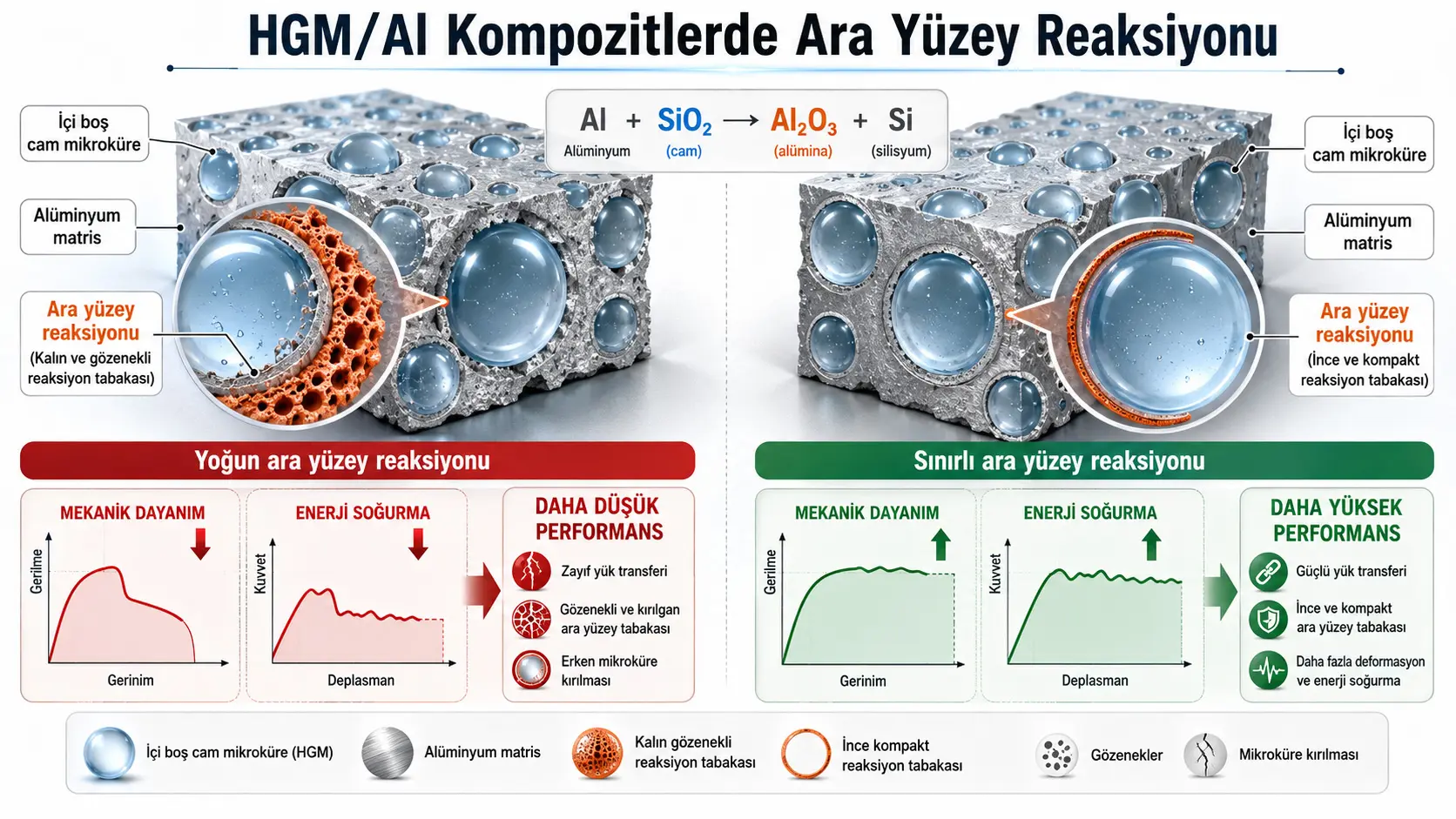
Utafiti huu unachunguza jinsi interfacial reactions zinazotokea wakati wa heat treatment katika aluminum-matrix syntactic foams zilizoimarishwa kwa hollow glass microspheres zinavyobadilisha mechanical strength, compressive deformation na energy-absorption capacity. Researchers waliweka same MZ40-type glass microspheres ndani ya ZL101, ZL104 na ZL102 Al-Si alloys zenye takriban %7, %9 na %12 silicon by mass kwa vacuum-pressure infiltration. Composites ziliwekwa kwanza katika annealing at 400 °C; sehemu yake baadaye ilifanyiwa solution treatment at 550 °C for 10 hours, water quenching na aging at 170 °C for 14 hours.
During solution treatment, aluminum ilireact na SiO2 katika microsphere shell na kuunda porous, loose reaction layer yenye predominantly γ-Al2O3. Katika HGM/ZL101-STA sample, full-reaction appearance ilionekana katika %70,1 ya large microspheres zilizochunguzwa; fraction hii ilikuwa %37,3 katika HGM/ZL104-STA na only %8,2 katika higher-silicon HGM/ZL102-STA. Results zinaonyesha interfacial reaction inakuwa kinetically suppressed kadiri silicon fraction ya matrix inavyoongezeka.
Intense reaction iliharibu load-bearing capacity ya glass microspheres. Katika HGM/ZL101 baada ya solution treatment na aging, peak compressive stress ilishuka kutoka 155,56 MPa hadi 151,32 MPa na plateau stress kutoka 113,64 MPa hadi 89,18 MPa. Specific energy absorption ilishuka kutoka 50,30 kJ/kg hadi 41,04 kJ/kg. HGM/ZL104 pia ilionyesha reduction sawa katika plateau stress na energy absorption.
Kinyume chake, katika HGM/ZL102-STA ambapo high silicon content ililimit reaction, heat treatment ilitoa positive result. Peak stress iliongezeka kutoka 194,32 MPa hadi 212,12 MPa, plateau stress kutoka 138,78 MPa hadi 151,87 MPa na specific energy absorption kutoka 57,82 kJ/kg hadi 63,89 kJ/kg. Hivyo benefit ya matrix hardening haikuzidiwa na reaction-induced weakening ya microsphere shell.
Digital image correlation results pia zilionyesha damage mode ilibadilika with reaction. Katika annealed HGM/ZL101, one large shear band oriented approximately 45° ilivuka specimen rapidly, wakati katika heavily reacted HGM/ZL101-STA many small and mutually independent shear bands ziliunda successively. Accordingly stress curve ilionyesha sawtooth-like gradual decline badala ya single sharp drop.
Kwa mtazamo wa Uturuki: Findings zinaweza kusaidia development ya low-density metallic syntactic foams kwa automotive crash elements, rail-system buffers, lightweight marine and aerospace structures, defense-oriented impact absorbers na machine-protection components nchini Uturuki. Ili method itumike Uturuki, chemical composition na crush strength ya local glass microspheres, actual silicon na magnesium content ya Al-Si alloy, infiltration homogeneity, reaction-layer thickness na heat-treatment window zinapaswa kuvalidateiwa separately. Bila dynamic impact, high-strain-rate, fatigue, thermal-cycling na real-component-scale tests, study hii haiwezi kutoa direct design values kwa specific vehicle, train, ship au protective structure.
Hollow glass microsphere/aluminum composite ni nini?
Hollow glass microsphere/aluminum composites ni metal-matrix syntactic foams ambapo many closed glass spheres zimedistributeiwa ndani ya aluminum au aluminum-alloy matrix. Katika conventional metal foams voids huunda irregular cells, wakati katika syntactic foams size na geometry ya voids zinadhibitiwa zaidi na microspheres zinazotumika.
Kwa sababu glass microspheres ni hollow, material density hupungua. Wakati huo huo sphere shells huvunjika wakati wa compression, surrounding metal matrix hudeform plastically na voids hufungwa progressively, hivyo consuming energy. Mechanism hii inaweza kuunda long na relatively stable compression plateau.
Average density ya composites zilizotumika katika study ilikuwa takriban 1,34–1,35 g/cm³. Microsphere volume fraction ilikuwa takriban %69,2–69,6 na total porosity takriban %51,2–51,5. Values hizi zinaonyesha large fraction ya material ni hollow microspheres na cavities zao.
Main research question
Solution treatment na aging katika aluminum alloys zinaweza kuongeza matrix strength. Hata hivyo shells za glass microspheres zina high proportion ya SiO2. Katika high temperature aluminum inaweza kureact na SiO2 na chemically transform microsphere shell.
Kwa hiyo main question ni: wakati metal matrix ina-strengthen kwa heat treatment, ikiwa glass microspheres zinaweak kutokana na interfacial reaction, overall mechanical na energy-absorption performance ya composite inabadilika kwa direction gani?
Researchers walichunguza balance hii kwa Al-Si alloys tatu zenye different silicon contents. Basic assumption ni kwamba matrix silicon content inapoongezeka, chemical driving force kwa diffusion ya reaction-released silicon toward matrix inapungua na hivyo interfacial reaction inakuwa slower.
Al-Si alloys zilizotumika
| Alloy | Si | Mg | Mn | Al | Density |
|---|---|---|---|---|---|
| ZL101 | %7,01 | %0,35 | Not reported | %91,49 | 2,68 g/cm³ |
| ZL104 | %9,16 | %0,31 | %0,21 | %90,16 | 2,67 g/cm³ |
| ZL102 | %12,31 | %0,01 | Not reported | %87,77 | 2,62 g/cm³ |
ZL101 na ZL104 ni hypoeutectic Al-Si alloys. Silicon content ya ZL102 iko closer to eutectic composition. Magnesium katika ZL101 na ZL104 huchangia precipitation hardening baada ya solution treatment na aging. Kwa sababu magnesium ni very low katika ZL102, strength response yake kwa heat treatment ni more limited.
Properties za MZ40 glass microspheres
| Property | Reported value |
|---|---|
| Bulk density | 0,77 g/cm³ |
| Median diameter | 13,6 µm |
| Average shell thickness | 0,65 µm |
| Internal porosity | %74 |
| Isostatic crush strength | 110 MPa |
| Softening temperature | Approximately 800 °C |
| SiO2 | Approximately %75 |
| CaO | Approximately %14 |
| Na2O | Approximately %10 |
To separate broken microspheres, flotation in deionized water ilitumika na intact microspheres zikakaushwa at 80 °C.
Preform iliandaliwaje?
Microspheres zilisinteriwa at 620 °C for 150 minutes bila applied pressure. SEM image kwenye page 3 inaonyesha spheres zimebondiwa kwa small sintering necks.
Bonds hizi zinalimit displacement ya microspheres dhidi ya drag forces zinazotokea during liquid-aluminum infiltration na kusaidia kupata more homogeneous structure.
Vacuum-pressure infiltration
Composites ziliandaliwa katika ZYQ250/250-10.1500 vacuum-pressure infiltration furnace. Main applied conditions zilikuwa:
| Process parameter | Value |
|---|---|
| Furnace vacuum | 7,5 Pa |
| Microsphere preform temperature | 600 °C |
| Al alloy melting temperature | 760 °C |
| Infiltration pressure | 5 MPa |
| Holding under pressure | 5 minutes |
| Billet diameter | 54 mm |
| Billet height | 100 mm |
Baada ya furnace ku-evacuateiwa na microsphere preform kuheated, high-pressure argon ilisukuma molten aluminum ndani ya mold na voids between microspheres. Samples zilichukuliwa kutoka region 50 mm away from infiltration inlet.
At least five parallel samples ziliandaliwa kwa kila composite na results averaged. Hata hivyo study haikutoa standard deviation au confidence interval kwa all table results.
Heat-treatment groups
| Condition | Annealing | Solution treatment | Aging |
|---|---|---|---|
| O condition | 400 °C, 6 hours; furnace cooling | Not applied | Not applied |
| STA condition | 400 °C, 6 hours; furnace cooling | 550 °C, 10 hours; water quenching | 170 °C, 14 hours; air cooling |
10-hour solution-treatment condition at 550 °C ilichaguliwa relatively severe ili kuunda distinct reaction layer. Kwa hiyo results zinaweza kutorepresent directly industrial heat-treatment schedules with shorter time or lower temperature.
Response ya matrix alloys kwa heat treatment
| Alloy condition | Yield strength | Tensile strength | Elongation at break |
|---|---|---|---|
| ZL101-O | 65,37 MPa | 132,92 MPa | %10,43 |
| ZL101-STA | 284,12 MPa | 319,06 MPa | %3,32 |
| ZL104-O | 66,51 MPa | 115,69 MPa | %13,91 |
| ZL104-STA | 276,75 MPa | 315,13 MPa | %4,47 |
| ZL102-O | 60,46 MPa | 113,67 MPa | %5,58 |
| ZL102-STA | 80,31 MPa | 157,81 MPa | %5,88 |
Yield strengths za ZL101 na ZL104 ziliongezeka more than threefold with aging. Kinyume chake elongation values zilipungua markedly. Researchers wanaeleza behavior hii kwa β″ na β′-type fine precipitates katika Mg-containing alloys kuzuia dislocation motion.
Kwa sababu ZL102 lacks Mg, precipitation hardening ilibaki limited; increase katika yield strength ilikuwa takriban %32,8. Spheroidization ya eutectic silicon ilipunguza stress concentration na kuchangia slight increase in elongation.
Composite density na microsphere fraction
Composite density ilipimwa kwa Archimedes method:
\[ \rho_{\mathrm{sf}}=\frac{m_1}{m_1-m_0}(\rho_0-\rho_1)+\rho_1 \]
Hapa m1 ni composite mass in air, m0 mass in liquid; ρ0 density ya liquid na ρ1 density ya air.
Microsphere volume fraction:
\[ V_{\mathrm{HGM}}=\frac{\rho_m-\rho_{\mathrm{sf}}}{\rho_m-\rho_{\mathrm{HGM}}} \]
na total porosity:
\[ V_p=P_0V_{\mathrm{HGM}} \]
zilihesabiwa kwa equations hizi.
| Composite | Density | HGM volume fraction | Total porosity |
|---|---|---|---|
| HGM/ZL101 | 1,35 g/cm³ | %69,63 | %51,52 |
| HGM/ZL104 | 1,35 g/cm³ | %69,47 | %51,42 |
| HGM/ZL102 | 1,34 g/cm³ | %69,19 | %51,20 |
Small differences katika density na microsphere volume among groups zinapunguza likelihood kwamba mechanical differences zinatokana only na porosity fraction.
Interfacial reaction
Main reaction kati ya aluminum na silica katika microsphere shell ilitolewa kama:
\[ 4\mathrm{Al}+3\mathrm{SiO}_2\rightarrow2\mathrm{Al}_2\mathrm{O}_3+3\mathrm{Si} \]
Reaction ilionyeshwa kwa separate equations kwa liquid na solid aluminum, lakini chemical stoichiometry ilibaki same. Aluminum inareduce SiO2; alumina na elemental silicon ambayo inaweza kudissolve au kuprecipitate katika matrix huundwa.
Calculated Gibbs free-energy changes kwa 400 °C na 550 °C zilikuwa respectively −533,44 na −501,95 kJ/mol. Negative values zinaonyesha reaction ni thermodynamically possible katika temperatures zote mbili. Hata hivyo actual reaction amount inaamuliwa na temperature, time na element diffusion rates.
Reaction product iliidentifyiwaje?
TEM image kwenye page 7 inaonyesha continuous reaction region takriban 2,3 µm thick katika HGM/ZL101-STA interface.
High-resolution TEM ilipima lattice spacings 0,198 nm na 0,140 nm; rings katika selected-area electron diffraction zilimatch (400) na (440) planes za cubic γ-Al2O3 phase.
Researchers wanasema layer si pure γ-Al2O3 pekee, bali mixture inayoundwa predominantly na phase hii na possibly small amounts of other phases.
Silicon content ilibadilishaje reaction?
| Composite | HGM showing full reaction in O condition | HGM showing full reaction in STA condition |
|---|---|---|
| HGM/ZL101 | %9,4 | %70,1 |
| HGM/ZL104 | %5,7 | %37,3 |
| HGM/ZL102 | %4,5 | %8,2 |
Reaction amount ilipungua continuously kadiri matrix silicon content ilivyoongezeka. Kulingana na researchers, silicon iliyoreleaseiwa na reaction inasafiri toward low-silicon aluminum matrix under stronger concentration gradient. Matrix ikiwa tayari ina high silicon, gradient hii na therefore reaction propagation rate hupungua.
It should be remembered kwamba “full reaction” fraction inawakilisha specific counting criterion ndani ya study. Counting ilifanywa at 200× magnification, 630×350 µm image area, kwa microspheres larger than 20 µm diameter na not invaded by aluminum. Results hazionyeshi directly complete three-dimensional reaction ya whole microsphere shell.
Growth ya reaction layer
EDS line scan katika HGM/ZL104 ilipima reaction layer approximately 60 nm katika annealed condition na approximately 1,2 µm katika STA condition.
| Criterion | 400 °C annealed condition | 550 °C solution-treated condition |
|---|---|---|
| Reaction layer | Approximately 60 nm | Approximately 1,2 µm |
| Farthest Al penetration into HGM | Approximately 0,5 µm | Approximately 1,3 µm |
| Interfacial gap | Locally approximately 90 nm | No pronounced separation observed |
| Layer morphology | Thin and more continuous | Thick, tortuous and nanoporous |
Effect ya temperature on diffusion imeelezwa kwa Arrhenius relation:
\[ D=D_0\exp\left(-\frac{Q}{RT}\right) \]
D ni diffusion coefficient, D0 pre-factor, Q activation energy, R gas constant na T absolute temperature. Temperature inapoongezeka, D grows exponentially.
Kwa diffusion-controlled growth ya reaction layer:
\[ \frac{dx}{dt}=\frac{k}{2x} \]
relation imetolewa. x ni reaction-layer thickness, t time na k parabolic rate constant. Layer inapothicken, inakuwa harder kwa Al atoms kufikia reaction front na instantaneous growth rate hupungua.
Kulingana na study interpretation, at 400 °C growth inalimitishwa mainly na slowness ya interfacial chemical reaction, while at 550 °C chemical barrier inakuwa weak na element diffusion becomes primary rate-controlling step.
Kwa nini nanopores huunda?
Pores approximately 30–90 nm in size ziliobserviwa katika reaction layer. Researchers wanaeleza pore formation kwa two combined mechanisms:
- Formation ya Kirkendall voids kwa sababu Al atoms zinadiffuse inward na reaction-generated Si atoms outward at different rates,
- Volume contraction wakati SiO2 na Al zinatransform kuwa reaction products with denser atomic packing.
Considering only formation ya γ-Al2O3 from SiO2, molar-volume contraction ilihesabiwa %13,6; considering all solid products %12,1.
Voids zinapunguza density ya reaction layer, kucreate local stress concentration na kufacilitate crack initiation during compression. At same time zinaweza kupunguza further reaction growth kwa kuunda physical barriers in front of advancing atoms.
Four stages za compression curves
- Elastic region: Stress increases approximately linearly up to about %3,2 strain.
- Initial stress drop: Stress decreases rapidly due to microsphere fracture na shear-band formation.
- Plateau region: Microspheres fracture progressively, metal matrix deforms plastically na structure carries load over long deformation range.
- Densification: After approximately %61 strain, voids close na stress rises rapidly.
Densification strain ya composites zote ni approximately %61. Main reason ni same microspheres, similar microsphere volume fraction na same manufacturing method.
Compression-strength results
| Composite | Density | Densification strain | Peak stress | Plateau stress |
|---|---|---|---|---|
| HGM/ZL101-O | 1,35 g/cm³ | %61,15 | 155,56 MPa | 113,64 MPa |
| HGM/ZL101-STA | 1,35 g/cm³ | %61,10 | 151,32 MPa | 89,18 MPa |
| HGM/ZL104-O | 1,35 g/cm³ | %61,40 | 196,85 MPa | 143,69 MPa |
| HGM/ZL104-STA | 1,35 g/cm³ | %61,00 | 185,31 MPa | 109,14 MPa |
| HGM/ZL102-O | 1,34 g/cm³ | %61,05 | 194,32 MPa | 138,78 MPa |
| HGM/ZL102-STA | 1,34 g/cm³ | %61,09 | 212,12 MPa | 151,87 MPa |
Kwa nini heat treatment iliweak ZL101 na ZL104 composites?
According to rule of mixtures, if microspheres had not been damaged, precipitation hardening ya matrix ingeweza kuongeza strengths za HGM/ZL101 na HGM/ZL104 composites by approximately %120,46 na %113,79 respectively.
In reality peak stress ya HGM/ZL101-STA decreased %2,7 na plateau stress %21,5. Katika HGM/ZL104-STA peak stress decreased %5,9 na plateau stress %24,0.
Result hii inaonyesha weakening ya microspheres by interfacial reaction ilikuwa dominant over hardening ya metal matrix. Particularly katika long plateau region, load-bearing capacity ni sensitive kwa successive fracture ya weakest microspheres.
Kwa nini ZL102 iliimprove?
Katika HGM/ZL102 high silicon content ililimit reaction kwa kiwango kikubwa. Therefore load-bearing capacity ya microsphere shells ilihifadhiwa na more limited solid-solution hardening ya matrix ikaweza kuonekana katika composite performance.
Katika HGM/ZL102-STA peak stress increased %9,2 na plateau stress %9,4. Theoretical increase calculated for matrix hardening ilikuwa %11,82. Measured increase approaching this estimate ina-support interpretation kwamba interfacial damage remained low.
“Strongest” na “weakest” microsphere control
Study inapendekeza peak na plateau stresses zinacontroliwa na different mechanisms.
Peak stress: strongest-microsphere control
Before first major shear band forms, low-strength microspheres zinaweza kufracture locally. Hata hivyo macroscopic shear band haiwezi kupropagate until microsphere with highest load-bearing capacity katika stress-concentration region fractures. Therefore peak stress proposed to be determined by “strongest microspheres”.
Plateau stress: weakest-microsphere control
During plateau, weak microspheres near existing shear band fracture successively, forming low-resistance path ambayo band inaweza kupropagate. Thus plateau stress partly depends on load-bearing capacity ya “weakest microspheres”.
Interpretation hii inatumika kueleza kwa nini plateau stress decreases much more than peak stress katika heavily reacted ZL101 na ZL104 composites. Mechanism inategemea not direct measurement ya individual microsphere forces, but combined interpretation ya SEM, DIC na macroscopic curves.
DIC images zilionyesha nini kuhusu damage mode?
Digital image correlation results kwenye page 15 zililinganisha HGM/ZL101-O na HGM/ZL101-STA.
Annealed HGM/ZL101-O
- Initially strain ilidistribute relatively uniformly over surface.
- At approximately %3 strain, single localization band about 45° to compression direction formed.
- After peak, band rapidly crossed specimen.
- Stress curve showed sharp step-like drop.
HGM/ZL101-STA
- From %1,8 strain onward, multiple local localization regions appeared near lower surface.
- After peak at approximately %2,4 these regions developed into independent small shear bands.
- Instead of one band suddenly crossing specimen, distributed progressive damage formed.
- Stress curve showed slower sawtooth-like decline.
Researchers wanaattribute change hii kwa reaction kutotokea to same extent in all microspheres, hivyo load capacities zao kudiverge. Microspheres with different degrees of weakening fracture at different load levels, so damage initiates in many small regions badala ya concentrating in single plane.
Fracture surfaces
Katika annealed HGM/ZL101, tearing ridges indicating plastic deformation zilionekana kwenye aluminum matrix. Broken microsphere edges zilikuwa smoother and more continuous, while some shells carried multiple cracks together with matrix.
Katika STA condition thick reaction layer became crack-initiation region. Microspheres fractured at lower stresses na successive damage developed in neighboring spheres. At same time ductility ya hardened matrix decreased; number of tearing ridges dropped na flat cleavage surfaces larger than 10 µm appeared in some regions.
Energy absorption ilihesabiwaje?
Energy absorption per unit volume:
\[ W=\int_0^{\varepsilon_m}\sigma\,d\varepsilon \]
ilihesabiwa kwa equation. Hapa σ ni compressive stress, ε strain na εm densification strain.
Specific energy absorption per mass:
\[ SEA=\frac{W}{\rho} \]
ilipatikana. ρ ni composite density.
| Composite | Energy absorption | Specific energy absorption |
|---|---|---|
| HGM/ZL101-O | 67,90 MJ/m³ | 50,30 kJ/kg |
| HGM/ZL101-STA | 55,41 MJ/m³ | 41,04 kJ/kg |
| HGM/ZL104-O | 83,37 MJ/m³ | 61,76 kJ/kg |
| HGM/ZL104-STA | 66,81 MJ/m³ | 49,49 kJ/kg |
| HGM/ZL102-O | 77,48 MJ/m³ | 57,82 kJ/kg |
| HGM/ZL102-STA | 85,61 MJ/m³ | 63,89 kJ/kg |
Specific energy absorption ya HGM/ZL101-STA decreased approximately %18,4 na ya HGM/ZL104-STA approximately %19,9. Katika HGM/ZL102-STA approximately %10,5 increase occurred.
Highest specific energy absorption ilikuwa 63,89 kJ/kg kwa HGM/ZL102-STA. Annealed HGM/ZL104-O pia showed high performance at 61,76 kJ/kg.
Kwa nini ZL104 ni additionally important?
Although ZL104 matrix responded strongly to precipitation hardening, interfacial reaction increased substantially during long solution treatment at 550 °C. Therefore theoretical strengthening potential ya matrix haikuonekana katika composite.
Researchers wanafikiri optimized heat treatment kama lower temperature au shorter duration inaweza kutumia ZL104 matrix hardening while limiting microsphere reaction. Proposal hii haikujaribiwa experimentally ndani ya study na imetolewa kama future-study possibility.
Strengths za study
- Three different Al-Si matrices compared using same microsphere and manufacturing method.
- At least five parallel samples reported for each composite.
- Microsphere fraction na density are close among groups.
- Reaction product studied not only by EDS but also TEM, HRTEM and SAED.
- Reaction-layer thickness and Al penetration distance quantitatively evaluated.
- Interfacial-reaction fraction quantified by image analysis.
- Mechanical properties of matrix alloys measured separately.
- DIC strain maps used together with compression curves.
- Damage mechanism supported by SEM fracture surfaces.
- Volumetric and specific energy absorption reported together.
Main limitations za study
- Study ni preprint ambayo haijapitia peer review.
- 10-hour solution treatment at 550 °C ilichaguliwa specifically to generate strong reaction na inaweza kutorepresent typical production conditions.
- Interfacial-reaction fraction calculated only from microspheres larger than 20 µm in diameter; median microsphere diameter ni 13,6 µm.
- Two-dimensional cross-section image does not directly show three-dimensional reaction extent ya whole microsphere shell.
- No standard deviation or total number of microspheres counted for reaction fraction.
- Most composite mechanical results lack error bars and statistical-significance analysis.
- DIC comparison performed only on HGM/ZL101.
- Study examined only quasi-static loading at 0,001 s−1.
- Impact, blast and high-strain-rate energy absorption not measured.
- Fatigue, repeated compression and cyclic damage not examined.
- Samples taken from only specific billet location; axial homogeneity not mapped in detail.
- Individual crush strength of microsphere shells not directly measured after heat treatment.
- “Strongest” and “weakest” microsphere mechanisms not verified by direct single-sphere tests.
- Minority phases in reaction layer not definitively identified.
- Actual residual stress and interfacial bond strength after heat treatment not measured.
- Long-term temperature, humidity and corrosion resistance not studied.
- No testing on actual automotive, rail-system or protective-structure component.
- Production cost, mass producibility and recycling not evaluated.
Important reporting issues in source
- Conclusion states HGM/ZL101 peak stress decreased %6; Table 6 values 155,56 and 151,32 MPa correspond to approximately %2,7 decrease.
- Peak-stress reduction of about %5,9–6 applies to HGM/ZL104.
- Figure 6 caption labels samples (e) and (f) again as HGM/ZL101; experiment sequence and main text indicate they are HGM/ZL102.
- Figure 14 called “tensile fracture morphology”; main text states samples are fragments detached from shear band during compression.
- In Table 7 composite names changed from HGM/ZL to MZ40/ZL; they appear to represent same material groups.
- Expression “full interfacial reaction” is based on visible cross-sectional morphology and should not be interpreted as full volumetric transformation of whole sphere.
- Number of microspheres evaluated for interfacial-reaction amount and between-sample distribution not provided.
- Order of matching thermal-expansion-coefficient values to materials requires separate checking in source.
Which conclusions are supported?
- HGM/Al syntactic foam with density about 1,34–1,35 g/cm³ can be produced by vacuum-pressure infiltration.
- Long solution treatment at 550 °C markedly increased reaction between Al and SiO2 in glass shell.
- Main component of reaction layer identified as metastable γ-Al2O3.
- Pores 30–90 nm in size formed in reaction layer.
- Fraction of microspheres showing full-reaction appearance decreased as matrix silicon content increased.
- Intense reaction reduced plateau stress and energy absorption of HGM/ZL101 and HGM/ZL104.
- High-silicon ZL102 matrix largely limited interfacial reaction.
- HGM/ZL102-STA reached peak stress 212,12 MPa and specific energy absorption 63,89 kJ/kg.
- Intense reaction associated with transition from one large shear band to many small shear bands.
- Plateau stress is more sensitive than peak stress to partial microsphere weakening.
Which conclusions are not proven?
- Does not prove %12 silicon is universal optimum for all glass-microsphere/aluminum systems.
- Does not show 550 °C for 10 hours is industrially optimal heat treatment.
- Does not prove HGM/ZL102 will be best composite under real impact and blast loads.
- Does not show quasi-static energy-absorption values remain same in high-speed collision.
- Does not show interfacial reaction can be completely prevented.
- Does not prove all phases in reaction layer are γ-Al2O3.
- Does not measure load-bearing capacity of each microsphere individually.
- Does not demonstrate fatigue and long-term durability of composites.
- Does not prove material is ready for direct use as automotive or defense component.
- Does not evaluate whether production is economical, scalable or environmentally superior.
Mbinu na Matokeo ya Utafiti
Summary ya experimental method
| Method component | Applied approach |
|---|---|
| Composite type | Hollow glass microsphere/aluminum-matrix syntactic foam |
| Microsphere | MZ40, approximately %75 SiO2 |
| Matrices | ZL101, ZL104 and ZL102 Al-Si alloys |
| Manufacturing | Microsphere-preform sintering and vacuum-pressure infiltration |
| Preform sintering | 620 °C, 150 minutes |
| Infiltration | 760 °C melt, 600 °C preform, 5 MPa, 5 minutes |
| Annealing | 400 °C, 6 hours, furnace cooling |
| Solution treatment | 550 °C, 10 hours, water quenching |
| Aging | 170 °C, 14 hours, air cooling |
| Microstructure | OM, SEM, EDS, TEM, HRTEM and SAED |
| TEM sample preparation | Focused ion beam |
| Mechanical test | Quasi-static tension and compression, 0,001 s−1 |
| Compression specimen | 10 mm diameter, 15 mm height |
| DIC specimen | 10×10×15 mm prism |
| Parallel sample | At least five for each composite |
Matrix na interface relationship
| Matrix | Matrix hardening by heat treatment | STA reaction fraction | Composite result |
|---|---|---|---|
| ZL101 | Very high | %70,1 | Microsphere weakening dominant; plateau and SEA decreased |
| ZL104 | Very high | %37,3 | Performance decreased despite matrix hardening |
| ZL102 | Limited | %8,2 | Reaction suppressed; mechanical performance increased |
Main quantitative findings
| Criterion | Lowest or initial value | Highest or final value | Interpretation |
|---|---|---|---|
| Composite density | 1,34 g/cm³ | 1,35 g/cm³ | Very close among groups |
| Microsphere volume | %69,19 | %69,63 | Similar filler amount |
| Total porosity | %51,20 | %51,52 | High and similar |
| Reaction layer, ZL104 | 60 nm, annealed | 1,2 µm, STA | Large increase with temperature |
| TEM reaction layer | Approximately 2,3 µm, HGM/ZL101-STA | Local and alloy-dependent measurement | |
| Nanopore size | 30 nm | 90 nm | In reaction layer |
| STA full-reaction fraction | %8,2, ZL102 | %70,1, ZL101 | Decrease with increasing Si |
| Highest peak stress | 212,12 MPa, HGM/ZL102-STA | High Si and low reaction | |
| Highest plateau stress | 151,87 MPa, HGM/ZL102-STA | High sustained load-bearing capacity | |
| Highest specific energy absorption | 63,89 kJ/kg, HGM/ZL102-STA | Best value in study | |
Performance change before and after heat treatment
| Composite | Peak-stress change | Plateau-stress change | Specific-energy-absorption change |
|---|---|---|---|
| HGM/ZL101 | Approximately −%2,7 | −%21,5 | Approximately −%18,4 |
| HGM/ZL104 | −%5,9 | −%24,0 | Approximately −%19,9 |
| HGM/ZL102 | +%9,2 | +%9,4 | +%10,5 |
Separation ya evidence levels
| Conclusion | Evidence type | Limit |
|---|---|---|
| γ-Al2O3 formation | HRTEM lattice spacings and SAED | Minority phases not fully identified |
| Reaction decreases as Si increases | Image-based counting in three alloys | Only large microsphere cross-sections counted |
| Layer thickening | SEM-EDS line scan and TEM | Local measurements |
| Plateau-stress reduction | Quasi-static compression curves | High-speed behavior unknown |
| Change in shear-band mode | DIC maps | Shown only in ZL101 |
| Strongest/weakest microsphere model | Combined interpretation of compression curve, DIC and SEM | Individual microsphere strength not measured |
| Energy-absorption performance | Stress-strain integral | Specific to quasi-static loading |
Key application implication
Heat-treatment selection haiwezi kutegemea only hardening ya aluminum matrix. Chemical stability ya microsphere shell lazima itathminiwe simultaneously. Even if matrix hardens strongly, composite performance inaweza kupungua ikiwa reaction layer inaweak microspheres.
Study data zinaonyesha higher matrix silicon inaweza kuwa effective compositional tool to limit interfacial reaction. Hata hivyo effects ya high silicon on ductility, machinability, casting behavior na other service properties hazikutathminiwa ndani ya study hii.
Dokezo la Chanzo na Mbinu
Full original title: Influence of Interfacial Reaction on Mechanical Properties and Energy Absorption Performance of HGM/Al Composites
Authors and correct order: Fangzhou Zhang, Yangwei Wang, Daiyuan Li, Jiawei Bao, Rui An, Changle Zhang
Co-first author au equal contribution: Hakuna co-first-authorship au equal-contribution statement katika uploaded version.
Corresponding author: Jiawei Bao
Corresponding author email: baojiawei993@163.com
Author emails:
- Fangzhou Zhang: 15262996767@163.com
- Yangwei Wang: wangyangwei@bit.edu.cn
- Daiyuan Li: ldy010914@163.com
- Jiawei Bao: baojiawei993@163.com
- Rui An: bitanrui@163.com
- Changle Zhang: zhangchangle1209@163.com
Institutional affiliations:
- School of Materials Science and Engineering, Beijing Institute of Technology, Beijing 100081, China
- Tangshan Research Institute, Beijing Institute of Technology, Tangshan 063000, China
- Luoyang Ship Material Research Institute, Luoyang 471023, China
Author-institution matching:
- Fangzhou Zhang: Beijing Institute of Technology, School of Materials Science and Engineering
- Yangwei Wang: Beijing Institute of Technology, School of Materials Science and Engineering
- Daiyuan Li: Beijing Institute of Technology, School of Materials Science and Engineering
- Jiawei Bao: Beijing Institute of Technology, School of Materials Science and Engineering
- Rui An: Tangshan Research Institute, Beijing Institute of Technology
- Changle Zhang: Luoyang Ship Material Research Institute
ORCID: No ORCID information in uploaded version.
Journal: Not published in peer-reviewed journal.
Original journal publisher: None.
Publication platform: SSRN
Publication date: Appears as 28 July 2026.
Page count: 25
Source type: Preprint research study including aluminum-matrix syntactic-foam production, heat treatment, interface characterization, quasi-static compression and energy-absorption experiments
Peer-review status: Study has not undergone peer review. All pages of uploaded version contain “Preprint not peer reviewed” warning.
Official link:Official SSRN preprint page
Funding: Authors state research received no specific support from public, commercial or nonprofit funding organizations.
Conflict of interest: Authors declare no known financial interest or personal relationship that could affect study.
Data access: Data will be shared on request. No open data-repository link is provided for raw microscopy, DIC and mechanical-test data.
Author contributions:
- Fangzhou Zhang: Investigation, original draft, review and editing
- Yangwei Wang: Conceptualization, project administration, review and editing
- Daiyuan Li: Investigation
- Jiawei Bao: Supervision, review and editing
- Rui An: Supervision, review and editing
- Changle Zhang: Investigation and supervision
Makala hii ya Kiswahili imeandaliwa kwa kuchunguza text ya uploaded study, its nine equations, seven tables, fifteen main figures, figures repeated on pages 20–25, microsphere-preform image, alloy microstructures, tensile na compression curves, SEM-EDS maps, TEM-HRTEM-SAED analysis, reaction-fraction graph, DIC strain maps, fracture morphologies na energy-absorption results.
External sources zilitumika only to verify bibliographic identity ya SSRN record, title, DOI na publication timing. Hakuna experimental result kutoka external source iliyoongezwa kwenye scientific content ya study.
Main limitations ni lack of peer review, severe solution-treatment condition selected specifically to make reaction visible, reaction counting based only on large microspheres, limited reporting of statistical uncertainties, DIC analysis applied to only one alloy na all energy-absorption results derived from quasi-static compression tests.
Acha maoni
Anwani yako ya barua pepe haitachapishwa. Sehemu za lazima zimewekewa alama ya *