

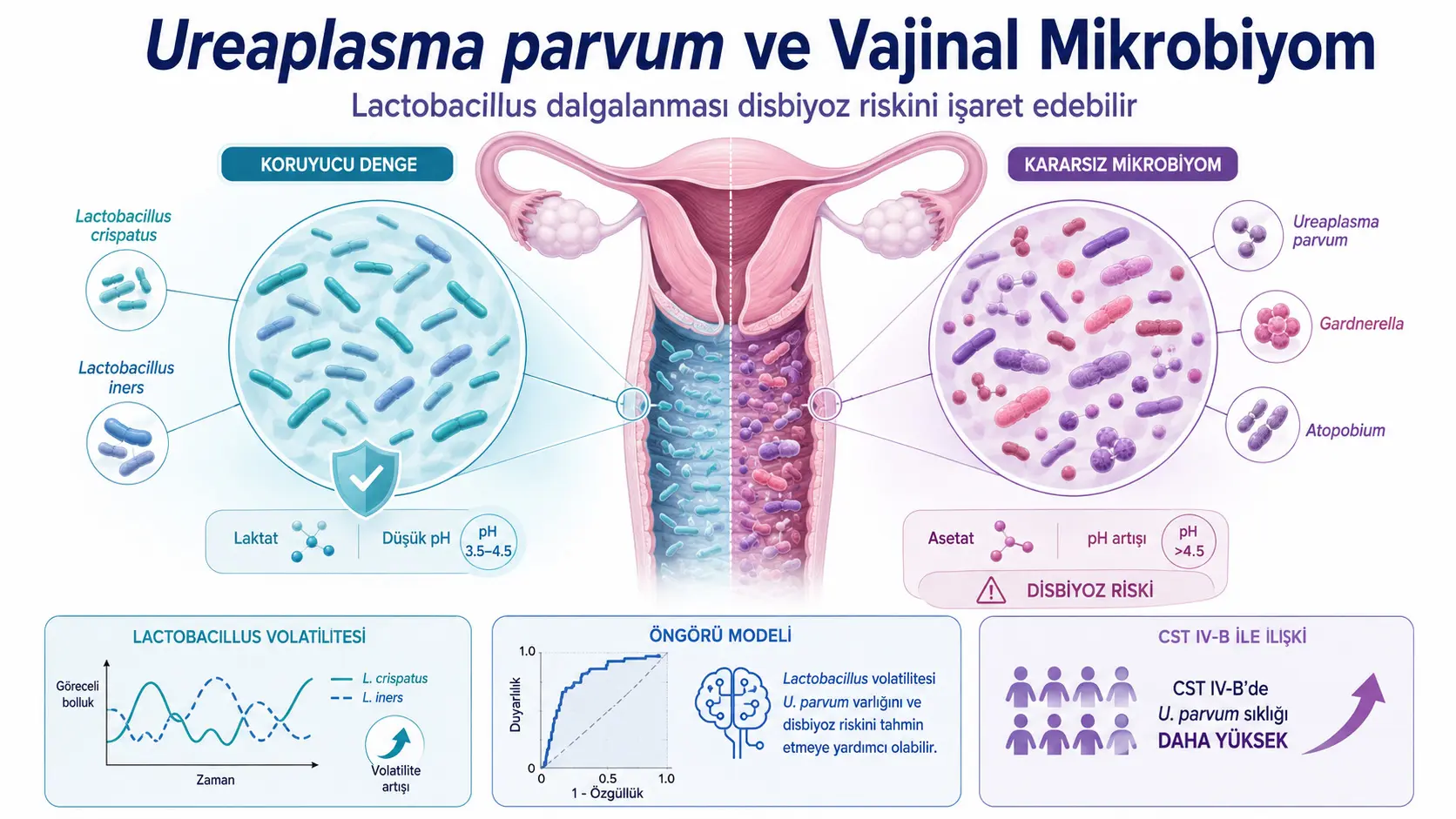
Микробиоми маҳбал яке аз қабатҳои асосии муҳофизатии саломатии ҷинсӣ ва репродуктивии занон мебошад. Дар бисёр экосистемаҳои маҳбал, ки солим ҳисоб мешаванд, намудҳои Lactobacillus бартарӣ доранд. Ин бактерияҳо махсусан тавассути истеҳсоли кислотаи лактикӣ ба паст нигоҳ доштани pH-и маҳбал мусоидат мекунанд. pH-и паст ҳамчун монеаи биологӣ амал карда, пайваст шудан ва афзоиши бисёр патогенҳоро дар луобпарда душвор месозад. Аз ин рӯ микробиоми маҳбал танҳо “ҷамъияти бактерияҳои мавҷуд” нест, балки низоми фаъоли экологии муҳофизат аз сироятҳо мебошад.
Масъалаи асосии ин таҳқиқот ин аст, ки маънои мавҷудияти Ureaplasma parvum, ки дар маҳбал зуд-зуд муайян мешавад, ҳанӯз равшан нест. U. parvum дар баъзе таҳқиқотҳо бо мушкилоти саломатии репродуктивӣ, сироятҳои бо роҳи ҷинсӣ гузаранда ва натиҷаҳои номатлуби ҳомиладорӣ алоқаманд дониста шудааст. Аммо махсусан дар занони беаломат маълум нест, ки ин бактерия худ аз худ патоген аст, микроорганизми оппортунистӣ мебошад ё дар баъзе ҳолатҳо метавонад қисми микробиоми маҳбал бошад. Study ин номуайяниро тавассути арзёбии presence-и U. parvum якҷо бо composition, metabolic function ва temporal stability-и microbiome баррасӣ мекунад.
Sample-и research қисми prospective longitudinal study-и ESTIMATE мебошад. Cisgender women ages 18-22 дохил шуданд. Pregnancy ва sterilization exclusion criteria буданд. Participants asked шуданд, ки every six months бо Evalyn Brush vaginal samples-ро худ ҷамъ кунанд; samples after arrival at study center at -80°C stored шуданд. Survey data ҳам about sexual behavior, partner count, age at first intercourse, safer-sex precautions, previous STIs, pregnancies, medications, substance use ва comorbidities ҷамъоварӣ шуд.
Дар microbiological side-и study two main analysis streams буданд. First, DNA-based detection of 11 sexually transmitted pathogens with EUROArray STI-11 panel. Panel included Chlamydia trachomatis, Neisseria gonorrhoeae, Mycoplasma genitalium, Mycoplasma hominis, Ureaplasma parvum, Ureaplasma urealyticum, herpes simplex virus 1/2, Treponema pallidum, Haemophilus ducreyi ва Trichomonas vaginalis. Second stream was microbiome analysis based on V3/V4 regions of 16S rRNA gene. This approach used to identify which bacterial groups were present and their relative abundances.
At baseline, suitable STI-panel and sequencing data were available from 240 women. Initial screening found U. parvum positivity in 81 women, or %33,75. After samples with other STI agents were removed, analysis included 204 women. Of these 204 women, 136 formed STI-negative control group and 68 were positive only for U. parvum. Thus study tried to examine relationship between U. parvum and vaginal microbiome while reducing confounding from other detected STIs.
Clinical and behavioral data showed age and body mass index were similar between groups. In contrast, U. parvum-positive women had younger age at first intercourse, longer duration of sexual activity and higher number of sexual partners. For example median partner count was 1 in U. parvum-negative group and 2 in positive group. Mean duration of sexual activity was 3,4 years in negative group and 4,45 years in positive group. No significant difference in intercourse frequency; median 5 times per month in both groups. Findings indicate U. parvum detection may relate to sexual exposure, but study argues this alone does not explain microbial findings and internal microbiome dynamics also matter.
Vaginal microbial communities were classified using community state types, or CSTs. CST classification groups vaginal microbiomes according to dominant bacterial structure. For example CST I usually indicates Lactobacillus crispatus dominance, CST III Lactobacillus iners dominance, and CST IV-B is associated with Gardnerella species and higher diversity. In study, communities dominated by L. crispatus and L. iners made up %80,4 of all samples. This shows most young asymptomatic women still had Lactobacillus-centered vaginal microbiomes.
Figure 1 visualizes microbial community types in population using hierarchical clustering. Heatmap shows 25 most abundant bacterial taxa at species level. Overall pattern shows L. crispatus or L. iners dominance in most participants, while smaller group had dominance of other Lactobacillus species such as L. gasseri, L. jensenii or L. fornicalis. In non-Lactobacillus-dominant communities, especially Gardnerella species occurred at high abundance. Distribution panels in same figure show CST II occurred only in U. parvum-negative women, whereas CST IV-B was more prominent among U. parvum-positive women.
Figure 2 more clearly shows association of U. parvum positivity with CST distribution and microbial-diversity measures. Most striking value was in CST IV-B: U. parvum was detected in %75 of women with this community type. Highest rate in other CST groups was %36. This difference shows U. parvum is not evenly distributed across all vaginal community types; it is concentrated especially in Gardnerella-rich, more diverse microbial structures associated with dysbiosis.
Alpha diversity was also evaluated. Alpha diversity means microbial diversity within a single sample. Shannon and Simpson diversity indices were significantly higher in U. parvum-positive women. Shannon p=0,0306, Simpson p=0,0274. Researchers noted increase was not due to more bacterial species, but more even distribution of existing bacteria, i.e. increased evenness. Evenness p=0,0196. This matters because dysbiosis does not always mean “many more species.” Sometimes relative loss of previously dominant protective species and more even but undesirable rise of other organisms can make ecosystem less stable.
Since Shannon diversity index was used, its basic logic can be represented in standard form:
\[ H' = -\sum_{i=1}^{S} p_i \ln(p_i) \]
Here H' is Shannon diversity index, S number of species in sample, and p_i relative abundance of species i. Formula was not derived in detail in study; it is included here as basic ecological formula to explain the diversity measure. In simple terms, if one bacterium dominates a community strongly, diversity is lower; if many bacteria are present in more similar proportions, diversity is higher.
Figure 3 shows differences in relative abundance of bacterial species and predicted metabolic functions between U. parvum-positive and negative women. In U. parvum-positive samples, Lactobacillus fraction was reduced while non-Lactobacillus taxa such as Gardnerella, Atopobium and Bifidobacterium became more prominent. Indicator-species analysis identified a broad group of bacteria associated with U. parvum positivity. Combined relative abundance of these groups reached about %8 in U. parvum-positive women.
These taxa were shown to matter not only for “which bacteria are present?” but also “what might microbiome be doing?” Researchers combined Human Vaginal Microbiome Genome Collection data, gapseq-based metabolic-pathway prediction and 16S rRNA data to estimate potential metabolic functions. Analysis showed greater representation of heterofermentative pathway called Bifidobacterium shunt in U. parvum-positive vaginal microbiota.
Bifidobacterium shunt is a metabolic pathway associated particularly with acetate production. Study interprets that in U. parvum-positive women, accompanying bacteria such as Gardnerella, Atopobium and Bifidobacterium in positive women may shift vaginal ecosystem toward acetate production compared with healthy lactate-producing profile. This is biologically relevant because lactate is a major metabolite of healthy Lactobacillus-dominant vaginal environment, while increased acetate is associated with bacterial-vaginosis-like dysbiosis. However study did not directly measure metabolites; it inferred metabolic pathways from 16S data and genomic references. Therefore result should be read as “metabolic capacity associated with acetate production was more represented,” not “acetate definitely increased by a measured amount.”
One of most original concepts is “microbial volatility.” Here volatility means how much relative abundance of a bacterial species fluctuates over time. If proportion of a bacterium is similar across three sampling time points, volatility is low; if high at one time, low at another and changes again later, volatility is high. This means examining not just snapshot of vaginal microbiome but ecological stability over time.
Volatility was defined as standard deviation of each taxon’s relative abundances. Logic can be explained by:
\[ s_x = \sqrt{\frac{1}{n-1}\sum_{t=1}^{n}(x_t-\bar{x})^2} \]
Here s_x is volatility of given bacterium, x_t its relative abundance at a given time, \bar{x} mean relative abundance across time points, and n number of measurements. Because three consecutive swab samples were used, concept reflects roughly 1 year of microbiome change sampled at six-month intervals. Larger value means more unstable relative abundance over time.
For longitudinal analysis 120 participants with three consecutive samples were evaluated. %30,8 were U. parvum-positive at baseline and %69,2 negative. Alluvial diagrams in supplementary figures show CST transitions over time. Among U. parvum-negative women more stable Lactobacillus-dominant profiles such as CST I-A increased, while U. parvum-positive women showed more fluctuation between community types. This supports idea that U. parvum presence co-occurs with more dynamic microbial ecosystem.
Figure 4 shows volatility of L. crispatus, L. iners and different Gardnerella species was higher in U. parvum-positive women. Importantly, researchers examined not only what was found in U. parvum-positive women, but also what might predict later U. parvum acquisition among women initially negative. For this, 69 women who remained U. parvum-negative across three consecutive microbiome samples were evaluated; 58 stayed negative later, while 11 subsequently acquired U. parvum.
Researchers built binary logistic-regression model using L. crispatus volatility, L. iners volatility and sexual-behavior risk score. General mathematical structure is:
\[ P(Y=1|X) = \frac{1}{1+e^{-z}} \]
\[ z = \beta_0 + \beta_1V_{L.crispatus} + \beta_2V_{L.iners} + \beta_3R_{cinsel\ davranış} \]
Here P(Y=1|X) is probability of later U. parvum acquisition, V_{L.crispatus} volatility of L. crispatus, V_{L.iners} volatility of L. iners, R_{cinsel davranış} sexual-behavior risk score, and \beta coefficients weights learned from data. Study did not provide detailed model coefficients, so formula cannot be used for individual risk calculation. It is included only to explain logistic-regression logic.
All three variables contributed significantly: L. crispatus volatility p=0,0187, L. iners volatility p=0,0098, sexual-behavior score p=0,0097. Gardnerella volatility did not significantly contribute. Researchers explain this by lower prevalence of individual Gardnerella species and greater suitability of highly prevalent taxa for reliable volatility estimation.
For model performance researchers selected %35 probability threshold. At this threshold model achieved %88,4 overall accuracy. Confusion matrix showed 54 true negatives correctly classified, 7 true positives correctly classified, 4 false positives and 4 false negatives. ROC AUC was 0,79. When AUC approaches 0,5 discrimination approaches chance; near 1 discrimination increases. Thus 0,79 may be interpreted as moderate-good discrimination in this dataset. But acquisition occurred in only 11 women, so model requires validation in larger and different populations.
Historical importance is that study adds new dimension to long-known relationship among Lactobacillus dominance, bacterial vaginosis and STI susceptibility. Earlier approaches often focused on microbiome composition at single time point. This study adds question “how stable is this microbiome over time?” to “what does it look like today?” This ecological-dynamics perspective is a strength.
Current importance is that U. parvum positivity is not presented as definite disease marker requiring treatment. Study notes current guidelines do not recommend routine U. parvum screening in asymptomatic individuals to prevent unnecessary antibiotic use. Researchers also note antibiotic U. parvum eradication may damage vaginal microbiota and worsen dysbiosis, and whether treatment improves outcomes is unknown. Therefore study does not support automatic “U. parvum detected, treat it” conclusion.
For future, study provides starting point for risk models based on vaginal microbiome stability. If validated in larger cohorts, temporal volatility of Lactobacillus species might help understand future risk of vaginal dysbiosis or some STI acquisition. But this is currently a research hypothesis. Study does not provide clinical screening test, treatment algorithm or personal risk calculator.
For everyday life, study shows vaginal health should not be understood from a single bacterium or one test result. Vaginal microbiome can be thought of like garden: a healthy garden needs not just one beneficial plant, but a stable balanced ecosystem resistant to unwanted overgrowth. Lactobacillus species are like protective plants. If this protective structure fluctuates frequently, other microorganisms may establish more easily. “Volatility” tries to quantify this ecological instability.
Strengths include prospective longitudinal design, regular sampling from young asymptomatic women, exclusion of other pathogens by STI panel, 16S rRNA-based microbiome analysis, metabolic-pathway prediction and volatility-based predictive modeling. Especially using three consecutive samples gives richer information than single-time-point studies.
Limitations are important. First, study is preprint without peer review. Second, sample is limited to cisgender women ages 18-22, so findings cannot directly generalize to other ages, geographies, ethnicities, pregnancy or symptomatic groups. Third, metabolic analysis is pathway prediction based on genomic and 16S data, not direct metabolite measurement. Fourth, U. parvum acquisition model had only 11 positive events; meaningful as proof of concept but insufficient for clinical use. Fifth, observational design cannot establish whether U. parvum causes microbiome instability, instability facilitates U. parvum acquisition, or both arise from shared behavioral, immune or environmental factors.
Study says: U. parvum is common in young asymptomatic women; its presence is associated with Gardnerella-rich, more diverse, acetate-related and more temporally volatile microbial communities. L. crispatus and L. iners volatility together with sexual-behavior score predicted subsequent U. parvum acquisition in this dataset.
Study does not say every woman with U. parvum is ill, nor that U. parvum positivity automatically requires antibiotics. It does not show definite benefit of vaginal microbiota transplantation, live biotherapeutic products or probiotics in U. parvum-positive women. Model is not validated for individual clinical decisions.
Усул ва Натиҷаҳои Таҳқиқот
Research is based on prospective longitudinal data from ESTIMATE cohort. Aim was to assess relationship of U. parvum presence and later acquisition with vaginal microbiome composition, predicted metabolic function and temporal stability.
| Method / Data Component | Use in Study | Meaning |
|---|---|---|
| Participant group | Cisgender women ages 18-22; pregnancy and sterilization as exclusions | Relationship between vaginal microbiome and U. parvum studied in young asymptomatic women. |
| Sampling | Self-collected vaginal samples every six months using Evalyn Brush | Allowed tracking microbiome changes over time. |
| STI panel | DNA-based detection of 11 sexually transmitted pathogens by EUROArray STI-11 | Other STI agents were excluded for cleaner comparison of U. parvum. |
| 16S rRNA analysis | PCR of V3/V4 regions, MiSeq sequencing, mothur processing and species assignment with EzBioCloud | Relative abundance of vaginal bacteria determined. |
| CST classification | Community types identified with Euclidean hierarchical clustering | Vaginal microbiomes divided into Lactobacillus-dominant and Gardnerella-rich communities. |
| Alpha diversity | Shannon and Simpson indices; Wilcoxon rank-sum test | Microbial diversity within each sample assessed. |
| Metabolic pathway prediction | VMGC genomes, gapseq, MetaCyc and OTU-pathway mapping | Potential microbial functions assessed, especially Bifidobacterium shunt. |
| Volatility analysis | Standard deviation of each taxon’s relative abundance across three consecutive samples | Temporal stability or fluctuation of microbiome measured. |
| Predictive model | Logistic regression with L. crispatus volatility, L. iners volatility and sexual-behavior score | Attempted to predict later U. parvum acquisition among initially negative women. |
Main baseline numerical findings:
| Finding | Numerical Value | Interpretation |
|---|---|---|
| Women evaluated at baseline | 240 | Baseline samples with STI panel and sequencing data |
| Baseline U. parvum positivity | 81/240; %33,75 | U. parvum was common in young asymptomatic women. |
| Cohort after excluding other STIs | 204 women | 136 U. parvum-negative, 68 U. parvum-positive |
| Age | Negative: 20,5 years; positive: 20,7 years; p=0,29 | No significant age difference. |
| Body mass index | Negative: 22,6; positive: 22,8; p=0,74 | No significant BMI difference. |
| Age at first intercourse | Negative: 17,22 years; positive: 16,29 years; p<0,01 | U. parvum-positive group had lower age at first intercourse. |
| Duration sexually active | Negative: 3,4 years; positive: 4,45 years; p<0,01 | Longer sexual-exposure duration in positive group. |
| Number of sexual partners | Median negative: 1; median positive: 2; p<0,01 | Higher partner count in positive group. |
| Monthly intercourse frequency | Median 5 in both groups; p=0,27 | No significant frequency difference. |
Main CST and community-structure findings:
| Microbiome Finding | Study Result | Scientific Meaning |
|---|---|---|
| L. crispatus and L. iners dominance | %80,4 of communities dominated by these two Lactobacillus species. | Lactobacillus dominance is common among young asymptomatic women. |
| CST I proportion | %51,5 | Most common community type was Lactobacillus crispatus-rich CST I. |
| CST III proportion | %28,9 | Lactobacillus iners-dominant communities were second largest group. |
| CST IV-B | Much more common among U. parvum-positive women. | Gardnerella-rich higher-diversity structure associated with U. parvum. |
| U. parvum positivity within CST IV-B | %75 | More than twice highest rate in other CSTs. |
| CST II | Observed only in U. parvum-negative women. | L. jensenii-dominant CST II not seen with U. parvum in this dataset. |
| Alpha diversity | Shannon p=0,0306; Simpson p=0,0274 | U. parvum-positive samples had higher microbial diversity. |
| Evenness | p=0,0196 | Diversity increase driven more by even distribution than species count. |
Functional microbiome analysis supported a shift in U. parvum-positive microbiomes from Lactobacillus-centered lactate metabolism toward increased representation of Bifidobacterium shunt associated with Gardnerella, Atopobium and Bifidobacterium. This pathway is associated with acetate production. Study therefore interprets U. parvum presence within a microbial context potentially shifted toward acetate-lactate imbalance, but this is predicted function, not direct metabolite measurement.
Longitudinal and predictive-model results:
| Longitudinal / Model Finding | Numerical Value | Interpretation |
|---|---|---|
| Subgroup with three consecutive samples | 120 participants | Temporal microbiome change evaluated. |
| Baseline U. parvum-positive | 37 people; %30,8 | Positivity in longitudinal subgroup resembled main cohort. |
| Baseline U. parvum-negative | 83 people; %69,2 | Negative comparison group. |
| Group used for prediction model | 69 women | Women U. parvum-negative across three consecutive samples. |
| Later U. parvum acquisition | 11 people; %15,9 | Positive outcome model attempted to predict. |
| Remained negative | 58 people; %84,1 | Negative class. |
| Significant model variables | L. crispatus volatility p=0,0187; L. iners volatility p=0,0098; sexual-behavior score p=0,0097 | Both microbial instability and behavioral risk contributed. |
| Model threshold | %35 probability | Threshold chosen with focus on positive prediction. |
| Overall accuracy | %88,4 | High classification accuracy in this dataset. |
| AUC | 0,79 | Moderate-good discrimination. |
| Confusion matrix | 54 true negatives, 7 true positives, 4 false positives, 4 false negatives | Some acquisitions captured but misclassifications remain. |
Taken together, findings suggest U. parvum acquisition may not be explained by sexual behavior alone; temporal instability of vaginal microbiome may form an important biological background. This is not causal proof. Microbiome volatility may facilitate U. parvum acquisition, U. parvum presence may increase fluctuations, or both may arise from shared behavioral, immune or environmental factors.
Ёддошт оид ба Манбаъ ва Усул
Ин мақола бар таҳқиқоти Simon Graspeuntner, Nadja Käding, Mariia Lupatsii, Ronja M. G. Bohm, Elisa Wierenberg, Lina J. Steinlein, Silvio Waschina, Frederike Kadgien ва Jan Rupp бо унвони “Ureaplasma parvum selects for a higher volatility of Lactobacillus species which is directly connected to vaginal dysbiosis” асос ёфтааст.
Source text is a preprint research article and explicitly states “This preprint research paper has not been peer reviewed”. Therefore it has not undergone peer review. Findings are scientifically detailed but should not be treated as clinical-practice guideline, diagnostic standard or treatment recommendation before peer-reviewed validation.
Study has prospective longitudinal cohort design. Regular vaginal samples were collected, STI panel used to screen pathogens, 16S rRNA gene-based microbiome analysis performed, metabolic pathways predicted using genomic reference data, and logistic-regression model built from microbial volatility. It was not a clinical treatment trial of antibiotics, probiotics, live biotherapeutic products or vaginal-microbiota transplantation.
This content is based only on PDF findings. No unsupported claims of clinical benefit, definite treatment efficacy, screening recommendation, commercial application, safety guarantee or individual-risk calculation were added. Metabolic pathways were predicted rather than metabolites directly measured, so acetate-lactate interpretations should be read as predicted microbial-function context.
Study does not show that every person with U. parvum should be treated. It notes current guidelines do not encourage routine U. parvum screening of asymptomatic people to avoid unnecessary antibiotics. Predictive model is proof of concept requiring larger-cohort validation, not individual clinical decision tool.
Шарҳ гузоред
Нишонии почтаи электронии шумо нашр намешавад. Майдонҳои ҳатмӣ бо * нишон дода шудаанд