

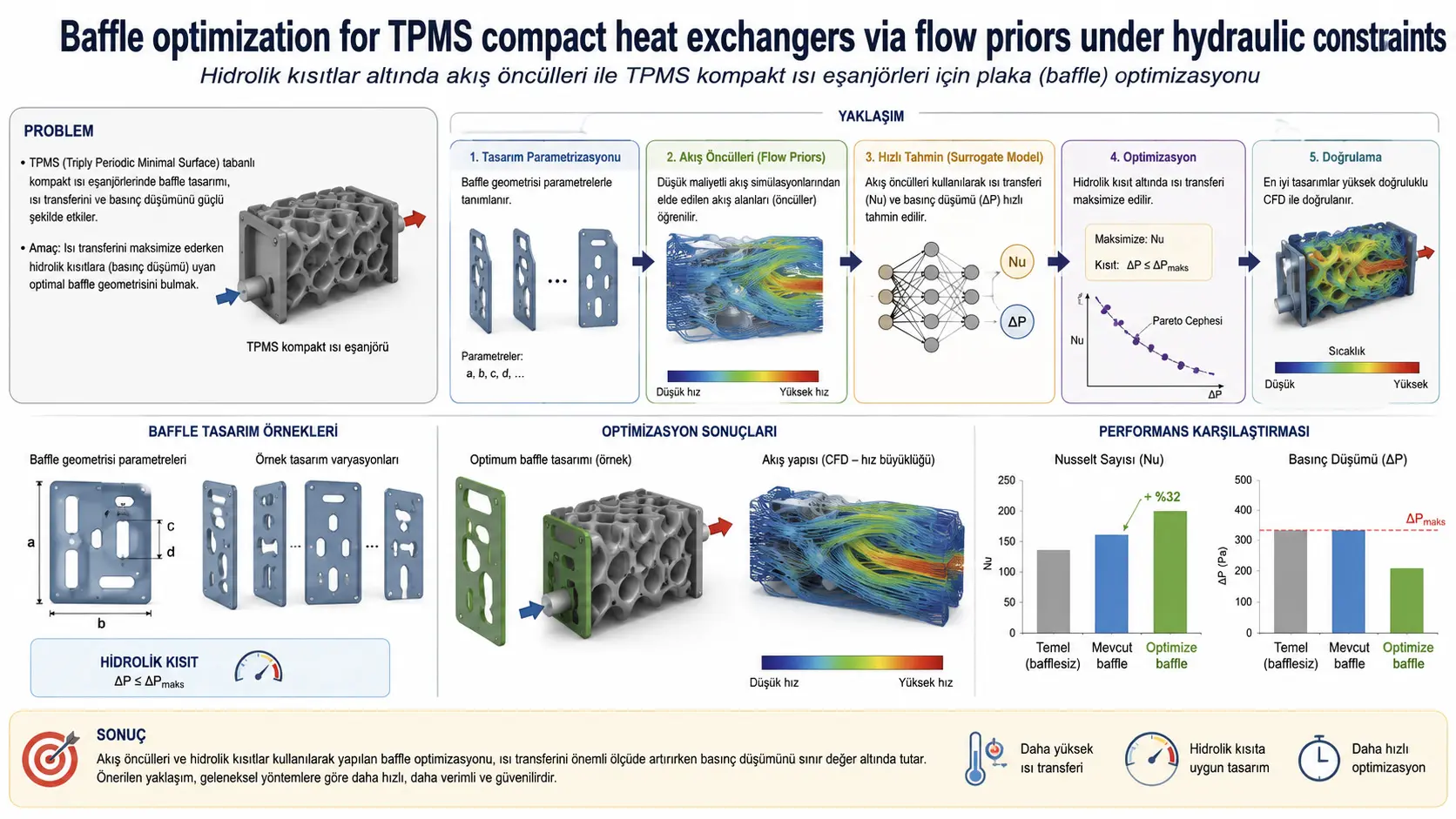
Ин таҳқиқот ҳадаф дорад, ки дар мубодилагарҳои гармии фишурдаи дорои сатҳҳои минималии сегонаи даврӣ (TPMS), ки бо истеҳсоли изофӣ сохта мешаванд, сатҳи дохилӣ самараноктар истифода шавад. Муҳаққиқон baffle-ҳоро танҳо ҳамчун монеаҳое, ки turbulence-ро зиёд мекунанд, не, балки ҳамчун унсурҳои идоракунии ҷараён баррасӣ кардаанд, ки ҷараёнҳои гарм ва сардро аз роҳҳои кӯтоҳи муқовиматашон паст дур мекунанд, минтақаҳои рукудро кам мекунанд ва вохӯрии ду ҷараёнро дар девори муштараки TPMS танзим менамоянд.
Дар усули дудараҷаи optimization, outer loop дарозии як роҳи намояндагии ҷараёнро, ки ба pressure-drop иҷозашуда мувофиқ аст, меҷӯяд. Inner loop бошад genetic algorithm-ро бо physical priors-и арзонҳисоб, вобаста ба дарозии роҳ, гардишҳои наздики inlet, мунтазамии паҳноии канал, dead zones ва мувофиқати counterflow-и гарм-сард, роҳнамоӣ мекунад. COMSOL CFD analyses-и гарон барои sweep кардани ҳамаи candidates истифода намешаванд; онҳо танҳо барои тасдиқи pressure drop-и design-ҳои ками аз pre-screening гузашта ва ranking кардани heat transfer истифода мешаванд.
Дар ҳолати намояндагии P-type бо inlet velocity-и 1 m/s ва маҳдудияти pressure drop-и 20 kPa, усули пешниҳодшуда танҳо бо 10 CFD evaluation ба 37,96 W heat transfer расидааст. Дар ҳамин constraint, genetic algorithm-и анъанавӣ, ки мустақиман бо CFD кор мекунад, бо тақрибан 100 evaluation 28,97 W, ва TPMS core-и бе baffle 21,63 W ҳосил кардааст. Ҳамин тавр, design-и пешниҳодшуда нисбат ба reference-и бе baffle %75,5 ва нисбат ба беҳтарин feasible result-и direct genetic algorithm тақрибан %31 heat transfer-и бештар додааст.
Дар шаш TPMS structure ва operating condition-и гуногун, зиёдшавии heat transfer-и беҳтарин design-ҳое, ки pressure-drop limit-ро иҷро мекунанд, нисбат ба equivalents-и бе baffle аз %24,4 то %78,6 тағйир ёфтааст. Аммо full controlled comparison бо direct genetic algorithm танҳо дар representative 20 kPa P-type case анҷом шудааст. Натиҷаҳо numerical simulation мебошанд; additive-manufactured prototype, experimental heat-exchanger test, surface roughness, fouling, manufacturing tolerance ва structural-strength validation вуҷуд надоранд.
Чаро surface area-и калон дар TPMS heat exchanger худ аз худ кофӣ нест?
Triply periodic minimal surfaces геометрияҳоеанд, ки дар се самт дар фазо такрор мешаванд, curvature-и smooth доранд ва ду fluid network-и ба ҳам нарасандаро ташкил медиҳанд. Ин хусусиятҳо TPMS structures-ро бо сабаби high surface-area density, continuous flow channels ва complex geometries-и мувофиқ ба additive manufacturing барои compact heat exchangers ҷолиб мекунанд.
Аммо large total internal surface area маънои онро надорад, ки тамоми ин surface дар heat transfer самаранок иштирок мекунад. Дар ду open connected channel network, fluid метавонад аз inlet то outlet роҳи low-resistance-ро интихоб кунад. Дар ин ҳолат дар баъзе regions high-speed short-circuit paths пайдо мешаванд, дар regions-и дигар бошад low velocity, underfeeding ё stagnation дида мешавад. Surface-и physically available-и heat exchanger метавонад аз ҷиҳати thermal суст истифода шавад, зеро flow онро ба қадри кофӣ sweep намекунад.
Comparison-и Figure 1 ин mechanism-ро равшан нишон медиҳад. Дар structure-и бе baffle streamline-ҳо байни inlet ва outlet дар corridor-ҳои муайян ҷамъ мешаванд ва қисмҳои калони core дар low speed мемонанд. Бо илова кардани baffles, роҳҳои hot ва cold flows дароз мешаванд, flow ба sections-и гуногуни core равона мешавад ва қисми low-speed zones дубора фаъол мегардад.
Нақши baffle нисбат ба conventional heat exchangers чӣ фарқ дорад?
Дар shell-and-tube heat exchangers, baffles асосан барои cross-direct кардани flow, баланд кардани turbulence ва disruption-и boundary layer истифода мешаванд. Дар TPMS channels бошад fluid метавонад байни pores-и connected ба route-ҳои гуногун гузарад, бинобар ин вазифаи асосии baffle бештар flow-path management аст, на direct turbulence generation.
Дар approach-и researchers baffle чунин вазифаҳоро иҷро мекунад:
- Бастани overly short ва low-resistance paths байни inlet ва outlet,
- Равона кардани flow ба underused TPMS regions,
- Пешгирии excessive local contractions ва expansions,
- Кам кардани unnecessary pressure loss аз sharp turns-и наздики inlet,
- Ба counterflow arrangement мувофиқтар кардани ҳаракати hot ва cold flows дар common wall,
- Thermally activating кардани surface-и бештар дар доираи fixed pumping power ё pressure-drop limit.
Масъалаи асосии optimization чӣ гуна муайян шудааст?
Baffle layouts дар cold ва hot sides мутаносибан бо \(B^c\) ва \(B^h\) нишон дода мешаванд. Ҳадаф maximum кардани heat transfer-и CFD-calculated бе гузаштан аз upper pressure-drop limit мебошад:
\[ \max_{B^c,B^h} J_{\mathrm{CFD}}\left(B^c,B^h\right) \quad \text{koşuluyla} \quad \max\left(\Delta p_c,\Delta p_h\right)\leq\Delta p_{\max} \]
Дар ин ҷо \(J_{\mathrm{CFD}}\) thermal objective function аз full flow ва heat-transfer solution; \(\Delta p_c\) ва \(\Delta p_h\) pressure drops дар cold ва hot side; ва \(\Delta p_{\max}\) maximum allowable pressure drop барои ҳар ду flow circuit мебошанд.
Final selection metric дар study average-и heat transfer-и ҳисобшуда дар ду side мебошад:
\[ Q=\frac{Q_c+Q_h}{2} \]
\(Q_c\) ва \(Q_h\) heat-transfer values мебошанд, ки мутаносибан аз cold ва hot flow ҳисоб шудаанд. Дар steady-state solution бо adiabatic outer surfaces интизор аст ин ду values ба ҳам наздик бошанд. Фарқи хурд миёни онҳо numerical energy-balance residual-ро ифода мекунад.
Чаро pressure drop ҳамчун hydraulic budget тафсир шудааст?
Дар ҳамаи comparisons volumetric flow rates fixed нигоҳ дошта шудаанд. Pumping power-и як flow circuit чунин ифода мешавад:
\[ W_p=\frac{\Delta p\,\dot{V}}{\eta_p} \]
Дар ин ҷо \(W_p\) required pumping power; \(\Delta p\) pressure drop; \(\dot{V}\) volumetric flow rate; ва \(\eta_p\) pump efficiency мебошанд. Вақте flow rate ва pump efficiency fixed мебошанд, limiting pressure drop ба гузоштани upper bound барои allowable pumping power баробар аст.
Total pumping power-и ду flow circuit чунин аст:
\[ W_{p,\mathrm{toplam}}=\frac{\Delta p_c\dot{V}_c}{\eta_c}+\frac{\Delta p_h\dot{V}_h}{\eta_h} \]
Аз ин рӯ study highest possible heat transfer-ро бе pressure-drop consideration намеҷӯяд. Саволи асосӣ ин аст, ки дар fixed hydraulic allowance чӣ қадар useful thermal capacity гирифтан мумкин аст.
Аммо actual pumping power-и ҳамаи designs баробар нест. Pressure-drop constraint танҳо як common upper hydraulic allowance муайян мекунад. Баъзе designs қисми ками allowance-ро, баъзеи дигар қариб тамоми limit-ро истифода мекунанд.
Baffle geometry чӣ гуна numerically represented шудааст?
Ҳар flow channel ба structured Cartesian grid cells тақсим шудааст. Мавҷуд ё набудани baffle дар horizontal ва vertical cell boundaries бо binary matrices нишон дода шудааст:
\[ B^Q=\left(B^{H,Q},B^{V,Q}\right) \]
\[ B^{H,Q}\in\{0,1\}^{N_x\times(N_y+1)}, \qquad B^{V,Q}\in\{0,1\}^{(N_x+1)\times N_y} \]
\(Q\) cold ё hot channel; \(B^{H,Q}\) horizontal baffle segments; \(B^{V,Q}\) vertical baffle segments-ро ифода мекунанд. Value-и one маънои мавҷуд будани baffle дар boundary-и дахлдор ва zero маънои open passage-ро дорад.
Аз ин wall layout accessibility field-и \(C^Q\) сохта шудааст, ки cells-и дастрас барои fluid-ро нишон медиҳад. Open cells ҳамчун graph nodes, neighboring cells-и бе baffle байни онҳо ҳамчун graph edges муайян шудаанд. Ҳамин тавр ҳар baffle layout ба connectivity problem табдил дода шудааст, ки accessible paths аз inlet то outlet дорад.
Чаро two-level optimization истифода шудааст?
Ҳал кардани ҳар genetic-algorithm candidate бевосита бо full CFD computational cost-и хеле баланд дорад. Study кӯшиш кардааст ин problem-ро бо тақсим кардани tasks байни outer ва inner loops ҳал кунад.
Outer loop: ёфтани path length мувофиқ ба pressure limit
Outer loop target representative path length-и \(L_{\mathrm{tar}}\)-ро бо binary search танзим мекунад. Азбаски бо дароз шудани flow path одатан hydraulic resistance зиёд мешавад, path length ҳамчун cheap approximate control variable барои pressure drop истифода шудааст.
Дар ҳар trial path length, inner optimization candidate layout ҳосил мекунад, candidate бо COMSOL ҳал мешавад ва maximum pressure drop аз ду side бо limit муқоиса мешавад. Агар candidate аз limit поён бошад, longer path санҷида мешавад; агар аз limit гузарад, path кӯтоҳ карда мешавад. Вақте difference байни lower ва upper path bounds аз як grid unit кам мешавад, acceptable target length муайян мегардад.
Inner loop: ёфтани baffle placement барои length-и муайян
Inner loop baffles-и cold ва hot sides-ро бо genetic algorithm меҷӯяд. Аммо candidates-ро бо CFD не, бо five priors арзёбӣ мекунад, ки approximate physical flow behavior-ро ифода мекунанд. Ҳамин тавр many geometric candidates зуд screened мешаванд ва CFD танҳо ба small promising candidate set татбиқ мешавад.
Дар workflow-и Figure 2 аввал pressure-drop limit ва inlet-outlet conditions муайян мешаванд, баъд outer loop target path length-ро бо binary search update мекунад. Inner genetic algorithm барои ҳар target дар hot ва cold side candidate baffle layouts ҳосил мекунад; дар final target length five best designs бо full CFD verified шуда, final layout интихоб мешавад.
Representative flow path чӣ гуна extracted шудааст?
Дар graph-и accessible cells барои ҳар channel shortest path байни inlet ва outlet муайян шудааст. Агар multiple paths бо same length бошанд, path бо fewest turns интихоб шудааст:
\[ P^Q=\left(p^Q_1,p^Q_2,\ldots,p^Q_{n_Q}\right), \qquad p^Q_1=s^Q,\quad p^Q_{n_Q}=t^Q \]
Дар ин ҷо \(P^Q\) representative path; \(p^Q_m\) center-и cell дар path; \(s^Q\) ва \(t^Q\) inlet ва outlet nodes мебошанд. Path length бо grid-edge count чунин аст:
\[ L(P^Q)=n_Q-1 \]
Пеш аз extract кардани path, redundant wall segments, ки inlet-outlet connectivity ё local width-ро тағйир намедиҳанд, remove шудаанд. Ин process пешгирӣ мекунад, ки baffles-и ба physical flow таъсирнакунанда аз genetic algorithm ҳамчун advantageous ҳисоб шаванд.
Flow priors кадом physical problems-ро ифода мекунанд?
1. Мутобиқат ба target path length
Наздикии representative path ба target-и outer loop бо penalty-и зерин чен мешавад:
\[ f^Q_{\mathrm{uzunluk}}=\left|L(P^Q)-L_{\mathrm{tar}}\right| \]
Агар path хеле short бошад, flow метавонад қисми кофии core-ро истифода накунад. Path-и overly long бошад pressure drop-ро зиёд мекунад. Ин term кӯшиш мекунад baffles route-и мувофиқ ба hydraulic budget ташкил кунанд.
2. Inlet-weighted turn penalty
Ҳар direction change дар flow path метавонад local loss ба вуҷуд орад. Дар study turns-и near inlet weight-и баландтар гирифтаанд:
\[ w_{\mathrm{konum}}(i)=1-\frac{i}{n_Q} \]
\(i\) location-и turn дар path; \(n_Q\) total node count-и path мебошад. Азбаски turn-и near inlet метавонад entire downstream region-ро таъсир диҳад, он нисбат ба turn-и near outlet heavier penalized мешавад. Sharp turns-и хеле наздик низ нисбат ба isolated turn баъд аз long straight section penalty-и баландтар мегиранд.
3. Channel-width regularity
Local channel widths дар representative path чен шуда, coefficient of variation ҳисоб шудааст:
\[ CV_w^Q=\frac{\operatorname{std}\left(\{w_m^Q\}\right)}{\operatorname{mean}\left(\{w_m^Q\}\right)} \]
\(w_m^Q\) accessible channel width мебошад, ки дар point-и дахлдори path perpendicular ба flow direction чен мешавад. Frequent narrowing ва widening метавонад flow distribution-ро вайрон карда, local pressure losses эҷод кунад. Small coefficient of variation channel structure-и regular-тарро ифода мекунад.
4. Dead-region ва unnecessary-side-route penalty
Барои ҳар accessible cell sum-и shortest distances аз inlet то cell ва аз cell то outlet ҳисоб шудааст. Ҳар қадар ин sum аз direct shortest inlet-outlet path зиёд бошад, cell ҳамон қадар inefficient side route ҳисоб шудааст:
\[ s^Q_{r,c}=d^Q_{\mathrm{giriş},r,c}+d^Q_{\mathrm{çıkış},r,c}-L^Q_{\mathrm{kısa}} \]
Cells дар shortest route excess value-и zero доранд. Cells-и reachable, ки long detour талаб мекунанд, positive penalty мегиранд. Disconnected cells heavy penalty мегиранд, ки даҳ баробари shortest-path length мебошад. Channel-level dead-region metric average-и ҳамаи accessible cells аст.
5. Hot-cold counterflow matching
Дар ideal counterflow, region-и near hot inlet бояд ба cold outlet ва region-и near hot outlet ба cold inlet мувофиқ бошад. Study ҳадаф дорад sum-и normalized inlet distances дар two channels ба one наздик бошад:
\[ \frac{d^c_{r,c}}{L_c}+\frac{d^h_{r,c}}{L_h}\approx1 \]
Deviation аз ин matching дар ҳамаи commonly accessible cells чен шуда, ба counterflow penalty-и \(f_{\mathrm{cf}}\) табдил дода шудааст. Ҳамин тавр method на танҳо cold ва hot channels-ро separately тартиб медиҳад, балки meeting-и two flows-ро дар thermally suitable locations along common TPMS wall низ арзёбӣ мекунад.
Combined prior objective
Барои single channel path length, turn, width ва dead-zone metrics weighted-combined шудаанд:
\[ f^Q_{\mathrm{tek}}=\lambda_{\mathrm{uzunluk}}\frac{f^Q_{\mathrm{uzunluk}}}{L^Q_{\mathrm{kısa}}}+\lambda_{\mathrm{dönüş}}f^Q_{\mathrm{dönüş}}+\lambda_{\mathrm{genişlik}}f^Q_{\mathrm{genişlik}}+\lambda_{\mathrm{ölü}}\frac{f^Q_{\mathrm{ölü}}}{L^Q_{\mathrm{kısa}}} \]
Joint objective function-и cold ва hot channels чунин аст:
\[ F(B^c,B^h;L_{\mathrm{tar}})=f^c_{\mathrm{tek}}+f^h_{\mathrm{tek}}+\lambda_{\mathrm{cf}}f_{\mathrm{cf}} \]
\(\lambda\) coefficients relative importance-и priors-и гуногунро муайян мекунанд. Аммо numerical values-и ин coefficients дар study report нашудаанд. Ин omission independent reproduction-и algorithm бо same settings-ро душвор мекунад.
Илова бар ин, equations \(F\)-ро ҳамчун sum of penalty terms месозанд ва explain мекунанд, ки lower values better мебошанд, аммо дар alternating genetic algorithm section гуфта шудааст, ки \(F\) “maximized” шудааст. Агар unreported fitness transformation истифода нашуда бошад, ин statement inconsistency-и methodological дар objective direction мебошад.
Genetic algorithm чӣ гуна run шудааст?
Simultaneous optimization-и ҳамаи binary baffle variables дар cold ва hot sides high-dimensional combinatorial problem месозад. Аз ин рӯ researchers alternating optimization истифода кардаанд:
- Hot side fixed нигоҳ дошта, baffles дар cold side optimized шудаанд.
- Updated cold side fixed карда шуда, baffles дар hot side optimized шудаанд.
- Process то мутобиқ шудани two sides тавассути counterflow matching такрор шудааст.
Дар ҳар single-side genetic algorithm stage population-и 100 individuals ва 200 generations истифода шудааст. Parents бо tournament selection интихоб шудаанд, crossover татбиқ шудааст ва ҳар binary wall variable independently бо mutation probability-и 0,05 тағйир дода шудааст. Best individual бо elitism нигоҳ дошта шудааст.
Пас аз crossover ва mutation candidates аз repair process гузаштанд. Ин process disconnected ё floating obstacle layouts-ро remove карда, inlet-outlet connectivity-ро restore намудааст ва representative path length-ро ба target value-и outer loop наздик кардааст. Танҳо repaired candidates, ки connectivity conditions-ро иҷро мекунанд, бо prior objective scored шудаанд.
CFD model ва boundary conditions
Full flow ва heat-transfer validation бо COMSOL Multiphysics 6.4 иҷро шудааст. Model conjugate heat transfer-ро байни stainless-steel TPMS solid ва two counterflowing water circuits ҳал мекунад.
- Flow steady ва incompressible қабул шудааст.
- Navier-Stokes ва energy equations якҷо ҳал шудаанд.
- Cold-flow inlet temperature 293 K, hot-flow inlet temperature 353 K fixed шудааст.
- Velocity boundary condition дар inlets ва pressure boundary condition дар outlets истифода шудааст.
- No-slip, temperature continuity ва heat-flux continuity дар fluid-solid interfaces татбиқ шудаанд.
- Outer walls thermally insulated қабул шудаанд.
- Ҳама methods бо same mesh, boundary conditions, solver settings ва post-processing method муқоиса шудаанд.
Mesh-independence check
Mesh sensitivity дар final baffled design-и G-type, speed 2 m/s, depth 1 ва target 60 kPa омӯхта шудааст. COMSOL Normal, Extra fine ва Extremely fine meshes муқоиса шудаанд.
| Mesh level | Total pressure drop, \(\Delta p_c+\Delta p_h\) (kPa) | Heat transfer \(Q\) (W) | Pressure difference relative to finest mesh | \(Q\) difference relative to finest mesh |
|---|---|---|---|---|
| Normal | 106,75 | 113,47 | +%3,69 | +%0,13 |
| Extra fine — used mesh | 104,04 | 113,13 | +%1,05 | -%0,18 |
| Extremely fine | 102,96 | 113,33 | Reference | Reference |
Heat-transfer difference байни Extra fine ва Extremely fine meshes танҳо %0,18, total pressure-drop difference дар two sides тақрибан %1,05 буд. Researchers барои пешгирии higher computational cost Extra fine mesh-ро дар all subsequent analyses истифода карданд.
Representative 20 kPa comparison чӣ нишон дод?
Controlled comparison барои P-type, one-period, inlet velocity 1 m/s ва pressure-drop limit 20 kPa дар both sides анҷом шуд. Baffle-free reference, direct genetic algorithm ва flow-prior genetic algorithm дар same CFD solution conditions муқоиса шуданд.
| Method | CFD evaluations | \(Q\) (W) | Cold/hot effectiveness (%) | \(\Delta p_c/\Delta p_h\) (kPa) |
|---|---|---|---|---|
| Baffle-free TPMS | 1 | 21,63 | 47,03 / 47,03 | 0,88 / 15,69 |
| Direct genetic algorithm | Тақрибан 100 | 28,97 | 62,97 / 62,97 | 1,98 / 16,66 |
| Flow-prior method | 10 | 37,96 | 82,54 / 82,54 | 19,38 / 19,79 |
Baffle-free core дар hot side ба 15,69 kPa pressure drop расида, дар cold side танҳо 0,88 kPa истифода кардааст. Best feasible design-и direct genetic algorithm ҳам дар cold side бо 1,98 kPa қисми зиёди hydraulic allowance-ро истифода накардааст. Design-и пешниҳодшуда бошад both flow circuits-ро ба 20 kPa limit наздик карда, available hydraulic allowance-ро ба thermal capacity balanced-тар табдил додааст.
Figure 3 нишон медиҳад direct genetic algorithm дар cold side route-и нисбатан short ва simple гузоштааст, flow-prior method бошад cold flow-ро дар қисми васеътари core гардиш додааст. Path дар hot side simpler нигоҳ дошта шуда, different representative lengths барои two channels интихоб шудаанд. Final cold/hot path length 57/15 мебошад.
Velocity fields дар Figure 4 нишон медиҳанд flow-prior design high-speed regions-ро ба қисми larger core паҳн кардааст. Дар baffle-free structure velocity дар corridor-ҳои муайян concentrate мешавад, дар proposed structure cold ва hot streamlines area-и larger TPMS-ро sweep мекунанд. Temperature map низ нишон медиҳад thermal transition zone байни two flows васеътар ва regular-тар шудааст.
Даҳ CFD evaluation чӣ гуна истифода шуд?
10 evaluations-и proposed method ба two stages тақсим шуданд. First five evaluations барои outer loop буданд, то path length-и мувофиқ ба pressure limit пайдо шавад. Next five evaluations top five candidates-и genetic algorithm-ро дар fixed 57/15 path length бо full CFD verified карданд.
Баъзе candidates дар pressure-search stage аз 20 kPa limit гузаштанд. Ин нишон медиҳад на ҳамаи intermediate designs-и method feasible мебошанд. Вазифаи outer loop истифодаи ин violations барои adjust кардани path-length bound ва наздик кардани final candidate set ба pressure limit мебошад.
Best feasible result-и first stage 36,14 W буд, ва пас аз validation-и final five candidates 37,96 W ба даст омад. Пас ҳатто only first stage аз baffle-free ва direct-GA references баландтар буд; second stage additional 1,82 W improvement дод.
Натиҷаҳо дар шаш operating condition
| Condition | Pressure limit (kPa) | Baffle-free \(Q\) (W) | Best path \(L_c/L_h\) | Best \(\Delta p_c/\Delta p_h\) (kPa) | Best \(Q\) (W) | Gain |
|---|---|---|---|---|---|---|
| P-type, speed 1, depth 1 | 20 | 21,63 | 57 / 15 | 19,38 / 19,79 | 37,96 | +%75,5 |
| P-type, speed 1, depth 1 | 25 | 21,63 | 63 / 17 | 23,60 / 21,84 | 38,63 | +%78,6 |
| G-type, speed 1, depth 1 | 20 | 36,90 | 23 / 23 | 16,99 / 18,40 | 60,18 | +%63,1 |
| G-type, speed 1, depth 1, 7×12 area | 30 | 64,38 | 23 / 25 | 16,61 / 16,98 | 80,06 | +%24,4 |
| P-type, speed 1, depth 2 | 25 | 44,98 | 63 / 19 | 20,02 / 19,83 | 77,48 | +%72,3 |
| G-type, speed 2, depth 1 | 60 | 73,93 | 21 / 21 | 49,26 / 54,77 | 113,13 | +%53,0 |
Highest improvement %78,6 дар P-type 25 kPa case, lowest improvement %24,4 дар longer 7×12 G-type design area гирифта шудааст. Researchers мегӯянд, дар long ва narrow structures flow ҳатто дар baffle-free state regular-тар ва in through-flow direction developed-тар буда метавонад; аз ин рӯ stagnant area-и reactivatable камтар мемонад. Ҳамзамон narrow geometry pressure penalty-и new baffles-ро зудтар зиёд мекунад.
Дар conditions бо more pronounced dead zones ё imbalanced flow distribution, improvement room-и baffles калонтар буд. Аммо six conditions inlet velocity, TPMS structure, geometric depth ва pressure limit-и гуногун доранд. Аз ин рӯ absolute values мисли 113,13 W ва 37,96 W набояд барои direct performance ranking байни conditions истифода шаванд.
Pressure-drop graphs чӣ нишон медиҳанд?
Figure 6 pressure drops дар cold ва hot sides-ро дар outer search ва final five candidates нишон медиҳад. Дар P-type cases, вақте symmetric path lengths барои cold ва hot sides интихоб шуданд, hot-side pressure drop хеле баланд шуд, cold side бошад аз hydraulic limit поён монд. Outer loop ин imbalance-ро бо selecting different \(L_c/L_h\) pairs ислоҳ кард.
Дар high-speed 60 kPa G-type case танҳо shortest path pair дар first stage two-sided pressure limit-ро иҷро кард. Аз final five validation candidates ҳам танҳо first, second ва fifth designs feasible монданд. Ин result тасдиқ мекунад, ки representative path length useful predictor барои pressure drop аст, аммо perfect нест.
Heat-transfer graphs чӣ гуна interpretation мешаванд?
Дар Figure 7 green regions candidates-и satisfying pressure limit, gray horizontal lines baffle-free references-ро нишон медиҳанд. Final design на танҳо аз рӯйи highest \(Q\), балки аввал бо condition-и satisfying pressure limit интихоб шудааст.
Баъзе candidates-и exceeding pressure limit higher ё similar thermal results додаанд; аммо feasible design қабул нашудаанд. Ин distinction муҳим аст: heat transfer-ро танҳо бо adding baffles зиёд кардан success нест. Increase бояд дар defined hydraulic allowance бошад.
Ablation study нишон дод кадом priors заруранд?
Researchers path-length control-ро fixed нигоҳ дошта, other four priors-ро one by one хориҷ карданд. All variants дар 57/15 path pair арзёбӣ шуданд.
| Method variant | \(Q\) (W) | \(\Delta p_c/\Delta p_h\) (kPa) | 20 kPa limit |
|---|---|---|---|
| Full method | 37,96 | 19,38 / 19,79 | Satisfied |
| Without width regularity | 36,44 | 19,14 / 66,57 | Not satisfied |
| Without inlet-weighted turn penalty | 36,91 | 24,45 / 20,76 | Not satisfied |
| Without unnecessary-route/dead-zone penalty | 37,72 | 19,83 / 20,72 | Slightly not satisfied |
| Without hot-cold matching | 36,20 | 17,36 / 19,79 | Satisfied |
Вақте width regularity хориҷ шуд, heat transfer ба full method наздик монд, аммо hot-side pressure drop бо 66,57 kPa аз limit more than threefold гузашт. Ин term пешгирӣ мекунад, ки excessive hydraulic resistance дар чанд narrow bottleneck ҷамъ шавад.
Ҳангоми хориҷ кардани inlet-weighted turn penalty, limit дар both sides exceeded шуд. Ин result нишон медиҳад especially near-inlet ва frequent turns барои regulating local pressure loss муҳиманд.
Ҳангоми хориҷ кардани dead-zone penalty heat transfer танҳо 0,24 W кам шуд; hot side 0,72 kPa limit violation дошт. Азбаски selected baseline layout аллакай few dead zones дошт, thermal effect-и ин term маҳдуд, hydraulic-regulating effect бошад noticeable-тар буд.
Ҳангоми хориҷ кардани hot-cold counterflow matching pressure limit нигоҳ дошта шуд, аммо \(Q\) аз 37,96 W ба 36,20 W кам шуд. Ин term барои hydraulic feasibility не, барои improving thermal matching-и two flows дар common surface кор мекунад.
Механизми асосие, ки study нишон медиҳад
Натиҷаҳо нишон медиҳанд, ки танҳо adding more obstacles ба TPMS core automatically better heat exchanger намесозад. Location-и baffles, paths-и hot ва cold flows, local channel width ва distribution-и pressure drop байни two circuits якҷо муҳиманд.
Success-и proposed method аз three linked effects меояд:
- Flow аз low-resistance short-circuit paths байни inlet ва outlet дур карда шуд.
- Қисми larger TPMS core бо high ё medium velocity flow sweep шуд.
- Progression directions-и hot ва cold flows дар common wall ба counterflow arrangement-и мувофиқтар оварда шуданд.
Ҳамин тавр, зери same upper pressure-drop limit surface-и дохилии бештар дар useful heat transfer иштирок кардааст. Консепсияи “surface activation”, ки researchers истифода мекунанд, маънои воқеан истифода шудани available geometric area аз ҷониби flow ва temperature difference-ро дорад.
Study чиро дастгирӣ мекунад?
Study дастгирӣ мекунад, ки дар specific numerical conditions flow-prior-guided baffle placement метавонад дар TPMS cores, бе exceeding pressure-drop limit, heat transfer-и баландтар аз baffle-free design ҳосил кунад.
Дар representative 20 kPa case, бо same binary wall representation, repair method, CFD solution ва pressure limit, flow-prior method \(Q\)-и баландтар аз direct genetic algorithm-ро бо тақрибан one-tenth CFD evaluations ба даст овард.
Results дар six conditions нишон медиҳанд method метавонад feasible candidates-ро дар different P ва G structures, velocities, geometric depths ва pressure limits ёбад. Аммо direct genetic-algorithm comparison танҳо дар one condition анҷом шудааст, аз ин рӯ algorithmic superiority дар all conditions proven нест.
Study чиро исбот намекунад?
- Нишон дода нашудааст, ки optimized baffles метавонанд бо metal additive manufacturing бе defects истеҳсол шаванд.
- Heat transfer ё pressure drop дар real prototype чен нашудааст.
- Surface roughness, printing defects, channel blockage, fouling ва long-term corrosion effects model нашудаанд.
- Effect-и baffles ба mechanical strength ва fatigue life-и TPMS core омӯхта нашудааст.
- Total pumping power ҳамчун direct objective function optimized нашудааст; upper pressure-drop limit ҳамчун approximate hydraulic budget истифода шудааст.
- Variable-flow, transient ё two-phase operating conditions арзёбӣ нашудаанд.
- Нишон дода нашудааст, ки proposed method дар all TPMS topologies ё all Reynolds numbers superior аст.
- Genetic weights ва баъзе reproducibility settings-и algorithm пурра report нашудаанд.
- Method аз peer review нагузаштааст.
Арзиши муҳандисӣ барои Туркия
Дар Туркия дар energy, defense, aerospace, hydrogen systems, heat pumps, power electronics, battery thermal management ва waste-heat recovery ба heat exchangers ниёз ҳаст, ки дар volume-и хурдтар heat transfer-и баландтар диҳанд. Азбаски TPMS structures метавонанд бо metal additive manufacturing сохта шаванд, study на танҳо theoretical geometry analysis, балки preliminary-design method медиҳад, ки бо advanced manufacturing якҷо мешавад.
Ҷиҳатҳои method, ки ба R&D-и Туркия интиқол дода мешаванд:
- Optimization-и baffle placement пеш аз printing барои locally manufactured TPMS samples,
- Истифодаи upper pressure-drop limit ҳамчун direct design constraint дар systems бо limited pump ё compressor power,
- Сохтани geometry-specific flow priors барои reducing CFD cost,
- Optimization-и hot ва cold flow channels бо mutual thermal matching, на independently,
- Илова кардани additive-manufacturing tolerance, minimum wall thickness ва support requirement ба repair stage-и genetic algorithm,
- Experimental validation-и numerical results бо pressure sensors, flow meters ва calorimetric heat balance.
Дар real Turkish application study набояд ҳамчун final design recipe истифода шавад. Агар ба ҷойи water oil, air, refrigerant ё fuel истифода шавад; temperature range, material, surface quality ва pump efficiency тағйир ёбанд, optimization бояд аз нав иҷро шавад.
Усул ва бозёфтҳои таҳқиқот
Хулосаи техникии method
| Method element | Approach дар study |
|---|---|
| Research type | CFD-based numerical modeling ва discrete baffle-placement optimization |
| Heat exchanger | TPMS compact heat exchanger with two connected hot ва cold channels |
| Structures studied | TPMS configurations called P-type ва G-type in the study |
| Decision variables | Horizontal ва vertical binary baffle segments in structured grid |
| Outer optimization | Binary search for representative path length matching pressure-drop limit |
| Inner optimization | Alternating genetic-algorithm optimization of cold ва hot sides |
| Population | 100 individuals |
| Generation count | 200 generations in each single-side GA stage |
| Mutation rate | 0,05 for each binary variable |
| Priors | Path length, inlet-weighted turns, width regularity, dead-zone suppression ва hot-cold counterflow matching |
| CFD software | COMSOL Multiphysics 6.4 |
| Fluids | Counterflowing hot ва cold water |
| Solid material | Stainless-steel TPMS matrix |
| Inlet temperatures | Cold side 293 K, hot side 353 K |
| Mesh | COMSOL Extra fine; \(Q\) difference %0,18 relative to finest mesh |
| Primary output | \(Q=(Q_c+Q_h)/2\) under pressure-drop limit |
| Comparisons | Baffle-free reference, direct GA ва flow-prior GA |
Натиҷаҳои асосии representative comparison
- Proposed method 37,96 W produced, %75,5 higher heat transfer than baffle-free reference.
- Increase over direct genetic algorithm result-и 28,97 W тақрибан %31 мебошад.
- Proposed method 10 CFD evaluations, direct GA тақрибан 100 CFD evaluations истифода кардааст.
- Cold ва hot side effectiveness ба %82,54 расидааст.
- Pressure drops 19,38 ва 19,79 kPa буда, аз 20 kPa limit поён мондаанд.
- Direct GA дар cold side танҳо 1,98 kPa истифода карда, hydraulic allowance-ро imbalanced гузоштааст.
- Final representative path lengths 57 grid steps дар cold side ва 15 дар hot side мебошанд.
Common findings аз six conditions
- Baffled designs дар all conditions \(Q\)-и баландтар аз baffle-free reference ҳосил кардаанд.
- Feasible gain range %24,4–%78,6 мебошад.
- Improvement ratio дар longer ва narrower design area кам шудааст.
- Дар cores бо more imbalanced flow distribution, surface area-и reactivatable by baffles larger буд.
- Representative path length бо pressure drop related буд, аммо alone exact feasibility guarantee надод.
- CFD validation-и final five candidates дар баъзе conditions first-stage result-ро slightly but measurably improved кардааст.
Ҷиҳатҳои қавии study
- Controlled algorithm comparison under same binary design representation ва same CFD protocol анҷом шудааст.
- Pressure drop ҳамчун direct feasibility constraint истифода шудааст, на танҳо reported output.
- Heat-transfer increase бо velocity, temperature ва streamlines дар two sides at mechanism level таҳлил шудааст.
- Numerical-solution sensitivity бо mesh-independence study санҷида шудааст.
- Different TPMS structures, velocities, geometric depths ва pressure limits tested шудаанд.
- Ablation analysis hydraulic ва thermal role-и ҳар physical prior-ро separately арзёбӣ кардааст.
- CFD дар every genetic-algorithm step истифода нашуда, computational cost significantly кам шудааст.
Reproducibility ва interpretation limitations
- Numerical values-и \(\lambda\) weights, ки flow priors-ро combine мекунанд, report нашудаанд.
- Ҳарчанд penalty function дар equations бояд minimized шавад, algorithm description “maximized” ибораро истифода кардааст.
- Stopping criterion-и genetic algorithm ва exact number of alternating rounds detailed дода нашудаанд.
- All physical dimensions-и TPMS ва design domains дар main text sufficiently detailed нестанд.
- Direct GA comparison танҳо дар one of six conditions вуҷуд дорад.
- Ҳарчанд CFD evaluation counts муқоиса шудаанд, total CPU time ва hardware information дода нашудааст.
- Experimental prototype validation вуҷуд надорад.
- Temperature-dependent variation-и material properties detailed report нашудааст.
- Manufacturing tolerance, minimum printable channel, support structures ва powder-removal requirements ба optimization дохил нашудаанд.
- Structural stress, thermal fatigue ва pressure resistance омӯхта нашудаанд.
- Fouling ва long-term operation effects model нашудаанд.
Ёддошти манбаъ ва усул
- Номи пурраи аслии таҳқиқот: Baffle optimization for TPMS compact heat exchangers via flow priors under hydraulic constraints
- Муаллифон ва тартиб: Lingxin Cao; Xiangjun Wu; Hanyue Xu; Xiaowei Duan; Bingteng Sun; Qiang Du; Dechun Li; Lin Lu
- Equal contribution ё equal first authorship: Зикр нашудааст.
- Corresponding author: Lin Lu
- Corresponding author email: Дар study нишон дода нашудааст.
- Institution 1: School of Information Science and Engineering, Shandong University, Qingdao, Shandong, China
- Institution 2: School of Computer Science and Technology, Shandong University, Qingdao, Shandong, China
- Institution 3: Advanced Gas Turbine Laboratory, Institute of Engineering Thermophysics, Chinese Academy of Sciences, Beijing, China
- DOI: 10.2139/ssrn.6944970
- Publication platform: SSRN
- Platform operator: Elsevier
- Original publisher: Татбиқ намешавад. SSRN preprint platform аст ва version-и examined peer-reviewed journal publication нест.
- Peer-reviewed journal: Accepted ё published peer-reviewed journal name дар study нишон дода нашудааст.
- Publication year: 2026
- Source type: Preprint of CFD-based numerical optimization research
- Peer-review status: Study аз peer review нагузаштааст.
- Official SSRN link:SSRN study page
- DOI link:10.2139/ssrn.6944970
Uploaded version SSRN record 6944970-ро ҳамчун DOI ва footer истифода мекунад. Earlier record-и SSRN 6878424 бо same original title ва author list низ вуҷуд дорад. Study шарҳ намедиҳад, ки relation байни two records previous version, corrected version ё duplicate record аст. Аз ин рӯ citation бояд 10.2139/ssrn.6944970-ро истифода кунад, ки ба current examined file мувофиқ аст.
Research бо grants-и U25A20438, 62472258 ва 52488101 аз National Natural Science Foundation of China, инчунин grant-и QDBSH20250202009 аз Qingdao Postdoctoral Science Foundation дастгирӣ шудааст.
Author contribution roles, data ё code access link ва explicit conflict-of-interest statement дар study мавҷуд нестанд. Genetic-algorithm implementation code, COMSOL model files ва ҳамаи optimized binary wall matrices бо open archive link пешниҳод нашудаанд.
Ин шарҳи тоҷикӣ бо баррасии text, equations, algorithm flowchart, baffle layouts, velocity ва temperature fields, streamlines, pressure-drop graphs, heat-transfer graphs, tables ва ablation comparisons омода шудааст. Scientific content танҳо ба examined study такя мекунад; external sources танҳо барои bibliographic verification-и DOI, author record, platform ва publication status истифода шудаанд.
Натиҷаҳои study дар numerical-design level мебошанд. Reported increases-и %24,4–%78,6 experimental device measurements нестанд, балки results-и COMSOL simulations under specified geometry, fluid, velocity, temperature ва pressure-drop limits мебошанд. Барои табдил додани findings ба real product performance additive-manufactured prototype, pressure ва temperature measurements, calorimetric validation, manufacturing-tolerance analysis ва long-term durability tests лозиманд.
Шарҳ гузоред
Нишонии почтаи электронии шумо нашр намешавад. Майдонҳои ҳатмӣ бо * нишон дода шудаанд