

Дар саратони пешрафтаи забон, табобати ҷарроҳӣ баъзан хориҷ кардани қисми хеле калон ё қариб тамоми забонро талаб мекунад. Ин амалиёт glossectomy номида мешавад. Агар тамоми забон хориҷ карда шавад, total glossectomy; агар қисми хеле зиёдаш хориҷ шуда, қисми хурде нигоҳ дошта шавад, near-total glossectomy гуфта мешавад.
Забон танҳо узви сухан нест. Он дар фурӯбарӣ, ҳаракат додани луқма дар даҳон, роҳнамоии ғизо ҳангоми хоидан, эҷоди фишори дохили даҳон, шакл додани овозҳо ва назорати saliva ва bolus вазифаҳои асосӣ дорад. Аз ин рӯ, дар бемороне, ки қисми зиёди забон хориҷ мешавад, ҳадафи reconstruction танҳо бастани холигии даҳон нест. Ҳадафи аслӣ он аст, ки бофтаи нав, яъне neotongue, ҳаҷми кофӣ, protrusion-и муносиб, баландии қобили тамос бо palate ва мавқее дошта бошад, ки swallowing ва speech-ро дастгирӣ кунад.
Study маҳз ба ҳамин нуқта тамаркуз мекунад: Пас аз total ё near-total glossectomy барои tongue reconstruction кадом flap натиҷаҳои беҳтари functional ва oncologic медиҳад? VRAM flap, ки солҳои зиёд истифода шудааст, ё ALT flap, ки donor-site morbidity-и камтар дорад?
Чаро ин problem муҳим аст?
T4 tongue squamous cell carcinoma ҳам life-threatening аст ва ҳам quality of daily life-ро сахт таъсир медиҳад. Advanced tongue tumors аксаран бо pain, dysphagia, speech impairment, nutritional loss ва weight loss зоҳир мешаванд. Surgery метавонад барои хориҷ кардани tumor лозим бошад; аммо preservation of speech and swallowing after surgery барои баргашти бемор ба life ҳадди ақал ба андозаи tumor control муҳим аст.
Дар ин беморон good reconstruction танҳо aesthetic issue нест. Оё бемор метавонад orally feed шавад? Speech understandable мемонад? Aspiration risk кам мешавад? Neotongue метавонад дар oral cavity enough height пайдо кунад? Агар пас аз radiotherapy volume loss рӯй диҳад, function нигоҳ дошта мешавад? Study ин questions-ро тавассути VRAM ва ALT flaps баррасӣ мекунад.
VRAM flap чист?
VRAM flap musculocutaneous flap аст, ки аз rectus abdominis muscle ва skin/subcutaneous tissues-и anterior abdominal wall омода мешавад. Он солҳои зиёд one of important options барои total tongue reconstruction ҳисоб шудааст. Introduction-и study мегӯяд rectus abdominis flap дер боз ҳамчун “gold standard” барои reconstruction after total glossectomy қабул шуда буд.
Advantage-и VRAM танҳо volume нест. Бо истифодаи rectus fascia метавон support-и ба neomylohyoid sling монанд сохт. Ин structure барои кам кардани sagging ё ptosis-и neotongue ва нигоҳ доштани reconstructed tongue above floor of mouth кӯмак мекунад. Яке аз main problems after total glossectomy ин аст, ки neotongue sufficiently bulky ва forward-upward contact-capable shape ташкил карда наметавонад. Muscle and fascia component-и VRAM метавонад аз ин viewpoint support диҳад.
ALT flap чист?
ALT flap fasciocutaneous flap аст, ки аз anterolateral thigh гирифта мешавад. Он яке аз common free flaps дар head-neck reconstruction мебошад. Study advantage-и ALT-ро махсусан бо lower donor-site morbidity мепайвандад. Яъне ба ҷойи гирифтани abdominal-wall muscle, гирифтани tissue from thigh метавонад дар some patients functional loss-и камтар ё more acceptable donor-site outcome диҳад.
Аммо ALT flap дар tongue reconstruction challenge-и муҳим дорад: depending on subcutaneous-fat thickness at thigh, flap метавонад too thick or bulky бошад. In some patients this bulk may help total tongue reconstruction; in others excessive oral volume may be problematic. Дар study flap selection therefore based on preoperative pinch test performed шудааст.
Patient groups чӣ гуна ташкил шуданд?
Study total 75 patients-ро дар бар мегирад, ки between February 2019 and February 2023 treated шудаанд. Аз онҳо 60 male ва 15 female мебошанд. Ҳама oral-tongue histologically confirmed squamous cell carcinoma доштанд ва according to AJCC edition 8 бо stage IVA ё IVB disease treated шуданд.
Patients ба two groups divided шуданд:
- Group A: 30 patients receiving VRAM flap.
- Group B: 45 patients receiving ALT flap.
Allocation randomized набуд. Skin and subcutaneous fat thickness in anterolateral thigh бо pinch test measured шуд. Агар measurement <1,5 cm бошад VRAM flap, агар ≥1,5 cm бошад ALT flap интихоб шуд. Ин threshold ба previous recommendations оид ба minimum flap thickness барои satisfactory function in tongue reconstruction асос ёфтааст.
Surgery ва reconstruction чӣ гуна анҷом шуд?
Ҳама patients wide local excision for primary tumor гирифтанд, surgical margin of 1,5–2 cm aimed шуда, bilateral modified radical neck dissection performed шуд. Study танҳо patients-ро included кардааст, ки according to Ansarin et al. glossectomy classification type IVB ё type V glossectomy undergone кардаанд.
Defect dimensions during reconstruction planning measured шуданд. Length from tip of tongue to posterior defect margin, width as maximum transverse dimension evaluated шуд. VRAM flap %30 wider than defect designed шуд. ALT flap бошад both width and length %40 larger than defect prepared шуд.
Ин intentional oversizing important аст. Flaps метавонанд over time volume lose кунанд, ва radiotherapy/scar contraction neotongue-ро shrink кунад. Агар initial volume дар total tongue reconstruction insufficient бошад, speech and swallowing метавонанд дар months later even worse шаванд.
Дар VRAM flap, rectus fascia with heavy nonabsorbable sutures passed through tunnels along mylohyoid line suspended шуд. Aim — prevent downward sagging and provide inferior support to neotongue. Дар ALT flap distal %40 part folded onto itself to mimic supportive role of rectus abdominis muscle and fixed to mandible. Дар all patients permanent sutures from hyoid bone to mandibular parasymphysis used for laryngeal suspension.
Adjuvant therapy чӣ гуна дода шуд?
Аз 75 patients, 73 — яъне %97,3 — postoperative radiotherapy гирифтанд. Dose 60 Gy / 30 fractions reported шудааст. Stage IVB patients weekly cisplatin 40 mg/m² concurrent chemotherapy гирифтанд. Stage IVA patients radiotherapy alone гирифтанд. Two patients refused adjuvant treatment.
Ин information important аст, зеро functional outcomes на танҳо flap, балки effects of radiotherapy-ро ҳам reflect мекунанд. After radiotherapy scar, volume loss, soft-tissue stiffness, xerostomia ва swallowing changes метавонанд occur кунанд. Therefore flap comparison бояд within multimodal-treatment context interpreted шавад.
Speech and swallowing чӣ гуна assessed шуданд?
Functional outcomes via speech and swallowing evaluated шуданд. Speech intelligibility бо Performance Status Scale for Head and Neck Cancer Patients аз 0–4 scored шуд. Swallowing бо 7-point Functional Oral Intake Scale evaluated шуд.
Assessments independently by three specialists — head-neck surgeon, radiation oncologist ва physical medicine/rehabilitation specialist — performed шуданд. Final scores as mean of these ratings calculated шуданд. Text mentions follow-up at postoperative month 1, 6 and 12, while methods emphasize 6 and 12 months after radiotherapy. Therefore timing should be interpreted with awareness of this wording difference.
Functional results in overall cohort чӣ гуна буданд?
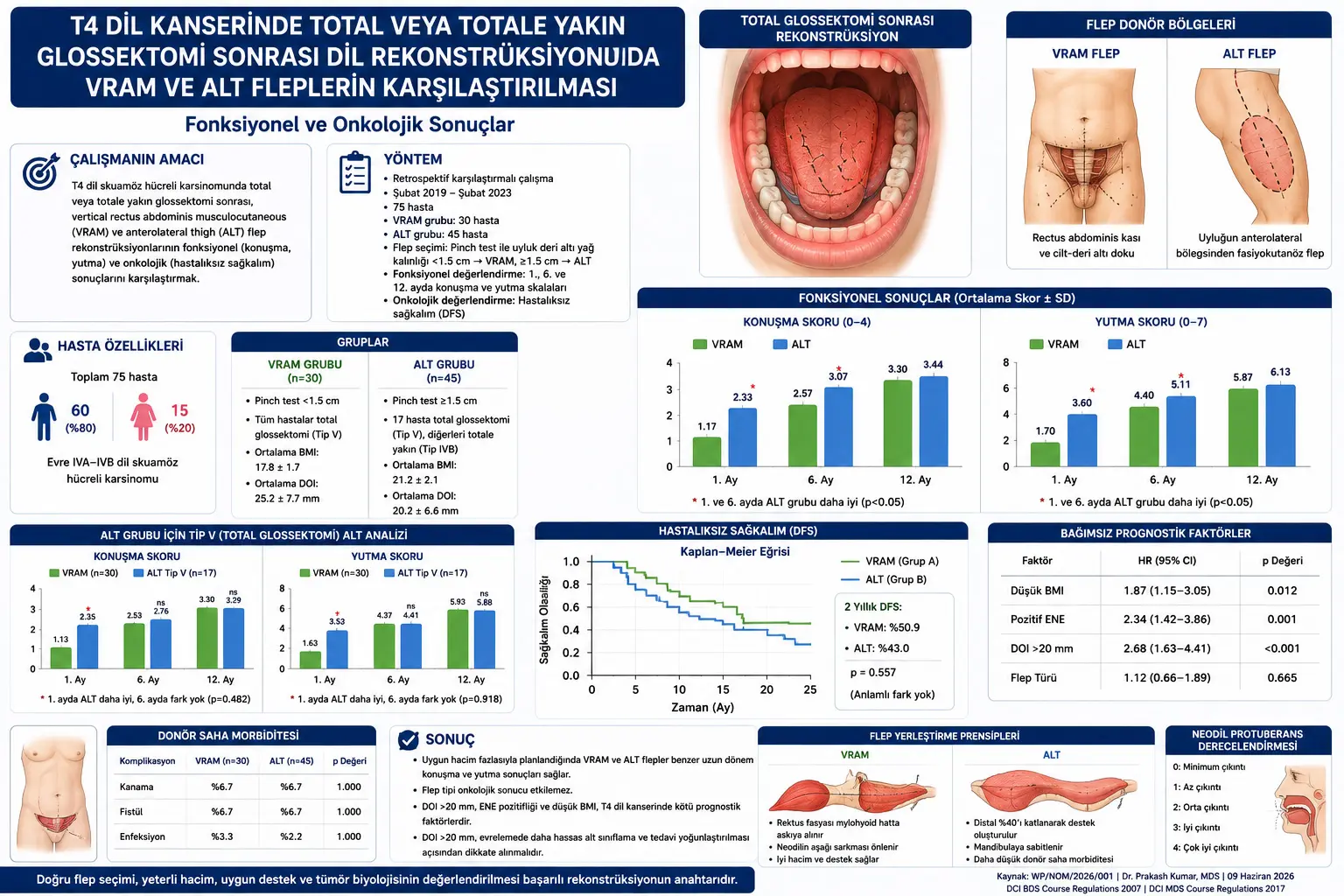
In general comparison, ALT group appeared better for early functional outcomes. According to Table 1, speech score at month 1 was 1,17 ± 0,45 in VRAM and 2,33 ± 0,70 in ALT; difference significant (p < 0,001). At month 6 speech score was 2,57 ± 0,48 in VRAM and 3,07 ± 0,67 in ALT; again significant (p < 0,001).
Swallowing showed similar early advantage. Month-1 swallowing score was 1,70 ± 0,70 in VRAM and 3,60 ± 0,54 in ALT (p < 0,001). At month 6 values were 4,40 ± 1,35 for VRAM and 5,11 ± 0,86 for ALT (p = 0,02).
At first glance these numbers suggest ALT flap is better. But study makes an important correction: all patients in VRAM group underwent total glossectomy; in ALT group only 17 had total glossectomy and others had near-total glossectomy. Therefore better function in ALT group may reflect preservation of more native tongue tissue rather than flap itself.
Why is type V total-glossectomy subgroup analysis important?
To reduce this bias, researchers compared only patients who underwent type V total glossectomy. This analysis compared all 30 VRAM patients with 17 ALT patients who had total glossectomy.
In subgroup analysis ALT still had better speech and swallowing at month 1 (p < 0,001). But by month 6 speech difference was not significant (p = 0,482) and swallowing difference also not significant (p = 0,918). DOI values were comparable in this subgroup (p = 0,484).
This is one of the key clinical messages: In total tongue reconstruction, if adequate volume and protuberance are achieved, VRAM and ALT can provide similar longer-term speech and swallowing outcomes. ALT may look better early, but among total-glossectomy patients the difference disappears by month 6.
Why is neotongue protuberance so important?
Neotongue protuberance means how bulky, elevated and palate-approaching the reconstructed tongue is within oral cavity. After total glossectomy this is critical. When natural tongue movement is lost, passive volume and ability of reconstructed tissue to contact palate become major determinants of swallowing and speech.
Study used neotongue protuberance grading proposed by Yun et al. Visual material schematically shows grading and examples of reconstructions with different protuberance scores. Higher protuberance represents greater elevation in oral cavity and potentially better palate contact.
Table 1 reports mean neotongue protuberance grade of 3,0 in VRAM and 2,9 in ALT; difference not significant (p = 0,535). This suggests both approaches aimed for similar volumetric protrusion.
Figures support findings чӣ гуна?
Reconstruction drawings visualize principles of VRAM and ALT placement. In VRAM illustration rectus abdominis tissue fills floor-of-mouth and tongue defect to create supported neotongue. In ALT drawing flap is folded to create bulk and support. These images make concepts of “oversizing” and “neotongue bulk” clearer.
Clinical photographs show different postoperative intraoral neotongue appearances. They support central claim: After total glossectomy success means not just flap survival, but achieving sufficient oral prominence and functional shape.
Kaplan–Meier curve shows disease-free-survival lines of VRAM and ALT groups running close together, without clear separation. This visual result aligns with p = 0,557 and supports interpretation that flap type did not significantly alter disease-free survival.
Oncologic outcomes чӣ гуна буданд?
Median follow-up for entire cohort was 21,0 months. Among censored disease-free patients median follow-up was 34,5 months. Estimated 2-year disease-free survival was %50,9 for VRAM and %43,0 for ALT. Log-rank difference was not significant (p = 0,557).
This suggests reconstruction type is not main determinant of tumor control. In advanced tongue cancer, disease-free survival is driven more by tumor biology and pathological risk factors. Multivariable analysis likewise found flap type not independent prognostic factor.
Why is DOI so important?
Depth of invasion, or DOI, indicates how far tumor extends from surface into deeper tissues and is an important pathological parameter. In this study DOI was among strongest markers for disease-free survival.
Estimated disease-free survival was %62,7 for DOI ≤20 mm and %34,5 for DOI >20 mm. Difference was significant. Authors propose DOI >20 mm as strong adverse prognostic factor in T4 tongue squamous cell carcinoma and suggest it might support more refined subclassification.
Biologically this makes sense: deeper invasion suggests more aggressive spread, possible increased lymph-node metastasis and extranodal-extension risk, and more advanced presentation. Study argues DOI >20 mm is not just anatomical measurement but strong reflection of disease course.
What does ENE positivity mean?
Extranodal extension (ENE) means cancer has extended beyond capsule of metastatic lymph node into surrounding tissue. In head-neck cancers ENE generally relates to worse prognosis. In this study ENE positivity also adversely affected disease-free survival.
According to study, all stage IVB cases were ENE-positive. Median DFS for ENE-positive patients was 9 months and 2-year DFS %28,4. For ENE-negative patients 2-year DFS was %58,4. Difference was significant (p = 0,026).
This result emphasizes importance of nodal biology in advanced tongue cancer. Even if primary tumor is removed and reconstruction succeeds, extracapsular nodal spread can markedly raise recurrence risk.
Why did BMI emerge as prognostic factor?
Study reported lower preoperative body mass index as independent predictor of worse disease-free survival. Mean BMI was 17,8 ± 1,7 in VRAM and 21,2 ± 2,1 in ALT, a significant difference (p < 0,001).
In advanced tongue cancer low BMI may reflect not merely thin body habitus but pain, dysphagia, inadequate nutrition, weight loss and reduced physiological reserve due to disease. Lower BMI can make intensive treatments such as surgery, radiotherapy and chemotherapy harder to tolerate. Thus its independent prognostic role is clinically plausible.
Complications чӣ гуна буданд?
Complication rates in Table 1 were generally similar. Bleeding rate was %6,7 in both groups; fistula rate also %6,7 in both. Infection was %3,3 in VRAM and %2,2 in ALT.
These data suggest no marked difference in early surgical complications. However only limited complication categories were reported; broader parameters such as donor-site function, long-term volume loss and patient-reported quality of life need separate evaluation.
What literature gap does study address?
Article notes few direct comparisons of VRAM and ALT after total or near-total glossectomy. Especially in T4 oral-tongue squamous cell carcinoma, data evaluating functional and oncologic outcomes in same cohort are limited.
Study aims to fill this gap by comparing two commonly used flaps in one surgical center with standardized selection protocol and similar surgical principles. Intentional flap oversizing is emphasized as practical strategy to preserve neotongue volume in total tongue reconstruction.
Strengths of study
One strength is reliance on real clinical patient series. In severe and functionally destructive T4 tongue squamous cell carcinoma, it assesses impact of reconstruction on speech, swallowing and disease-free survival together.
Second strength is explicit protocol for VRAM versus ALT selection. Pinch-test thigh-fat thickness guided flap choice, with VRAM designed %30 and ALT %40 oversized. This anticipates volume loss and protuberance problems from start.
Third strength is type V total-glossectomy subgroup analysis in addition to overall comparison. This attempts to reduce bias from preserved natural tongue tissue in ALT group.
Fourth strength is evaluation not only of function but also disease-free survival and prognostic factors, showing reconstruction choice should not be considered separately from cancer control.
Limitations of study
As noted in article, study is single-center and nonrandomized, so selection bias is possible. VRAM group had lower BMI, higher DOI and all underwent total glossectomy, while ALT group included near-total glossectomy patients. These differences may influence functional and oncologic results.
Second limitation is follow-up duration. Median follow-up is 21,0 months for cohort. Disease-free patients have 34,5 months, but longer follow-up is needed for mature long-term oncologic outcomes.
Third limitation is lack of blinding of functional evaluators. Observer bias may affect semi-subjective speech and swallowing ratings.
Fourth limitation is sample size. Type V subgroup in ALT consists of only 17 patients, limiting statistical power.
Fifth, study is unreviewed preprint. Results require cautious interpretation and validation in larger, preferably multicenter studies.
Study чӣ мегӯяд ва чӣ намегӯяд?
Study says both VRAM and ALT can provide functional outcomes after total or near-total glossectomy when volume is planned appropriately. ALT appears better for early speech/swallowing in overall group, but this difference disappears at month 6 in total-glossectomy subgroup. Flap type is not independent prognostic factor for disease-free survival.
Study does not say ALT or VRAM is definitively superior for every patient. Because it is not randomized, it cannot prove absolute causal superiority. Surgical selection should be considered together with BMI, thigh tissue thickness, defect type, DOI, expected radiotherapy effect and reconstructive strategy.
Усул ва Натиҷаҳои Таҳқиқот
Тарҳи study
| Ҷузъи усул | Татбиқ дар study | Маъно |
|---|---|---|
| Навъи study | Single-center comparative clinical study | Contains real patient data, but not randomized. |
| Patient count | 75 patients | Series of T4 oral-tongue squamous cell carcinoma undergoing total or near-total glossectomy. |
| Period | February 2019 – February 2023 | Represents consecutive clinical experience at one surgical center. |
| Groups | VRAM n=30; ALT n=45 | Two reconstruction methods compared. |
| Flap selection | Pinch test: <1,5 cm VRAM; ≥1,5 cm ALT | Choice based on thigh subcutaneous-fat thickness. |
| Adjuvant treatment | 73/75 patients received 60 Gy / 30 fractions radiotherapy | Most patients underwent multimodal treatment. |
Хусусиятҳои гурӯҳҳо
| Variable | VRAM / Group A | ALT / Group B | p value |
|---|---|---|---|
| Patient count | 30 | 45 | - |
| Age, mean ± SD | 51,7 ± 11,6 | 49,7 ± 10,6 | 0,439 |
| Female proportion | %0,0 | %31,1 | <0,001 |
| Smokers | %80,0 | %64,4 | 0,140 |
| KPS | 88,0 | 89,3 | 0,356 |
| BMI | 17,8 ± 1,7 | 21,2 ± 2,1 | <0,001 |
| Tumor diameter | 48,2 ± 5,5 mm | 46,5 ± 3,5 mm | 0,138 |
| DOI | 25,2 ± 7,7 mm | 20,2 ± 6,6 mm | 0,005 |
| Stage IVA | %66,7 | %64,4 | 1,000 |
Functional results
| Functional measure | VRAM / Group A | ALT / Group B | p value | Interpretation |
|---|---|---|---|---|
| Speech score, month 1 | 1,17 ± 0,45 | 2,33 ± 0,70 | <0,001 | ALT clearly better early. |
| Speech score, month 6 | 2,57 ± 0,48 | 3,07 ± 0,67 | <0,001 | ALT advantage persists in overall group. |
| Swallowing score, month 1 | 1,70 ± 0,70 | 3,60 ± 0,54 | <0,001 | ALT better for early swallowing. |
| Swallowing score, month 6 | 4,40 ± 1,35 | 5,11 ± 0,86 | 0,02 | Difference favors ALT in overall group. |
Type V total-glossectomy subgroup result
| Comparison | Finding | Clinical meaning |
|---|---|---|
| Month-1 speech and swallowing | ALT type V subgroup better than VRAM; p < 0,001 | ALT may allow faster early recovery. |
| Month-6 speech | Difference not significant; p = 0,482 | Speech outcomes become similar over time. |
| Month-6 swallowing | Difference not significant; p = 0,918 | With adequate volume, two flaps may provide similar swallowing after total glossectomy. |
| DOI comparison | Difference not significant; p = 0,484 | Subgroup analysis attempts to reduce tumor-depth bias. |
Complications
| Complication | VRAM / Group A | ALT / Group B | Interpretation |
|---|---|---|---|
| Bleeding | %6,7 | %6,7 | Same rate reported. |
| Fistula | %6,7 | %6,7 | Same rate reported. |
| Infection | %3,3 | %2,2 | Similar and low early infection rates. |
Disease-free survival and prognostic factors
| Oncologic variable | Result | Interpretation |
|---|---|---|
| 2-year DFS, VRAM | %50,9 | Not statistically different from ALT. |
| 2-year DFS, ALT | %43,0 | Flap type not independent determinant of DFS. |
| Between-group DFS difference | p = 0,557 | No significant difference on Kaplan–Meier analysis. |
| DOI ≤20 mm | DFS %62,7 | Associated with better disease-free survival. |
| DOI >20 mm | DFS %34,5 | Marked adverse prognostic sign. |
| ENE positivity | Median DFS 9 months; 2-year DFS %28,4 | Strong adverse prognostic factor. |
| ENE negativity | 2-year DFS %58,4 | Better than ENE-positive outcome. |
Independent risk factors from multivariable analysis
| Independent factor | Meaning in study | Clinical interpretation |
|---|---|---|
| Low BMI | Associated with worse DFS | Nutritional status and physiological reserve matter in advanced tongue cancer. |
| Positive ENE | Associated with worse DFS | Extracapsular nodal spread reflects aggressive disease. |
| High DOI | Especially DOI >20 mm associated with poor prognosis | May justify more refined subclassification within T4. |
| Flap type | Not independent prognostic factor | Tumor biology matters more than reconstruction type for oncologic outcome. |
Key messages from figures and graphs
Kaplan–Meier curve shows VRAM and ALT disease-free-survival lines close together, supporting no meaningful oncologic difference.
Neotongue protuberance diagram shows not only volume but position of volume in oral cavity matters. Neotongue that approaches palate and creates enough projection is considered more functional for speech and swallowing.
VRAM and ALT reconstruction drawings show different strategies for filling defect. VRAM uses rectus tissue and fascial support; ALT uses folding and mandibular fixation to create bulk. These visuals make concepts of “volume preservation” and “preventing ptosis” concrete.
Умумии technical conclusion
Main technical conclusion is that in total tongue reconstruction, more decisive factors than flap type itself are neotongue volume, protuberance, defect width, preserved native tongue tissue and tumor biology. ALT appears to offer early functional advantage in overall cohort, but becomes comparable with VRAM by month 6 in total-glossectomy subgroup. Oncologically, DOI >20 mm, ENE positivity and low BMI are more critical than flap type.
Ёддошт оид ба Манбаъ ва Усул
Ин мақола бар study-и Khoi A. Nguyen, Can Q. Nguyen ва Khuong H. Le бо унвони “Comparative Functional and Oncologic Outcomes of Vertical Rectus Abdominis Musculocutaneous Versus Anterolateral Thigh Flap Reconstruction After Total or Near-Total Glossectomy for T4 Tongue Squamous Cell Carcinoma” асос ёфтааст. Study VRAM ва ALT reconstruction-ро дар patients with T4 oral-tongue squamous cell carcinoma after total or near-total glossectomy compare мекунад.
Source text preprint аст ва explicit statement-и “This preprint research paper has not been peer reviewed” дорад. Therefore it has not undergone peer review. Findings should be read as clinical research data requiring cautious evaluation, not finalized guideline or standard-treatment recommendation.
Ин content танҳо methods, patient groups, tables, Kaplan–Meier graph, functional assessments, surgical drawings ва results presented in PDF-ро истифода мекунад. Claims of guaranteed clinical success, universal superiority of one flap, definite survival benefit or change in standard of care not in PDF have not been added.
Study has important limitations: single-center, nonrandomized, baseline group differences, all VRAM patients had total glossectomy while ALT group also included near-total cases. Functional assessment was not blinded and follow-up may be limited for long-term oncologic outcomes. Larger multicenter and better-balanced studies are needed.
Шарҳ гузоред
Нишонии почтаи электронии шумо нашр намешавад. Майдонҳои ҳатмӣ бо * нишон дода шудаанд