

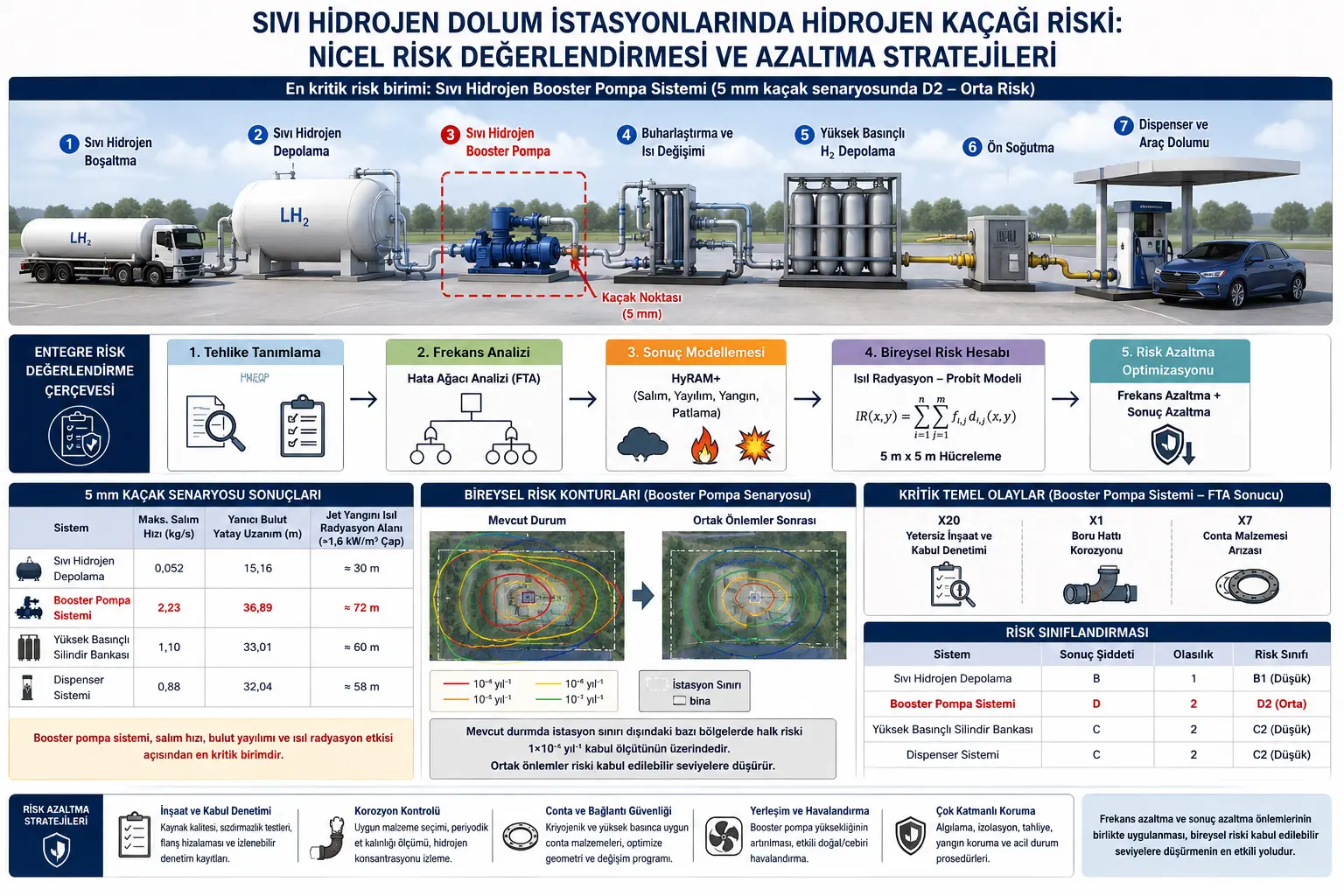
Масъалаи асосии таҳқиқот: Хавф дар стансияҳои пуркунии ҳидрогени моеъ дар куҷо ҷамъ мешавад?
Ҳидроген дар гузариш ба энергияи тоза, махсусан барои бахши нақлиёт, ҳамчун интиқолдиҳандаи муҳими энергия баррасӣ мешавад. Мошинҳои барқии fuel-cell бартариҳое чун масофаи дароз, пуркунии зуд ва набудани carbon emissions аз exhaust доранд. Аммо паҳншавии ин мошинҳо танҳо ба vehicle technology вобаста нест; инчунин инфрасохтори пуркунии ҳидроген бояд бехатар ва дорои иқтидори калон бошад.
Liquid-hydrogen refuelling stations нисбат ба gaseous-hydrogen stations баъзе бартариҳои муҳим доранд. Volumetric storage density-и liquid hydrogen баландтар аст; яъне дар ҳамон volume миқдори бештари hydrogen нигоҳ дошта мешавад. Transport cost метавонад камтар шавад, баъд аз vaporization high-purity hydrogen ба даст оварда шавад ва дар баъзе processes storage/transport pressure нисбат ба gaseous-hydrogen systems пасттар бошад. Аз ин рӯ liquid hydrogen ҳамчун option-и қавӣ барои future high-capacity hydrogen stations баррасӣ мешавад.
Аммо safety problem дар маркази study маҳз аз physical conditions паси ин бартариҳо бармеояд. Liquid hydrogen дар very low temperature, under cryogenic conditions нигоҳ дошта мешавад. Дар баъзе points-и station, liquid phase, vaporization, high-pressure gas phase, heat exchange ва vehicle refuelling дар як process chain ҷой доранд. Ин вазъ makes it complex to determine how hydrogen disperses after leak, how quickly it forms flammable mixture, and when it can become jet fire or, under delayed ignition, explosion.
Study махсусан баъзе hazard properties-и hydrogen-ро таъкид мекунад. Hydrogen colorless ва odorless аст, бинобар ин leak-ро бо human senses directly detect кардан душвор аст. Minimum ignition energy тақрибан 0,02 mJ мебошад; ин value хеле паст аст. Diffusion coefficient метавонад ба 6,11 × 10⁻⁵ m²/s расад. Ин маънои онро дорад, ки hydrogen метавонад бо air rapidly mix шуда ва under suitable conditions flammable cloud ташкил кунад. Ба таври рӯзмарра, hydrogen leak метавонад invisible, odorless ва rapidly spreading risk zone созад; аммо ин analogy танҳо барои simplified explanation аст. Actual risk assessment бо modeling ва probability calculations анҷом шудааст.
Холигии адабиёт: Аз gaseous-hydrogen stations ба liquid-hydrogen stations мустақим гузаштан мумкин нест
Барои risk assessment-и hydrogen refuelling stations methods ва software мисли HAZOP, FMEA, fault-tree analysis, HyRAM+, Phast ва Safeti пештар махсусан дар gaseous-hydrogen stations зиёд истифода шудаанд. Ин studies mature approach барои leak scenarios, jet fire, explosion, individual-risk contours ва separation distances сохтаанд.
Аммо liquid-hydrogen refuelling stations same conditions надоранд. Дар ин ҷо cryogenic storage, phase change, low-temperature effects, high-pressure equipment ва liquid-to-gas transition якҷо арзёбӣ мешаванд. Risk model, ки дар gaseous-hydrogen station кор мекунад, агар direct ба liquid-hydrogen station татбиқ шавад, метавонад баъзе critical physical processes-ро miss кунад. Аз ин рӯ literature gap-и research чунин аст: бо integrated QRA framework нишон додан, ки дар liquid-hydrogen refuelling station кадом system dominant risk unit аст, кадом basic failures risk-ро бештар мекунанд ва кадом measures both leak probability ва consequence severity-ро кам карда метавонанд.
Ҳудуди station ва системаҳои таҳлилшуда
Study representative liquid-hydrogen refuelling station-ро баррасӣ мекунад. Station process аз unloading-и liquid hydrogen аз tanker, storage, pressurization бо cryogenic booster pump, vaporizer ва heat exchanger барои табдил ба high-pressure gaseous hydrogen, нигоҳдорӣ дар high-pressure cylinder bank, pre-cooling ва vehicle refuelling иборат аст.
Research station-ро ба six functional units ҷудо мекунад:
- Liquid-hydrogen storage,
- Liquid-hydrogen pressurization,
- Vaporization and heat exchange,
- High-pressure hydrogen storage,
- Hydrogen pre-cooling,
- Vehicle refuelling.
Мувофиқи HAZOP ва FMEA results, барои detailed risk analysis four critical systems интихоб шудаанд: liquid-hydrogen storage system, liquid-hydrogen booster-pump system, high-pressure hydrogen cylinder bank ва dispenser system. Ин choice муҳим аст, зеро study entire station-ро ҳамчун single hazard box намебинад; онро engineering system мешуморад, ки equipment-и гуногун separate risk contribution доранд.
HAZOP ва FMEA чӣ нишон доданд?
HAZOP deviations-и process parameters мисли pressure, temperature, flow ва liquid level-ро меомӯзад. Масалан, “high pressure”, “low temperature”, “no flow”, “reverse flow” conditions дар ҳар process node бо possible causes and consequences арзёбӣ мешаванд. Study station-ро ба eight analysis nodes ҷудо карда ва дар онҳо 61 process deviation ва 223 potential accident scenario муайян кардааст.
Аз ин 223 scenarios, 171 low risk ва 52 medium risk classified шудаанд. High ё very-high risk scenario ёфт нашудааст. Аммо ин result маънои “station completely safe” надорад. Зеро medium-risk scenarios дар certain nodes concentrate шудаанд. Especially liquid-hydrogen storage, liquid-hydrogen pressurization, high-pressure hydrogen storage ва dispenser systems stand out. Liquid-hydrogen pressurization ва high-pressure hydrogen storage nodes ҳар яке 11 medium-risk scenario доранд.
FMEA equipment/component level failures-ро examines мекунад. Study барои critical systems 231 failure mode ва 427 potential cause муайян кардааст. FMEA results high-risk failure mode нишон намедиҳанд, аммо medium-risk failures махсусан around valve leak, pipeline leak, seal failure ва sensor failure concentrate мешаванд. Ин finding муҳим аст: hydrogen safety танҳо dramatic scenarios мисли exploding large tank нест. Seal, valve, connection, sensor ва pipe failures, ки ordinary менамоянд, метавонанд chain reaction шуда serious leak and fire risk созанд.
Formula-и FMEA risk index
Basic relation барои FMEA risk classification чунин аст:
[ RI = SI + PI ]
Дар ин ҷо RI risk index, SI severity index ва PI occurrence-probability index мебошад. SI нишон медиҳад failure чӣ қадар severe consequence дорад, PI бошад how likely it is. Масалан, small leak if frequent метавонад high PI дошта бошад; агар fatal consequence expected набошад SI lower мешавад. Conversely, rare but fatal scenario high SI ва low PI дошта метавонад. Study ин dimensions-ро combine карда failure modes-ро ба low, acceptable, medium and high-risk classes ҷудо кардааст.
Fault-tree analysis: Ҳатто як basic event метавонад leak-ро оғоз кунад
Пас аз муайян кардани critical systems бо HAZOP ва FMEA, fault-tree analysis анҷом шудааст. Fault-tree analysis нишон медиҳад top event аз кадом combinations of basic events ба амал омада метавонад. Дар ин study top event hydrogen release from relevant system мебошад. Масалан, барои booster-pump system top event ҳамчун “hydrogen release from liquid-hydrogen booster-pump system” defined шудааст.
Дар booster-pump fault tree pipeline failure, pump-body damage, pump-accessory failure, human factors ва third-party damage ба назар гирифта шудаанд. Basic events X1 то X27 дар study pipeline corrosion, connection failure, pressure-control valve failure, insulation failure, pump-body quality issue, design defect, seal-material failure, incorrect seal installation, flange leak, valve-body leak, insufficient construction-personnel competence, inadequate corrosion control, inadequate welding, inadequate acceptance inspection, lack of maintenance, lack of safety management ва natural disasters-ро дар бар мегиранд.
Дар booster-pump fault tree 26 minimal cut sets ёфт шудаанд. Аз онҳо 25 single-event sets мебошанд; танҳо one two-event set аст. Ин нишон медиҳад, ки system дар баъзе points ба single failures sensitive аст. Ба ибораи дигар, certain basic events alone метавонанд top event — hydrogen release — ро trigger кунанд. Ин finding critical importance-и protection layers ва quality-assurance processes-ро нишон медиҳад.
Study се basic event-ро махсусан барои booster-pump system highlighted мекунад:
- X20: Inadequate construction/acceptance inspection,
- X1: Pipeline corrosion damage,
- X7: Seal-material failure.
Ин three events бо сабаби high contributions in probability and importance ҳамчун priority risk-reduction targets қабул шудаанд. Ин practical value-и study-ро зиёд мекунад: risk not only from “hydrogen hazard”, but from concrete engineering processes чун inspection, material, welding, connection, corrosion ва maintenance.
Мантиқи probability calculations
Basic-event probabilities дар study бо two methods муайян шудаанд. Барои sensors, safety valves, control valves ва similar equipment, OREDA database ва HIAD 2.1 hydrogen incident data истифода шуда data-based probability estimation анҷом шудааст. Барои events with weak statistical data, expert judgment ва fuzzy mathematics combined шудаанд.
One important formula барои database-based failure-rate estimation чунин аст:
\[ \bar{\lambda}=\frac{1}{\sum_{i=1}^{k}\frac{1}{\frac{\lambda_i}{\tau_i}+\hat{\sigma}_i^2}}\times\sum_{i=1}^{k}\left(\frac{1}{\frac{\lambda_i}{\tau_i}+\hat{\sigma}_i^2}\times\frac{n_i}{\tau_i}\right) \]
Дар ин ҷо \bar{\lambda} average failure rate барои component type; \lambda_i reported failure rate барои sample i; \hat{\sigma}_i estimated standard deviation of sample; n_i number of failures; ва \tau_i operating time мебошад. Main idea он аст, ки failure data from different sources бо uncertainties weighted шуда appropriate average failure rate гирифта шавад.
Барои repairable components, unit failure probability relation чунин аст:
\[ F=\frac{\lambda}{\lambda+\mu}\approx\frac{\lambda}{\mu}=\lambda t \]
Дар ин ҷо F failure probability, \lambda weighted failure rate, \mu repair rate ва t mean repair time мебошад. Study assume мекунад \lambda much smaller than \mu, so relation to F ≈ λt reduces. Practically, as failure rate and repair time increase, probability component is in failed state increases.
Top-event probability дар fault tree via minimal cut sets ҳисоб шудааст:
\[ P(T)=P\left(\bigcup_{j=1}^{n}K_j\right) \]
Дар ин ҷо P(T) probability of top event, hydrogen release from system; K_j j-th minimal cut set. Minimal cut set is smallest combination of basic events sufficient to cause top event. If many minimal cut sets contain a single event, system is more vulnerable to single failures.
Calculated top-event probabilities are:
| System | Hydrogen-release top-event probability |
|---|---|
| Liquid-hydrogen storage system | 9,9956 × 10⁻³ |
| Liquid-hydrogen booster-pump system | 1,1115 × 10⁻² |
| High-pressure hydrogen cylinder bank | 1,0045 × 10⁻² |
| Dispenser system | 1,4282 × 10⁻² |
Дар table dispenser system numerically highest top-event probability дорад. Аммо integrated risk assessment dominant risk unit-ро booster-pump system интихоб мекунад. Сабаб ин аст, ки танҳо release probability не, балки release rate, flammable-cloud extent, jet-fire radiation footprint ва individual-risk contours together considered шудаанд. Therefore most critical system need not have highest probability alone; probability and consequence severity jointly determine risk.
Modeling-и consequence: Чаро scenario-и leak-и 5 mm муҳим аст?
Study representative small-hole leak ҳамчун 5 mm equivalent leak diameter интихоб кардааст. Small-hole leaks метавонанд share-и meaningful аз loss-of-containment events ташкил кунанд, бинобар ин дар engineering risk analysis scenario-и муҳим мебошанд. Барои four systems separate release parameters defined шудаанд:
| System | Leak location | Pipe diameter | Pipe length | Leak diameter | Temperature | Pressure |
|---|---|---|---|---|---|---|
| Liquid-hydrogen storage | Storage-vessel outlet pipe | 48,3 mm | 5 m | 5 mm | 20 K | 0,45 MPa |
| Booster pump | Pump-outlet pipe | 34 mm | 3 m | 5 mm | 28 K | 100 MPa |
| High-pressure cylinder bank | Cylinder-bank outlet pipe | 18 mm | 5 m | 5 mm | 288,15 K | 100 MPa |
| Dispenser | Dispenser outlet pipe | 18 mm | 2,5 m | 5 mm | 233,15 K | 70 MPa |
HyRAM+ 5.1 барои calculate кардани hydrogen release rate, jet dispersion, jet-fire thermal radiation ва explosion overpressure after delayed ignition истифода шудааст. Thermophysical properties аз CoolProp database гирифта шудаанд. One limitation should be noted: consequence analysis focuses on post-vaporization dispersion, combustion and explosion; flashing ё two-phase flow near orifice detailed solved нашудааст. Cryogenic liquid-hydrogen releases, after orifice, ҳамчун equivalent vaporized gaseous-hydrogen jet at engineering scale model шудаанд.
Mass release rate ва jet model
Thermodynamic orifice model used in HyRAM+ assumes isentropic flow through leak point. Basic relations барои orifice velocity ва mass flow are:
\[ \frac{v^2}{2}+h=h_0 \]
\[ \dot{m}=\frac{\pi}{4}d^2m''C_d=\frac{\pi}{4}d^2\rho vC_d \]
Дар ин ҷо v orifice velocity, h_0 upstream stagnation enthalpy, h specific enthalpy at orifice, \dot{m} mass release rate, d equivalent leak diameter, \rho fluid density ва C_d discharge coefficient мебошанд. First formula energy balance-ро represent мекунад: қисми pressure and thermal energy of fluid at leak converts to velocity. Second formula uses velocity, density and hole area to calculate kilograms of hydrogen released per second.
For hydrogen-jet dispersion, Gaussian-like radial profiles for velocity, density and hydrogen mass fraction are used:
\[ v=v_{cl}\exp\left(-\frac{r^2}{B^2}\right) \]
\[ \rho=(\rho_{cl}-\rho_{amb})\exp\left(-\frac{r^2}{\lambda^2B^2}\right)+\rho_{amb} \]
\[ \rho Y=\rho_{cl}Y_{cl}\exp\left(-\frac{r^2}{\lambda^2B^2}\right) \]
Дар ин ҷо r radial distance from jet center, B jet half-width, \lambda ratio between density-spread and velocity-spread widths, Y hydrogen mass fraction, cl centerline conditions ва amb ambient conditions мебошанд. Ин formulas нишон медиҳанд, ки hydrogen concentration ва velocity at jet center highest мебошанд ва бо radial distance decrease мекунанд.
Jet fire ва thermal radiation
Агар hydrogen leak immediately ignites, jet fire ба вуҷуд меояд. Jet fire combustion of high-pressure hydrogen as flaming jet from leak point мебошад. Main lethal effect often thermal radiation аст. Study uses HyRAM+ flame-length correlation and weighted multi-source radiation model барои jet-flame length and thermal radiation.
Dimensionless flame length is:
\[ L^*=\begin{cases}\frac{13.5Fr^{2/5}}{(1+0.07Fr^2)^{1/5}}, & Fr<5\\ 23, & Fr>5 \end{cases} \]
Дар ин ҷо L* dimensionless flame length and Fr Froude number мебошанд. Froude number relative dominance of jet momentum versus gravity-ро нишон медиҳад. In high-momentum jets flame метавонад further extend; at low momentum buoyancy and gravity more strongly affect flame geometry.
Thermal-radiation calculation uses:
\[ q=\tau S_{rad}\frac{V_F}{A_f} \]
\[ S_{rad}=X_{rad}\dot{m}_{fuel}\Delta H_c \]
Дар ин ҷо q thermal-radiation flux at target, \tau atmospheric transmissivity, V_F view factor, A_f flame surface area, S_{rad} total radiative power, X_{rad} radiative fraction, \dot{m}_{fuel} fuel mass flow rate ва \Delta H_c heat of combustion мебошанд. Бо забони сода, as amount of escaping hydrogen and combustion energy increase, heat radiated to surroundings increases. Ин heat метавонад nearby people, equipment, plastic materials, wood surfaces and safety systems-ро damage кунад.
Delayed ignition ва explosion overpressure
Агар hydrogen immediately ignite нашавад, аввал flammable cloud formed мешавад. Агар cloud later encounters ignition source, explosion ё rapid combustion метавонад overpressure эҷод кунад. Study delayed-ignition explosion overpressure-ро бо Baker-Strehlow-Tang model ҳисоб кардааст.
Flammable-cloud mass, combustion energy and scaled-distance relations are:
\[ m_{flam}=\int_{S=0}^{S=\infty}\left(\int_{r_Y=Y_{UFL}}^{r_Y=Y_{LFL}}\rho Y2\pi r\,dr\right)ds \]
\[ E_{flam}=k_{reflection}m_{flam}\Delta H_c \]
\[ R^*_{BST}=\frac{R}{(E_{flam}/P_{ambient})^{1/3}} \]
\[ P^*=\frac{P_s}{P_{ambient}} \]
Дар ин ҷо m_flam flammable-cloud mass, Y_LFL and Y_UFL hydrogen mass fractions at lower and upper flammability limits, E_flam combustion energy, k_reflection ground-reflection coefficient, R distance from explosion center to target, P_s peak overpressure and P_ambient ambient pressure мебошанд. Model explosion effect-ро not merely by presence of cloud, but by flammable-range hydrogen mass, energy and target distance calculates.
Results: Чаро booster-pump system prominent шуд?
Maximum hydrogen release rates calculated for four critical systems are:
| System | Maximum hydrogen release rate |
|---|---|
| Liquid-hydrogen storage system | 0,052 kg/s |
| Liquid-hydrogen booster-pump system | 2,23 kg/s |
| High-pressure hydrogen cylinder bank | 1,1 kg/s |
| Dispenser system | 0,88 kg/s |
Ин result clearly shows why booster-pump system becomes critical. Under same 5 mm leak diameter, 100 MPa pressure and cryogenic conditions at pump outlet produce much higher mass release rate. A 2,23 kg/s hydrogen release, even from apparently small 5 mm leak, can create large flammable cloud and severe thermal-radiation area.
Flammable-cloud extents based on 4 volume-percent hydrogen lower flammability limit are:
| System | Horizontal distance | Minimum vertical distance | Maximum vertical distance |
|---|---|---|---|
| Liquid-hydrogen storage system | 15,16 m | -0,99 m | 3,19 m |
| Liquid-hydrogen booster-pump system | 36,89 m | -2,72 m | 3,63 m |
| High-pressure hydrogen cylinder bank | 33,01 m | -1,27 m | 1,63 m |
| Dispenser system | 32,04 m | -1,32 m | 1,76 m |
Дар booster-pump system flammable cloud horizontal extent reaches 36,89 m. This is critical for station layout, equipment spacing, personnel position, vehicle waiting areas and public exposure near site boundary. Hydrogen mole-fraction fields shown in study indicate hydrogen moves at high concentration along jet axis and then dilutes by mixing with ambient air. White contour represents 4 volume-percent lower flammability limit. Area inside contour is hazardous for fire or explosion if ignition source exists.
Jet-fire analysis again shows booster-pump system has widest effect. Approximate diameter of region above 1,6 kW/m² is given as 72 m. For booster-pump system, areas exceeding 4, 12,5 and 25 kW/m² thresholds are calculated as 1385 m², 531 m² and 227 m² respectively. According to thresholds used in study, 37,5 kW/m² can be 100% fatal under 1-minute exposure, 25 kW/m² is very critical for serious injury and fatality under prolonged exposure, 12,5 kW/m² important for burns and material damage, and 4 kW/m² can cause pain after more than 20 seconds exposure.
Explosion-overpressure results are different. Under 60-second delayed-ignition scenarios, peak overpressures stay below 25 kPa in all scenarios. Personnel effects are mostly light injury and facility effects mainly minor damage such as glass breakage. Therefore study chooses jet-fire thermal radiation as dominant lethal mechanism for individual-risk calculation.
Individual-risk calculation: Annual fatality risk at a particular point
Individual risk means annual probability that a person continuously present at a particular point is exposed to fatal effect. Basic formula used is:
\[ IR(x,y)=\sum_{i=1}^{n}\sum_{j=1}^{m}f_{i,j}d_{i,j}(x,y) \]
Дар ин ҷо IR(x,y) individual risk at coordinate (x,y), f_i,j annual frequency of accident consequence j from source i, and d_i,j(x,y) conditional fatality probability at same point. Formula multiplies two things: how often accident can occur and how fatal it would be at that point if it occurs.
Physical-effect values, thermal radiation or explosion pressure, are converted to fatality probability using probit model:
\[ d_i=\frac{1}{\sqrt{2\pi}}\int_{-\infty}^{Y-5}\exp\left(-\frac{u^2}{2}\right)du \]
Дар ин ҷо d_i fatality probability, Y probit variable, u integration variable. For thermal radiation dose relation used is:
\[ Y=-37.23+2.56\ln D \]
\[ D=I^{1.33}t_s \]
Дар ин ҷо D lethal dose, I thermal-radiation flux and t_s exposure time. Exposure time is 60 seconds and area around station divided into 5 m × 5 m square cells, with individual risk calculated at center of each cell.
Risk classification: D2 чӣ маъно дорад?
Jet-fire probabilities and consequence severity are assessed together. Calculated jet-fire probabilities are:
| System | Hydrogen-release probability | Release rate | Jet-fire probability | Probability class |
|---|---|---|---|---|
| Liquid-hydrogen storage system | 9,9956 × 10⁻³ | 0,052 kg/s | 7,996 × 10⁻⁵ | 1 |
| Liquid-hydrogen booster-pump system | 1,1115 × 10⁻² | 2,23 kg/s | 5,891 × 10⁻⁴ | 2 |
| High-pressure hydrogen cylinder bank | 1,0045 × 10⁻² | 1,1 kg/s | 5,324 × 10⁻⁴ | 2 |
| Dispenser system | 1,4282 × 10⁻² | 0,88 kg/s | 7,569 × 10⁻⁴ | 2 |
For personnel impact, site population density is assumed 0,003 person/m². Under this assumption, for booster-pump system deaths, severe injuries and minor injuries are calculated as 1, 2 and 4 respectively. For high-pressure cylinder bank and dispenser systems death count is 0, severe injury 1 and minor injury 2. For liquid-hydrogen storage system, death, severe injury and minor injury are approximately zero in this scenario.
Integrated risk classification is:
| System | Consequence severity | Probability | Risk class |
|---|---|---|---|
| Liquid-hydrogen storage system | B | 1 | B1, low risk |
| Liquid-hydrogen booster-pump system | D | 2 | D2, medium risk |
| High-pressure hydrogen cylinder bank | C | 2 | C2, low risk |
| Dispenser system | C | 2 | C2, low risk |
Table makes main conclusion clear: booster-pump system is critical not only by probability but also by consequence severity and is only one of four systems classified as medium risk. Therefore station-level individual-risk map and risk-reduction options are evaluated around this system.
ALARP ва public risk: Чаро outside-site boundary муҳим аст?
Study uses ALARP approach and UK HSE individual-risk criteria. Upper tolerable limit is 1 × 10⁻³ year⁻¹ for workers, 1 × 10⁻⁴ year⁻¹ for public, and broadly acceptable threshold is 1 × 10⁻⁶ year⁻¹ for both groups.
Individual risk near booster pump reaches order of 10⁻⁴ year⁻¹. Worker risk within station generally remains tolerable, while station building area drops below 10⁻⁷ year⁻¹. However, in some nearby areas outside site boundary public risk exceeds 1 × 10⁻⁴ year⁻¹ acceptance criterion. This is one of most critical safety messages: design appearing acceptable for workers inside site can create unacceptable risk for public outside boundary.
Ин result daily-life relevance ҳам дорад. Hydrogen refuelling stations are not only industrial sites with technical staff; users, service personnel, pedestrians and nearby areas may be affected when stations are near urban or transport corridors. Therefore risk assessment must examine not just what happens inside equipment, but effects of leak extending beyond site boundary.
Risk reduction: Кам кардани probability ё consequence?
Study evaluates risk reduction from two directions: reducing leak probability and reducing consequence severity. Best result is achieved by combining both approaches.
Critical basic events X20, X1 and X7 for booster-pump system are targeted. For X20, inadequate construction and acceptance inspection, full-process acceptance system for equipment and piping is proposed, emphasizing welding quality, flange alignment, system leak-tightness and traceable inspection records. For X1, pipeline corrosion, cryogenic/corrosion-resistant materials, enhanced protection at elbows/welds, hydrogen-concentration monitoring, wall-thickness measurement and periodic borescope inspection are recommended. For X7, seal-material failure, seal materials resistant to cryogenic temperature and high pressure, optimized sealing geometry and preventive replacement program are proposed.
When these measures are applied, booster-pump release probability is reduced to 1 × 10⁻³ and jet-fire probability to 5,3 × 10⁻⁵. This shows probability-reduction measures substantially shrink risk map. However, study also notes probability reduction alone does not eliminate all high-risk contours.
On consequence-reduction side, increasing booster-pump installation height is examined. This helps reduce near-ground hydrogen accumulation and shrinks 10⁻⁴ and 10⁻⁶ year⁻¹ risk contours. In particular, keeping 10⁻⁴ year⁻¹ contour largely within site boundary is viewed positively for public risk. But this measure alone does not produce strong enough risk reduction.
Most effective approach is combined frequency-reduction and consequence-reduction measures. Study shows off-site individual risk and total risk contour decline more under combined measures than under single measures. Thus risk management in liquid-hydrogen refuelling stations should not rely only on “if leak occurs, put up barrier”; it should be supported from outset by quality, materials, maintenance, monitoring and acceptance-inspection measures that reduce leak probability.
Ҷиҳатҳои қавии таҳқиқот
Яке аз strengths-и study ин аст, ки он танҳо бо qualitative hazard identification маҳдуд намешавад. HAZOP ва FMEA hazards-ро identify мекунанд, fault-tree analysis contribution-и basic events-ро ҳисоб мекунад, HyRAM+ physical consequences-ро model мекунад ва дар final stage individual-risk contours тавлид мешаванд. Ҳамин тавр study аз “which system is hazardous?” ба “which basic failure, through which physical consequence, creates unacceptable risk in which area?” мегузарад ва integrated framework пешниҳод мекунад.
Strength-и дигар ин аст, ки risk-reduction recommendations directly from analysis results derive мешаванд. Масалан, recommendations барои construction acceptance inspection, pipeline corrosion ва seal-material failure general safety advice нестанд; онҳо priority шудаанд, зеро дар booster-pump fault tree contribution-и баланд доштанд. Similarly equipment layout, ventilation ва radiation protection ба cloud ва thermal-radiation footprints from HyRAM+ results асос ёфтаанд.
Маҳдудиятҳои таҳқиқот
Limitations, ки study худаш нишон медиҳад, бояд carefully read шаванд. Аввал, танҳо representative 5 mm leak scenario model шудааст. Large-diameter pipe ruptures, long-duration microleaks ё complex scenarios with multiple equipment failures explicitly examined нашудаанд. Аз ин рӯ results should not be seen as complete map of all possible accidents.
Second, баъзе basic-event probabilities аз general databases adapted ё бо expert judgment estimated шудаанд. Although OREDA ва HIAD 2.1 data истифода шудаанд, operational data specific to liquid-hydrogen refuelling stations limited буда метавонанд. Ин uncertainty in fault-tree probabilities месозад.
Third, for cryogenic releases flashing ва two-phase flow near orifice detailed solved нашудаанд. Study post-vaporization release-ро as equivalent gaseous-hydrogen jet model кардааст. Ин engineering-scale assessment meaningful аст, аммо more detailed flow physics метавонад future CFD-based models талаб кунад.
Fourth, study preprint аст ва peer reviewed нашудааст. Therefore results should be treated as valuable technical analysis, not final industrial standard or validated field evidence.
Аҳамият аз нуқтаи назари гузашта, имрӯз ва оянда
Дар гузашта most hydrogen-safety studies focus on gaseous-hydrogen refuelling stations доштанд. Ин study кӯшиш мекунад knowledge gap-ро бо jointly considering cryogenic, high-pressure and phase-change conditions specific to liquid-hydrogen stations кам кунад.
For present-day infrastructure growth, safety of hydrogen refuelling requires not only capacity and cost, but early integration of layout, equipment quality, maintenance, monitoring, emergency isolation, ventilation and public risk into design. Identifying booster-pump system as critical unit is directly actionable warning for designers and operators.
For future, quantitative risk assessments like this can support safe deployment of hydrogen stations in urban, highway, logistics-center or heavy-vehicle contexts. More real operational data, CFD-supported detailed flow modeling, societal-risk curves and cost-benefit analyses could further strengthen framework.
Daily-life impact is that widespread hydrogen vehicles depend not only on vehicle technology, but on infrastructure where people can refuel safely, workers are protected and public risk in neighboring areas remains acceptable. This study treats safety problem not as invisible “hazard” but as measurable, mappable and reducible engineering problem.
Усул ва Натиҷаҳои Таҳқиқот
Қадамҳои усул
- System boundary defined: Liquid-hydrogen unloading, storage, pressurization, vaporization, high-pressure storage, pre-cooling and vehicle-refuelling processes муайян шуданд.
- HAZOP applied: Eight process nodes аз рӯи pressure, temperature, flow and liquid-level deviations таҳлил шуданд.
- FMEA applied: Critical equipment/component failures, causes, consequences and risk levels муайян шуданд.
- Fault-tree analysis conducted: Hydrogen-release top events for liquid-hydrogen storage, booster pump, high-pressure cylinder bank and dispenser systems model шуда basic-event contributions ҳисоб шуданд.
- HyRAM+ consequence modeling performed: For 5 mm leak scenario release rate, flammable cloud, jet-fire thermal radiation and explosion overpressure ҳисоб шуданд.
- Individual risk calculated: Jet-fire thermal radiation selected as lethal effect mechanism and risk contours generated with 5 m × 5 m cells.
- Risk reduction evaluated: Leak-probability reduction, consequence reduction and combined approach муқоиса шуданд.
Натиҷаҳои асосии ададӣ
| Topic | Finding |
|---|---|
| HAZOP result | 61 process deviations and 223 potential accident scenarios identified; 171 low risk, 52 medium risk; no high or very-high risk scenario. |
| FMEA result | 231 failure modes and 427 potential causes identified; no high-risk failure mode; medium risks concentrated around valve leak, pipe leak, seal failure and sensor failure. |
| Critical systems | Liquid-hydrogen storage, liquid-hydrogen booster pump, high-pressure cylinder bank and dispenser systems selected for detailed analysis. |
| Booster-pump fault tree | 26 minimal cut sets; 25 are single-event sets, showing sensitivity to single failures. |
| Critical basic events | Inadequate acceptance inspection, pipeline corrosion and seal-material failure are priority risk-reduction targets for booster-pump system. |
| Highest release rate | 2,23 kg/s in booster-pump system. |
| Largest flammable cloud | 36,89 m horizontal extent in booster-pump system. |
| Most critical jet-fire effect | Booster-pump system; areas above 4, 12,5 and 25 kW/m² are 1385, 531 and 227 m² respectively. |
| Explosion overpressure | Peak overpressure below 25 kPa in all 60-second delayed-ignition scenarios; jet fire dominates fatal risk. |
| Integrated risk class | Booster-pump system D2, medium risk; other three systems low risk. |
| Individual risk | Reaches order of 10⁻⁴ year⁻¹ near booster pump; public risk exceeds acceptance criterion in some nearby off-site areas. |
| Risk reduction | Combined frequency and consequence reduction more strongly lowers off-site individual risk and total risk contour than individual measures. |
Тафсири техникӣ
Technical meaning-и study ин аст, ки risk in liquid-hydrogen stations набояд танҳо tank-centric бошад. Booster pump transition point аст, ки liquid hydrogen ба high-pressure process мегузарад. Low temperature, high pressure, density, piping connections, sealing systems and mechanical vibration together act мекунанд. Therefore small leak can create high release rate and large flammable cloud.
Model results show fire risk dominates explosion risk under examined conditions. This particularly applies to open-site and 5 mm leak scenario. Аммо meaning is not “explosion unimportant in all LHRS accidents”. Narrower claim is: under small-hole, open-site and 60-second delayed-ignition conditions studied, jet-fire thermal radiation dominates lethal risk.
Practical message is clear: around booster pump, material selection, sealing, corrosion monitoring, acceptance inspection, ventilation, equipment layout, emergency isolation and thermal-radiation protection must be considered together. Reliance on single barrier is insufficient; multiple independent protection layers are needed.
Ёддошт оид ба Манбаъ ва Усул
Ин мақола дар асоси таҳқиқоти Jiepu Li, Xiaoxiong Lei, Shouhua Zhang, Hong Yang, Wulin Han, Weihua Wang ва Xiang Li бо унвони “Quantitative risk assessment and mitigation of hydrogen releases at a liquid hydrogen refuelling station” таҳия шудааст. Study hydrogen-leak risk in liquid-hydrogen refuelling stations quantitatively evaluates and combines HAZOP, FMEA, fault-tree analysis, HyRAM+ consequence modeling and individual-risk calculation.
Source is preprint research paper and explicitly contains “This preprint research paper has not been peer reviewed”. Therefore study has not undergone peer review. Results should be read as technical risk assessment awaiting completed peer-review process, not final field evidence or industrial standard.
Explanations in this content are based on PDF study. No claims absent from PDF such as definite implementation success, commercial success, field success, safety guarantee or regulatory approval have been added. Study is not direct accident investigation validated by field accident data; it is quantitative risk assessment on representative station layout, fault-tree analysis and HyRAM+-based consequence modeling.
Study has important limitations. Only representative 5 mm leak scenario was modeled; large pipe ruptures, persistent microleaks and multiple-equipment failures were not explicitly examined. Some basic-event probabilities were adapted from general databases or estimated with expert judgment. Near-orifice two-phase flow for cryogenic liquid-hydrogen release was not resolved in detail; post-vaporization release was treated as equivalent gaseous-hydrogen jet. These limitations require cautious interpretation of results.
Шарҳ гузоред
Нишонии почтаи электронии шумо нашр намешавад. Майдонҳои ҳатмӣ бо * нишон дода шудаанд