

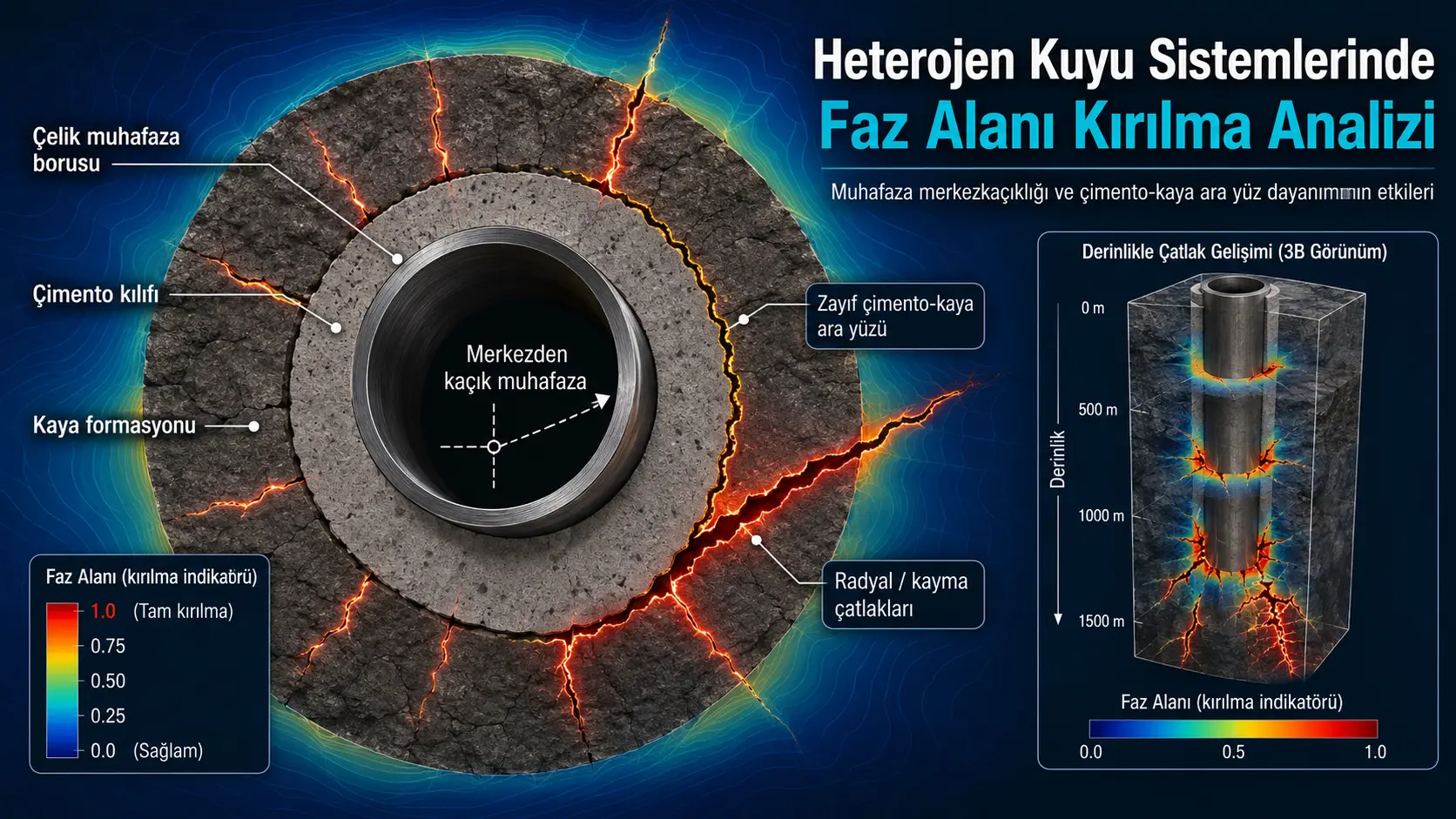
Дар чоҳҳои пармакунӣ қубури пӯлодии муҳосиракунанда, ғилофи сементии атрофи он ва қабати сангӣ як системаи бисёрқабатаи борбардор ва изолятсиониро ташкил медиҳанд. Дур шудани қубури муҳосиракунанда аз маркази чоҳ ё заиф шудани пайванди байни семент ва санг метавонад шиддатҳоро дар минтақаҳои муайян мутамарказ карда, боиси оғози барвақти тарқишҳо, тағйири самти онҳо ва пайдоиши роҳҳои осебе шавад, ки барои гузариши моеъ мусоиданд.
Барои таҳқиқи ин раванд муҳаққиқон модели гибридии шикасти phase-field-ро таҳия карданд, ки interface-ҳои заифи маводро низ дар бар мегирад. Модел аввал бо ҳалли аналитикӣ ва масъалаҳои муқоисавии пештар нашршуда санҷида шуд. Сипас eccentricity-и casing, strength-и cement-rock interface ва three-dimensional crack interactions бо таҷрибаҳои алоҳидаи ададӣ омӯхта шуданд.
Натиҷаҳо нишон доданд, ки вақте casing дар марказ буд, crack-initiation pressure 71 MPa буд, аммо дар eccentricity-и yüzde 83,33 то 49,5 MPa коҳиш ёфт. Ин тақрибан yüzde 30 loss of strength-ро ифода мекунад. Вақте eccentricity ба yüzde 50 расид, дар rock formation non-radial inclined shear cracks низ пайдо шуданд. Агар cement-rock interface то тақрибан yüzde 30 strength-и surrounding materials заиф шавад, cracks ба ҷои гузаштан ба rock along interface deflect шуда, дар cement radial cracks-и бештар ба вуҷуд меоянд.
Чаро well integrity муҳим аст?
Чоҳҳои сементшуда танҳо дар истеҳсоли нафт ва газ истифода намешаванд. Geothermal energy, underground hydrogen and natural-gas storage, carbon-dioxide injection, underground waste storage, groundwater production ва various mining applications низ ба similar well architecture такя мекунанд. Дар ин system steel casing mechanical support медиҳад, cement sheath gap байни pipe ва rock-ро пур мекунад ва fluid migration байни different geological layers-ро маҳдуд месозад.
Аммо агар casing комилан дар center of well ҷойгир нашавад, cement thickness дар circumferential direction тағйир меёбад. Thin cement region метавонад higher stresses гирад. Cement shrinkage, drilling-mud residues, voids, temperature changes ва inadequate cementing ҳам cement-rock ё steel-cement interfaces-ро заиф карда метавонанд.
Main damage modes radial cracks, shear cracks, steel-cement debonding, cement-rock debonding ва disk-shaped fractures perpendicular to well axis мебошанд. Вақте ин defects якҷо мешаванд, fluid channels маъруф ба microannulus пайдо шуда, hydraulic isolation of well метавонад вайрон шавад.
Phase-field method crack-ро чӣ гуна ифода мекунад?
Дар traditional finite-element models crack path метавонад пешакӣ муайян карда шавад. Дар phase-field approach crack на ҳамчун sharp geometric surface, балки ҳамчун diffuse region, ки material аз intact state ба damaged state мегузарад, ифода мешавад.
Дар model d phase-field variable damage state-и material-ро нишон медиҳад. Тақрибан d = 0 intact material ва d = 1 fully cracked region-ро ифода мекунад. Material stiffness бо function-и зерин кам мешавад:
\[ g(d)=(1-d)^2 \]
Бо ин роҳ crack initiation, branching, coalescence ва direction changes байни materials метавонанд бе predefined crack line, ҳамчун натиҷаи energy minimization ба вуҷуд оянд.
Total potential energy elastic-strain energy-и two materials, regularized crack-surface energy inside volume ва interface-specific fracture energy-ро якҷо дар бар мегирад:
\[ U = \sum_{m=1}^{2}\int_{\Omega^m}g(d^m)\psi^m(\varepsilon(u^m))\,d\Omega + \sum_{m=1}^{2}\int_{\Omega^m}G_c^m \frac{1}{2} \left[ \frac{(d^m)^2}{\ell} + \ell|\nabla d^m|^2 \right]d\Omega + \int_{\Gamma_{\mathrm{int}}}G_c^{\mathrm{ib}}\tilde{d}^{\,2}\,d\Gamma \]
Дар ин ҷо u displacement field, ε small-strain tensor, ψ elastic-energy density, Gc critical energy-release rate, ℓ phase-field length scale ва Γint material interface мебошанд.
Interface strength чӣ гуна тағйир дода шуд?
Strength-и bond between cement and rock бо параметри κ муайян шуд. Effective interface fracture energy чунин ифода гардид:
\[ G_c^{\mathrm{eff}}=G_c^{\mathrm{nb}}(1+\kappa) \]
Gcnb fracture energy-и neutrally bonded interface аст. κ = 0 neutral bond, κ > 0 strengthened bond, κ < 0 weakened bond-ро ифода мекунад. Масалан, агар κ = −0,7 бошад, effective fracture energy-и interface ба yüzde 30-и neutral case мефарояд.
Model дар tension-dominated regions stiffness-ро кам мекунад ва tension-compression energy split-ро истифода мебарад, ки nonphysical crack growth under compression-ро пешгирӣ мекунад. Барои preventing damage closure/healing history field, ки maximum tensile energy reached in past-ро нигоҳ медорад, низ истифода шудааст.
Casing eccentricity
Offset-и casing from center бо dimensionless eccentricity parameter муайян шуд:
\[ e=\frac{r_e}{R_2-R_1} \]
Дар ин ҷо re distance between casing center and well center, R1 ва R2 relevant inner and outer radii мебошанд. e = 0 concentric system, high e values geometry-ҳоро нишон медиҳанд, ки cement sheath дар як тараф noticeably thinner аст.
Model дар се марҳила тасдиқ шуд
1. Analytical stress solution дар eccentrically perforated pipe
Дар validation-и аввал cement pipe бо eccentric hole модел шуд, ки inner surface-и он 30 MPa ва outer surface 50 MPa pressure дошт; tangential stresses бо Jeffery closed-form analytical solution муқоиса шуданд. Inner radius 69,5 mm, outer radius 94,5 mm, center offset 10 mm ва eccentricity yüzde 40 интихоб шуд.
Solution бо тақрибан 7,6 million quadrilateral finite elements analytical stress distribution-ро умуман reproduce кард. Maximum relative error дар 90-degree location бо high stress gradient yüzde 11,37 буд. Researchers ин difference-ро ба stress resolution-и first-order quadrilateral elements нисбат доданд.
2. Two-material plate бо weak circular interface
Дар validation-и дуюм two-material plate бо size 540 × 540 mm, initial crack-и 50 mm ва weak circular interface омӯхта шуд. Interface fracture energy 50 N/m ва weakening parameter −0,875 таъриф шуд.
Crack аввал дар material one бо opening mode пеш рафт, ҳангоми расидан ба circular weak interface along interface deflect шуд ва баъд ба material two re-enter кард. Damage path бо published reference simulation strong qualitative agreement нишон дод. Small differences дар points where crack left interface ба он нисбат дода шуданд, ки reference model interface-ро finite-thickness third material, current study бошад zero-thickness sharp surface модел кардааст.
3. Well geometry бо steel, cement ва rock
Дар validation-и сеюм realistic well section бо steel casing, cement sheath ва Castlegate sandstone formation модел шуд. Аз сабаби symmetry quarter geometry истифода шуд ва бо тақрибан 700 thousand quadrilateral elements ҳал гардид.
Model radial cracks дар cement, crack transfer into rock formation, microcracks at steel-cement interface ва debonding-ро дар agreement бо published reference study reproduce кард. Аз сабаби very high fracture energy of steel crack ба steel body дохил нашуд ва along steel-cement boundary deflect шуд.
Бо зиёд шудани eccentricity strength of well кам шуд
Researchers seven different eccentricity values аз yüzde 0 то yüzde 83,33 истифода карданд. Internal well pressure at crack initiation чунин тағйир ёфт:
| Casing eccentricity | Crack-initiation pressure |
|---|---|
| %0 | 71 MPa |
| %16,67 | 65,5 MPa |
| %33,33 | 61 MPa |
| %50 | 57 MPa |
| %66,67 | 53 MPa |
| %75 | 51,5 MPa |
| %83,33 | 49,5 MPa |
Вақте eccentricity аз yüzde 0 то yüzde 83,33 зиёд шуд, crack-initiation pressure 21,5 MPa кам шуд. Дар concentric geometry tangential stress around cement асосан uniform буд; дар eccentric geometries дар thinnest cement region concentrated шуд. First crack низ consistently дар ҳамин thin region оғоз ёфт.
Ҳангоми pressure 97 MPa, concentric well symmetric crack pattern-ро нигоҳ дошт, аммо бо increasing eccentricity damage clearly asymmetric шуд. Баъд аз first crack, cracks-и нав дар thicker cement regions бо counterclockwise sequence пайдо шуданд.
Yüzde 50 eccentricity fracture mode-и нав ба вуҷуд овард
Вақте eccentricity ба yüzde 50 расид, inclined cracks deviating from radial direction дар rock мушоҳида шуданд. Ин cracks, ки тақрибан дар 10-degree azimuth region оғоз шуданд, бо high local shear stresses вобаста буданд. Ин fracture mode, ки дар concentric system набуд, нишон дод, ки geometric imperfection на танҳо fracture pressure, балки crack type ва direction-ро ҳам тағйир дода метавонад.
Weak interface crack path-ро тағйир дод
Барои cement-rock interface κ аз −0,5 то −0,9 тағйир дода шуд. Clear effect of interface weakening дар κ ≤ −0,7 пайдо шуд. Ин шарт маънои онро дорад, ки interface relative to neutral bond effective fracture energy-и yüzde 30 ё камтар дорад.
Дар stronger interfaces radial crack-и cement directly into rock formation мегузашт. Дар weak interfaces crack ба ҷои entering rock along cement-rock boundary deflect шуд. Trapping crack at interface immediate stress release дар cement sheath-ро пешгирӣ кард ва conditions барои formation of new radial cracks фароҳам овард.
Дар κ = −0,8, ки interface yüzde 80 weakened буд, load-displacement curves multiple successive fracture jumps нишон доданд. Дар neutral bond бошад two radial cracks almost simultaneously оғоз шуда, single dominant fracture point дар curve пайдо шуд.
Weakest interface на ҳамеша case-и earliest rock cracking буд. Барои κ = −0,8 crack ба rock formation дар 123,5 MPa гузашт, барои κ = −0,9 transition то 144 MPa delayed шуд. Сабаб ин буд, ки yüzde 90 weakened interface earlier and more extensively debonded, stress in cement-ро locally relieved ва rock system-ро mechanically partially decoupled кард.
Ин result нишон медиҳад, ки interface weakness well behavior-ро one-directional and linear тағйир намедиҳад. Weaker bond interface debonding-ро осон мекунад ва дар баъзе conditions crack transfer into rock-ро delay карда метавонад; дар иваз more damage in cement ва potential leakage paths ба вуҷуд меорад.
three-dimensional model processes-еро нишон дод, ки plane-strain assumption намебинад
Дар final stage three-dimensional well model with 100 mm depth ҳал шуд. Cement-rock interface yüzde 90 weakened шуд. Initial mesh аз 724 thousand trilinear eight-node elements иборат буд. Бо damage progression adaptive mesh refinement фаъол гардид.
| Internal pressure | Three-dimensional damage development |
|---|---|
| 70,5 MPa | First full-depth radial crack through cement formed and stopped at weak interface. |
| 75 MPa | Second full-depth radial crack and additional interface debonding formed. |
| 101,5 MPa | New crack initiated only in upper one-third of well. |
| 105 MPa | Limited-depth crack propagated upward/downward while deviating from well axis. |
| 106,5 MPa | Similar new partial-depth crack formed. |
| 128 MPa | Two cracks began crossing cement-rock interface at different depths. |
| 128,5-129 MPa | Cracks coalesced along interface; one propagated through full depth to complete damage. |
Stress shadows around initial cracks prevented later cracks from initiating simultaneously through full well depth. Consequently cracks nucleated at different depths, deviated from axis and coalesced along interface. Such behavior cannot be represented by two-dimensional plane-strain models.
Calculation initially had about 400 thousand degrees of freedom and reached 113 million degrees of freedom after adaptive refinement. Simulation required about 20 thousand core-hours on cluster with 2,45 GHz AMD 64-core processors. Researchers estimated same solution with uniformly fine mesh would require about 12 billion degrees of freedom.
Engineering meaning чист?
Study нишон медиҳад, ки quality of well centralization набояд танҳо аз cement consumption ё installation tolerance дида шавад. Casing offset метавонад pressure at crack initiation-ро кам кунад ва баъд аз threshold муайян new shear-fracture modes in rock ба вуҷуд орад.
Cement-rock bond strength низ набояд танҳо “strong” ё “weak” арзёбӣ шавад. Interface strength муайян карда метавонад, ки crack ба rock мегузарад ё не, along interface deflect мешавад ё не, чанд new cracks in cement пайдо мешаванд ва damage through depth чӣ гуна coalesce мешавад.
Model computational framework барои cementing design, casing-centralizer placement, interpretation of cement-bond logs ва evaluation of well pressure limits медиҳад. Аммо пеш аз истифодаи results ҳамчун direct field safety factor онҳо бояд бо actual well geometries, material properties, temperature history, pore pressure ва fluid effects recalibrated шаванд.
Усул ва бозёфтҳои таҳқиқот
Research design
Study ба ҷои physical experiment validated computational experiments истифода мекунад. Hybrid phase-field fracture model ба multi-material finite-element systems with weak interfaces татбиқ шудааст. Solution бо staggered iterative algorithm, ки displacement ва damage fields навбатӣ ҳал мешаванд, иҷро шудааст.
- Дар two-dimensional analyses plane-strain assumption истифода шуд.
- Bilinar quadrilateral elements дар two-dimensional meshes ва trilinear hexahedral elements дар three-dimensional mesh истифода шуданд.
- Convergence tolerance барои L2 norm difference of nodal damage vectors between two successive iterations 10−2 таъин шуд.
- Дар visualizations elements бо damage variable greater than 0,9 cracked region ҳисоб шуданд.
- Model дар deal.II open-source finite-element library татбиқ шуд.
- three-dimensional solution parallel computing ва adaptive mesh refinement истифода кард.
Materials used in main numerical experiments
| Property | Rock formation | Cement sheath | Steel casing |
|---|---|---|---|
| Young modulus | 8,28 GPa | 25 GPa | 200 GPa |
| Poisson ratio | 0,25 | 0,20 | 0,30 |
| Critical energy-release rate | 100 N/m | 80 N/m | 100.000 N/m |
| Phase-field length scale | 2,7 × 10⁻⁴ m | 2,7 × 10⁻⁴ m | 2,7 × 10⁻⁴ m |
Main findings
- When casing eccentricity increased from yüzde 0 to yüzde 83,33, crack-initiation pressure dropped from 71 MPa to 49,5 MPa.
- First crack consistently initiated in thinnest region of cement sheath in eccentric wells.
- At eccentricity yüzde 50 and above, inclined cracks formed in rock formation where shear stress was high.
- When effective cement-rock interface strength fell to yüzde 30 of neutral case or below, deflection and debonding along interface dominated over crack transfer.
- Weak interface promoted successive new radial cracks in cement.
- Most weakened interface was not case of earliest rock cracking; early extensive debonding relieved stress locally and delayed transfer into rock.
- three-dimensional model revealed crack initiation at different depths, stress shadowing, off-axis crack growth and coalescence along interface.
Маҳдудиятҳо
- Study preprint аст ва peer review нашудааст.
- Results physical field experiments нестанд, балки validated numerical-model results мебошанд.
- Model ба linear isotropic elasticity ва brittle phase-field assumptions асос ёфтааст.
- At interface only opening-dominated damage modeled мешавад; frictional slip ignored аст.
- Fluid flow, poroelasticity, thermal effects ва hydro-mechanical coupling included нестанд.
- Most two-dimensional results depend on plane-strain assumption.
- three-dimensional model 100 mm deep demonstration problem аст, not direct field-scale representation.
- Maximum relative error in analytical stress validation is yüzde 11,37.
- Calculated pressure thresholds depend on selected geometry, material properties and phase-field length scale; should not be treated as universal limits for all wells.
- Potential leakage paths and sustained casing-pressure risk are inferred from mechanical crack geometry; direct fluid transport was not simulated.
Ёддошти манбаъ ва усул
Тадқиқоти аслӣ: “Phase-field analysis of fracture in heterogeneous wellbore systems: effects of casing eccentricity and cement-formation interface strength.”
Муаллифон: Tharunsarathy Sachithanantham, Wasim Niyaz Munshi, Chandrasekhar Annavarapu ва Birendra Jha.
Corresponding author: Chandrasekhar Annavarapu. Equal-contribution statement вуҷуд надорад.
Institutions: Indian Institute of Technology Madras, Department of Civil Engineering; University of Southern California, Mork Family Department of Chemical Engineering and Materials Science.
Year and source type: Original numerical engineering research and preprint dated 2026.
Peer-review status: Study ҳанӯз peer reviewed нашудааст. Results набояд ҳамчун final published journal article арзёбӣ шаванд.
Platform: SSRN.
Official study link:SSRN study record
Scientific method, numerical values, equations, material properties, visual interpretations, findings ва limitations дар ин content танҳо ба examined study асос ёфтаанд. External sources танҳо барои bibliographic verification of author identity, institution, platform, publication date ва DOI истифода шудаанд; scientific results absent from study илова нашудаанд.
Шарҳ гузоред
Нишонии почтаи электронии шумо нашр намешавад. Майдонҳои ҳатмӣ бо * нишон дода шудаанд