

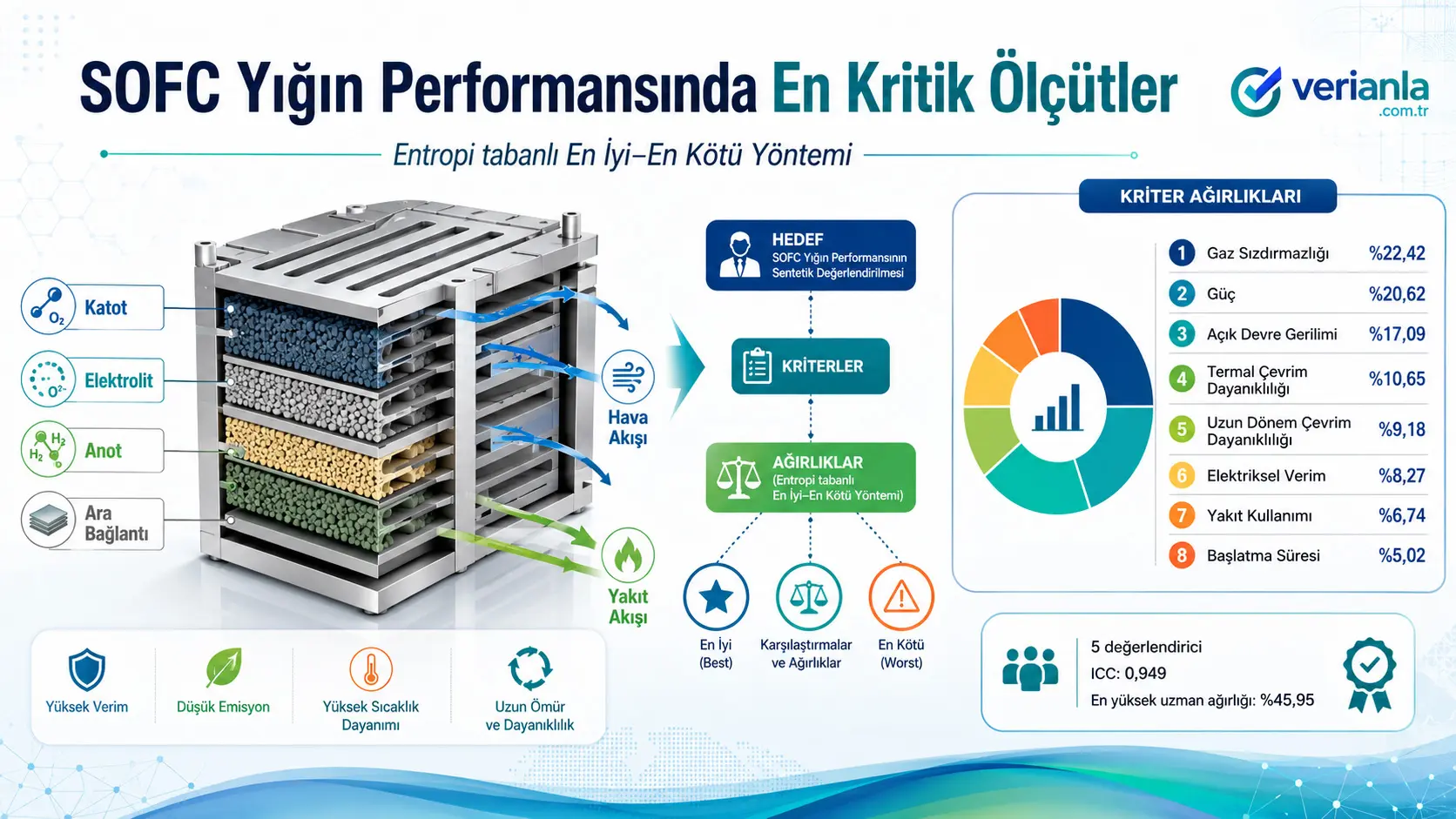
Иҷрои умумии solid oxide fuel cell stacks аз бисёр хусусиятҳои ба ҳам вобаста, ба монанди power, open-circuit voltage, gas tightness, electrical efficiency, fuel utilization, start-up time ва cycle durability вобаста аст. Ҳамаи ин хусусиятҳоро equally important ҳисоб кардан метавонад reliability ва durability-и stack-ро дуруст намояндагӣ накунад. Ин study барои ҳисоб кардани relative importance-и performance criteria аз evaluations-и multiple experts як new entropy-based Best-Worst Method, яъне entropy-based Best-Worst Method approach пешниҳод мекунад.
Дар classical BWM decision maker аввал most important ва least important criterion-ро муайян мекунад; баъдан best criterion-ро бо other criteria ва other criteria-ро бо worst criterion дар scale-и 1-9 муқоиса мекунад. Extension proposed by study ба ҷойи combining directly five evaluators' individual BWM results by equal average, барои ҳар evaluator deviation- ва entropy-based importance weight ҳисоб мекунад. Evaluations considered closer to group result ва carrying more discriminative information weight-и higher мегиранд.
Дар SOFC example application eight electrical and operational criteria арзёбӣ шуданд. Мувофиқи final group weights, most important criterion gas tightness бо %22,42 мебошад. Онро power бо %20,62 ва open-circuit voltage бо %17,09 пайравӣ мекунанд. Lowest weight %5,02 ба start-up time дода шудааст. Weights-и five evaluators equal набуданд; fourth evaluator бо %45,95 largest influence in group result дошт.
Average-measure intraclass correlation coefficient байни individual evaluations ва final group weights 0,949 ҳисоб шуда, %95 confidence interval 0,862-0,988 ёфт шудааст. Researchers инро high group consistency маънидод мекунанд. Similar ranking of criteria across five repeated evaluations низ ҳамчун indicator of stability барои method пешниҳод шудааст.
Бо вуҷуди ин, study танҳо ба five evaluators, eight preselected criteria ва single example application такя мекунад. Identities, expertise levels, independence ва selection method-и evaluators шарҳ дода нашудаанд. Ғайр аз ин, measured data from actual SOFC stacks ё alternative stack ranking вуҷуд надорад. Аз ин рӯ research sampled applicability-и proposed weighting-combination algorithm-ро нишон медиҳад; method superior in all sectors ё determined weights universal for all SOFC designs буданро исбот намекунад.
Масъалаи асосии таҳқиқот чист?
Solid oxide fuel cell як electrochemical energy technology аст, ки барои тавлиди electricity аз chemical energy of fuel истифода мешавад. Main component of SOFC power system fuel-cell stack мебошад, ки аз many cells ва interconnect elements иборат аст. Мувофиқи starting approach of study, performance-и stack reliability ва service life-и whole power-generation system-ро directly affect мекунад.
Performance-и SOFC stack бо single number шарҳ дода намешавад. Power метавонад high бошад while gas tightness insufficient; electrical efficiency метавонад high бошад while thermal-cycle durability low мемонад. Аз ин рӯ comprehensive evaluation two questions-ро талаб мекунад:
- Which features should be included in evaluation?
- How much should each feature influence overall performance result?
Second question дар multi-criteria decision-making methods ҳамчун “criteria weighting” ифода мешавад. Giving high weight to a criterion means performance on that criterion has stronger effect on final evaluation score.
Main methodological problem study tries to solve is: When multiple evaluators assign different importance weights to same criteria, how can these individual preferences be combined into one group weight fairly, consistently, and while considering information content?
Components of SOFC stack performance
Figure 1 on page 4 of PDF shows SOFC stack performance in five main groups:
| Main performance group | Subcriteria shown in figure | Meaning of evaluation |
|---|---|---|
| Power-generation performance | Open-circuit voltage, power | Electrical generation capability of stack |
| Efficiency performance | Electrical efficiency, fuel utilization, internal reforming efficiency | How effectively fuel and energy are used |
| Operating durability | Long-term cycle durability, thermal-cycle durability | Retention of performance during repeated and long-duration operation |
| Start-up performance | Start-up time | Speed at which system reaches operating conditions |
| Safety performance | Pressure difference, allowable operating pressure, gas tightness, electrical insulation | Safe operating limits of stack and separation of flows |
Stack schematic on right side of figure shows cathode, electrolyte, anode, anode support and interconnect layers. Fuel flow proceeds on anode side and air flow on cathode side. Within this structure, gas tightness is considered a central performance criterion for keeping fuel and oxidant flows in designed channels.
Why is multi-criteria decision-making method necessary?
Multi-criteria decision making is a family of methods that enables joint evaluation of multiple and sometimes conflicting criteria. First, importance weights of criteria are determined; then scores of alternatives on criteria can be combined with these weights.
In SOFC context, a stack cannot be considered best only because it gives highest power. If long-term durability, gas tightness or thermal-cycle behavior is weak, high initial power may not represent superiority over whole service period. Weighting method defines how much these different characteristics contribute to a single comprehensive evaluation.
Classes of criteria-weighting methods
Study evaluates weighting methods in three general classes:
- Subjective methods: Generate weights through preferences of experts or decision makers.
- Objective methods: Generate weights through variability, amount of information or intercriterion correlation in data for alternatives.
- Combined methods: Use subjective and objective weights together.
Table 1 in PDF compares advantages and limitations of Delphi, AHP, ANP, DEMATEL, BWM, entropy weighting, PCA, CRITIC and various deviation-based methods.
Analytic Hierarchy Process
AHP organizes decision objective, criteria and alternatives in hierarchical layers. Method is understandable and widely used, but may require many pairwise comparisons; consistency test is needed, and relationships among criteria are not always represented.
Figure 2 on page 5 of PDF shows target, criterion and alternative layers of AHP. As number of criteria and alternatives grows, comparison connections between layers rapidly increase.
Analytic Network Process and DEMATEL
ANP can represent more complex network relationships in which criteria at same level affect each other. However, model setup and calculation process are more difficult.
DEMATEL focuses on visualizing cause-effect relations and interactions among criteria. However, it may be unsuitable when criteria have no clear interaction or when number of criteria is small.
Objective weighting methods
Entropy weighting evaluates how much different information criterion data contain. A criterion providing greater discrimination among alternatives may receive higher weight. However, this approach is based on data distribution rather than engineering meaning of criterion.
PCA reduces dimensions using correlations among criteria, but resulting components are not identical to original criteria. CRITIC considers both data variability and conflict or correlation among criteria.
Why did study select BWM?
Best-Worst Method uses two special comparison vectors instead of requiring decision maker to compare every pair of criteria separately:
- Importance of best criterion relative to all other criteria,
- Importance of all other criteria relative to worst criterion.
This structure requires fewer judgments than AHP using full pairwise comparison matrix. Study also emphasizes that BWM's special comparison structure can produce more consistent results.
However, classical BWM converts preferences of one decision maker into weights. In real engineering evaluations, views of different experts may be used. In that case, not only criterion weights but also influence of experts or decision makers on group result must be determined.
Critique of Bayesian BWM
Study states Bayesian BWM previously developed for group decision making models pairwise comparisons with multinomial distribution. Authors criticize this distributional assumption, arguing importance ratings 1-9 are not chosen by decision makers with equal probability and independently.
This is methodological rationale of paper. However, study does not subject Bayesian BWM and proposed entropy-based method to comprehensive accuracy or predictive comparison on same data. Therefore general superiority over Bayesian BWM is not directly demonstrated by this example application.
Classical BWM steps
Step one: Define criteria
Decision maker identifies n criteria to participate in evaluation:
\[ C = \{c_1,c_2,\ldots,c_n\} \]
Step two: Select best and worst criterion
Decision maker selects most important criterion as cB and least important criterion as cW.
Step three: Build two comparison vectors
Superiority of best criterion over others is represented by “Best-to-Others” vector:
\[ A_B = (a_{B1},a_{B2},\ldots,a_{Bn}) \]
Superiority of other criteria over worst criterion is “Others-to-Worst” vector:
\[ A_W = (a_{1W},a_{2W},\ldots,a_{nW})^T \]
Comparisons are made from 1 to 9:
- 1: Equal importance,
- 9: Extremely more important.
Step four: Calculate criterion weights
Ideally weight ratios are expected to match provided pairwise comparisons:
\[ \frac{w_B}{w_j}=a_{Bj} \]
\[ \frac{w_j}{w_W}=a_{jW} \]
Because these equalities may not be exactly satisfied in real judgments, an optimization minimizing deviation is solved. Linear BWM used in example application is:
\[ \min \xi^L \]
\[ |w_B-a_{Bj}w_j|\leq \xi^L,\quad j=1,\ldots,n \]
\[ |w_j-a_{jW}w_W|\leq \xi^L,\quad j=1,\ldots,n \]
\[ \sum_{j=1}^{n}w_j=1 \]
\[ w_j\geq0 \]
- wB: Weight of best criterion,
- wW: Weight of worst criterion,
- wj: Weight of criterion j,
- ξL: Optimized value of maximum deviation between comparisons and weights.
As ξL approaches zero, internal consistency of judgments is considered to increase.
Consistency ratio
In classical BWM consistency ratio is defined as:
\[ CR=\frac{\xi^*}{CI} \]
- ξ*: Inconsistency value obtained from optimization,
- CI: Consistency index depending on comparison value between best and worst criteria.
Table 2 in PDF gives CI values as 0,00; 0,44; 1,00; 1,63; 2,30; 3,00; 3,73; 4,47 and 5,23 as comparison value rises from 1 to 9. As CR approaches zero, comparisons are considered more consistent.
Multiplicative BWM
Study also presents multiplicative BWM using logarithms of comparison values along with classical and linear models. After logarithmic weights are calculated in optimization, original criterion weights are obtained by exponential transformation and normalization:
\[ w_i=\frac{\exp(v_i)}{\sum_{j=1}^{n}\exp(v_j)} \]
In first stage of proposed entropy-based group approach, any of classical, linear or multiplicative BWM can be used. Linear model was selected in SOFC example application.
Structure of entropy-based group BWM
Proposed method consists of three main stages:
- Calculate each decision maker's personal criterion weights with BWM,
- Calculate each decision maker's importance weight within group,
- Combine personal criterion weights with iterative model based on relative entropy.
Deviation weight of decision maker
Total squared deviation between personal weights of decision maker k and group weights in iteration d is calculated as:
\[ R_k^d=\sum_{j=1}^{n}(W_j^d-W_j^k)^2 \]
- Wjd: Group weight at iteration d,
- Wjk: Personal weight assigned by decision maker k,
- Rkd: Total deviation between personal decision and group result.
As deviation increases, deviation-based weight of decision maker decreases. Normalized deviation weight is:
\[ r_k^d=\frac{1/R_k^d}{\sum_{k=1}^{m}(1/R_k^d)} \]
Thus evaluation closer to group result receives higher deviation weight.
Entropy weight of decision maker
Entropy component is used to represent information content of decision maker's preference distribution over criteria. In PDF, entropy of decision maker is constructed from normalized distribution of ratios of personal weights relative to group weights.
Normalized entropy value is generally expressed as:
\[ s_k^d=\frac{E_k^d}{E_k^{\max}}=\frac{E_k^d}{\log_2 n} \]
Then entropy weight is:
\[ e_k^d=\frac{1-s_k^d}{m-\sum_{k=1}^{m}s_k^d} \]
.
- Ekd: Entropy of decision maker at relevant iteration,
- n: Number of criteria,
- m: Number of decision makers,
- skd: Normalized entropy,
- ekd: Entropy-based decision-maker weight.
According to study's interpretation, less discriminative and more similar preferences across criteria show greater disorder or entropy. Entropy weight aims to account for discriminative information carried by decision maker's preference distribution for group.
Final decision-maker weight
Deviation and entropy weights are combined linearly:
\[ U_k^d=\alpha r_k^d+\beta e_k^d \]
In SOFC application:
\[ \alpha=0{,}6 \]
\[ \beta=0{,}4 \]
were selected. Therefore %60 of decision-maker weight is determined by closeness to group result and %40 by entropy component.
Study states these coefficients can be selected by decision makers according to characteristics of problem. However, why α = 0,6 and β = 0,4 is more appropriate than other possible pairs was not demonstrated by experimental or theoretical optimization.
Combining personal weights into group weight
Criterion weights of decision makers are calculated using weighted geometric aggregation exponentiated by decision-maker importance:
\[ W_j^d= \frac{\prod_{k=1}^{m}(W_j^k)^{U_k^d}} {\sum_{j=1}^{n}\prod_{k=1}^{m}(W_j^k)^{U_k^d}} \]
In this formula, each decision maker's personal criterion weight influences result according to that decision maker's group-importance weight. Denominator ensures sum of all criterion weights equals one.
Stopping iteration
Because decision-maker weights depend on group result and group result depends on decision-maker weights, calculation is iterative. Process stops when group weights in two successive iterations are sufficiently close:
\[ \sqrt{\sum_{j=1}^{n}(W_j^d-W_j^{d-1})^2}<\varepsilon \]
In SOFC example stopping threshold was:
\[ \varepsilon=0{,}001 \]
.
Figure 6 on page 22 of PDF shows algorithm loop. Initially personal criterion weights and first importance weights for all decision makers are taken. Group weights and decision-maker importances are recalculated; if convergence condition is not satisfied, process repeats from previous group result.
Кадом меъёрҳо дар SOFC application истифода шуданд?
Дар example application-и study eight criteria интихоб шуданд:
| Criterion | Tajik explanation | Main performance area |
|---|---|---|
| Gas tightness | Газногузарӣ | Safety and flow separation |
| Open circuit voltage | Шиддати open circuit | Power-generation performance |
| Power | Қувва | Power-generation performance |
| Long-term cycle durability | Давомнокии cycle-и дарозмуддат | Operating durability |
| Thermal cycle durability | Давомнокии thermal cycle | Operating durability |
| Electrical efficiency | Самаранокии барқӣ | Efficiency performance |
| Fuel utilization | Истифодаи сӯзишворӣ | Efficiency performance |
| Start-up time | Вақти оғоз | Start-up performance |
Some features shown in Figure 1, such as internal reforming efficiency, pressure difference, allowable operating pressure and electrical insulation, were not included among eight criteria of example application. Study does not explain in detail by what systematic selection or elimination process these eight criteria were chosen.
Best and worst criterion choices of five evaluators
| Evaluator | Most important criterion | Least important criterion |
|---|---|---|
| #1 | Power | Start-up time |
| #2 | Power | Start-up time |
| #3 | Open circuit voltage | Start-up time |
| #4 | Gas tightness | Start-up time |
| #5 | Gas tightness | Start-up time |
All evaluators selected start-up time as least important criterion. In contrast, three different approaches appeared for best criterion: two evaluators selected power, one selected open-circuit voltage and two selected gas tightness.
Pairwise comparison data
Table 4 on page 24 of PDF shows superiority of best criterion selected by each evaluator over other criteria. Table 5 gives superiority of other criteria over commonly selected worst criterion, start-up time.
For example, first evaluator selected power as best criterion and judged power nine times more important than start-up time. Fourth evaluator selected gas tightness as best and judged it seven times more important than start-up time.
These values are not physical measurements. Expression “nine times more important” corresponds to score 9 on BWM verbal importance scale; it does not mean ninefold increase in an actual engineering quantity.
Personal weights of each evaluator
| Criterion | #1 | #2 | #3 | #4 | #5 |
|---|---|---|---|---|---|
| Gas tightness | %13,19 | %22,06 | %16,67 | %24,46 | %29,24 |
| Open circuit voltage | %19,79 | %11,03 | %24,65 | %17,36 | %13,29 |
| Power | %29,26 | %32,61 | %16,67 | %17,36 | %19,93 |
| Long-term cycle durability | %9,90 | %8,82 | %11,12 | %8,68 | %7,97 |
| Thermal cycle durability | %9,90 | %7,35 | %11,12 | %11,57 | %9,97 |
| Electrical efficiency | %7,92 | %6,30 | %8,34 | %8,68 | %7,97 |
| Fuel utilization | %5,65 | %6,30 | %6,67 | %6,94 | %6,64 |
| Start-up time | %4,40 | %5,52 | %4,76 | %4,96 | %4,98 |
Power weights of first two evaluators were %29,26 and %32,61 respectively. Third evaluator assigned %24,65 to open-circuit voltage; fourth and fifth evaluators assigned %24,46 and %29,24 respectively to gas tightness.
Start-up time remained around %4,4-%5,5 in all evaluations. This shows complete agreement in selecting worst criterion was also reflected in personal weights.
Final importance weights of decision makers
| Evaluator | Importance weight in group decision |
|---|---|
| #1 | %11,62 |
| #2 | %11,14 |
| #3 | %13,59 |
| #4 | %45,95 |
| #5 | %17,70 |
Fourth evaluator alone received approximately %46 weight. Therefore final group result differs substantially from equal-weighted average of five experts.
Fourth evaluator's selection of gas tightness as best criterion and accounting for almost half of group weight strongly contributed to gas tightness ranking first. In terms of method, this is not an error; method is designed to give higher influence to some evaluators due to group-result proximity and entropy measures.
However, concentration around %46 requires separate examination of effect of decision-maker weighting on result. PDF does not explain why fourth evaluator is more reliable or expert than others using personal background or independent competency data. Weight is derived entirely from mathematical preference agreement.
Final combined weights of SOFC criteria
| Rank | Performance criterion | Final weight |
|---|---|---|
| 1 | Gas tightness | %22,42 |
| 2 | Power | %20,62 |
| 3 | Open circuit voltage | %17,09 |
| 4 | Thermal cycle durability | %10,65 |
| 5 | Long-term cycle durability | %9,18 |
| 6 | Electrical efficiency | %8,27 |
| 7 | Fuel utilization | %6,74 |
| 8 | Start-up time | %5,02 |
Figure 7 on page 29 of PDF shows final weights as donut chart. Three largest slices are gas tightness, power and open-circuit voltage. Together these three criteria account for:
\[ 22{,}42+20{,}62+17{,}09=60{,}13\% \]
of total weight. In other words, roughly three-fifths of total evaluation influence in model is concentrated in these three criteria.
Total weight of two durability criteria is:
\[ 10{,}65+9{,}18=19{,}83\% \]
while sum of electrical efficiency and fuel utilization is:
\[ 8{,}27+6{,}74=15{,}01\% \]
.
What does gas tightness ranking first mean?
Result shows that within decision structure of evaluators participating in study, gas tightness has higher total importance than other seven criteria. This result does not mean:
- Gas tightness always has %22,42 importance in every SOFC application,
- Power or durability is secondary,
- Start-up time is practically unimportant.
do not mean.
Weights are product of comparisons by specific five evaluators, specific eight criteria and method parameters α = 0,6 and β = 0,4. If application purpose, SOFC type, fuel, operating temperature or mission profile changes, decision preferences and resulting weights may also change.
ICC consistency validation
Study evaluated agreement between personal weights of five evaluators and final combined weights using intraclass correlation coefficient.
| ICC measurement | ICC value | %95 confidence interval |
|---|---|---|
| Single measurement | 0,755 | 0,511-0,933 |
| Average measurement | 0,949 | 0,862-0,988 |
Study interpreted ICC above 0,75 as high consistency. Average-measure ICC of 0,949 indicates high agreement between common average of five evaluators and combined weight structure.
In conclusion ICC value is rounded as 0,94. Main validation text and Table 8 give more precise value 0,949.
High ICC alone does not show criterion weights accurately predict real SOFC performance. ICC here measures similarity of weighting structure among evaluators; it does not measure external validity or accuracy in predicting actual stack failures.
Stability or sensitivity validation
Criterion weights in five separate comprehensive evaluation tests are shown in Figure 8 on page 31 of PDF as five horizontal bar charts.
In first three tests:
- Gas tightness,
- Open circuit voltage,
- Power
remained in top three positions. In fourth and fifth tests, open-circuit voltage fell to fourth place and thermal-cycle durability rose into top three.
Electrical efficiency, fuel utilization and start-up time remained in bottom three in all tests. Researchers interpreted this overall ranking stability as sensitivity or stability validation of method.
However, this analysis is not broader mathematical sensitivity analysis involving systematic variation of α and β coefficients, removing one evaluator, or adding error to comparison scores. It is based on ranking similarity across five repeated weighting exercises.
Strengths of study
- Proposes a clear iterative algorithm to extend classical BWM to multiple decision makers.
- Does not automatically assume equal weights for decision makers.
- Uses distance from group result and information content of preference distribution as separate components.
- Recalculates decision-maker weights and criterion weights jointly until convergence.
- Provides all core formulas and algorithm flow of proposed method.
- Reports all personal comparisons and weights of five evaluators in tables.
- Provides final criterion weights and decision-maker weights explicitly.
- Quantitatively evaluates within-group consistency with ICC.
- Visually presents ranking changes in five repeat tests.
- Method has a general group multi-criteria decision-making structure not limited only to SOFCs.
Limitations of study
- Study is a preprint not peer reviewed.
- Uploaded PDF does not include title page containing author and affiliation information.
- PDF does not include author-contribution, funding, conflict-of-interest or data-access statements.
- Only five evaluators were used.
- Identities, education, SOFC experience and selection method of evaluators are not explained.
- Evaluators are assumed to make decisions independently; independence was not directly tested.
- Selection and elimination method for eight criteria is not described in detail.
- Not all SOFC performance features shown in Figure 1 were included in example application.
- Method was not tested with measured performance data from actual SOFC stacks.
- Multiple real stack alternatives were not ranked and best stack was not selected.
- It was not shown that determined weights improve prediction of failure, service life or field performance.
- Choice of α = 0,6 and β = 0,4 was not justified in detail.
- Sensitivity of convergence threshold ε = 0,001 to alternative values was not shown.
- Fourth evaluator receiving %45,95 weight creates substantial concentration in result.
- Decision-maker weight is derived from preference-structure agreement with group result, not expertise or measurement accuracy.
- An expert opinion different from group majority but scientifically correct may receive low deviation weight.
- Relationship of entropy component to engineering accuracy was not validated with real performance data.
- Proposed method was not comprehensively compared on same data with Bayesian BWM, equal-weight average or other group-BWM methods.
- ICC shows inter-evaluator agreement, not external accuracy.
- Stability test is not comprehensive parameter or error-propagation analysis.
- Computational behavior of method in large decision-maker groups was not experimentally shown.
- Applicability to different industries is proposed in conclusion but illustrated only with SOFC criteria.
What study supports
- Multiple personal criterion weights obtained with BWM can be combined iteratively using entropy and deviation components.
- Unequal importance weights can be assigned to decision makers.
- Algorithm converged in sample dataset and produced final criterion weights.
- Average ICC agreement of five evaluators' personal preferences with final group is high.
- In examined sample group, gas tightness received highest and start-up time lowest weight.
- Gas tightness, power and open-circuit voltage account for approximately %60 of weights.
- Top and bottom criterion groups remained generally stable across five repeated evaluations.
- Proposed method offers mathematical framework worth investigating for group-based engineering evaluations.
What study does not prove
- It has not been proven that gas tightness universally carries %22,42 importance in all SOFC stacks.
- It has not been shown that start-up time is least important criterion in all applications.
- It has not been shown that proposed method is superior to all existing group decision-making methods.
- It has not been shown that method provides more accurate SOFC lifetime or reliability prediction.
- No comprehensive performance score of a real SOFC stack was calculated.
- SOFC stacks from different manufacturers were not compared.
- Correlation of determined weights with experimental performance outcomes was not tested.
- It has not been proven that fourth evaluator is technically more reliable than other evaluators.
- High ICC alone does not prove real-world accuracy of method.
- It has not been shown that results from five-person sample generalize to large expert groups.
- It has not been experimentally validated that method can be used unchanged across all sectors.
Possible significance for SOFC engineering
Practical value of study is offering a method that can systematically combine performance priorities of different experts. Such a weighting system could in future be used in:
- Comparison of different SOFC stack designs,
- Determining which properties receive priority in test programs,
- Allocation of product-development resources,
- Structuring quality-control criteria,
- Prioritizing maintenance and reliability indicators.
However, these applications were not performed in current study. To turn method into real engineering decision, criterion weights need to be combined with actual stack performance matrix and resulting ranking validated with field or experimental data.
Possible significance for multi-criteria decision-making research
General novelty of proposed approach is calculating decision-maker weights from relationship of individual preferences with group result rather than assigning them externally as fixed. Thus group weight and decision-maker weight are jointly determined within same iterative process.
Following validations are important for future studies:
- Larger and different expert groups,
- Comparison with Bayesian BWM and other group-aggregation methods,
- Systematic sensitivity analysis for α and β coefficients,
- Robustness analysis preserving outlier expert opinions,
- Missing or uncertain comparison data,
- External validation in real alternative rankings,
- Repeated application in different engineering sectors.
Усул ва натиҷаҳои таҳқиқот
Technical summary of method design
| Method component | Structure applied in study |
|---|---|
| Decision problem | Weighting comprehensive performance criteria of SOFC stack |
| Number of decision makers | 5 evaluators |
| Number of decision criteria | 8 criteria |
| Personal weighting method | Linear Best-Worst Method |
| Comparison scale | 1-9 |
| Decision-maker deviation component | Squared deviation between personal and group weights |
| Decision-maker information component | Normalized entropy weight |
| Deviation coefficient | α = 0,6 |
| Entropy coefficient | β = 0,4 |
| Group aggregation | Decision-maker-weighted geometric aggregation |
| Convergence condition | Euclidean distance between successive group weights < 0,001 |
| Consistency validation | Intraclass correlation coefficient |
| Stability evaluation | Comparison of rankings in five separate evaluation tests |
Technical summary of criterion weights
| Criterion | Weight | Relative position |
|---|---|---|
| Gas tightness | %22,42 | Highest |
| Power | %20,62 | Second |
| Open circuit voltage | %17,09 | Third |
| Thermal cycle durability | %10,65 | Fourth |
| Long-term cycle durability | %9,18 | Fifth |
| Electrical efficiency | %8,27 | Sixth |
| Fuel utilization | %6,74 | Seventh |
| Start-up time | %5,02 | Lowest |
Technical summary of decision-maker weights
| Evaluator | Importance weight | Status relative to group result |
|---|---|---|
| #1 | %11,62 | Low-medium influence |
| #2 | %11,14 | Lowest influence |
| #3 | %13,59 | Medium influence |
| #4 | %45,95 | Highest influence |
| #5 | %17,70 | Second-highest influence |
Technical summary of validation results
| Validation | Result | Interpretation in study |
|---|---|---|
| Single-measure ICC | 0,755 | Above high-consistency threshold |
| Single-measure %95 CI | 0,511-0,933 | Wide uncertainty interval |
| Average-measure ICC | 0,949 | Strong group consistency |
| Average-measure %95 CI | 0,862-0,988 | High agreement interval |
| Repeat tests | Top and bottom criterion groups largely retained | Stability indicator |
Technical interpretation of figures
Figure 1: SOFC performance hierarchy
Figure shows evaluation structure extending from individual electrical and operational criteria to five main performance groups and then to overall stack performance. Layered SOFC drawing on right visualizes relationship of performance criteria to physical stack components and gas flows.
Figure 2: AHP hierarchy
Many connections among decision objective, criterion layer and alternative layer are shown. Figure visually demonstrates how full pairwise comparisons can become increasingly complex as decision problem grows.
Figure 3: Use of weighting methods in literature
Graph with nested rings for years 2016 through July 2023 shows AHP, entropy weighting and Delphi leading in literature dataset examined, while BWM use is lower but rises over time.
This graph is not ranking of scientific accuracy of methods. It only shows publication-use shares according to Web of Science query used by study.
Figure 5: BWM workflow
Defining criteria, selecting best and worst criterion, forming two comparison vectors and calculating optimal weights are shown in sequential boxes.
Figure 6: Combining personal preferences into group result
Personal criterion weights and initial decision-maker weights produce first group result. Then decision-maker importances and group criterion weights are recalculated repeatedly; when difference between successive results falls below 0,001, final weights are output.
Figure 7: Final SOFC criterion weights
In donut chart largest slice is gas tightness at %22,42 and second largest is power at %20,62. Start-up-time slice at %5,02 is smallest.
Figure 8: Comparison of five repeat tests
Five horizontal bar charts show limited position changes among top-ranked criteria. In first three tests gas tightness, power and open-circuit voltage are top group. In fourth and fifth tests thermal-cycle durability moves ahead of open-circuit voltage. Start-up time is last in all graphs.
Methodological result
Directly demonstrated result of study is that entropy- and deviation-based decision-maker weighting can be applied to personal criterion weights from BWM. In example problem algorithm converged, produced group weights and yielded high average ICC value.
Direct SOFC result of study is that according to preferences of five participants, gas tightness, power and open-circuit voltage received highest weights. Benefit of these weights for real stack selection or field performance must be validated separately in subsequent experimental and decision applications.
Ёддошт оид ба манбаъ ва усул
Full original title: An entropy-based best-worst method to synthetic evaluation the performance of the solid oxide fuel cell stacks: Multi-criteria decision making approach
Authors and order in official SSRN record: Yun Luo; Xinyuan Yang; Xuqian Chen; Wenchun Jiang; Qian Zhang.
Author information in PDF: Author names and affiliations are not present on visible pages of uploaded PDF. Author list was verified from official SSRN bibliographic record.
Equal contribution or co-first authorship: No equal-contribution statement is present in uploaded PDF or accessed SSRN record.
Contact author: Yun Luo is shown as “Contact Author” in SSRN record.
Contact email: Could not be verified because it was not openly displayed.
Institutional affiliations
- Yun Luo: No affiliation information given in official SSRN record.
- Xinyuan Yang: No affiliation information given in official SSRN record.
- Xuqian Chen: No affiliation information given in official SSRN record.
- Wenchun Jiang: No affiliation information given in official SSRN record.
- Qian Zhang: Qingdao University of Technology, Qingdao 266033, China.
Source type: Quantitative preprint research article including method development and example engineering application.
Publication platform: SSRN.
Publication date: 15 June 2026.
Page count: 38.
DOI: 10.2139/ssrn.6946094
Official link:SSRN study record
Peer-review status: Not peer reviewed. Pages of PDF contain warning “Preprint not peer reviewed”.
Peer-reviewed journal: No verified peer-reviewed journal version was identified in bibliographic check dated 27 July 2026.
Original journal publisher: None because peer-reviewed journal version is unverified. Current publication platform is SSRN.
Author contributions: Uploaded PDF contains no CRediT or other author-contribution statement.
Funding: Uploaded PDF contains no funding statement.
Conflict of interest: Uploaded PDF contains no conflict-of-interest statement.
Data and code access: Pairwise comparisons and calculated weights of decision makers are given in tables, but no independent data or source-code repository is specified.
Article preparation method: Ин мақолаи туркии Verianla бо баррасии text, equations, tables, flowcharts, weighting graphs ва results-и 38-page preprint uploaded by user омода шудааст. No scientific finding from outside PDF was added. External sources were used only for bibliographic verification of author identity, author order, DOI, publication date, platform and peer-review status.
Main methodological limit: Research is not a performance experiment scoring or ranking actual SOFC stacks. It illustrates converting subjective importance weights assigned by five evaluators to eight criteria into a group result. Relationship of determined weights with real stack reliability, service life or failure data has not been validated.
This study is a preprint that has not undergone peer review. Proposed entropy-based BWM offers a promising mathematical approach for group decision making, but its generalizability, superiority to alternative methods and accuracy in real engineering decisions need validation with broader datasets.
Шарҳ гузоред
Нишонии почтаи электронии шумо нашр намешавад. Майдонҳои ҳатмӣ бо * нишон дода шудаанд