

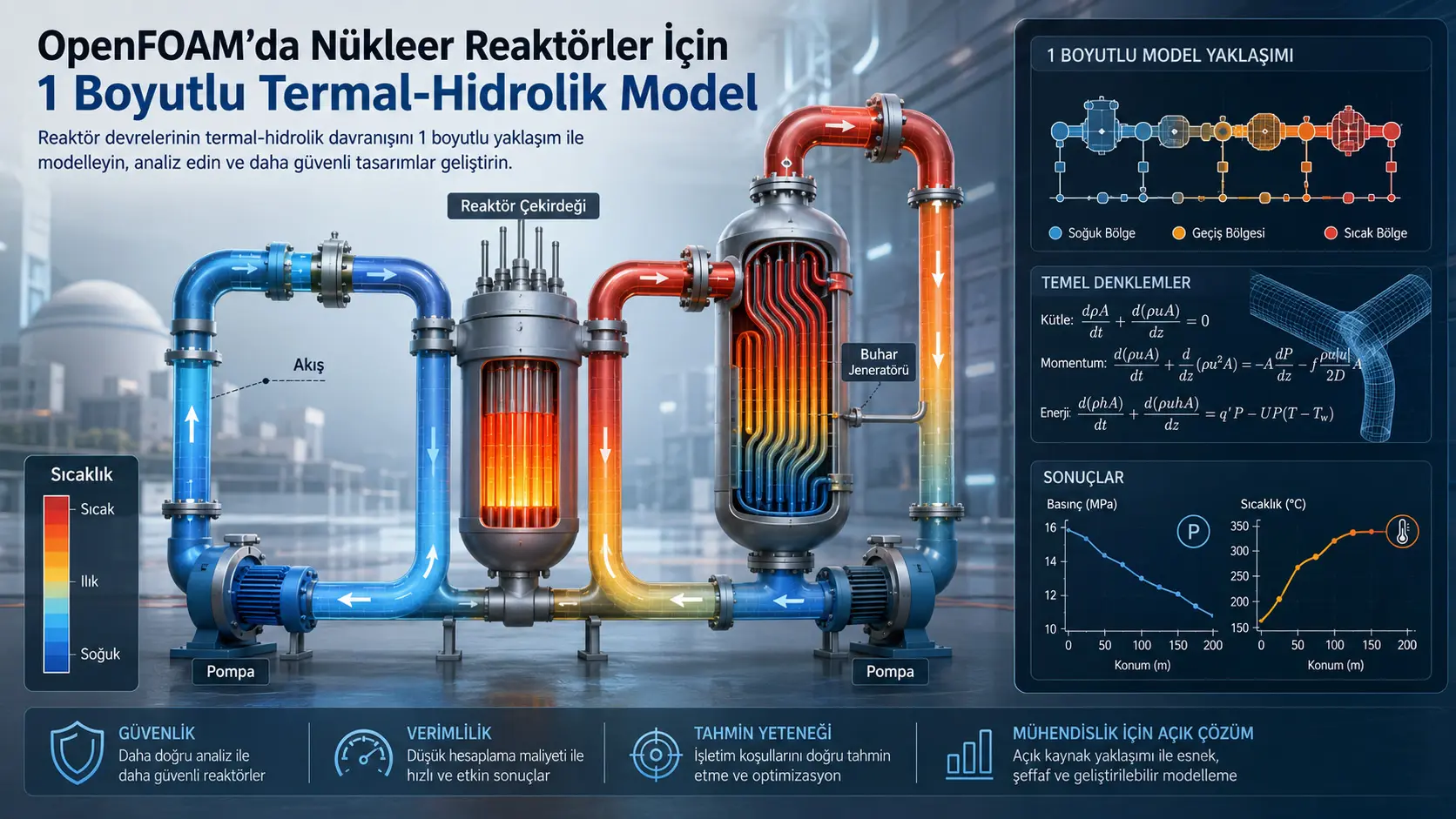
Ин таҳқиқот барои моделсозии тамоми ҳалқаҳои реакторҳои ҳастаӣ, ки аз қубурҳо, насосҳо, пайвастҳо, манбаъҳои гармӣ ва талафоти гидравликӣ иборатанд, дар муҳити OpenFOAM як чаҳорчӯбаи нави якандозагии thermal-hydraulics таҳия мекунад. Ба ҷойи тағйир додани муодилаҳои мавҷудаи якфазавии масса, импулс ва энергияи платформаи foamForNuclear, method шароити нави сарҳадӣ, моделҳои пайвастҳои бисёршоха, ҳисобҳои pressure jump, four-region pump model ва automatic mesh-generation tools-ро илова мекунад, ки ҷузъҳои якандозагиро бо нигоҳ доштани масса, импулс ва энергия ба ҳам мепайванданд. Дар analytical validation problems, натиҷаҳои flow, pressure ва temperature relative errors-и камтар аз %1 додаанд; дар муқоиса бо TRACE барои simplified two-loop reactor circuit, steady-state core flow rates тақрибан дар ҳудуди %3 мувофиқ омадаанд. Бо вуҷуди ин, study танҳо single-phase flows-ро фаро мегирад ва на бо experimental reactor system, балки бо analytical solutions ва another system code муқоиса шудааст.
Main objective-и framework-и нав сохтани common foundation аст, ки low-cost one-dimensional system models-ро бо high-fidelity CFD ё porous-media models дар same OpenFOAM infrastructure муттаҳид карда тавонад. Developed branchConnector1D boundary condition ҳангоми фарқ кардани cross-sections-и connected pipes ба ҷойи баробар кардани velocities mass flow rate-ро нигоҳ медорад. pressureCoupling1D бошад dynamic pressure, local hydraulic loss, pump pressure ва hydrostatic differences-ро дар single pressure-jump equation якҷо мекунад. Four-region homologous pump model ҳангоми pump trip метавонад наздикшавии flow ба zero, reverse flow ва inertia-driven rundown-и pump-ро represent кунад.
Аз нигоҳи Туркия: Study аз ҷиҳати nuclear-energy engineering, reactor-safety analysis, research reactors, small modular reactor studies, energy-systems education ва open-source engineering software development дар Туркия methodological value дорад. Барои истифодаи approach дар research ва design projects-и Туркия, target reactor бояд бо real geometry, materials, pumps, valves, heat exchangers ва control data аз нав сохта шавад; бо experimental loops ва international benchmark problems validate гардад; software quality assurance, version control ва uncertainty analyses анҷом дода шаванд. Аз ин research набояд conclusion гирифта шавад, ки developed framework барои licensing analyses ready аст, two-phase accidents-ро model карда метавонад, TRACE ё RELAP5-ро directly replace мекунад ё safety-и real nuclear facility-ро исбот кардааст.
Чаро one-dimensional reactor system codes лозиманд?
Thermal-hydraulic behavior-и nuclear power plants бо фаъолияти якҷояи reactor core, hot ва cold legs, pumps, steam generators, pressure vessels, connecting pipes ва safety systems муайян мешавад. Modeling-и entire plant бо high-resolution three-dimensional CFD барои routine safety analyses метавонад computational cost-и хеле баланд эҷод кунад.
One-dimensional system codes pipes ва equipment-ро ҳамчун control volumes arranged along axis represent мекунанд. Ҳамин тавр pressure, flow rate, temperature ва energy distribution дар entire reactor circuit бо relatively low computational cost пайгирӣ мешавад. TRACE, RELAP5 ва ATHLET established examples of this approach мебошанд.
Аммо дар new reactor designs three-dimensional phenomena мисли natural circulation, large pools, thermal stratification ва complex mixing zones низ муҳим шудаанд. Аз ин рӯ, ба ҷойи single fidelity level, multi-fidelity methods таҳия мешаванд, ки баъзе regions бо one-dimensional system model, баъзе regions бо porous-media approach ва critical regions бо CFD ҳал мешаванд.
Камбудии foamForNuclear чӣ буд?
foamForNuclear платформаи OpenFOAM-based multiphysics ва multifidelity nuclear analysis мебошад. Platform тавассути development ва integration-и GeN-Foam ва OFFBEAT solvers ҳадаф дорад different physics мисли flow, heat transfer, neutronics ва fuel behavior-ро дар common environment run кунад.
Мувофиқи study, гарчанде foamForNuclear метавонист CFD ва porous-media-based thermal-hydraulic regions-ро дар same simulation run кунад, он local one-dimensional system infrastructure-и заруриро барои сохтани entire plant circuit надошт. Барои components мисли pump, valve, elbow, T-junction, diameter change ва local loss external system code ё OpenModelica coupling лозим буд.
Researchers барои бартараф кардани ин dependency framework-и local-ро таҳия карданд, ки дар дохили OpenFOAM кор мекунад. Statement, ки work “first implementation directly embedded in OpenFOAM” аст, priority claim-и худи researchers мебошад; дар study comprehensive independent software-priority review пешниҳод нашудааст.
Developed framework чиро тағйир медиҳад?
Study existing single-phase porous-media thermal-hydraulic equations-и foamForNuclear-ро rewrite намекунад. Field equations solving conservation of mass, momentum and enthalpy ҳамон тавр мемонанд. New work асосан infrastructure-и зеринро илова мекунад:
- Boundary conditions connecting one-dimensional pipes at different orientations and cross-sections,
- Velocity coupling that conserves mass flow across area changes,
- Junctions where three or more branches meet,
- Pressure jump including dynamic pressure, local losses, pump and hydrostatic effects,
- Pump characteristics covering forward and reverse flow,
- Pump-trip and inertia-driven rundown model,
- Mass-flow-weighted enthalpy mixing at junctions,
- Automatic one-dimensional pipe-network generation tools through Python.
Чаро existing one-dimensional approach-и OpenFOAM кофӣ набуд?
OpenFOAM метавонад бо истифода аз empty boundary condition дар баъзе faces-и thin three-dimensional mesh two- ё one-dimensional solutions эҷод кунад. Аммо empty condition танҳо ба solution иҷозат медиҳад дар directions tangent to corresponding face тағйир ёбад, бинобар ин дар pipe networks that change direction problem ба вуҷуд меояд. Масалан, circuit containing 90° elbow cannot be represented like a straight mesh in one direction.
Ҳамчун solution метавон дар outer faces-и pipes slip wall ва дар junctions cyclic ё барои nonconformal meshes cyclicAMI истифода бурд. Гарчанде ин method pipes-ро at different angles connect карда метавонад, study three main problems identified кардааст:
- Mass conservation: Applying same velocity at boundary of two pipes with different cross-sectional areas does not guarantee same mass flow passes.
- Applying same boundary type to all fields: Pressure, velocity and enthalpy should be coupled; however an auxiliary field such as hydraulic diameter need not be continuous across junction.
- Complex mesh generation: Manually specifying translation vector, rotation angle and rotation center for every connection increases risk of error in large circuits.
branchConnector1D чӣ мекунад?
Researchers connection boundary condition called branchConnector1D developed карданд, то ба different field variables different behavior таъин карда шавад. Fields that must be physically coupled, such as pressure, velocity, enthalpy and selected turbulence variables, бо cyclic coupling matched мешаванд, while fields that may remain different across junction, such as hydraulic diameter, receive zero gradient.
This distinction ensures that only variables that must be conserved or continuous are strongly coupled to opposite pipe. Thus artificial connection forcing all fields to same value is avoided.
Дар pipes-и different diameter mass чӣ гуна conserved мешавад?
When cross-sections, densities or effective flow areas of two pipes differ, mass flow rates must be equated instead of velocities. Fundamental relation used in study is:
\[ \alpha_P \rho_P A_P U_P = \alpha_N \rho_N A_N U_N \]
Here \(\alpha\) denotes fraction occupied by phase in control volume, \(\rho\) density, \(A\) cross-sectional area and \(U\) velocity. \(P\) and \(N\) refer to control volumes on two sides of junction.
Velocity contribution from neighboring side is scaled using area, density and phase fraction. Thus velocity can increase in smaller pipe and decrease in larger pipe while total mass flow through junction remains same.
Multi-branch junctions чӣ гуна modeled шуданд?
Standard cyclic OpenFOAM connection is designed for binary relation between two faces. In T-junction one main pipe can split into two branches or two branches merge into one pipe. Figure 1 on page 7 of study shows arrangement where two separate connection faces are created at end of main pipe and connected to upper and lower branches.
Mass conservation at three-branch junction is written:
\[ \alpha_a\rho_aA_aU_a+ \alpha_b\rho_bA_bU_b+ \alpha_c\rho_cA_cU_c=0 \]
Velocities are positive when directed toward junction and negative when directed away. Effective neighbor velocity of one boundary face is calculated not only from directly matched face but also from mass flows coming from all other branches in junction.
Because contribution from other branches is added as explicit source term, formulation is semi-implicit rather than fully implicit. Optional relaxation may be applied to this explicit term to improve convergence under highly unbalanced flow distributions.
Since creating multiple connection faces at end of one cell may distort geometric cell volume, researchers recalculated volumes of cells adjacent to junction and face contributions in pressure–velocity coupling.
Pressure jump кадом effects-ро дар бар мегирад?
Conserving mass flow through junction does not mean pressures on two sides must be equal. Area change, elbow, valve, pump and elevation difference can create physical pressure jump.
For this purpose boundary condition pressureCoupling1D was developed. In OpenFOAM solvers including buoyancy, transported modified pressure is:
\[ p_{rgh}=p-\rho gz \]
Pressure jump between two sides is expressed in study with following components:
\[ p_{rgh,1}-p_{rgh,2} = \frac{1}{2}\rho\left(U_1^2-U_2^2\right) -\frac{1}{2}K\rho_uU_u^2 +S_p +gz\left(\rho_2-\rho_1\right) \]
First term represents dynamic-pressure difference, second local hydraulic loss, \(S_p\) pump pressure increase, and last term hydrostatic correction due to density and elevation.
Because local-loss coefficient \(K\) and pump source can be given as time-dependent functions, transient events such as valve movement or pump trip can be modeled. When flow reverses, loss term is reoriented relative to new inlet side.
Барои pump кадом two models developed шуданд?
First model defines pump head as polynomial of volumetric flow:
\[ h(Q)=\sum_i c_iQ^i \]
When pump speed changes, coefficients are scaled according to affinity laws. This model is simple and useful near design operating point in forward-flow conditions. However, because \(h(Q)\) is single-valued, it cannot fully represent zero flow, reverse flow or reverse rotation.
Second model is homologous or four-region pump approach used in system codes. Flow rate, rotational speed and head are nondimensionalized relative to nominal values:
\[ q^*=\frac{Q}{Q_R}, \qquad \omega^*=\frac{\omega}{\omega_R}, \qquad h^*=\frac{h}{H_R} \]
Forward and reverse flow together with forward and reverse rotation are divided into four operating regions. In each region, pump head and hydraulic torque are calculated from piecewise-linear tables. This arrangement represents conventional eight-octant pump characteristics in four regions by combining octants with similar normalization.
Pump trip ва inertia-driven rundown чӣ гуна ҳисоб мешавад?
Pump speed can be specified by user as time schedule or calculated from rotor dynamics after pump trip. When motor torque is removed, rotational speed changes according to:
\[ I\frac{d\omega}{dt} = -T_{\mathrm{hy}}\left(q^*,\omega^*\right) -T_f(\omega) \]
Here \(I\) is rotor moment of inertia, \(T_{\mathrm{hy}}\) hydraulic torque exerted by fluid and \(T_f\) mechanical friction torque.
When rotor equation is solved together with four-region pump characteristics, pump can pass continuously from normal operating point to low flow, zero flow and reverse-flow region. This feature is important for reactor transients involving loss of pump and flow reversal.
Дар junctions energy conservation чӣ гуна таъмин шудааст?
At point where multiple branches merge, outlet enthalpy cannot simply equal enthalpy of one neighboring pipe. Outlet fluid is mixture of all streams entering junction. Study computes inlet enthalpy by mass-flow-weighted average:
\[ h_{\mathrm{mix}} = \frac{\sum_i\dot{m}_ih_i} {\sum_i\dot{m}_i} \]
\[ \dot{m}_i = \max\left(\rho_i\alpha_iA_iU_i,0\right) \]
Summation is performed only for branches flowing toward junction. If a branch flows out of junction, enthalpy is transported with zero-gradient behavior. When flow direction changes during transient, branches participating in mixing are dynamically reidentified.
Python interface circuit setup-ро чӣ гуна осон мекунад?
foamForNuclear Python API expanded шудааст, то one-dimensional pipe segments бо start position, direction, length, hydraulic diameter, number of cells ва elbow radius defined шаванд.
Start of a new pipe can be given as existing pipe object instead of coordinate vector. In this case new pipe is automatically connected to outlet of previous pipe; required rotation, translation and boundary conditions are generated by software.
For independent pipes inlet and outlet faces, and for connected pipes branchConnector1D connections are automatically generated. Thus manual calculation of rotation center and geometric transformation for every junction in large circuit is not required.
First analytical validation: flow split and recombination
In first validation problem water flow with inlet flow rate 570 L·s−1 split into two parallel branches with different diameters, lengths and friction factors and then recombined. There is 9 m elevation difference between two T-junctions.
Results obtained on 1090-cell mesh are:
| Variable | Analytical solution | FFN result | Relative error |
|---|---|---|---|
| First-branch flow rate | 121,8 L·s−1 | 122,2 L·s−1 | %0,33 |
| Second-branch flow rate | 448,2 L·s−1 | 447,8 L·s−1 | %0,089 |
| A–B pressure difference | 147 kPa | 147,15 kPa | %0,10 |
These results show mass flow distributed into different branches and distributed friction losses are calculated consistently with analytical solution.
Second validation: pumped and natural-circulation closed loop
Second problem is closed loop made of four pipes with diameters 80, 90, 100 and 110 mm. Each pipe is 40 m long. In first configuration flow is driven by pump; in second by buoyancy arising from heating lower pipe to 350 K and cooling upper pipe to 300 K.
| Condition | Analytical flow rate | FFN flow rate | Reported error |
|---|---|---|---|
| Pumped loop | 0,0976 m3·s−1 | 0,0976 m3·s−1 | <%0,05 |
| Natural-circulation loop | 0,7345 m3·s−1 | 0,7341 m3·s−1 | <%0,05 |
Source shows analytical and numerical results are very close. However, magnitudes of flow rates given in m3·s−1 in table require unit or scale explanation when considered together with stated pipe diameters, lengths and pump curve. For example, using source equation \(H_{\mathrm{pump}}=0{,}15-15Q^2\) with \(Q=0{,}0976\) gives pump head of only approximately 0,0071 m. Therefore flow-rate unit or decimal notation in Table 3 should be checked by authors.
Third validation: multiple branches and energy mixing
Final analytical problem is more complex pipe network containing two successive flow splits, two recombinations and localized 30 MW heat source. Inlet velocity is 1 m·s−1, elbow loss coefficient 0,9 and T-junction loss coefficient 1,2.
Figure 5 on page 18 shows temperature in heated upper branch rising and temperature distributed to other branches after mixing junctions. Figure 6 on page 19 visualizes different velocity magnitudes in parallel branches.
| Variable | Analytical solution | FFN result | Relative error |
|---|---|---|---|
| Lower-branch flow rate \(Q_b\) | 0,4367 m3·s−1 | 0,4369 m3·s−1 | %0,06 |
| Heated-branch flow rate \(Q_h\) | 0,1442 m3·s−1 | 0,1444 m3·s−1 | %0,16 |
| Unheated upper sub-branch flow rate \(Q_l\) | 0,2045 m3·s−1 | 0,2047 m3·s−1 | %0,08 |
| Outlet temperature | 309,11 K | 309,20 K | %0,03 |
This comparison shows not only total flow but also distribution among parallel branches and outlet enthalpy resulting from mixing streams at different temperatures agree with analytical result.
Барои TRACE comparison чӣ гуна reactor circuit сохта шуд?
At system-level assessment, simplified two-loop primary circuit resembling pressurized-water reactor was used. Model includes:
- Reactor core,
- Lower and upper plena,
- Two symmetric hot legs,
- Two steam-generator representations,
- Two main coolant pumps,
- Two cold legs,
- Cross-connection between plena
. Figure 7 on page 20 shows TRACE nodalization next to OpenFOAM/FFN pipe network.
Distributed friction was calculated with Churchill correlation, while convection in core and steam generators used El-Genk correlation. Core was represented by lumped fuel-rod model including one-dimensional radial heat conduction within fuel and conjugate heat transfer to coolant.
Nominal conditions of main pumps are:
| Pump parameter | Value |
|---|---|
| Nominal volumetric flow rate | 4,65 m3·s−1 |
| Nominal angular speed | 124,2 rad·s−1 |
| Rotor moment of inertia | 590 kg·m2 |
Figure 8 on page 21 shows homologous pump-head and torque curves used commonly in both codes.
Дар steady state FFN ва TRACE чӣ қадар мувофиқ шуданд?
Four conditions with both pumps operating at nominal and half speeds were compared:
| Right pump speed | Left pump speed | TRACE core flow | FFN core flow | Difference |
|---|---|---|---|---|
| %100 | %100 | 4929,2 kg·s−1 | 4817,5 kg·s−1 | −%2,3 |
| %100 | %50 | 3538,5 kg·s−1 | 3459,2 kg·s−1 | −%2,2 |
| %50 | %100 | 3538,5 kg·s−1 | 3459,2 kg·s−1 | −%2,2 |
| %50 | %50 | 2454,5 kg·s−1 | 2399,1 kg·s−1 | −%2,3 |
FFN predicted total flow approximately %2,2–2,3 lower at all operating points. Researchers attribute this systematic difference not to mass-conservation error in connection method but to differences in friction and local hydraulic-loss models between codes.
In asymmetric cases where one pump ran at half speed, loop-flow ratios were also close. With right pump at %100 and left at %50, TRACE calculated right/left flow ratio 3,714 and FFN 3,870.
Zero-power pump-trip transient
In first transient, core power was not used and only hydraulic behavior was examined. When right pump tripped, its speed gradually decreased due to rotor inertia, right-loop flow decreased, and pressure difference created by operating left loop through common core caused flow reversal in right loop.
In Figure 9 on page 23, TRACE solid lines and FFN dashed lines largely overlap through pump rundown, passage through zero flow and reverse flow. Study did not provide numerical error norm or maximum-difference value throughout transient; assessment of “very good agreement” is primarily based on visual comparison of curves.
Nominal-power pump-trip transient
In second transient, core heat generation was also included. As right pump tripped, coolant flow decreased, core outlet temperature increased, and resulting density differences strengthened buoyancy. Thus natural-circulation effects joined hydraulic resistance and pump inertia in circuit behavior.
Figure 10 on page 24 compares four variables:
- Right-loop mass flow rate,
- Right-pump rotational speed,
- Core outlet temperature,
- Heat-transfer coefficient of right steam generator.
FFN and TRACE curves remained close through pump rundown, flow-direction reversal, rise of core temperature and transition to mixed-convection regime. However, study reported no integral error, time lag, peak-temperature difference or uncertainty interval for this transient.
Main conclusions supported by study
- One-dimensional pipes with different cross-sections and orientations were connected inside OpenFOAM while conserving mass flow.
- Flow split and merging in junctions containing three or more branches gave errors below %1 relative to analytical solutions.
- Mass-flow-weighted enthalpy mixing reproduced outlet temperature in multi-branch network with %0,03 error.
- Pressure-jump model represented dynamic pressure, local loss, pump and hydrostatic effects in same boundary condition.
- Four-region pump model represented transitions to low-flow, zero-flow and reverse-flow regions after pump trip.
- Python API automatically generated connection geometries and boundary conditions of pipe networks.
- In simplified reactor circuit FFN and TRACE steady-state core flow rates agreed within %3.
- In zero- and nominal-power pump-trip transients, FFN closely followed TRACE flow and temperature trends.
Study чиро нишон намедиҳад?
- Framework does not model two-phase flow, boiling, condensation, void fraction or critical heat flux.
- No pipe break, loss-of-coolant accident or steam-generating reactor transient was validated.
- Results were not compared with experimental thermal-hydraulic facility.
- TRACE comparison is not independent physical validation; it demonstrates consistency of results from two computational codes.
- Only one simplified reactor circuit and two pump-trip scenarios were examined.
- No quantitative transient error norms, uncertainty intervals or sensitivity analysis were provided.
- Two-way coupling of one-dimensional and high-fidelity CFD regions in same problem was not demonstrated.
- Software was not shown ready for regulatory nuclear-safety analyses.
- Wall time, memory use, parallel scalability and computational cost relative to TRACE were not reported numerically.
- Source-code version, commit ID and validation input files used for this work were not shared.
Strengths of study
Main strength is that study not only introduces new solver infrastructure but tests each fundamental component with separate analytical problems. Flow splitting, natural circulation, pump pressure, local losses and temperature mixing were assessed with isolated validation problems.
Treating junctions with separate physical rules for mass, momentum and energy is methodologically important. In particular, dynamic calculation of enthalpy mixing according to flow direction is compatible with flow reversals during transients.
Presence of four-region homologous model alongside polynomial pump model extends framework beyond normal operating point to pump-trip and reverse-flow conditions.
Python API provides practical software layer that can reduce orientation, connection and transformation errors arising when complex circuits are built manually.
Main limitations and points requiring clarification
Most important scope limitation is single-phase formulation. In nuclear-plant safety analyses, boiling, evaporation, condensation, two-phase pressure loss and interphase transfer are decisive in many events. Authors state two-phase extension is under development, but this version provides no two-phase equations or results.
Analytical validations show low errors, but detailed mesh and time-step convergence tables are only limitedly described. In first problem 1090 cells are stated sufficient for spatial convergence, yet results at different mesh resolutions are not shown.
In TRACE comparison, numerical differences are provided for steady state, while transient assessment relies largely on overlapping graphs. Metrics such as peak-value difference, root-mean-square error or event-timing error are not provided.
Unit or scale of closed-loop flow rates reported in Table 3 should be rechecked together with geometry and pump curve in same section. This does not eliminate closeness of analytical and FFN values; however if physical unit of both values is incorrect, validation result must be reinterpreted.
Although study is OpenFOAM-based software development, it does not provide open-access information for software version, source-code tag, input files or automated test package. This limits independent reproduction.
Усул ва бозёфтҳои таҳқиқот
Scope of model
| Feature | Implementation in study |
|---|---|
| Base platform | OpenFOAM-based foamForNuclear |
| Dimension | One-dimensional pipe and system network |
| Flow regime | Single phase |
| Conserved quantities | Mass, momentum and energy/enthalpy |
| Geometric components | Pipes, elbows, junctions, branches and diameter changes |
| Hydraulic components | Local losses, pumps and time-dependent pressure jumps |
| Thermal components | Heat sources, heat sinks and ideal mixing at junctions |
| Circuit generation | foamForNuclear Python API |
Developed software components
| Component | Task | Main limitation |
|---|---|---|
branchConnector1D | Create cyclic or zero-gradient connection on field basis | Contribution of other branches in multi-branch junction is calculated semi-implicitly |
| Mass-conserving velocity coupling | Preserve \(\alpha\rho AU\) across different areas | Applied to current single-phase formulation |
pressureCoupling1D | Apply dynamic-pressure, loss, pump and hydrostatic jump | Accuracy of loss coefficients depends on user inputs |
| Polynomial pump model | Create \(h(Q)\) curve at normal operating point | Cannot represent zero and reverse flow |
| Homologous pump model | Represent forward/reverse rotation and forward/reverse flow | Requires correct homologous head and torque tables |
| Inertial pump trip | Calculate rotor speed after motor torque is removed | Inertia and friction model must be specified by user |
| Enthalpy mixing | Weight streams entering junction by mass flow | Assumes ideal and instantaneous mixing inside junction |
| Python pipe API | Automatically create mesh, orientation and boundary conditions | Full input files and version identity not shared in study |
Analytical validation matrix
| Validation problem | Feature tested | Mesh or condition | Highest reported error |
|---|---|---|---|
| Flow split and merge | Junction mass conservation and friction loss | 1090 cells, 570 L·s−1 inlet | %0,33 |
| Pumped closed loop | Pump head and distributed losses | 320 cells, four pipes of different diameters | <%0,05 |
| Natural-circulation loop | Temperature-dependent density and buoyancy | 300–350 K temperature difference | <%0,05 |
| Multiple branching and heating | Flow distribution and enthalpy mixing | 30 MW heat source | %0,16 |
Main features of TRACE comparison model
| Subsystem | Modeling approach |
|---|---|
| Reactor circuit | Two-loop simplified PWR-like primary system |
| Core | Lumped fuel rod and one-dimensional radial conduction |
| Heat transfer | Conjugate fuel–coolant transfer and El-Genk correlation |
| Steam generators | Heat sinks with fixed secondary-side temperature |
| Friction | Churchill correlation and component-specific roughness |
| Pumps | Four-region homologous head and torque curves |
| Transient event | Trip of right main coolant pump |
| Compared scenarios | Zero power and nominal power |
Main quantitative findings
| Finding | Result | Interpretation limit |
|---|---|---|
| Analytical hydraulic validation | Reported errors %0,33 or lower | Selected idealized problems |
| Energy mixing | Outlet-temperature error %0,03 | Constant-property and ideal-mixing assumption |
| TRACE nominal steady state | FFN core flow %2,3 lower | Correlations in two codes are not completely identical |
| Asymmetric pump conditions | Total-flow difference below %3 | Only four speed combinations |
| Zero-power pump trip | Flow rundown and reversal visually close | No quantitative transient error metric provided |
| Nominal-power transient | Flow, pump speed, temperature and heat-transfer curves close | Single transient event and single reactor configuration |
Reproducibility and numerical reliability
Study provides fundamental equations, boundary conditions, analytical comparison values and main modeling assumptions of reactor circuit in detail. This facilitates methodological evaluation.
However, following information is missing or limited for independent reproduction:
- OpenFOAM and foamForNuclear versions used,
- Source-code commit or release tag,
- TRACE input model and version,
- Diameters, lengths, roughness and loss coefficients of all pipes,
- Complete list of time step and linear-solver tolerances,
- Transient mesh and time-step sensitivity,
- Wall time, CPU use and parallel scalability,
- Quantitative transient error measures for TRACE comparison,
- Input files allowing analytical tests to be run automatically.
Because this is deterministic computational study, experimental replication or classical statistical-significance test is not expected. Instead numerical uncertainty should be assessed through mesh resolution, time step, iteration tolerance, closure correlations and sensitivity to input parameters. These analyses are presented only to limited extent in current study.
Ёддошти манбаъ ва усул
Full original title of study: Development of a One-Dimensional Thermal-Hydraulics Framework for Nuclear Reactor Analysis in OpenFOAM
Authors and order: Giovanni Nervi, Alessandro Scolaro, Thomas Guilbaud, Matteo Bettiol, Mathieu Hursin.
Equal contribution or co-first authorship: No equal-contribution or co-first-authorship statement appears in study.
Corresponding or contact author: Uploaded study does not contain star or email identifying corresponding author. SSRN record page lists Giovanni Nervi as “Contact Author”.
Institutions: For Giovanni Nervi and Mathieu Hursin: Laboratory for Reactor Physics and Systems Behaviour, École Polytechnique Fédérale de Lausanne, Lausanne, Switzerland; for Alessandro Scolaro: Laboratory for Reactor Physics and Thermal-Hydraulics, Paul Scherrer Institute, Villigen, Switzerland; for Thomas Guilbaud: Transmutex SA, Geneva, Switzerland; for Matteo Bettiol: Laboratory for Simulation and Modelling, Paul Scherrer Institute, Villigen, Switzerland.
DOI: 10.2139/ssrn.7197741. This DOI belongs to SSRN preprint record and is not DOI of peer-reviewed journal article.
Journal or conference: No verified peer-reviewed journal or conference publication is identified for reviewed version.
Publication platform: SSRN.
Original publisher: No verified final journal publisher exists for study. SSRN is platform where preprint is distributed.
Publication year: 2026.
Source type: Research preprint in computational nuclear engineering, single-phase system thermal hydraulics and scientific-software development.
Peer-review status: Study has not undergone peer review. Every page contains warnings “This preprint research paper has not been peer reviewed” and “Preprint not peer reviewed”.
Official links:Official SSRN record page and SSRN DOI link.
Funding: Study was supported by ESFR-SIMPLE project funded by European Union under Grant Agreement 101059543.
Author contributions: Giovanni Nervi: conceptualization, data curation, formal analysis, investigation, methodology, software, validation, visualization and original draft; Alessandro Scolaro: conceptualization, formal analysis, methodology, project administration, software, supervision and review; Thomas Guilbaud: conceptualization, software and review; Matteo Bettiol: conceptualization, software, validation and review; Mathieu Hursin: conceptualization, project administration and supervision.
Data and code access: Reviewed study does not identify open repository for validation input files, software commit ID, TRACE model or raw numerical results. Example Python API code is provided; however this example is insufficient to independently reproduce entire study.
Ин мақолаи тоҷикӣ бар асоси method descriptions, 27 fundamental equations, four main result tables, T-junction and circuit schematics, temperature and velocity distributions, TRACE nodalization, homologous pump curves and pump-trip transient graphs of uploaded 27-page study омода шудааст. No new numerical result absent from study or scientific-performance finding from external source has been added. External-source use is limited to bibliographic verification of SSRN record, DOI, contact author and institutional identity information.
Main limitations of study are lack of peer review, model restricted to single-phase flows, absence of physical experimental validation, comparison of only one simplified reactor circuit with TRACE, absence of quantitative transient error measures, no reported performance and scalability measurements, lack of reproducible code and input files, and need for clarification of flow-rate unit or scale in closed-loop validation.
Results show developed framework correctly applies conservation equations in selected single-phase analytical tests and can produce trends similar to TRACE in simplified pump-trip transients. Findings do not imply licensing adequacy for real nuclear facility, two-phase accident analysis, experimental validation or regulatory approval for use.
Шарҳ гузоред
Нишонии почтаи электронии шумо нашр намешавад. Майдонҳои ҳатмӣ бо * нишон дода шудаанд