

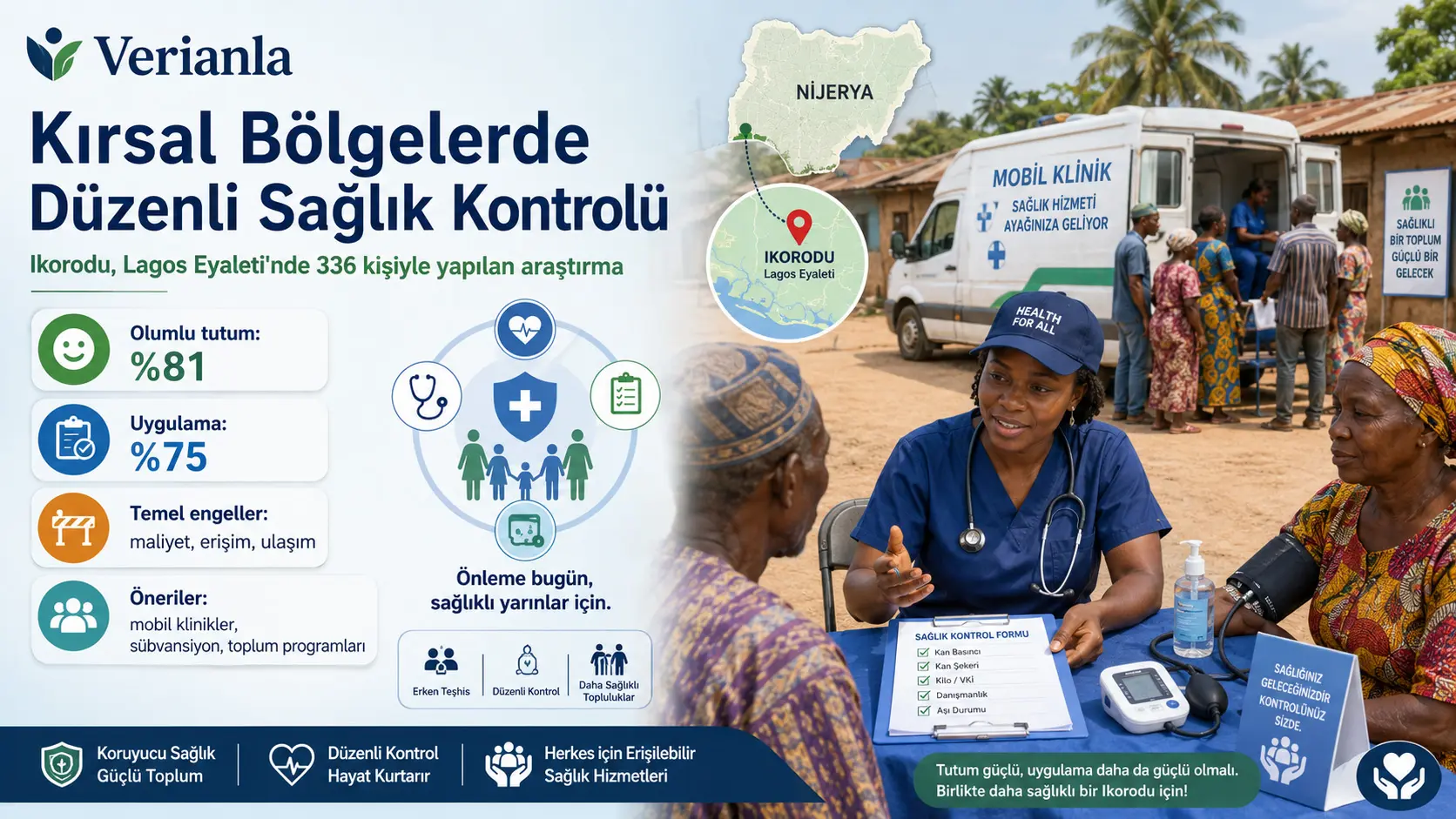
Натиҷаи асосии таҳқиқот ин аст, ки гарчанде муносибати умумии иштирокчиён ба муоинаи мунтазами тиббӣ мусбат буд, ин муносибати мусбат на ҳамеша ба истифодаи мунтазам ва саривақтии хизматрасонии тиббӣ табдил меёфт. Тақрибан %81 иштирокчиён муносибати мусбат изҳор кардаанд. Дар ҷадвалҳои гуногуни таҳлилӣ сатҳи “амалияи хуб” байни %75 ва %79 дода шудааст. Бо вуҷуди ин, %70,8 иштирокчиён гуфтаанд, ки муоинаҳои банақшагирифташуда аксар вақт ба таъхир меафтанд ё гузаронда намешаванд.
Хароҷот яке аз монеаҳои аз ҳама равшани таҳқиқот мебошад. Тақрибан %90 иштирокчиён бар ин назаранд, ки нокифоягии маблағ муоинаи мунтазами тиббиро бозмедорад. Сатҳи онҳое, ки дастрасӣ ба муассисаҳои тиббӣ ва кормандони соҳаи тандурустиро маҳдуд мешуморанд, низ баланд аст. Дар муқобил, %93 иштирокчиён фикр мекунанд mobile clinics, %94 financial incentive ё health subsidy, %94,5 community-based programs ва %85,5 transportation support метавонанд сатҳи муоинаҳои мунтазамро зиёд кунанд.
Дар chi-square analyses байни gender ва attitude ё practice робитаи аҳамиятнок ёфт нашуд. Байни age ва practice бошад, дар баъзе таҳлилҳо statistical significance гузориш шудааст. Аммо натиҷаҳо оид ба age ва attitude дар ҷадвалҳои гуногуни ҳуҷҷат пурра ба ҳам мувофиқ нестанд. Дар як ҷадвал age-attitude relationship аҳамиятнок нест, дар таҳлили баъдии sociodemographic бошад аҳамиятнок шумурда шудааст.
Таҳқиқот cross-sectional, self-reported ва бо sample-и асосан ҷавон анҷом шудааст. Илова бар ин, дар methods ва results баъзе numerical ва conceptual inconsistencies мавҷуданд. Аз ин рӯ, натиҷаҳо набояд ба тамоми rural population-и Ikorodu ба таври қатъӣ generalize карда шаванд; онҳо бояд ҳамчун exploratory data барои local public-health planning арзёбӣ шаванд.
Дар study “regular medical checkup” аз ҳолате фарқ карда шудааст, ки шахс танҳо ҳангоми бемор шудан ба муассисаи тиббӣ меравад. Ин мафҳум periodic physical examinations, disease screening, medical-history review, laboratory tests ва preventive-health counseling-ро дар бар мегирад.
Ҳадафи асосӣ ин аст, ки ба ҷойи интизори пайдо шудани symptoms, health risks дар марҳилаи барвақттар муайян шаванд. Хусусан hypertension, diabetes, баъзе cancers ва chronic diseases метавонанд муддати дароз бе complaints-и равшан пеш раванд.
Аммо “regular medical checkup” маънои иҷрои same tests with same frequency барои everyone-ро надорад. Content ва interval-и checkup метавонад вобаста ба age, gender, family history, lifestyle, existing diseases ва individual risks тағйир ёбад.
Масъалаи Асосии Таҳқиқот
Starting point-и study ин аст, ки одамони зиндагӣкунанда дар rural settlements гарчанде аҳамияти preventive health services-ро медонанд, health checkup-ро мунтазам иҷро намекунанд.
Researcher ин ҳолатро танҳо бо individual indifference шарҳ намедиҳад. Study пешниҳод мекунад, ки factors-и зерин метавонанд якҷо нақш дошта бошанд:
- Cost of health services,
- Limited health insurance,
- Distance to health centers,
- Transportation difficulty,
- Insufficient health workers and facilities,
- Incomplete knowledge about preventive health,
- Cultural and religious beliefs,
- Fear of receiving a negative diagnosis,
- Tendency to seek care only when disease symptoms become severe.
Аз ин рӯ, central question танҳо “do people consider checkups important?” нест. Саволи муҳимтар чунин аст:
Чаро муносибати мусбат ҳамеша ба рафтори муоинаи мунтазами тиббӣ табдил намеёбад?
Таҳқиқот Дар Куҷо Гузаронида Шуд?
Study дар Ikorodu Local Government Area-и Lagos State, Nigeria гузаронида шудааст. Researcher 10 settlements-и дорои rural characteristics-ро ба sample дохил кардааст:
- Oreta,
- Baiyeku,
- Igbogbo,
- Itamaga,
- Ogolonto,
- Ebute,
- Isawo,
- Adamo,
- Ogijo,
- Oreyo.
Дар study гуфта мешавад аз ҳар community 30 participants интихоб шудаанд. Ин ҳисоб 300 people медиҳад, аммо results section total sample-ро 336 people нишон медиҳад. Document шарҳ намедиҳад, ки remaining 36 people аз кадом communities ё бо кадом method ба sample илова шудаанд.
Тарҳи Таҳқиқот
Study cross-sectional research design дорад. Cross-sectional research attitudes, behaviors ё characteristics-и population-ро дар як specific time point чен мекунад.
Ин design барои муайян кардани current views of participants оид ба health checkups мувофиқ аст. Аммо он нишон намедиҳад, ки behavior over time чӣ гуна тағйир меёбад ва causal relationship-ро исбот карда наметавонад.
Масалан, relationship байни age ва regular health checkup маънои онро надорад, ки age alone ин behavior-ро cause мекунад. Бо age, income, disease burden, health knowledge ва need for healthcare низ тағйир ёфта метавонанд.
Оё Study Дар Ҳақиқат Mixed-Methods Аст?
Methods section мегӯяд research “mixed-methods” буда, дар баробари questionnaires, in-depth interviews with health workers, observations ва medical records низ истифода мешаванд.
Аммо results section танҳо quantitative results from structured questionnaire, percentages, pie charts ва chi-square analyses-ро пешниҳод мекунад. Separate results оид ба health-worker interviews, qualitative thematic analysis, observation findings ё medical-record data дода нашудаанд.
Аз ин рӯ, published results амалан quantitative cross-sectional survey research мебошанд. Mixed-method claim бо findings-и пешниҳодшуда пурра support намешавад.
Номуайянӣ Дар Sampling Method
Sampling process дар study ҳамчун “multistage sampling” тавсиф шудааст. Дар first stage communities бо simple random method интихоб шудаанд; дар second stage participants аз ҳар community бо purposive sampling интихоб шудаанд.
Дар section-и дигар гуфта мешавад eligible participants бо simple random sampling интихоб шудаанд.
Ин explanations пурра consistent нестанд. Purposive sampling nonprobability method мебошад, ки researcher people with certain characteristics-ро интихоб мекунад. Simple random sampling probability method аст, ки probability of selection барои ҳар individual known мебошад.
Норӯшан будани sampling method generalizability-и results ба тамоми rural population-и Ikorodu-ро маҳдуд мекунад.
Сохтори Демографии Иштирокчиён
Demographic distribution-и total 336 participants чунин аст:
| Хусусият | Шумора | Сатҳ |
|---|---|---|
| Мард | 150 | %44,6 |
| Зан | 186 | %55,4 |
| 18–29 сол | 208 | %62 |
| 30–49 сол | 57 | %17 |
| 50–69 сол | 64 | %19 |
| 70–89 сол | 7 | %2 |
| Муҷаррад | 218 | %65 |
| Оиладор | 115 | %34 |
| Бева | 3 | %1 |
Тақрибан ду-се ҳиссаи sample дар 18–29 age group буданаш муҳим аст. Ин метавонад боис шавад study бештар views of young adults-ро инъикос кунад, на general population-ро.
Хусусан дар 70–89 age group танҳо seven people ҳастанд. Percentages derived from such small subgroup statistically unstable мебошанд.
Тақсимоти Дин
Participants:
- %56 Christian,
- %37 Muslim,
- %5 followers of traditional beliefs,
- %2 classified as nonreligious.
Between religion and attitude/practice toward regular checkups significant relationship found нашуд. Аммо number of people in traditional-belief and nonreligious groups хеле кам аст. Therefore strong subgroup comparisons имконпазир нестанд.
Questionnaire Чӣ Гуна Омода Шуд?
Study structured questionnaire-и researcher-developed истифода кардааст. First section demographic characteristics чун age, gender, marital status and religion-ро фаро мегирад.
Second section 17 statements about regular medical checkups дорад. Participants яке аз four options-ро интихоб карданд:
- Strongly agree,
- Agree,
- Disagree,
- Strongly disagree.
Questions areas-и гуногунро фаро мегиранд: importance of checkups, cost, access, transportation, postponement, advanced-disease management, mobile clinics, financial incentives ва community-based programs.
Validity Ва Reliability-и Questionnaire
Study мегӯяд test-retest reliability ва internal-consistency assessment анҷом дода мешавад. Аммо results section reliability coefficient, масалан Cronbach alpha, пешниҳод намекунад.
Questionnaire is said to have been reviewed and validated by research supervisor, аммо detailed content-validity ё construct-validity analysis пешниҳод нашудааст.
Therefore psychometric strength of categories such as “positive attitude”, “good practice” and “good access” unclear мемонад.
Аксари Иштирокчиён Health Checkup-ро Муҳим Мешуморанд
%75,9 participants strongly agreed that checkup is fundamental part of medical routine, and %23,1 agreed.
Ҳангоми combining these two groups, approximately %99 participants see regular health checkup as necessary element of medical care.
Likewise participants:
- %92 said regular checkups are important for maintaining health,
- %87,7 said checkup is necessary even after treatment of disease is completed,
- %86,3 said health checkups are not waste of time.
Findings suggest problem is not simply lack of knowledge. Participants generally accept value of regular checkups.
Attitude Chart Дар Page 66
Pie chart on page 66 shows %81 positive and %19 negative attitudes.
| Attitude | Шумора | Сатҳ |
|---|---|---|
| Мусбат | 273 | %81 |
| Манфӣ | 63 | %19 |
Later chi-square tables report 274 positive and 62 negative attitudes. Another graph gives 276 positive and 60 negative.
Differences suggest different scoring cutoffs may have been used, but document does not explain these classifications.
Оё Муносибати Мусбат Пурра Ба Рафтор Табдил Меёбад?
Overall narrative says regular-checkup behavior remains insufficient despite positive attitude.
%70,8 participants reported that scheduled health checks are often skipped or postponed.
This shows knowing importance of checkups alone is insufficient. A person may believe in value of checkup but postpone it because of cost, transport, time or service limitations.
Ихтилоф Дар Сатҳи “Good Practice”
Pie chart on page 70 reports 253 people, or %75, with “good practice”, and 83 people, or %25, with “poor practice”.
A later table reports 266 good and 70 poor practice. Another graph shows 265 good and 71 poor.
In conclusion and discussion sections researcher sometimes describes practice as “low”.
This creates an important interpretation problem:
- According to total scores, majority are in “good practice” category.
- However more than %70 also report often skipping checkups.
Possible explanation is that “practice” category was built not from actual frequency of checkups alone, but from a mixed score including views on benefits, mobile clinics and health policies.
Questionnaire did not directly ask questions like “how many times in last year did you have a health check?” or “what was date of your latest checkup?”
Therefore “good practice” percentage should not be read as exact proportion of people truly undergoing regular checks.
Монеаҳои Молиявӣ
Approximately %89,8 participants thought financial constraints or inability to pay checkup fees prevent regular checkups.
This is one of strongest and most consistent findings.
In Nigeria, large share of health expenditure is out-of-pocket, which may push preventive care into lower priority for rural and low-income households.
If household must allocate limited income among food, housing, transportation and education, paying for checkup without obvious symptoms may be postponed.
Дастрасӣ Ба Health Services
Approximately %72,7 participants reported limited access to health facilities and health workers.
However responses to direct statement “accessing health-check facilities in Ikorodu is difficult” were more balanced:
- %27,4 strongly agreed,
- %24,5 agreed,
- %31,1 disagreed,
- %17 strongly disagreed.
Thus %51,9 thought access was difficult, while %48,1 did not.
Another graph states %62 had “good access” and %38 “poor access”.
Difference may arise because access was measured differently across questions. Physical presence of health facility does not necessarily mean service is economically, geographically and functionally accessible.
Мушкилоти Нақлиёт
%46,5 participants said reaching health-check facility from rural settlement was difficult, while %53,5 disagreed.
Yet %85,5 thought transportation support or better transport infrastructure would increase checkup use.
Together these findings suggest transportation may not be equally severe barrier for everyone, but there is strong expectation that better transport would increase healthcare use overall.
Health Checkup Ва Management of Advanced Disease
%96,2 participants believed regular checkup is important for managing and controlling progression of terminal diseases.
%84,5 said regular checkup could reduce treatment costs of terminal diseases.
Also %75 agreed that investment in health checkups could reduce long-term financial burden.
These results show general belief in economic and clinical benefits of early diagnosis and regular follow-up.
However research did not measure whether checkups actually reduced costs for specific diseases. These are participants’ views.
Истифодаи Мафҳуми “Terminal Disease”
Study uses “terminal disease” rather broadly. Some sections refer to cancer or progressive disease, while elsewhere chronic disease and conditions requiring early detection are handled in same framework.
Terminal disease generally refers to advanced, incurable disease that substantially limits life expectancy. Hypertension or early-stage diabetes do not fit this category.
This conceptual ambiguity may affect how participants understood questions and how results should be interpreted.
Пиронсолӣ Ва Health Checkup
%73,7 participants thought people start regular health checks as they get older.
This may be related to younger adults perceiving themselves at lower risk. According to Health Belief Model, if perceived susceptibility is low, motivation for preventive service use decreases.
But because sample is overwhelmingly young, this finding may reflect societal perception about age and checkups more than actual behavior of older adults.
Дастгирии Қавӣ Аз Mobile Clinics
%93 participants believed mobile health clinics or outreach health services in rural areas would increase regular checkup use.
Mobile clinics could bring services closer, including:
- Blood-pressure measurement,
- Blood-glucose screening,
- Basic physical examination,
- Pregnancy and child-health monitoring,
- Vaccination services,
- Referral for cancer screening,
- Health education,
- Chronic-disease follow-up.
For effectiveness, these should be regular, registered and linked to referral systems rather than one-off campaigns.
Financial Incentives Ва Subsidies
%94 participants said financial incentives or health subsidies would encourage rural residents to undertake regular medical checkups.
This shows cost is central not only as perceived barrier but also in proposed solutions.
Subsidies could take forms such as:
- Free basic screenings,
- Voucher systems for low-income households,
- Transport assistance,
- Community-based health insurance,
- Chronic-disease follow-up packages,
- Free assessment at mobile clinics.
Community-Based Programs
%94,5 participants believed community-based health programs targeting rural areas could promote regular checkups.
Programs are suggested in partnership with local leaders, religious institutions, women’s groups, youth organizations and community health workers.
Because study emphasizes cultural and social norms affecting health behavior, including trusted local actors may be more important than hospital-centered campaigns alone.
Модели Health Belief
Яке аз theoretical frameworks-и study Health Belief Model мебошад.
According to this model, preventive health behavior depends on perceptions of:
- Likelihood of getting a disease,
- How serious the disease is,
- Benefits of health checkup,
- Barriers such as cost, time and fear,
- Cues that trigger action.
Дар Ikorodu study participants benefits of health checkup-ро high perceive мекунанд. Аммо cost ва access barriers низ high мебошанд.
Therefore failure of positive attitude to turn into behavior is consistent with Health Belief Model: ҳатто агар perceived benefit high бошад, stronger perceived barriers метавонанд person-ро ба postponing checkup водор кунанд.
Theory of Planned Behavior
Second theoretical framework used is Theory of Planned Behavior.
According to this theory, intention to perform a behavior is influenced by three main elements:
- Attitude toward behavior,
- Expectations of society and close social environment,
- Perceived control over ability to perform behavior.
Participants generally have positive attitudes toward medical checkups. Аммо cost ва access problems метавонанд perceived control, яъне “I can do this”, reduce кунанд.
This theory also helps explain gap between positive attitude and low or irregular practice.
Модели Socioecological
Socioecological Model emphasizes that health behavior is not only individual choice.
Levels influencing behavior include:
- Individual level: Knowledge, beliefs, age and disease perception,
- Family and close environment: Support, social norms and caregiving responsibilities,
- Community level: Local leaders, transport and presence of health centers,
- Institutional level: Health workers, clinic hours and cost,
- Policy level: Health insurance, rural-health investment and subsidies.
Findings support this multilevel perspective. Cost, transportation, facility availability and community programs are not independent of individual attitude.
Diffusion of Innovations Theory
Study also uses Diffusion of Innovations Theory to explain adoption of regular health checkups within rural communities.
According to this theory, adoption of a new practice depends on communication channels, trusted persons, visible benefit of practice and readiness of social system.
When regular checkup becomes visible, accessible and trustworthy in community, use may increase. Mobile clinics and community-based programs therefore are not only services but also communication tools that spread behavior.
Оё Gender Бо Attitude Робита Дорад?
Chi-square result for gender and attitude toward regular checkup is:
\[ \chi^2 = 1{,}495,\quad sd = 1,\quad p = 0{,}222 \]
Because p value is greater than 0,05, no statistically significant relationship was found between gender and attitude.
| Gender | Positive Attitude | Negative Attitude |
|---|---|---|
| Мард | %78,7 | %21,3 |
| Зан | %83,9 | %16,1 |
Positive attitude appears slightly higher among women, but difference did not reach statistical significance in this sample.
Оё Gender Бо Practice Робита Дорад?
Analysis of gender and practice reported:
\[ \chi^2 = 1{,}647,\quad sd = 1,\quad p = 0{,}199 \]
Натиҷа ҳамин тавр пешниҳод шудааст.
Therefore no significant relationship was found between gender and health-checkup practice.
Later sociodemographic table similarly gives p = 0,810. Both analyses suggest gender is not a main determinant.
Робитаи Age Бо Practice
Analysis between age and regular health-checkup practice reported:
\[ \chi^2 = 8{,}896,\quad sd = 3,\quad p = 0{,}031 \]
Натиҷа ҳамин тавр гузориш шудааст.
This indicates significant association between age group and practice.
A later sociodemographic analysis also reports:
\[ \chi^2 = 14{,}511,\quad sd = 3,\quad p = 0{,}002 \]
Натиҷа ҳамин тавр пешниҳод шудааст.
However “good practice” percentages by age group differ between tables. For example, among 50–69 age group one table reports %89,1, another %64,1.
Such large difference suggests either same variable was classified differently or data-processing error may exist.
Чаро Натиҷаи Age Ва Attitude Номувофиқ Аст?
First age-attitude analysis reports:
\[ \chi^2 = 5{,}077,\quad sd = 3,\quad p = 0{,}166 \]
and states no significant relationship.
But later sociodemographic table reports:
\[ \chi^2 = 13{,}188,\quad sd = 3,\quad p = 0{,}004 \]
and states significant relationship.
These two results contradict each other for same sample and similar variable definition.
If different attitude-scoring methods were used, this should have been explained in methods. Because explanation is absent, exact conclusion about age-attitude relationship remains uncertain.
Marital Status Ва Religion
Between marital status and attitude:
\[ p = 0{,}742 \]
Between marital status and practice:
\[ p = 0{,}580 \]
Натиҷа ҳамин тавр дода шудааст.
Religion-attitude p = 0,089 and religion-practice p = 0,212.
According to these results, no significant relationship was identified between marital status or religion and attitude/practice toward regular medical checkups.
Бовар Ба Он Ки Checkup Хароҷотро Кам Мекунад
Approximately %70 participants believed regular checkup could reduce long-term costs of treating advanced disease.
This belief was not significantly related to gender:
\[ \chi^2 = 0{,}048,\quad p = 0{,}827 \]
Relationship with age was also not significant:
\[ \chi^2 = 3{,}705,\quad p = 0{,}295 \]
This suggests similar perception of economic benefit across age and gender groups.
Қавитарин Паёми Study
Most important conclusion is that structural barriers exist between knowledge/positive attitude and actual health behavior.
Participants consider health checkups necessary, yet appointments are postponed or skipped.
This gap can be summarized as:
| Area | Main Finding |
|---|---|
| Knowledge and attitude | Large majority view health checkups as important. |
| Practice | Checkups are often reported as delayed or skipped. |
| Cost | Emerges as one of strongest barriers. |
| Access | Shortages of health workers, facilities and transportation are reported. |
| Expected solutions | Strong support for mobile clinics, subsidies and community programs. |
Чаро Танҳо Health Education Кофӣ Набошад?
Findings suggest public-health campaigns that only say “health checkups are important” may be limited.
Most participants already know checkups are important.
Main problems may be:
- Inability to pay fees,
- Difficulty reaching health center,
- Insufficient service capacity,
- Not having time for checkup,
- Lack of trust in health system.
Therefore health education should be paired with access and financing reforms.
Тавсияҳои Study
Researcher proposes four main policy areas:
1. Наздик Кардани Health Services Ба Rural Settlements
Distance to preventive services should be reduced through mobile clinics, regular outreach screening and local primary-care units.
2. Ҳамкории Policy Ва Institutions
Government, local authorities, health institutions and civil-society organizations should develop joint programs supporting rural medical checkups.
3. Health Awareness Programs
Especially young people who see themselves as low risk should receive education on early diagnosis, chronic diseases and regular follow-up.
4. Кам Кардани Cost
Checkup fees, transportation costs and out-of-pocket health spending should be reduced through subsidy or insurance support.
Ҷиҳатҳои Қавии Study
- Direct data collected from rural sample of 336 people.
- Attempted inclusion of ten different settlements.
- Attitude, cost, access and policy solutions assessed within same research.
- Variables such as gender, age, marital status and religion examined with chi-square tests.
- Full questionnaire provided in appendix.
- Directly applicable suggestions for local public-health interventions developed.
Маҳдудиятҳои Study
1. Cross-sectional design
Study measures views at one time point. It does not show changes in behavior over time or effects of interventions.
2. Self-reported data
Participants reported their own health behaviors. Recall bias and socially desirable responses may affect findings.
3. Actual checkup frequency not measured directly
How many participants truly attended checkups in last year, which screenings they received or how many appointments they missed was not clearly recorded.
4. Age distribution is unbalanced
%62 participants are 18–29 years old. Only seven people are in oldest group.
5. Sampling method is unclear
Simple random and purposive sampling descriptions are both used. How total 336 was obtained is not fully explained.
6. Mixed-method results are absent
Interviews, observations and medical records were said to be used, but those data do not appear in results.
7. Psychometric results of questionnaire not reported
Although test-retest and internal consistency were planned, reliability coefficients were not provided.
8. “Good practice” category is unclear
How practice score and cutoff were calculated is not explained.
9. Inconsistencies between tables
Positive attitude, good practice and age relationships are reported with different numbers across tables.
10. Some references are not closely aligned with topic
Reference list contains studies on bone-cell biology, telomere length and diabetes with limited direct connection to healthcare access. It is unclear whether all references directly support claims in text.
11. Ethics-board information is incomplete
Informed consent is mentioned, but institutional ethics-board name, decision date or approval number is absent.
Натиҷаҳо Чӣ Гуна Тафсир Шаванд?
This study does not show that rural residents of Ikorodu are completely indifferent or opposed to regular medical checkups.
On the contrary, large majority see checkups as important, useful and potentially cost-reducing in long term.
However structural barriers such as access, cost and transportation limit behavior.
Therefore low healthcare use should not be explained simply as “people are unaware”.
Most valuable public-health message is this: Health behavior depends not only on knowledge, but on whether services are actually accessible and affordable.
Хулосаи Умумӣ
This research among 336 rural residents in Ikorodu shows positive attitude toward regular health checkups is widespread.
Approximately %81 reported positive attitude, and nearly all accepted health checkups as important part of medical routine.
Despite this, large proportion said checkups are delayed or skipped. Cost, limited healthcare access and transport problems were presented as main explanations.
Gender had no significant effect on attitude or practice. Age was associated with practice; however age-attitude results and some group percentages were inconsistent across tables.
Mobile clinics, community-based programs, financial incentives and transportation support received strongest support as solutions.
Research suggests awareness campaigns alone are insufficient in rural health policy. To expand actual checkup use, services need to become financially, geographically and institutionally accessible.
Усул ва Натиҷаҳои Таҳқиқот
Research is a quantitative cross-sectional survey. Although methods mention mixed-method approach, results provide only quantitative survey data.
Total 336 adults from rural communities in Ikorodu Local Government Area participated.
Data were collected with a researcher-developed 17-item questionnaire using modified four-option Likert scale.
Frequency, percentage and chi-square tests were used. Significance level accepted as 0,05.
| Main Outcome | Reported Value |
|---|---|
| Positive attitude | Approximately %81 |
| Good practice | Approximately %75–79 according to tables |
| Those viewing checkup as part of medical routine | Approximately %99 |
| Those saying checkups often postponed | %70,8 |
| Those reporting financial barrier | Approximately %89,8 |
| Support for mobile clinics | %93 |
| Support for financial incentives/subsidy | %94 |
| Support for community-based programs | %94,5 |
| Support for transportation assistance | %85,5 |
No significant relationship found between gender and attitude/practice. Age-practice relationship was significant at p = 0,031 and in later analysis p = 0,002.
Age-attitude relationship was p = 0,166 in one analysis and p = 0,004 in another. Due to inconsistency, exact direction remains unclear.
Ёддошт оид ба Манбаъ ва Усул
Ин мақола бар academic project-и Osariemen Henshaw Osaro-Uzama бо унвони “Attitude and Practice of Regular Medical Checkup Among Rural Dwellers of Ikorodu Local Government Area of Lagos State” асос ёфтааст, ки дар December 2023 ба National Open University of Nigeria, Faculty of Health Sciences, Department of Public Health ҳамчун requirement барои master’s degree пешниҳод шудааст.
Document is not peer-reviewed journal article. It is master’s research project and should not be treated as independently peer-reviewed publication evidence.
Study uses self-reported cross-sectional survey data. It does not demonstrate causality and does not directly verify actual checkup frequency with medical records.
It states informed consent and confidentiality principles would be followed, but institutional ethics-board approval or approval number is not provided.
There are clarity problems concerning sampling method, mixed-method implementation, questionnaire reliability and some chi-square results. Attitude and practice percentages also vary across tables and graphs.
No causal effects, disease-prevention rates or national-level generalizations not shown by study have been added. Findings are reported only within Ikorodu rural sample and stated limitations.
Шарҳ гузоред
Нишонии почтаи электронии шумо нашр намешавад. Майдонҳои ҳатмӣ бо * нишон дода шудаанд