

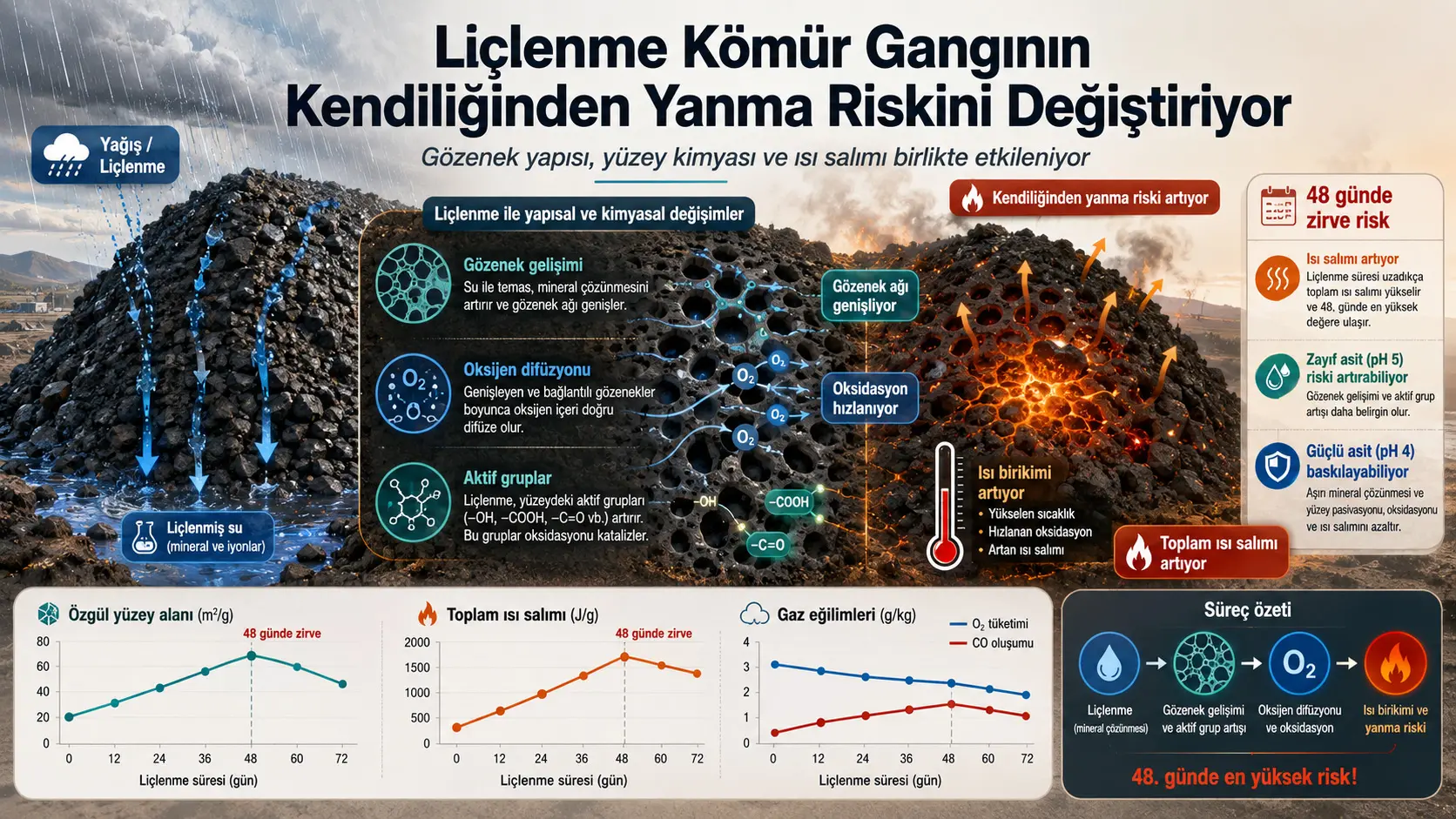
Гангаи ангишт; партови сахтест, ки пас аз истихроҷ ва шустани ангишт боқӣ мемонад ва метавонад дар баробари моддаҳои минералӣ ангишти боқимонда ва пайвастагиҳои сулфурдор дошта бошад. Вақте ки он муддати дароз дар ҳавои кушод нигоҳ дошта мешавад, оби борон аз дохили тӯдаи ганга гузашта, минералҳоро ҳал карда метавонад, сохтори сӯрохҳоро тағйир диҳад ва гурӯҳҳои химиявии рӯизаминиро табдил диҳад. Ин таҳқиқот омӯхтааст, ки leaching-и динамикӣ, ки боришро тақлид мекунад, ба оксидшавии ҳарорати паст ва тамоюли худсӯзии гангаи ангишти дорои сулфури баланд чӣ гуна таъсир мерасонад.
Намунаҳое, ки аз як кони ангишт дар музофоти Shanxi гирифта шуданд, бо оби тоза барои 3, 6, 12, 24, 48 ва 96 рӯз leach карда шуданд. Дар як гурӯҳи таҷрибавии алоҳида, намунаҳо барои шаш рӯз ба маҳлулҳои pH 7, pH 5 ва pH 4 дучор карда шуданд. Сохтори сӯрохҳо бо N₂ adsorption дар ҳарорати паст, химияи сатҳ бо FTIR, formation-и газ бо temperature-programmed oxidation, mass ва heat changes бо TG-DSC ва energy barriers бо Coats–Redfern kinetic analysis арзёбӣ шуданд.
Натиҷаҳо нишон доданд, ки таъсири leaching хаттӣ нест. Pore network ва specific surface area аввал рушд карда, тақрибан дар 48 рӯз ба сатҳи баландтарин расиданд, дар leaching-и дарозтар бошад аз сабаби collapse-и large pores ва пур шудани онҳо бо fine precipitates коҳиш ёфтанд. Specific surface area дар 48 рӯз ба 9,323 m²/g расид. Average pore diameter, ки дар raw sample 45,44 nm буд, дар охири 96 рӯз то 38,71 nm коҳиш ёфт.
Hydroxyl, oxygen-containing ва aromatic hydrocarbon groups низ дар 48 рӯз ба сатҳи баландтарин расиданд. FTIR peak areas-и ин се гурӯҳ мутаносибан ба 8,7, 10,2 ва 7,6 баробари raw sample расиданд. Aliphatic hydrocarbon groups бошад пештар, дар 24 рӯз, peak карданд.
Рушди сӯрохҳо ва афзоиши reactive surface groups интиқоли oxygen ба дохили gang particles ва low-temperature oxidation-ро суръат бахшид. Дар намунаи 48-рӯза crossing-point temperature то 168,4 °C паст шуд, total heat release то 733,1 J/g боло рафт ва apparent activation energy дар oxygen-adsorption stage то 72,53 kJ/mol коҳиш ёфт. Ин energy barrier тақрибан %64-и raw gang value мебошад.
Weakly acidic pH 5 solution бо зиёд кардани hydroxyl ва carboxyl groups low-temperature oxidation-ро нисбат ба pure water каме қавитар кард. Баръакс, strong acid дар pH 4 боиси dissolution ё degradation-и reactive organic structures ва surface groups шуд; total heat release-ро то 608,0 J/g коҳиш дода, онро аз raw sample value-и 624,6 J/g ҳам пасттар кард.
Таҳқиқот нишон медиҳад, ки rain ва acidic seepage water метавонанд fire risk дар coal-gangue piles-ро на танҳо бо таъмин кардани moisture, балки бо якҷоя тағйир додани pores, oxygen transport, surface chemistry ва reaction kinetics таъсир диҳанд. Аммо experiments дар laboratory columns анҷом дода шуданд. Temperature gradients, microbial activity, irregular rainfall, airflow ва moisture transport дар real piles бевосита modeled нашудаанд.
Чаро гангаи ангишт метавонад худ аз худ сӯзад?
Coal gangue пурра аз noncombustible mineral matter иборат нест. Он метавонад residual coal, fixed carbon, volatile organic compounds ва sulfur-bearing minerals мисли pyrite дошта бошад. Ин components метавонанд бо atmospheric oxygen оҳиста reaction карда heat истеҳсол кунанд.
Агар heat-и истеҳсолшуда аз pile ба environment ба қадри кофӣ зуд интиқол наёбад, temperature тадриҷан баланд мешавад. Oxidation, ки дар low temperature оғоз мешавад, баъд аз гузаштани critical temperature метавонад суръат гирад ва пеш аз пайдо шудани visible flame як long self-heating period ба вуҷуд ояд.
Composition-и raw gang sample, ки дар таҳқиқот омӯхта шудааст, аз ин нуқтаи назар диққатҷалбкунанда аст:
| Proximate-analysis component | Mass fraction |
|---|---|
| Moisture | %2,27 |
| Volatile matter | %14,32 |
| Ash | %57,13 |
| Fixed carbon | %26,28 |
| Element | Mass fraction |
|---|---|
| Carbon | %27,76 |
| Hydrogen | %2,159 |
| Oxygen | %9,455 |
| Nitrogen | %0,52 |
| Sulfur | %6,529 |
Гарчанде high ash fraction нишон медиҳад, ки қисми зиёди sample mineral matter аст, %26,28 fixed carbon, %14,32 volatile matter ва %6,529 sulfur нишон медиҳанд, ки миқдори назарраси reactive components барои oxidation ва heat generation мавҷуд аст.
Leaching чӣ маъно дорад?
Leaching равандест, ки ҳангоми гузаштани об аз дохили solid material, soluble minerals, ions ва chemical products-ро ҳал карда, бо худ мебарад. Дар gang piles-и open-air, rainwater аз upper surface ворид шуда, аз spaces байни particles мегузарад ва аз поёни pile ҳамчун seepage water мебарояд.
Ин process метавонад дар structure-и gang changes-и ба ҳам муқобил эҷод кунад:
- Dissolution-и carbonate ва clay minerals метавонад new voids ва cracks эҷод кунад.
- Connection of closed pores метавонад oxygen passage-ро осон кунад.
- Mineral coating, ки organic structures-ро мепӯшонад, метавонад хориҷ шуда reactive carbon surfaces-ро ошкор кунад.
- Water ва oxygen метавонанд formation-и active groups мисли hydroxyl, carbonyl ва carboxyl-ро зиёд кунанд.
- Very long-term ё strongly acidic leaching метавонад dissolution-и reactive structures ва collapse-и large pores-ро ба вуҷуд орад.
Аз ин рӯ кофӣ нест, ки фарз кунем rain танҳо gang-ро тар мекунад ё дар ҳама conditions онро cooling мекунад. Пас аз хориҷ шудани water ва re-exposure of sample to air, altered pore structure метавонад stronger oxygen transport-ро ба вуҷуд орад.
Саволи асосии таҳқиқот чист?
Муҳаққиқон кӯшиш кардаанд, ки се relation-ро дар як study шарҳ диҳанд:
- Leaching duration ва solution pH pore structure-ро чӣ гуна тағйир медиҳанд?
- Ин change reactive functional groups on gang surface-ро чӣ гуна transform мекунад?
- Transformation дар pore ва surface chemistry ба oxygen consumption, gas formation, heat release ва spontaneous-combustion kinetics чӣ гуна инъикос меёбад?
Previous studies асосан ба static immersion experiments асос ёфтаанд, ки samples барои certain period пурра дар water submerged буданд. Аммо дар real rainfall, water ба ҷойи ҷамъ шудан continuously through material ҳаракат мекунад. Dynamic dripping system-и study мақсад дошт ин flow-ро дар laboratory scale намояндагӣ кунад.
Намунаҳо чӣ гуна омода шуданд?
Gang samples аз як coal mine дар Xinzhou region of Shanxi province, China гирифта шуданд. Барои маҳдуд кардани premature reaction with oxygen, samples under inert atmosphere crushed, ground ва dry-sieved шуданд.
Four particle groups омода шуданд:
| Sieve range | Approximate particle size |
|---|---|
| 10–20 mesh | 2,0–0,9 mm |
| 20–40 mesh | 0,9–0,45 mm |
| 40–60 mesh | 0,45–0,30 mm |
| 60–80 mesh | 0,30–0,20 mm |
Ҳар particle-size class алоҳида classified, placed in airtight containers ва то experiments closed нигоҳ дошта шуд.
Dynamic leaching experiment чӣ гуна сохта шуд?
Experimental setup аз custom-made dripping device, flow regulator, leaching tubes, funnels, support plate ва waste-liquid collection tank иборат буд. Transparent acrylic columns inner diameter 53 mm, outer diameter 55 mm ва height 15 cm доштанд.
Дар base-и ҳар column тақрибан 2 cm quartz sand гузошта шуд. Болои он аз smallest to largest, аз ҳар four particle class 25 g гузошта шуд. Ҳамин тавр total gang used per column тақрибан 100 g буд.
Based on annual average rainfall of Xinzhou, total annual leaching volume 999 mL қабул карда шуд. Дар ҳар application 83 mL solution ба column бо rate-и 1 mL/min дода шуд ва process ҳар 24 hours такрор шуд.
Experimental groups кадомҳоянд?
| Experimental group | Variable | Conditions |
|---|---|---|
| Duration group | Leaching duration | 3, 6, 12, 24, 48 ва 96 days with pH 7 pure water |
| pH group | Solution acidity | pH 7, pH 5 ва pH 4; 6 days in all groups |
| Raw control | No leaching | Same drying ва storage procedures applied |
Samples after leaching аввал барои 48 hours дар trays air-dried, баъд дар 40 °C барои 48 hours under vacuum dried шуданд. Ҳамин тавр дар subsequent oxidation experiments direct effect of free water кам карда шуд ва permanent structural changes from leaching омӯхта шуданд.
Pore structure чӣ гуна measured шуд?
Аз ҳар sample тақрибан 0,8 g гирифта шуда дар Autosorb-iQ physical adsorption instrument analyzed шуд. Пеш аз measurement samples дар 80 °C барои 12 hours under vacuum degassed шуданд.
- Adsorbed gas: Nitrogen
- Measurement temperature: 77 K
- Relative pressure range: P/P0 = 0,001–0,995
- Adsorption points: 30
- Desorption points: 30
- Specific surface area: BET model
- Total pore volume: BJH model
- Pore-size distribution: DFT model
Adsorption curves чӣ нишон медиҳанд?
Nitrogen adsorption-desorption curves of all samples мувофиқи IUPAC classification Type IV(a) мебошанд. Ин shape нишон медиҳад, ки structure predominantly mesoporous аст ва contribution-и micropores низ мавҷуд буда метавонад.
Вақте P/P0 дар range 0–0,4 буд, nitrogen molecules small pores-ро пур карданд ва adsorbed amount nonlinearly increased. Пас аз approximately 0,4 adsorption ва desorption branches ҷудо шуданд.
H2(a)-type hysteresis loop дар curves ба “ink-bottle” pores ишора мекунад. Дар ин pores inner cavity wide аст, neck opening to outside бошад narrow. Вақте P/P0 аз 0,9 боло рафт, adsorbed nitrogen amount аз сабаби capillary condensation rapidly increased.
Pore network over time чӣ гуна changed шуд?
Бо зиёд шудани leaching duration, specific surface area ва total pore volume аввал increased, дар 48 days reached maximum ва баъд decreased. Highest specific surface area 9,323 m²/g чен шуд.
Average pore diameter бошад overall decreased:
- Raw gang: 45,44 nm
- 96-day sample: 38,71 nm
Дар Figure 4 yellow bars total pore volume, orange bars specific surface area ва blue line average pore diameter-ро нишон медиҳанд. Increase of bars ва decrease of blue line дар 24–48-day samples supports formation of numerous smaller micro- ва mesopores rather than large voids.
Early and middle period: pore opening
Between 12–48 days soluble carbonates ва some clay minerals removed шуданд, cracks widened ва closed voids connected шуданд. Formation of new micro- ва mesopores increased surface area available for oxygen contact.
Late period: pore narrowing and filling
Between 48–96 days prolonged water passage caused collapse of some large pores, while transported fine particles partially filled voids. Therefore surface area ва total volume decreased ва average pore diameter further decreased.
Бо вуҷуди ин, specific surface area of 96-day sample ҳанӯз аз raw gang higher аст. Пас late-stage decline маънои complete return to initial structure надорад.
Acidity ба pores чӣ гуна таъсир кард?
Acidic solutions dissolution of minerals like carbonates-ро accelerated карданд, specific surface area ва total pore volume increased while average pore size decreased. Study especially weakly acidic conditions-ро as producing many small pores арзёбӣ мекунад.
Аммо increase in pore number alone spontaneous-combustion risk-ро муайян намекунад. pH simultaneously organic functional groups on surface-ро changed кард ва between pH 5 and pH 4 different chemical outcomes ба вуҷуд овард.
FTIR analysis чӣ гуна conducted шуд?
Surface chemistry of samples бо VERTEX 80V FTIR spectrometer омӯхта шуд. Gang ва KBr дар mass ratio 1:180 mixed шуданд ва under 20 MPa pressure for 10 minutes pressed into pellets.
- Wavenumber range: 400–4.000 cm−1
- Spectral resolution: 4 cm−1
- Number of scans: 32
- Peak-deconvolution software: PeakFit
Four spectral regions separately evaluated шуданд:
| Wavenumber range | Represented structure |
|---|---|
| 3.800–3.000 cm−1 | Hydroxyl groups |
| 3.000–2.700 cm−1 | Aliphatic hydrocarbons |
| 1.800–900 cm−1 | Oxygen-containing functional groups |
| 900–600 cm−1 | Aromatic hydrocarbon structures |
Functional groups over time чӣ гуна changed шуданд?
Ҳамаи four main functional groups аввал increased ва баъд decreased. Аммо peak times яксон набуданд:
| Functional group | Time to reach maximum | Change versus raw sample |
|---|---|---|
| Hydroxyl groups | 48 days | 8,7-fold |
| Oxygen-containing groups | 48 days | 10,2-fold |
| Aromatic hydrocarbons | 48 days | 7,6-fold |
| Aliphatic hydrocarbons | 24 days | No exact fold ratio given in text |
Дар first 48 days combined effect of water ва oxygen surface oxidation-ро increased. Hydroxyl groups formed via alcohol ва phenol structures; баъзе аз онҳо ба oxygenated structures мисли ester, ether, aldehyde ва carboxyl табдил ёфтанд.
Дар same period oxygen attacked aromatic skeletons, broke some C–C bonds ва more reactive fragments formed. Swelling caused by water film steric hindrance between aliphatic chains and aromatic cores-ро reduced ва breakdown of long aliphatic chains-ро facilitated.
Between 48–96 days secondary oxidation largely completed, soluble oxidation products removed by flow ва degradation of aromatic structures continued. Therefore functional-group amounts decreased, аммо ҳатто дар 96-day samples above raw-gang level remained.
Чаро functional groups ба fire risk таъсир мекунанд?
Oxygenated groups мисли hydroxyl, carbonyl ва carboxyl active centers мебошанд, ки метавонанд oxygen-ро дар low temperatures chemically bind кунанд. Oxygen adsorption onto these sites метавонад unstable peroxide intermediates ва free radicals эҷод кунад.
Decomposition of these intermediates produces new radicals and heat, supporting chain oxidation reactions. Pores physical pathway барои oxygen transport, functional groups бошад chemical pathway for oxygen reaction медиҳанд.
Study simultaneous increase of oxygen-containing groups ва aromatic structures-ро ҳамчун formation of “dual active centers” тафсир мекунад. Ин two centers метавонанд ҳам oxygen capture ва ҳам reaction with carbon skeleton-ро accelerate кунанд.
Чаро pH 5 ва pH 4 different results доданд?
Weakly acidic pH 5
Дар pH 5 condition amount of hydroxyl, aliphatic hydrocarbon ва oxygen-containing functional groups increased; aromatic hydrocarbon proportion decreased. Муҳаққиқон инро бо accelerated formation of alcohol, phenol ва carboxyl ва oxidative hydroxylation of aromatic structures шарҳ доданд.
Ин surface chemistry low-temperature oxygen adsorption ва heat generation-ро нисбат ба sample leached with pure water каме increased кард.
Strongly acidic pH 4
Дар pH 4 condition total content of all main functional groups below raw-gang level fell. Strong acid caused further breakdown of aromatic skeletons ва side chains, removal of soluble products from sample ва loss of active centers.
Дар натиҷа pH 4, despite creating new pores, chemical sites required for oxidation-ро reduced ва especially total combustion intensity at higher temperatures-ро suppressed кард.
Temperature-programmed oxidation experiment чӣ гуна performed шуд?
Дар each experiment 50 g sample дар ZRD-III programmable tube furnace гузошта шуд. Sample аз 40 °C то 230 °C бо heating rate 0,8 °C/min heated шуд. Outlet gas at every 10 °C increase sampled ва бо GC-4000A gas chromatograph analyzed шуд.
Main indicators monitored:
- O₂ amount at outlet: Indicates oxygen consumption.
- CO formation: One of characteristic products of low-temperature oxidation.
- C₂H₄ formation: Provides information on breakdown of organic side chains ва oxidation progress.
Oxygen consumption чӣ гуна changed шуд?
During 0–48-day leaching, expanded mesopores ва increased physical adsorption areas caused O₂ decline below 120 °C to start approximately %2–3 earlier than raw sample.
Ин result нишон медиҳад, ки oxygen consumption by gang starts at lower temperature. While pore network facilitates oxygen transport, increased active groups accelerate chemical adsorption.
Дар 96-day sample, due to functional-group loss oxygen consumption weakened ва outlet O₂ increased again. Бо вуҷуди ин, values completely to raw-sample level барнагаштанд; preserved mesopore network partially compensated loss of chemical activity.
CO ва C₂H₄ results чӣ нишон медиҳанд?
Пас аз 48-day leaching:
- Maximum CO concentration became 1,39 times raw gang.
- CO peak temperature shifted 15 °C lower.
- C₂H₄ initial-appearance temperature decreased from 110 °C to 90 °C.
- C₂H₄ peak concentration increased approximately %18.
Ин four changes support earlier onset ва stronger progression of oxidation at low temperature.
Дар 96-day sample C₂H₄ onset temperature increased to 105 °C ва CO amount decreased. Аммо C₂H₄ peak remained above raw-gang level.
Gas formation дар acidic conditions чӣ гуна changed шуд?
Дар pH 5 condition low-temperature O₂ consumption increased ва CO production rose. C₂H₄ started appearing at 90 °C ва peak concentration was %12 higher than pH 7 group.
Above 180 °C, because reactive groups had been consumed earlier, rates of change in O₂ ва CO curves slowed. Therefore effect of pH 5 is temperature-dependent: it enhances low-temperature oxidation while potentially causing earlier depletion of reactive resources at high temperature.
Дар pH 4 group CO amount throughout entire temperature range remained below pH 7 group. C₂H₄ first appeared at 110 °C and concentration remained below neutral-leached sample. Ин supports that strong acid reduced reactive side chains ва functional groups.
Oxygen consumption rate at 70 °C чӣ гуна calculated шуд?
Дар paper oxygen consumption rate at 70 °C бо relation-и зерин calculated шуд:
\[ R_{O_2,70}=\frac{Q_{in}\,\varphi_{in}}{22400\,S\,L}\ln\left(\frac{\varphi_{in}}{\varphi_{out}}\right) \]
Дар ин ҷо:
- RO₂,70: Oxygen consumption rate at 70 °C.
- Qin: Inlet air flow, set at 96 mL/min.
- φin: Oxygen volume fraction in inlet air.
- φout: Oxygen volume fraction in outlet gas.
- S: Cross-sectional area of sample holder.
- L: Height of gang layer.
- 22400: Coefficient used in conversion between gas volume and molar amount.
As outlet oxygen fraction decreases, logarithmic term increases and calculated consumption rate rises.
Crossing-point temperature чиро нишон медиҳад?
Crossing-point temperature як integrated self-heating indicator мебошад, ки balance байни heat generated by sample ва heat lost to environment-ро намояндагӣ мекунад. Lower temperature нишон медиҳад, ки sample метавонад heat-ро earlier accumulate кунад ва spontaneous combustion-ға more prone бошад.
| Sample | Crossing-point temperature | Interpretation |
|---|---|---|
| 48 days | 168,4 °C | 18,4 °C lower than raw sample; strongest low-temperature oxidation |
| 96 days | 177,7 °C | Higher than 48 days but not returned to raw-gang level |
| pH 5 | 172,1 °C | Weak acid slightly increased oxidation |
| pH 4 | 182,3 °C | Strong acid suppressed oxidation |
Value rounded to 168 °C in abstract is given as 168,4 °C in results section.
Spontaneous-combustion index I чӣ гуна interpreted шуд?
Study states that I index for all samples ranged between 600–1.200 and indicated measurable spontaneous-combustion tendency. In classification used by this study, lower I value means higher risk.
- 48-day sample: I = 801,6; lowest value and highest risk
- 96-day sample: I = 924,1; risk decreased but remained higher than raw sample
- pH 4 sample: I = 975,7; approached raw-gang value
- pH 5 sample: approximately %7 lower I value than pH 7 control
Method note: PDF does not provide explicit calculation equation, coefficients or classification thresholds for this index. Therefore independent recalculation of I values is not possible from current text.
TG-DTG analysis чӣ гуна performed шуд?
Approximately 10 mg sample was placed in an Al₂O₃ crucible and heated in air atmosphere from 20 °C to 800 °C at 10 °C/min. Air flow was set to 100 mL/min.
TG curve shows change in sample mass, while DTG curve shows rate of mass loss per unit time.
Six characteristic temperatures чиро represent мекунанд?
| Symbol | Definition |
|---|---|
| T1 | Critical temperature |
| T2 | Dry-cracking temperature |
| T3 | Temperature of maximum mass |
| T4 | Ignition temperature |
| T5 | Temperature of maximum mass-loss rate |
| T6 | Complete-combustion or burnout temperature |
According to these temperatures, process was evaluated in five stages:
- T1–T2: Moisture evaporation
- T2–T3: Oxygen adsorption and mass gain
- T3–T4: Thermal decomposition
- T4–T6: Combustion
- After T6: Burnout
Чаро 24 days дар TG-DTG results фарқ мекунад?
T1, T2, T5 ва T6 temperatures аввал бо leaching duration decreased, баъд increased ва lowest levels-ро дар 24-day sample нишон доданд. Аз нуқтаи назари ин metrics, 24-day sample example-и fast entry into oxidation-related ignition process мебошад.
Maximum mass-loss rate ҳам аввал increased ва баъд decreased. Maximum mass-loss rate of all leached samples higher than raw gang буд. Ин indicates fixed carbon oxidized faster during combustion stage.
Between 0–48 days, moisture-evaporation stage shortened while oxygen-adsorption and mass-gain stage lengthened. Pore development made removal of adsorbed water and volatile components easier, while increase in active groups prolonged reaction time with oxygen.
Оё 24-day ва 48-day results ба ҳам зиданд?
Пурра зид нестанд; different experiments different processes-ро measure мекунанд:
- Some TG-DTG characteristic temperatures were lowest in 24-day sample. This shows certain higher-temperature reaction stages occurred earlier.
- Pore area, some active functional groups, low-temperature oxygen consumption, total heat release ва oxygen-adsorption activation energy reached highest-risk level in 48-day sample.
Аз ин рӯ 24 days can be considered point where some thermal transitions occur earliest; 48 days, point where low-temperature oxidation and total heat production together are strongest. Overall conclusion of paper assigns highest integrated spontaneous-combustion tendency to 48-day sample.
Acidic leaching TG-DTG stages-ро чӣ гуна changed кард?
In acid-leached samples compared with raw gang, T2 and T6 decreased, while T4 and T5 increased. Maximum mass-loss rate and total mass loss remained lower than pure-water-leached samples.
Acidic environment promoted pore development and volatile release, advancing low-temperature stages, but by dissolving some fixed carbon and sulfur-bearing minerals reduced high-temperature combustion intensity.
This dual effect was more evident in pH 5 group, while pH 4 group was more suppressive because of active-component loss.
DSC curves чӣ нишон медиҳанд?
DSC directly monitored heat uptake and release of sample. All samples showed similar staged curve shapes; however, transition from endothermic to exothermic behavior shifted to lower temperatures in leached samples.
Below 350 °C, heat flow of leached samples was higher than raw gang. This supports enhancement of low-temperature oxidation.
pH 5 sample showed higher heat flow than pH 7 sample below 350 °C. In contrast, exothermic peaks above 400 °C became smaller in acidic samples; peak of pH 4 sample fell below raw gang.
Total heat release чӣ гуна changed шуд?
| Sample | Maximum heat-release peak temperature | Maximum heat flow | Total heat release |
|---|---|---|---|
| Raw gang | 523,75 °C | 5,084 mW/mg | 624,6 J/g |
| 3 days | 522,11 °C | 5,371 mW/mg | 673,5 J/g |
| 6 days | 521,09 °C | 5,274 mW/mg | 675,8 J/g |
| 12 days | 518,21 °C | 5,511 mW/mg | 708,6 J/g |
| 24 days | 521,46 °C | 5,275 mW/mg | 715,4 J/g |
| 48 days | 522,98 °C | 5,310 mW/mg | 733,1 J/g |
| 96 days | 523,53 °C | 5,116 mW/mg | 655,2 J/g |
| pH 5 | 524,97 °C | 4,978 mW/mg | 683,7 J/g |
| pH 4 | 525,30 °C | 4,492 mW/mg | 608,0 J/g |
Total heat release of 48-day sample was 108,5 J/g, approximately %17,4 higher than raw sample. In 96-day sample value decreased to 655,2 J/g but remained above raw-sample value of 624,6 J/g.
pH 5 sample produced total heat of 683,7 J/g, slightly higher than 675,8 J/g of 6-day pure-water-leached sample for same duration. pH 4 sample value of 608,0 J/g was below raw gang.
Oxidation kinetics чӣ гуна calculated шуд?
Activation energy ва pre-exponential factor were calculated using Coats–Redfern equation:
\[ \ln\left[\frac{G(\alpha)}{T^2}\right]=\ln\left(\frac{AR}{\beta E}\right)-\frac{E}{RT} \]
Дар ин ҷо:
- G(α): Selected reaction-mechanism function.
- α: Conversion fraction.
- T: Absolute temperature, K.
- R: Universal gas constant, 8,314 J·mol−1·K−1.
- A: Pre-exponential factor, min−1.
- β: Heating rate, K/min.
- E: Apparent activation energy, kJ/mol.
In linear fitting of equation, slope is related to −E/R. Lower activation energy means lower energy barrier for reaction initiation and stronger low-temperature oxidation tendency.
Оё reaction mechanism бо leaching changed шуд?
Researchers tested nine common gas–solid reaction mechanism functions and selected best fit for each stage.
| Reaction stage | Best kinetic behavior | Interpretation |
|---|---|---|
| Oxygen adsorption; raw, 3 and 6 days | First order | Rate depends mainly on active-group concentration |
| Oxygen adsorption; other samples | 1,5 order | Active-site distribution and oxygen diffusion both important |
| Thermal decomposition | Zero order | Rate controlled mainly by temperature |
| Combustion | Second order | Unburned carbon and molecular oxygen jointly determine rate |
Transition of oxygen adsorption from first order to 1,5 order indicates that with prolonged leaching reaction became more dependent not only on number of chemical sites but also on oxygen transport in pore network.
Activation energy чӣ гуна changed шуд?
In oxygen-adsorption and mass-gain stage, activation energy of all leached samples was lower than raw gang. Lowest value measured in 48-day sample:
E = 72,53 kJ/mol
This corresponds to approximately %64 of raw-gang energy barrier. In other words, after 48-day leaching apparent energy barrier required to initiate low-temperature oxidation decreased by approximately %36.
Activation energies in pyrolysis stage remained within narrow range of 79,01–83,29 kJ/mol. This result indicates leaching had limited effect on pyrolysis stage and this stage was mainly temperature-controlled.
Activation energy in combustion stage first increased with duration, reached maximum at 48 days and decreased at 96 days. This increase does not mean low-temperature oxidation weakened. Study interprets that increased oxygenated and aromatic structures due to leaching participate more in combustion stage, changing apparent energy demand at high temperature.
Proposed integrated mechanism чист?
1. Mineral dissolution and pore restructuring
Water dissolves carbonates and clay minerals, creating voids and cracks. Connection of previously closed pores facilitates oxygen transport to deeper regions of gang particles.
2. Exposure of reactive organic surfaces
As mineral coatings are removed, organic carbon structures previously beneath mineral layers directly contact atmospheric oxygen.
3. Formation of active functional groups
Water–oxygen interaction breaks weak bonds in aliphatic side chains and coal skeleton. Oxygen-containing groups such as −OH, C=O and −COOH increase.
4. Chemical oxygen adsorption
Active groups bind oxygen at low temperature, forming unstable peroxides and free radicals. This process lowers energy barrier of oxidation chain reactions.
5. Heat accumulation
Better oxygen transport and faster surface reactions work together to increase oxygen consumption, CO and C₂H₄ formation, and total heat release.
6. Decline under excessive leaching
When leaching exceeds critical duration, pore collapse, filling with fine particles and loss of reactive organic products begin. Strong acid also reduces active carbon skeletons and functional groups. Thus oxidation activity decreases; however, because pore structure remains more developed than initially, risk does not completely disappear.
Ин барои early warning ва field management чӣ маъно дорад?
Study shows that evaluating only high-moisture period immediately after rainfall is insufficient. After water drains from pile and material dries again, a more open pore network and more reactive surface chemistry may remain.
Laboratory results particularly indicate period after medium-duration leaching should be monitored. However, 24- or 48-day thresholds cannot be applied directly to all field piles. Real timing can vary with rainfall amount, particle size, pile height, air permeability, temperature, pyrite content and drying rate.
In a mechanism-based early-warning approach, following indicators could be monitored together:
- Internal pile temperature and temperature-rise rate
- Decrease in O₂ in outlet air
- Appearance of characteristic gases such as CO and C₂H₄
- pH of seepage water
- Drying time after rainfall
- Airflow and permeability within pile
Study did not test this monitoring system in field; it only provides mechanistic data on which physical and chemical variables may be meaningful for early warning.
Strengths-и таҳқиқот кадоманд?
- Dynamic dripping-column system imitating rainfall flow was used instead of static immersion.
- Wide duration range of 3–96 days allowed both pore development and late-stage decline to be observed.
- Comparison of pH 7, pH 5 and pH 4 separated effects of weak and strong acid.
- Pore structure, surface chemistry, characteristic gases, thermal behavior and kinetic energy barriers were examined in same experimental sequence.
- Raw sample and all treatment groups underwent same drying procedure.
- Total heat release was quantitatively calculated by DSC.
- Separate kinetic mechanisms were evaluated for oxygen adsorption, pyrolysis and combustion stages.
- Connection among pore development, active-group formation and activation energy was explained with integrated mechanism.
Limitations-и таҳқиқот кадоманд?
- Study is a preprint not peer reviewed.
- Experiments were performed in 15 cm-high laboratory columns rather than real gang pile.
- Temperature gradients, airflow, compaction, irregular particle distribution and moisture migration in real piles were not directly represented.
- Microbial activity and real acid-mine drainage containing different ions were not examined.
- Only high-sulfur gang from a single mine site was used.
- Number of experimental replicates was not specified.
- Graphs do not include error bars, standard deviations or confidence intervals.
- No statistical significance tests between groups were reported.
- No in situ microscopic imaging directly demonstrating causal relation between pores and functional groups was performed.
- pH experiments were conducted only for six-day leaching; full pH-duration interaction was not investigated.
- No explicit calculation equation for spontaneous-combustion index I was given.
- Dissolved minerals and elements in leachate were not reported in detail.
- Experiment relied on regular dripping every 24 hours; duration and intensity variability of real rainfall was not represented.
- Results were not validated against field-scale fire onset or actual ignition time.
Натиҷаҳое, ки таҳқиқот дастгирӣ мекунад
- Dynamic leaching significantly altered pore network of studied high-sulfur gang.
- Specific surface area and pore volume increased up to 48 days and then declined.
- Hydroxyl, oxygenated and aromatic groups reached maximum at 48 days.
- All leached duration groups showed higher low-temperature oxidation activity than raw sample.
- 48-day sample had lowest crossing-point temperature, highest total heat release and lowest oxygen-adsorption activation energy.
- Weakly acidic pH 5 slightly strengthened low-temperature oxidation relative to neutral leaching.
- Strongly acidic pH 4 reduced active functional groups and total heat release.
- Very long leaching reduced risk but did not completely return sample to raw-gang level.
Натиҷаҳое, ки таҳқиқот исбот намекунад
- It is not proven that all coal-gangue types reach highest risk exactly after 48 days.
- It cannot be said that every acidic rainfall or seepage water increases fire risk.
- pH 4 treatment has not been shown to be safe or applicable field fire-prevention method.
- Laboratory-measured 168,4 °C cannot be used directly as ignition temperature of real gang pile.
- It cannot be concluded that rain always heats gang piles or fire will occur after every rainfall.
- Study did not quantitatively measure heavy-metal release, field concentrations of toxic gases or human exposure.
- Proposed mechanism has not been verified in low-sulfur or highly weathered gang from different mines.
- Molecular pathway between pore development and functional-group formation was not directly observed.
Усул ва натиҷаҳои таҳқиқот
Technical-method summary
| Technical element | Method applied in study |
|---|---|
| Sample source | A coal mine in Xinzhou, Shanxi province |
| Basic property | %6,529 sulfur, %57,13 ash, %26,28 fixed carbon |
| Particle sizes | Four fractions between 0,20–2,00 mm |
| Column | 53 mm inner diameter, 15 cm height |
| Sample amount | 25 g from each particle class; approximately 100 g total |
| Dripping | 83 mL, 1 mL/min, every 24 hours |
| Duration groups | 3, 6, 12, 24, 48 and 96 days; pH 7 |
| pH groups | pH 7, pH 5 and pH 4; six days |
| Pre-drying | 48 hours air + 48 hours vacuum at 40 °C |
| Pore measurement | 77 K N₂ adsorption; BET, BJH and DFT |
| FTIR | KBr pellet, 400–4.000 cm−1, 4 cm−1, 32 scans |
| Programmed oxidation | 50 g; 40–230 °C; 0,8 °C/min; gas measurement every 10 °C |
| TG-DSC | 10 mg; 20–800 °C; 10 °C/min; 100 mL/min air |
| Kinetic method | Coats–Redfern and nine mechanism functions |
Technical summary of main findings
| Indicator | Main result | Interpretation limit |
|---|---|---|
| Specific surface area | Highest value 9,323 m²/g at 48 days | For one mine and laboratory leaching conditions |
| Average pore diameter | Decreased from 45,44 nm to 38,71 nm at 96 days | Reflects formation of many small pores |
| Active groups | OH, oxygenated and aromatic groups peaked at 48 days | Relative comparison based on FTIR peak areas |
| CO | 1,39 times raw sample in 48-day sample | Measured under programmed laboratory heating |
| C₂H₄ onset | Decreased from 110 °C to 90 °C at 48 days | Cannot be directly equated with real pile temperature |
| Crossing point | 168,4 °C at 48 days | Integrated indicator specific to laboratory setup |
| Total heat release | 733,1 J/g at 48 days | 108,5 J/g higher than raw sample |
| Oxygen-adsorption activation energy | 72,53 kJ/mol at 48 days | Approximately %64 of raw-gang value |
| pH 5 | Low-temperature oxidation increased with hydroxyl and carboxyl formation | pH comparison only in six-day samples |
| pH 4 | Total heat release decreased to 608,0 J/g | Strong-acid field application not tested |
Considering all measurements together, highest integrated low-temperature oxidation and spontaneous-combustion tendency was observed under 48-day leaching condition. However, some characteristic temperatures in TG-DTG being lowest at 24 days shows that risk should be evaluated with multiple thermal, chemical and kinetic indicators rather than a single metric.
Ёддошт оид ба манбаъ ва усул
Номи пурраи аслии таҳқиқот: Effect of Leaching on the Oxidative Spontaneous Combustion Characteristics of Coal Gangue
Муаллифон ва тартиби онҳо дар PDF: Yaqi Qin; Chengyue Li; Xuyao Qi; Jinhu Li; Haining Qi.
Equal first author ё equal contribution: Дар PDF нишон дода нашудааст.
Corresponding author: Xuyao Qi.
Institutional affiliations:
- Key Laboratory of Gas and Fire Control for Coal Mines, School of Safety Engineering, China University of Mining and Technology, Xuzhou, China.
- State Key Laboratory of Coal Mine Disaster Prevention and Control, China University of Mining and Technology, Xuzhou, China.
- School of Safety Engineering, China University of Mining and Technology, Xuzhou, China.
- College of Safety Science and Engineering, Anhui University of Science and Technology, Huainan, China.
- College of Safety Science and Engineering, Xinjiang Institute of Engineering, Xinjiang, China.
Author–institution mappings: Yaqi Qin, Chengyue Li and Xuyao Qi: first three institutions within China University of Mining and Technology; Jinhu Li: Anhui University of Science and Technology; Haining Qi: Xinjiang Institute of Engineering.
DOI: 10.2139/ssrn.6945186
Journal: No peer-reviewed journal name or acceptance information appears in this version.
Publication platform: SSRN.
Original publisher: Peer-reviewed journal publisher information could not be verified. Document is an SSRN preprint record.
Document year: Appears as a 2026 preprint in SSRN bibliographic records; exact submission day is not stated in PDF.
Source type: Laboratory-scale preprint research article including dynamic leaching experiments, pore and surface-chemistry characterization, temperature-programmed oxidation, thermal analysis and kinetic modeling.
Peer-review status: This study has not undergone peer review.
Official SSRN link:https://papers.ssrn.com/sol3/papers.cfm?abstract_id=6945186
DOI link:https://doi.org/10.2139/ssrn.6945186
Funding: Natural Science Foundation of Jiangsu Province (BK20240104), Science & Technology Fundamental Resources Investigation Program (2025FY101700), National Key Research and Development Program of China (2024YFC3909302) ва National Natural Science Foundation of China (52574297).
Conflict of interest: Authors declared no known financial interest or personal relationship.
Data access: Data stated to be available upon request.
Ин мақолаи туркӣ бо баррасии text, equations, experimental parameters, tables, adsorption ва FTIR graphs, gas-concentration curves, TG-DTG/DSC profiles ва kinetic results-и PDF-и 40-саҳифагии боршуда омода шудааст. Аз берун аз PDF ягон new experimental finding, field-fire data ё health-effect result илова нашудааст. External verification танҳо барои DOI ва SSRN source identity истифода шудааст.
Main limitations are laboratory-scale experiments, examination of only one high-sulfur gang source, non-reporting of experimental replicates and statistical uncertainties, lack of full factorial investigation of pH-duration interaction, and results not yet validated in real gang piles.
Preprint warning: This study is a preprint that has not undergone peer review; findings require independent field and laboratory validation.
Шарҳ гузоред
Нишонии почтаи электронии шумо нашр намешавад. Майдонҳои ҳатмӣ бо * нишон дода шудаанд