

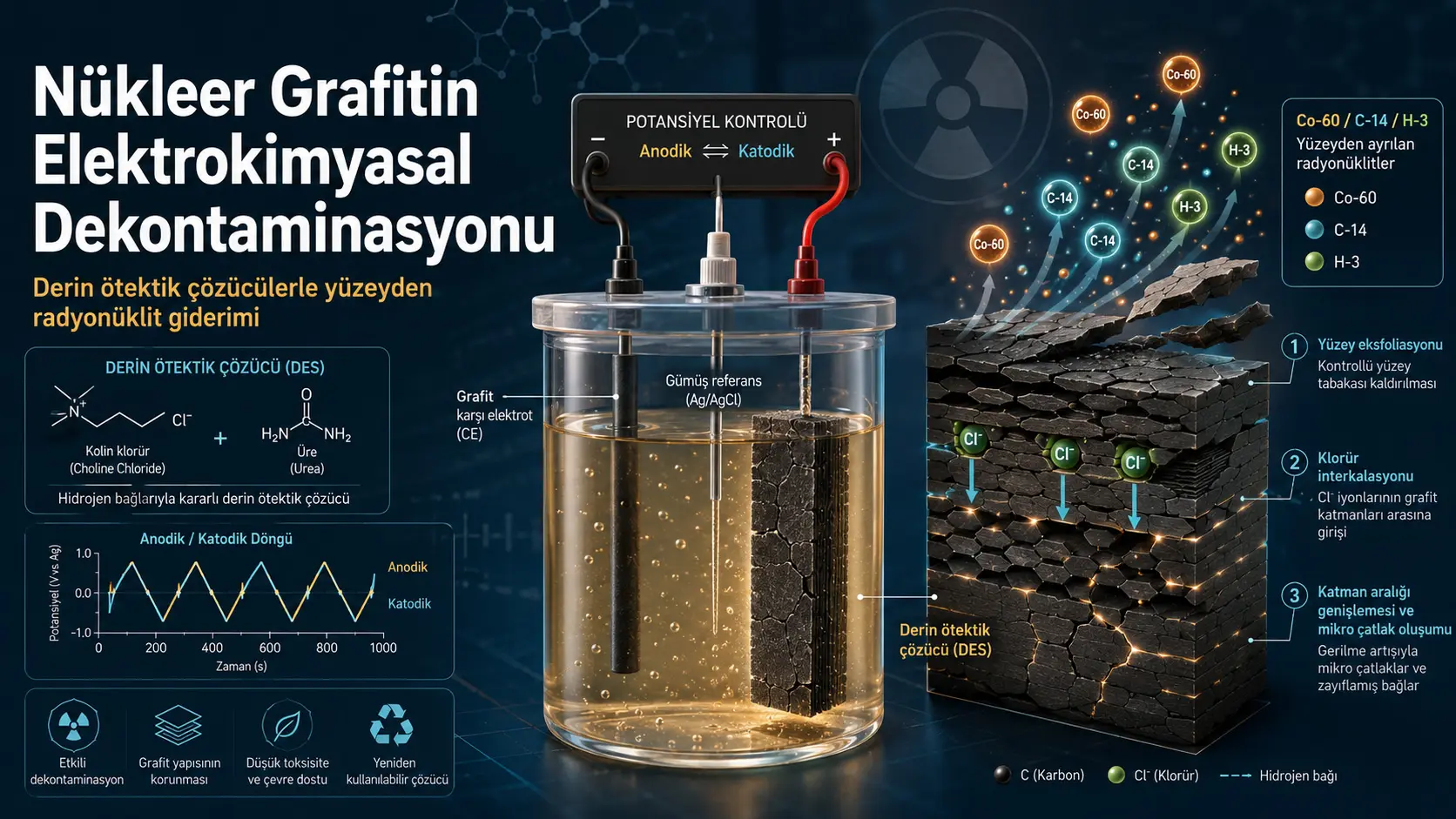
Utafiti huu unachunguza mchakato wa electrochemical unaorudiwa kwa mizunguko katika deep eutectic solvent yenye msingi wa choline chloride-urea, kwa lengo la kutenganisha metallic radionuclides kutoka irradiated nuclear graphite huku ukihifadhi kwa kiasi kikubwa mass ya graphite. Researchers kwanza walioptimize process kwa kutumia IG-110 graphite surrogate samples zenye cobalt ions karibu 20 nm chini ya surface, kisha wakatumia method hiyo kwenye real neutron-irradiated PGA graphite kutoka Wylfa, Oldbury na Dungeness Magnox reactors. Katika choline chloride-urea at 150 °C, treatment ya 10 cycles yenye positive na negative current pulses na total time ya 30 minutes iliondoa zaidi ya %95 ya near-surface implanted cobalt. Katika real Magnox graphite, hata hivyo, 60Co removal katika samples nyingi ilibaki kati ya %15-25 na highest values zikafikia karibu %30.
Findings za SEM, Raman, TEM, HRTEM, XRD, XPS na ToF-SIMS zinaonyesha separation haikutokea kwa dissolving graphite yote, bali kwa controlled exfoliation ya surface layer yenye thickness takribani 1-2 µm. Inapendekezwa kwamba wakati wa anodic pulse chloride ions zinaingia kati ya graphite layers, na wakati wa cathodic pulse sehemu yao hutoka au kure-distribute; wakati huo huo small cationic species derived from choline zinaweza kufikia gaps kati ya expanded layers. Repeated intercalation na de-intercalation huunda local lattice strain na microcracks na kusababisha contaminated surface layer kujitenga.
Method iliweza kuondoa baadhi ya near-surface radionuclides bila measurable loss ya graphite mass. Hata hivyo, removal ya 60Co, 14C na 3H katika real waste ilikuwa clearly lower than katika cobalt-implanted surrogate sample. Main reason ni kwamba cobalt katika surrogate sample ilikuwa karibu 20-40 nm depth, wakati radionuclides katika real reactor graphite zilisambazwa deeper na heterogeneously katika pores na throughout graphite volume. Study inaonyesha potential ya method kwa reducing waste volume na supporting graphite recycling; lakini complete decontamination, reuse safety, secondary-waste management, long-term material performance na industrial scalability bado hazijathibitishwa.
Tatizo kuu la utafiti ni nini?
Nuclear graphite imetumika katika graphite-moderated reactors kama neutron moderator na structural material. Study inasema zaidi ya 100 power reactors duniani zimetumia graphite na karibu 300.000 tonnes za irradiated nuclear graphite waste zitahitaji long-term management.
Graphite hii si large-volume solid waste pekee. Kutokana na neutron irradiation ndani ya reactor, impurities, corrosion products zinazohamishwa kutoka steel components na reactor operating environment, graphite inaweza kuwa na 60Co, 14C, 3H pamoja na mbalimbali fission au activation products. Katika United Kingdom, Magnox graphite imeclassified kama intermediate-level radioactive waste.
Current approach ni kuhifadhi graphite temporarily ili short-lived species zipungue kwa decay, kisha kuipeleka kwenye geological disposal facility. Lakini graphite volume, disposal-space requirement na long-term costs vinafanya research ya methods zinazoweza kupunguza radioactivity bila kuharibu graphite mass yote kuwa muhimu.
Ni matatizo gani yaliyopo katika current decontamination methods?
Study inalinganisha three main approaches:
- Thermal treatments: Zinaweza kuondoa baadhi ya surface-associated 14C species; lakini kuna high temperature, energy use na risk ya graphite oxidation.
- Acidic au oxidizing treatments: Zinaweza kusababisha graphite powdering, dissolution au significant mass loss.
- Molten-salt electrochemistry: Inaweza kutoa high radionuclide removal kwa alternating anode-cathode cycles; lakini inahitaji karibu 500 °C operating temperature, complex containment conditions na long processing time.
Goal ya research ni kutengeneza electrolyte inayoweza kupata intercalation na exfoliation behavior ya molten salts katika lower temperature.
Deep eutectic solvent ni nini?
Deep eutectic solvents (DES) ni mixtures ambazo kwa kawaida huundwa kwa kuchanganya hydrogen-bond acceptor na hydrogen-bond donor katika specific ratio na kuwa liquid katika temperature iliyo lower sana kuliko individual melting points za components zake.
Katika study, choline chloride ilitumika kama hydrogen-bond acceptor, na urea, ethylene glycol au oxalic acid kama hydrogen-bond donors. Components zilichanganywa katika 1:2 molar ratio na stirred at 60 °C hadi homogeneous transparent liquid ikapatikana.
Important properties za solvents hizi kwa study ni:
- Ability to dissolve metals na kuzi-transport electrochemically,
- Ionic conductivity,
- Ability to interact with graphite surface,
- Ability to operate at temperatures lower than molten salts,
- Support for ion entry between graphite layers because they contain chloride ions.
Study haithibitishi kwamba DES automatically ni harmless au sustainable at industrial scale. Solvent reuse, behavior after loading with radionuclides, degradation products na secondary waste management havija-evaluatewa fully katika research hii.
Properties za three different solvent systems
| Deep eutectic solvent | Melting point | Decomposition temperature | Conductivity | Electrochemical window | Experimental temperature |
|---|---|---|---|---|---|
| Choline chloride-urea | 12 °C | 172,7 °C | Approximately 157,2 mS/cm, at 150 °C | 4,29 V | 150 °C |
| Choline chloride-ethylene glycol | -66 °C | 90,3 °C | Approximately 15,2 mS/cm, at 80 °C | 2,4 V | 80 °C |
| Choline chloride-oxalic acid | 30 °C | 164,7 °C | Approximately 30-40 mS/cm, at 150 °C | 2,16 V | 150 °C |
Choline chloride-urea system ina both widest electrochemical window na highest reported conductivity at experimental temperature kati ya solvents zilizochunguzwa. Experimental results zinaonyesha kwamba si solvent conductivity pekee, bali solvent-graphite interaction na cyclic intercalation capability pia ni determining factors katika removal performance.
Kwa nini cobalt-implanted graphite ilitumika?
Kwa sababu radionuclides katika real reactor graphite zipo katika different chemical forms, pores tofauti na depths tofauti, ni difficult kutatua mechanism directly kutoka real waste. Kwa hiyo researchers waliimplant cobalt ions kwenye IG-110 nuclear-grade graphite ili kuunda near-surface, controlled na measurable metal distribution.
IG-110 samples ziliandaliwa katika dimensions 10 × 10 × 3 mm. Surfaces ziligrindiwa sequentially kwa 600, 1200, 2400 na 4000 grit silicon carbide paper; kisha zikapolishwa kwa 6 µm, 1 µm na 0,25 µm diamond suspension. Samples zilisafishwa ultrasonically katika ethanol kwa 10 minutes.
Cobalt implantation ilifanywa chini ya conditions zifuatazo:
- Ion: Co+,
- Energy: 25 keV,
- Fluence: 1,27 × 10¹⁶ ions/cm2,
- Number of samples: 15,
- Sample tilt to reduce channeling: 7°,
- Density peak according to SRIM model: approximately 20 nm,
- Depth over which implanted region extends: approximately 40 nm.
Controlled distribution hii iliruhusu removal kufuatiliwa kwa surface-sensitive EDS, XPS na ToF-SIMS methods. Hata hivyo, implanted cobalt at 20-40 nm depth haiwakilishi fully radionuclides ambazo katika real reactor graphite zimehamia deeper regions over years.
Real irradiated graphite samples zilichaguliwaje?
Optimized method ilitumika kwenye neutron-irradiated Pile Grade A (PGA) graphite kutoka Wylfa, Oldbury na Dungeness Magnox reactors. PGA ni polycrystalline graphite yenye porosity ambayo initially inaweza kufikia karibu %20. Wakati wa reactor operation, radiolytic oxidation katika CO2 coolant environment imebadilisha porosity na surface accessibility.
Samples zilikuwa exposed to approximately 6 dpa irradiation dose na approximately 270 °C irradiation temperature. Cylindrical specimens zenye approximately 12 mm diameter zilikatwa kuwa 6 ± 1 mm thick na zilitumika without pre-cleaning ili preserve realistic processing conditions.
PDF ina internal inconsistency kuhusu oxidation-induced mass loss ya samples. Sample-preparation section inasema materials zilizochukuliwa zina %36-40 mass loss, wakati results and discussion section inatoa approximately %20 ± 3 kwa Oldbury, %7 ± 3 kwa Wylfa na %13 ± 3 kwa Dungeness. Haijaelezwa kama data sets hizi mbili zinawakilisha different sample groups au ni textual inconsistency.
Electrochemical cell iliwekwaje?
Process ilifanywa katika cylindrical three-electrode cell yenye 40 mL DES:
- Working electrode: Graphite sample to be decontaminated,
- Counter electrode: Graphite rod,
- Quasi-reference electrode: Silver wire.
Graphite sample iliunganishwa kwenye graphite holder kwa high-temperature-resistant conductive carbon paste. Only sample surface iliachwa exposed to solvent. Before treatment open-circuit potential ilimonitoriwa na system ika-equilibrate mpaka drift ikashuka below 0,1 mV/s.
Cell iliwekwa katika oil bath ili control temperature. Heating ilitumika kupunguza DES viscosity na kuongeza conductivity yake.
Gas trapping system ilipima nini?
100 mL/min compressed-air flow iliyobeba volatile species kutoka cell ilielekezwa kwenye closed gas-trapping system. Kwa radioactive samples:
- Gases zili-oxidizewa katika tube furnace yenye CuO catalyst,
- 3H ilinaswa katika 0,1 M HNO3 solution,
- 14C ilikusanywa katika commercial carbon-trapping medium.
Katika gas-tightness tests outlet flow rate iliripotiwa kubaki within ±%1 of inlet flow rate. Capture efficiencies zilizovalidatewa kwa standards zilikuwa %95 ± 5 kwa 3H na %90 ± 5 kwa 14C.
Figure 1 inaonyesha series connection ya three-electrode cell na gas traps. First trap ina nitric acid, second trap ina carbon-capture medium. Setup hii inalenga si tu kuzuia volatile radionuclides zilizotoka kwenye solid kupotea, bali pia kuzifuatilia quantitatively.
Kwa nini positive current pekee haikutosha?
Researchers kwanza walijaribu anodic dissolution kwa constant positive current. Katika choline chloride-urea, applying 100, 200 na 500 mA kwa 60 minutes hakutoa detectable cobalt removal katika EDS au ToF-SIMS measurements.
Katika choline chloride-ethylene glycol, 200 mA na 60-minute anodic treatment pia haikutoa measurable removal. Katika choline chloride-oxalic acid system, electrochemical signal ikawa unstable after approximately 20 minutes na no removal ikaonekana.
Result hii inaonyesha kwamba cobalt oxidation electrochemically na transfer to solvent pekee haitoshi. Successful process ilihitaji reverse-polarity cycles zinazotengeneza ion entry into graphite layers, strain accumulation na physical separation ya surface layer.
Ni treatment protocol gani ilikuwa most effective?
Katika choline chloride-urea, 10-cycle treatment ambapo positive na negative currents zilitumika alternately iliondoa more than %95 of implanted cobalt within 30 minutes. Each cycle ilikuwa na:
- 2 minutes anodic pulse,
- 1 minute cathodic pulse
. Ten cycles total 30 minutes.
Main tables za study zinaonyesha positive current +100 mA na negative current -50 mA kwa cobalt-implanted IG-110. Application ya same cycle pattern katika choline chloride-ethylene glycol ilitoa only approximately %12 cobalt removal.
| Solvent and treatment | Temperature | Current and duration | Result |
|---|---|---|---|
| Choline chloride-urea, anode only | 150 °C | 100-500 mA, 60 minutes | No measurable removal |
| Choline chloride-urea, 10 cycles | 150 °C | +100 mA / -50 mA; 2 minutes / 1 minute | More than %95 of implanted Co removed |
| Choline chloride-ethylene glycol, anode only | 80 °C | 200 mA, 60 minutes | No measurable removal |
| Choline chloride-ethylene glycol, cyclic | 80 °C | 10 cycles | Approximately %12 removal |
| Choline chloride-oxalic acid, anode only | 150 °C | 100 mA, approximately 20 minutes | Unstable electrochemical response; no removal |
Kwa nini kuna uncertainty katika applied currents?
Kuna clear inconsistency kati ya different parts za PDF kuhusu treatment currents:
- Main experimental table na supporting Table S1 zinatoa +100 mA / -50 mA kwa cobalt-implanted IG-110 na irradiated PGA.
- Caption ya Figure 8 inaandika +200 mA / -100 mA kwa irradiated PGA results.
- Caption ya Figure S1 pia inaeleza 10-cycle IG-110 treatment kama +200 mA / -100 mA.
Kwa hiyo ni clear kwamba results zilipatikana at 150 °C with 10 cycles and 2 minute/1 minute pulses; lakini exact current pair used katika all characterization na real-waste experiments haiwezi kuverified kutoka PDF. Authors wanahitaji kueleza difference hii kwa reproducibility ya method.
ToF-SIMS results zilionyeshaje cobalt removal?
Figure 2 inaonyesha normalized depth profiles za cobalt na total area under profile. Baada ya single-polarity treatments Co profile ilipeak around 10-20 nm kama before treatment na ikaextend to approximately 40-60 nm.
After 10 cycles in choline chloride-urea, Co signal ilipungua sharply. Integrated signal ilishuka to less than approximately %5 of initial value. Experiment ilirudiwa twice na similar results zikapatikana.
Limited reduction ya profile area katika cyclic treatment with choline chloride-ethylene glycol inaonyesha successful removal inategemea chemical structure ya solvent used pamoja na presence ya current cycling.
Surface exfoliation ilionekanaje?
Katika SEM images implanted surface before treatment inaonekana relatively intact, wakati after 10 cycles in choline chloride-urea kuna clear surface restructuring na layer separation.
Katika Figure 3, partially exfoliated area ina only approximately 10 µm-wide original implanted surface structure iliyobaki. EDS line scans zinaonyesha cobalt iko only katika intact region hii na haidetectwi katika exfoliated areas.
High-magnification images zinaonyesha exfoliation haianzi randomly across entire surface simultaneously. Process inaanza kutoka:
- Pores,
- Edges of graphite layers,
- Grain boundaries,
- Regions damaged by implantation
na inaendelea as microcracks toward graphite volume. Separation ya near-surface contaminated layer ndiyo main physical cause ya cobalt removal.
Raman spectra zilionyesha nini?
Katika ion-implanted but non-exfoliated region, Raman G band around 1580 cm-1 na D band around 1350 cm-1 zilibroaden na kukaribiana. Appearance hii inaendana na carbon structure iliyoharibiwa na disordered by ion implantation.
Katika spectrum ya exfoliated region, D na G bands zimetengana more clearly. Researchers wana-interpret hii as removal ya implantation-damaged upper layer na exposure ya more ordered graphite structure underneath.
Raman result inaunga mkono kwamba whole graphite haikupoteza crystal order; badala yake damaged surface layer iliondolewa selectively.
TEM na elemental maps zilionyesha chloride imeingia wapi?
Two TEM lamellae ziliandaliwa kutoka treated sample:
- Region not yet exfoliated where cobalt remained,
- Region where exfoliation was complete and cobalt removed.
Katika non-exfoliated region, HAADF-STEM image ilionyesha dark band approximately 20 nm below surface. Band hii inalingana na cobalt implantation layer. STEM-EDS map iliconfirm Co katika region hii.
Chloride ilionekana concentrated below cobalt layer na ndani ya more ordered graphite layers. Distribution suggests chloride first enters from edge regions and progresses inward along layers.
Katika exfoliated region, cobalt haikudetectwa while chloride iliendelea kuonekana along grain boundaries na graphite layers. Hii ina-support direct role ya chloride entry katika process inayoseparate surface layer mechanically.
Je, HRTEM measurements zilionyesha graphite layers zimeexpand?
Katika untreated graphite, spacing between graphene layers ilipimwa approximately 3,35 ± 0,02 Å. Katika treated regions zenye lower chloride content spacing ilikuwa 3,59 ± 0,06 Å, na katika chloride-rich regions ilikuwa 3,63 ± 0,06 Å.
| Region | Local interlayer spacing | Interpretation |
|---|---|---|
| Untreated graphite | 3,35 ± 0,02 Å | Initial graphite layer spacing |
| Treated region with lower Cl | 3,59 ± 0,06 Å | Approximately %7 local expansion |
| Cl-rich treated region | 3,63 ± 0,06 Å | More pronounced local expansion and lattice distortion |
Uncertainty intervals za two treated regions zinaoverlap; kwa hiyo small difference kati ya 3,59 na 3,63 Å haipaswi kuonekana as definitive quantitative distinction on its own. Layer curvature na stacking disorder katika HRTEM images ni clearer indicators ya strain katika chloride-rich regions.
Katika processing ya local measurements, 90 small image regions zilianalyze; median interlayer spacing ilitumika na uncertainty ikahesabiwa kwa scaling median absolute deviation by 1,4826.
Bragg law inahesabuje graphite layer spacing?
Study ilihesabu interplanar spacing kutoka XRD peak positions kwa Bragg law:
\[ d = \frac{\lambda}{2\sin\theta} \]
- d: Distance between crystal planes; expressed in Å in study.
- λ: Wavelength ya X-ray used; 1,54060 Å for Cu Kα1.
- θ: Bragg angle; half ya 2θ value shown in XRD graph.
Peak ikishift kwenda lower 2θ angle, equation inaonyesha d spacing inaongezeka. Katika study, (002) peak shifted from 26,41° to 26,35° na average d002 increased from 3,37 Å to 3,38 Å.
Sababu HRTEM inaonyesha local spacings around 3,6 Å while XRD measures only 0,01 Å bulk change ni kwamba intercalation imeconcentrate only in top 1-2 µm region of approximately 3 mm-thick sample. XRD inakusanya signal from hundreds of micrometers depth, kwa hiyo expanded surface region contributes very small fraction ya total signal.
Scherrer equation ilionyesha structural change gani?
Coherent stacking height ya graphite layers along c-axis ilihesabiwa kwa Scherrer equation:
\[ L_c = \frac{K\lambda}{\beta\cos\theta} \]
- Lc: Coherent crystallite stacking height along c-axis,
- K: Shape factor; 0,94 used for polycrystalline graphite,
- λ: X-ray wavelength,
- β: Full width at half maximum of (002) peak; in radians,
- θ: Bragg angle.
After treatment FWHM ya (002) peak increased from 0,45° to 0,55°. Calculated Lc decreased from 18,95 nm to 15,50 nm. This approximately %18 reduction does not mean layers disappeared completely; it indicates reduced stacking coherence na increased turbostratic disorder.
Appearance ya new shoulder around 52,50° beside (004) peak at approximately 54,45° supports coexistence of graphite regions with different layer spacings.
XPS ilionyesha changes gani katika surface chemistry?
After cobalt implantation, O 1s signal na O KLL Auger feature increased. Researchers associate this increase with defects produced by implantation damage na oxygen-containing surface groups.
Katika C 1s spectra:
- Graphitic sp2 component approximately 284,5 eV,
- sp3 component approximately 284,8 eV,
- C-O approximately 286 eV,
- C=O approximately 287 eV,
- C-Co component approximately 283 eV
were modeled.
Katika implanted sample, low-binding-energy shoulder around 283 eV supported Co-C bond. After treatment Co signal hii disappeared, chlorine signal increased clearly na oxygen level decreased.
Strong sp3 component observed on treated surface. Researchers explain this not as permanent conversion of all graphite to sp3 carbon, but as contribution from choline-derived organic species remaining on surface.
ToF-SIMS ilibainisha choline-derived species zipi?
After ten-cycle choline chloride-urea treatment, three characteristic positive ions were detected:
- Choline+: C5H14NO+, m/z 104,107,
- Trimethylammonium+: C3H10N+, m/z 60,081,
- Ammonium/iminium species: C3H8N+, m/z 58,065.
Signals za species hizi were highest at outer surface, but could be tracked to approximately 100 nm depth. Inapendekezwa kwamba particularly smaller trimethylammonium na ammonium species zinaweza temporarily enter locally expanded graphite interlayers during cathodic pulse.
ToF-SIMS inaonyesha presence ya fragments hizi; lakini haibainishi directly exact formation reactions au molecular form yao between layers.
Proposed decontamination mechanism inafanyaje kazi?
- Anodic pulse: Positive current activates defective edges and pore walls in graphite.
- Chloride intercalation: Cl- ions enter between near-surface graphene layers, especially through edge and defect regions.
- Layer expansion: Ion entry increases interlayer spacing and creates local lattice strain.
- Cathodic pulse: Some chloride leaves or redistributes; small positive ions derived from choline can temporarily access expanded regions.
- Strain cycling: Repeated ion entry and exit cause swelling-contraction and stacking disorder in each cycle.
- Microcrack propagation: Strain concentrates at pre-existing pores, grain boundaries and defects.
- Exfoliation: Approximately 1-2 µm-thick surface layer separates.
- Radionuclide removal: Contaminants transfer to electrolyte by dissolution or directly together with surface layer.
Katika mechanism proposed by authors, dominant cause ya decontamination si bulk oxidation au complete dissolution ya graphite, bali intercalation-induced mechanical surface exfoliation. Limited gas formation from reduction of electrolyte species pia imependekezwa; lakini molecular identities za gases hazijabainishwa in detail.
Decontamination factor ilihesabiwaje?
Katika real radioactive samples, activity reduction ilihesabiwa kwa equation:
\[ DF = \frac{A_0-A}{A_0}\times100 \]
- DF: Decontamination factor as percentage,
- A0: Activity before treatment,
- A: Activity after treatment.
Kwa mfano, ikiwa initial activity ni 5.000 Bq/g na post-treatment activity ni 4.000 Bq/g:
\[ DF = \frac{5000-4000}{5000}\times100 = 20\% \]
Value hii inaonyesha %20 ya total activity katika sample iliondolewa by measured treatment. Removal percentage haimaanishi remaining activity imefikia safe disposal au reuse limit.
60Co iliondolewa kwa kiasi gani katika real Magnox graphite?
Katika most of nine samples katika Figure 8, 60Co decontamination factor ilikuwa approximately %15-25. Katika some individual samples value ilifikia around %30.
Reactor-based average graphs zinaonyesha approximately:
- Oldbury: around %18,
- Dungeness: around %14,
- Wylfa: around %20
removal. Hizi ni approximate values read from graph.
Katika Wylfa-1 sample yenye high initial activity, absolute activity reduction pia ilikuwa larger. Authors associate this with cobalt-containing corrosion products kutoka steel reactor components accumulating at different densities katika graphite surface regions.
No systematic relationship was found between axial or radial position ya sample ndani ya reactor na decontamination factor. Results zinaonyesha radionuclide distribution ni highly heterogeneous kutokana na reactor operating history, local oxidation na coolant chemistry.
Kwa nini surrogate sample ilitoa %95 lakini real graphite only %15-30 removal?
Katika cobalt-implanted IG-110, Co concentration peaks at approximately 20 nm na distribution remains within approximately 40 nm. Treatment, however, exfoliates approximately 1-2 µm surface layer. Kwa hiyo almost all implanted cobalt iko within treatment region.
Katika real PGA graphite, 60Co imehamia kwenye graphite pores na deeper regions during decades of reactor operation. Only fraction within near-surface 1-2 µm is accessible through exfoliation.
Kwa hiyo more than %95 removal katika surrogate sample haimaanishi same ratio itapatikana katika real waste. Surrogate experiment inaonyesha mechanism, while real graphite experiment inaonyesha access-depth limitation ya method.
14C na 3H results zilionyesha nini?
14C removal remained below %10 katika all samples. Values around %6-7 were seen in Wylfa samples na around %1-2 in Oldbury samples. Figure 8 indicates absolute removal approximately 2 kBq for Wylfa na approximately 0,6 kBq for Oldbury.
Because treatment temperature was 150 °C, 14C release was not attributed to high-temperature graphite oxidation. Researchers think release came from physical separation of 1-2 µm surface layer containing 14C.
3H removal remained below %1. Graph shows absolute removal approximately 0,3 kBq for Oldbury na approximately 1 kBq for Wylfa. This low ratio suggests tritium is not concentrated at surface and substantial part occupies positions requiring higher temperature or bulk oxidation.
Therefore method does not remove all major radionuclides in graphite with equal effectiveness.
Ni results gani zilipatikana kwa other gamma-emitting radionuclides?
Removal ya 241Am, 133Ba, 137Cs, 154Eu na 155Eu varied depending on reactor from which sample was taken. In some individual experiments in Figure 9, values approaching approximately %60 were seen for 241Am, 133Ba and 155Eu. However, these are not averages of all samples.
For example, in Oldbury graphite average 133Ba removal was around %40, while some individual measurements reached approximately %57. 137Cs and 154Eu removals were mostly around %10-25.
Higher removal of some radionuclides in Oldbury graphite was associated with higher open porosity and greater quantity of surface-accessible contaminants in those samples. However, study did not directly map chemical form of each radionuclide and exact depth distribution within graphite.
Je, increasing cycle number improved performance?
In Wylfa graphite 10, 20 and 30 cycles were compared. With available sample numbers and high between-sample variability, increasing from 10 to 30 cycles was not shown to produce statistically reliable performance increase.
Figure 11 shows for some radionuclides 20 cycles gave lower averages than 10 cycles, while 30 cycles gave higher averages again. Wide error bars and small sample size do not allow regular cycle-removal relationship to be established.
Main text states n = 2 samples per cycle for 20 and 30 cycles, while Figure 11 caption says values are averages of 2-5 experiments per cycle number. This is a second textual inconsistency requiring clarification about statistical sample size.
Data suggest major exfoliation event may occur within first 10 cycles; however, they do not prove more cycles are definitely useless.
Je, main graphite structure ilihifadhiwa?
In XRD patterns, main graphite peaks were largely preserved before and after treatment. SEM and TEM showed changes concentrated near surface. Researchers also reported no measurable or meaningful total mass loss after treatment.
However, following changes occurred:
- Approximately 1-2 µm region of surface was exfoliated.
- Local interlayer spacing increased.
- Coherent stacking height decreased by approximately %18.
- Chloride remained on surface and grain boundaries.
- Choline-derived organic species were detected to approximately 100 nm depth.
Therefore statement “structure was preserved” means whole graphite did not dissolve and main crystal phase remained. It does not mean treatment caused no surface changes.
Nguvu za utafiti ni zipi?
- Controlled cobalt implantation and real irradiated graphite were studied together.
- Three different deep eutectic solvents were compared.
- Single-polarity and cyclic treatments were separated, demonstrating necessary role of cycling.
- ToF-SIMS quantitatively tracked cobalt removal through depth profile.
- SEM and Raman showed removal of surface layer.
- HRTEM, XRD and STEM-EDS provided complementary evidence for chloride intercalation and layer expansion.
- XPS and ToF-SIMS identified chloride and choline derivatives after treatment.
- Method was tested on real Wylfa, Oldbury and Dungeness Magnox graphite.
- Gamma spectroscopy tracked 60Co and other gamma emitters, while liquid scintillation counting tracked 3H and 14C.
- A closed trapping system preventing radioactive gas escape and having validated recovery efficiency was used.
Mapungufu ya utafiti ni yapi?
- Study ni preprint ambayo haijapitia peer review.
- Experiments were performed in laboratory-scale cell containing 40 mL solvent.
- Industrial-size graphite blocks or continuously operating process were not tested.
- Applied positive and negative current values conflict across different parts of PDF.
- Sample count in cycle-number experiments differs between main text and figure caption.
- Radiolytic mass-loss values of reactor graphite are presented as two unreconciled data sets in different sections.
- Co in surrogate sample is at approximately 20-40 nm depth; it does not fully represent real radionuclide distribution.
- Real 60Co removal is mostly only %15-25.
- 14C removal remained below %10 and 3H below %1.
- Long-term effect of chloride and choline derivatives remaining in graphite after treatment was not evaluated.
- How many times DES can be reused and how radionuclides are recovered from solvent were not demonstrated.
- Volume, chemical composition and disposal method of secondary liquid waste were not determined.
- Energy consumption was not measured directly.
- No economic analysis, life-cycle assessment or facility-scale cost calculation was performed.
- Post-treatment graphite was not tested for neutronic, mechanical, thermal and radiological suitability for reuse.
- Terms “scalable” and “energy efficient” are authors’ future-application assessments; these features were not proven by industrial experiment.
Study inaunga mkono nini?
- Alternating anode-cathode pulses in choline chloride-urea can effectively remove near-surface implanted cobalt.
- Anode current alone does not produce same result.
- Chloride ions can enter between near-surface graphite layers.
- Intercalation creates local layer expansion and stacking disorder.
- Repeated pulses lead to controlled surface exfoliation starting from pores and edges.
- Exfoliation can separate near-surface radionuclides without dissolving main graphite bulk.
- Removal ratio in real Magnox graphite strongly depends on near-surface distribution of radionuclide.
- Method may provide basis for waste-volume-reduction research for some near-surface metallic and gamma-emitting contaminants.
Study haithibitishi nini?
- It has not been proven that nuclear graphite can be directly reused after treatment.
- It has not been shown that graphite waste class was downgraded or release limits were reached.
- It has not been shown that all 60Co, 14C or 3H inventory was removed.
- It has not been shown that method gives same performance for all reactor graphites.
- It has not been proven that treatment will proceed uniformly in large graphite blocks.
- Low toxicity or environmental superiority of DES was not directly measured by these experiments.
- Solvent recycling and final concentration of radionuclides were not demonstrated.
- Long-term mechanical strength and irradiation behavior of graphite were not evaluated.
- It has not been proven that more cycles provide no benefit under any conditions.
- It was not shown to be generally superior to molten-salt method; molten-salt processes achieved higher removal for some radionuclides.
Possible importance kwa nuclear-waste management ni nini?
Main contribution ya study ni kutoa mechanistic approach inayolenga electrochemically separating only contaminated surface layer badala ya oxidizing au dissolving entire irradiated graphite. Concentrating near-surface radionuclides pamoja na small graphite fraction could theoretically reduce volume of high-activity material requiring disposal.
Treatment temperature ya 150 °C ni lower kuliko molten-salt processes operating at approximately 500 °C. Main ten-cycle treatment lasts 30 minutes. Features hizi zina-support possibility ya simpler equipment na shorter processing time.
However, practical nuclear-waste process requires more than just ability to remove radionuclides from surface. Safe separation of radionuclides in DES, solvent recovery, management of gaseous and liquid secondary wastes, processing large blocks, radiation resistance and regulatory compliance of final product also need demonstration.
Authors propose adding LiCl to choline chloride-urea DES in future studies. Rationale is that Li+ ions may intercalate more easily into graphite and strengthen surface separation. This approach was not experimentally tested in current study.
Mbinu na Matokeo ya Utafiti
Sample and experimental design
| Experimental component | Applied feature or condition |
|---|---|
| Surrogate graphite | IG-110; 10 × 10 × 3 mm |
| Cobalt implantation | 25 keV Co+; 1,27 × 10¹⁶ ions/cm2; 7° tilt |
| Implantation depth | Peak approximately 20 nm; distribution to approximately 40 nm |
| Real waste graphite | PGA from Wylfa, Oldbury and Dungeness Magnox reactors |
| Irradiation condition | Approximately 6 dpa; approximately 270 °C |
| PGA sample geometry | Approximately 12 mm diameter; 6 ± 1 mm thickness; approximately 1 ± 0,2 g |
| DES composition | Choline chloride with urea, ethylene glycol or oxalic acid; 1:2 molar ratio |
| Electrolyte volume | 40 mL |
| Operating temperature | ChCl-urea and ChCl-oxalic acid: 150 °C; ChCl-ethylene glycol: 80 °C |
| Main cycle | 2 minutes anode + 1 minute cathode; 10 cycles; total 30 minutes |
| Current values | +100/-50 mA in tables; +200/-100 mA in some figure captions |
| Gas transport flow | 100 mL/min compressed air |
Characterization techniques
| Technique | Main conditions | Measured property |
|---|---|---|
| SEM/EDS | SEM 2 keV, 2,5 mm working distance; EDS 7 keV | Exfoliation, pores, Co surface distribution |
| Raman | 532 nm laser; 50× objective; 300-3000 cm-1; 8 s × 5 accumulations | D, G and second-order carbon bands |
| TEM/HRTEM | 200 kV; approximately 100 nm lamella with FIB | Graphite layers, microcracks and d-spacing |
| STEM-EDS | 512 × 512 pixels; 200 µs/pixel | C, Co and Cl elemental maps |
| XRD | Cu Kα; 40 kV, 40 mA; 15-90°; 0,033° step | d002, peak width, Lc and intercalation shoulder |
| XPS | Al Kα 1486,6 eV; 300 W; 1 mm spot | C, O, Co, Cl surface chemistry |
| ToF-SIMS | 40 keV C60+; 130 × 130 µm2; 240 sputter cycles | Co depth profile and choline-derived ions |
| HPGe gamma spectroscopy | 3 hours per sample; 3 hours background; ISOCS efficiency model | 60Co and other gamma-emitting radionuclides |
| Liquid scintillation counting | 30 minutes per sample | 3H and 14C |
Main structural findings
| Metric | Before treatment or reference | After treatment | Interpretation |
|---|---|---|---|
| Local graphite d-spacing | 3,35 ± 0,02 Å | 3,59 ± 0,06 Å; 3,63 ± 0,06 Å in Cl-rich region | Near-surface layer expansion |
| XRD (002) peak position | 26,41° | 26,35° | Small bulk-scale c-axis expansion |
| XRD d002 | 3,37 Å | 3,38 Å | Supports intercalation being surface-limited |
| (002) FWHM | 0,45° | 0,55° | Higher stacking disorder |
| Lc | 18,95 nm | 15,50 nm | Approximately %18 loss of coherent stacking |
| Exfoliation depth | Not applicable | Approximately 1-2 µm | Surface-selective separation |
| Chloride penetration | Absent | Upper approximately 10 nm by XPS; to approximately 1 µm by STEM-EDS | Reflects different sampling depths of techniques |
| Choline-derived ions | Absent | To approximately 100 nm | Supports interlayer access during cathodic pulse |
Main decontamination findings
| Radionuclide or surrogate contaminant | Sample | Reported removal | Interpretation limit |
|---|---|---|---|
| Implanted Co | IG-110 surrogate graphite | More than %95 | Co was approximately 20-40 nm deep |
| 60Co | Real Magnox PGA | Mostly %15-25; maximum approximately %30 | Deeper and heterogeneous distribution |
| 14C | Oldbury and Wylfa | Below %10; Wylfa to approximately %7 | Only near-surface fraction |
| 3H | Oldbury and Wylfa | Below %1 | Tritium largely not in surface region |
| 241Am | Some Oldbury experiments | Approximately %60 in individual measurements | Not average of all samples |
| 133Ba | Especially Oldbury | Average approximately %40; approximately %57 in individual measurements | Depends on reactor and sample distribution |
| 137Cs and 154Eu | Various Magnox samples | Approximately %10-25 | High between-sample variability |
| 155Eu | Some Oldbury experiments | Approximately %60 in individual measurements | Does not represent average performance |
Technically strongest result of study is near-complete removal of cobalt implanted at approximately 20 nm below surface. Most important result for real waste is partial separation of various near-surface gamma-emitting radionuclides without measurable mass loss. However, real 60Co, 14C and 3H results show method effectively treats only surface-accessible radionuclide fraction.
Maelezo ya Chanzo na Mbinu
Full original title of study: Electrochemical Decontamination of Nuclear Graphite in Deep Eutectic Solvents
Author order in PDF: F. S. Altamimi; E. Aradi; B. F. Spencer; S. Sheraz; N. P. Lockyer; A. N. Jones; C. A. Sharrad.
Names written in full in SSRN record: Emily Aradi, Ben F. Spencer, Abbie N. Jones and Clint A. Sharrad. Full names of F. S. Altamimi, S. Sheraz and N. P. Lockyer are not explicitly given in examined PDF and SSRN record; therefore they were not inferred.
Author-order warning: SSRN recommended citation order places Ben F. Spencer before Emily Aradi. In examined PDF, E. Aradi appears before B. F. Spencer. This article preserves original PDF order.
Equal contribution or co-first authorship: Not stated.
Corresponding author: F. S. Altamimi.
Corresponding-author email: Fa.altamimi@outlook.sa
Institutional affiliations
- Department of Chemical Engineering, The University of Manchester, Oxford Road, Manchester M13 9PL, United Kingdom.
- The Nuclear Graphite Research Group, Henry Royce Institute, Department of Mechanical and Aerospace Engineering, The University of Manchester, Oxford Road, Manchester M13 9PL, United Kingdom.
- Dalton Nuclear Institute, The University of Manchester, Oxford Road, Manchester M13 9PL, United Kingdom.
- Department of Chemical Engineering, The University of Hail, Hail 55476, Saudi Arabia.
- Photon Science Institute, Department of Materials, Faculty of Science and Engineering, The University of Manchester, Oxford Road, Manchester M13 9PL, United Kingdom.
- Photon Science Institute, Department of Chemistry, The University of Manchester, Oxford Road, Manchester M13 9PL, United Kingdom.
Source type: Experimental preprint research article.
Peer-review status: Study has not undergone peer review. All pages of PDF contain warning “Preprint not peer reviewed”.
Preprint platform: SSRN.
Publication date: 15 June 2026.
DOI: 10.2139/ssrn.6946187
Official source link:https://ssrn.com/abstract=6946187
Peer-reviewed journal: No verified peer-reviewed journal version was found as of 27 July 2026.
Original publisher: Peer-reviewed journal or original journal publisher information could not be verified from this version. Publication platform of study is SSRN.
Author contributions
- F. S. Altamimi: Conceptualization, methodology, formal analysis, investigation, writing original draft and visualization.
- E. Aradi: Investigation, review and editing.
- B. F. Spencer: Investigation, review and editing.
- S. Sheraz: Investigation.
- N. P. Lockyer: Resources.
- A. N. Jones: Supervision, resources, review and editing.
- C. A. Sharrad: Supervision, resources, review and editing.
Funding and infrastructure: Research is part of doctoral work funded by University of Hail. Henry Royce Institute, EPSRC support and UK National Nuclear User Facility infrastructure provided various instrumentation and radiochemistry facilities.
Conflict of interest: Authors declared no known financial interest or personal relationship that could influence study.
Data access: Data are stated to be available upon request.
Article preparation method: Makala hii ya Kituruki iliandaliwa kwa kuchunguza main text, supporting materials, equations, tables, graphs na microscopy images za 56-page preprint uploaded by user. No scientific finding from outside PDF was added; external source was used only to verify DOI, publication date and SSRN bibliographic record.
Main limitation: Method is effective for near-surface contaminants but did not completely remove radionuclides distributed through real graphite volume. Because of textual inconsistencies in process parameters, small sample size, high between-sample variability, lack of demonstrated solvent recovery and absence of scale-up experiments, results should be regarded as laboratory-scale mechanism and feasibility evidence.
Study hii ni preprint ambayo haijapitia peer review; results zake zinapaswa kusomwa kwa kuzingatia limitation hii. Haijaonyeshwa kwamba graphite inaweza safely reused, waste class can be downgraded, au method ni economical at industrial scale.
Acha maoni
Anwani yako ya barua pepe haitachapishwa. Sehemu za lazima zimewekewa alama ya *