

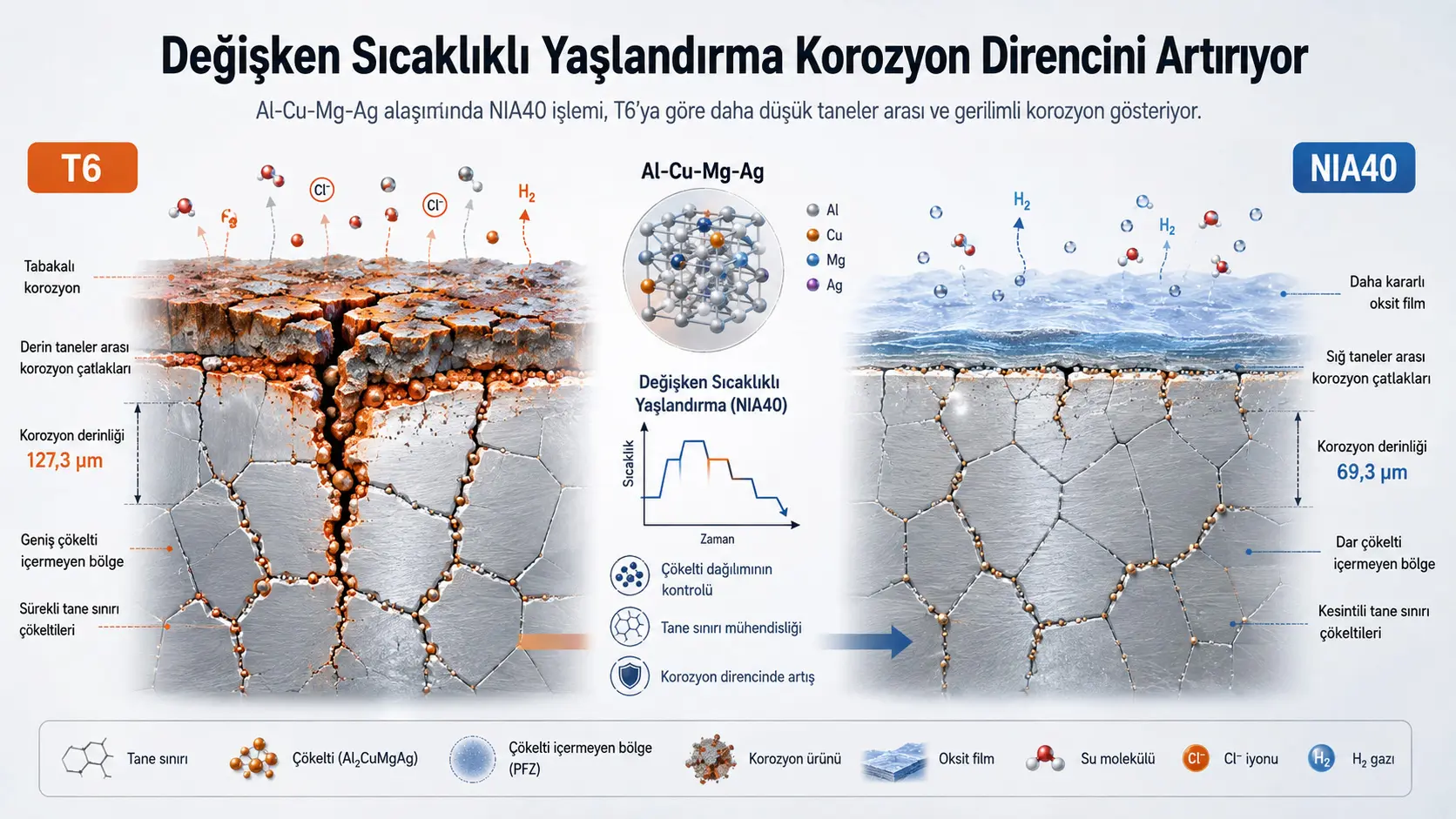
Ин таҳқиқот меомӯзад, ки non-isothermal variable-temperature aging дар Al-Cu-Mg-Ag alloys-и барои high-temperature strength designed тавассути кадом microstructural mechanisms corrosion resistance-ро зиёд мекунад. Traditional T6 isothermal aging at 165 °C бо NIA40 process муқоиса шуд, ки аз 90 °C оғоз карда, бо rate 40 °C·hour−1 то 210 °C баланд мешавад; mechanical tests, intergranular corrosion, exfoliation corrosion, slow-strain-rate tensile testing, in-situ electrochemical impedance, SEM, TEM, HAADF-STEM ва KPFM analyses якҷоя истифода шуданд. NIA40 process tensile strength-ро нисбат ба T6 танҳо 8 MPa кам кард, average intergranular corrosion depth-ро аз 127,3 μm то 69,3 μm паст намуд; corrosion current density-ро кам кард ва stress-corrosion susceptibility index-ро аз 0,17 то 0,07 поён овард. Researchers ин improvement-ро бо discontinuous шудани copper-rich grain-boundary precipitates, narrow шудани precipitate-free zone, smaller microgalvanic potential difference ва limited hydrogen accumulation шарҳ медиҳанд. Бо вуҷуди ин, study peer review нашудааст; танҳо one laboratory alloy, 3 mm-thick rolled sheet ва controlled saline solution conditions омӯхта шуда, industrial scale, fatigue, real atmosphere, welded joints ва long-term service life validated нашудаанд.
Main contribution-и study нишон додани он аст, ки aging process на танҳо alloy hardness ва precipitate size, балки chemistry, continuity ва surrounding precipitate-free zone of grain-boundary precipitates-ро ҳам муайян мекунад. Дар conventional T6 condition, copper-rich precipitates stretching along grain boundaries continuous electrochemical path ба вуҷуд оварданд, ки corrosion метавонад аз рӯи он advance кунад. Дар NIA40 condition бошад higher temperature reached in shorter time redistribution of solute atoms-ро таъмин кард; connection between grain-boundary precipitates-ро канд ва ба protective oxide film кӯмак кард, ки under stress longer stable монад.
Аз нигоҳи Туркия: Findings метавонанд ба heat-treatment design of aluminum alloys developed for aviation, defense, armored vehicles, marine applications, high-speed transport ва lightweight components operating at high temperature in Turkey methodological contribution диҳанд. Барои application, actual chemical composition of alloys produced in Turkey, sheet thickness, forging or rolling direction, furnace temperature uniformity, heating-cooling rate, quench delay ва residual stresses бояд ба назар гирифта шуда, revalidation performed шавад. Salt spray, humid atmosphere, marine environment, thermal cycling, fatigue, weld zones, coating compatibility ва full-scale component tests ҳам лозиманд. Аз ин research хулоса кардан мумкин нест, ки NIA40 process дар ҳамаи 2xxx-series alloys used in Turkey same result медиҳад, service life-и existing defense or aviation components-ро бо specific percentage дароз мекунад ё process industrially economical аст.
Масъалаи таҳқиқот чист?
Al-Cu-Mg-Ag alloys бо сабаби Ω ва θ′ precipitates, ки strength at high temperatures медиҳанд, барои aviation ва high-performance structural applications арзёбӣ мешаванд. Аммо high copper content метавонад alloy-ро ба local electrochemical differences дар chloride-containing humid environments моил кунад. Вақте alloy under stress аст, cracking of protective oxide film, arrival of chloride ions at metal surface ва accumulation of hydrogen at grain boundaries and defect regions метавонанд intergranular corrosion, exfoliation corrosion ва stress-corrosion cracking-ро якҷоя тезонанд.
How copper, magnesium and silver atoms distribute during aging на танҳо strengthening precipitates inside grains, балки size, chemistry ва continuity of grain-boundary precipitates-ро ҳам муайян мекунад. Formation of continuous precipitate chain at grain boundary метавонад continuous path эҷод кунад, ки corrosion аз як grain ба next advance кунад. Инчунин migration of solute atoms to grain boundary метавонад on both sides of boundary precipitate-free regions ташкил диҳад, ки electrochemically more active behave мекунанд.
Main question ин аст, ки aging process with temperature changing over time метавонад solute distribution-ро regulate карда corrosion paths-ро break кунад ё не ва ҳамзамон mechanical strength-и alloy-ро нигоҳ дорад ё не.
Two aging processes compared
Ҳар two sample groups баъд аз solution treatment at 510 °C for 1,5 hours ва water quenching prepared шуданд. Conventional T6 sample at 165 °C isothermally aged шуд. Дар NIA40 sample temperature аз 90 °C оғоз шуда, бо 40 °C·hour−1 то 210 °C raised ва сипас бо 20 °C·hour−1 lowered шуд.
NIA40 sample тақрибан дар 4 hours peak hardness reached кард, дар ҳоле ки T6 sample барои reaching similar hardness level тақрибан 13–14 hours талаб кард. Linear temperature-time relation used in study:
\[ T = T_0 + kt \]
Here T temperature at a given time, T0 initial temperature, k heating rate and t time. According to researchers’ kinetic calculation, aging level equivalent to 14-hour reference aging at 165 °C is reached in approximately 3,94 hours at heating rate 40 °C·hour−1.
Mechanical strength нигоҳ дошта шуд?
Room-temperature standard tensile results of peak-aged samples were close. T6 sample tensile strength 501 ± 2,8 MPa, yield strength 447 ± 1,6 MPa ва elongation %11,2 ± 0,2. For NIA40 corresponding values were 493 ± 3,6 MPa, 440 ± 2,1 MPa ва %11,3 ± 0,1.
| Aging condition | Tensile strength | Yield strength | Elongation |
|---|---|---|---|
| T6 | 501 ± 2,8 MPa | 447 ± 1,6 MPa | %11,2 ± 0,2 |
| NIA40 | 493 ± 3,6 MPa | 440 ± 2,1 MPa | %11,3 ± 0,1 |
NIA40 process tensile strength-ро 8 MPa ва yield strength-ро 7 MPa кам кард; elongation unchanged монд. This result нишон медиҳад, ки under examined laboratory conditions improved corrosion resistance бо large mechanical-strength loss ба даст наомадааст. Аммо number of experimental repeats and statistical-significance test for group differences provided нашудааст.
Intergranular corrosion чӣ гуна changed шуд?
Samples according to GB7998-2005 method дар solution containing 1 mol·L−1 NaCl ва 10 mL H2O2 per liter барои 6 hours immersed шуданд. Cross-sectional images of T6 sample showed corrosion cracks progressing along grain boundaries both deep and laterally; depths 132, 115 and 135 μm identified in three measurement regions. Average 127,3 μm.
For NIA40 measured depths were 65, 68 and 75 μm, average 69,3 μm. Thus average corrosion depth decreased by approximately 58 μm or %45,6 relative to T6. NIA40 images showed cracks changing direction and attack remaining mostly localized around coarse second-phase particles.
| Sample | Measured corrosion depths | Average depth | Observed propagation mode |
|---|---|---|---|
| T6 | 132, 115 and 135 μm | 127,3 μm | Continuous horizontal and vertical propagation along grain boundaries |
| NIA40 | 65, 68 and 75 μm | 69,3 μm | More limited, direction-changing and localized propagation |
Чаро exfoliation corrosion delayed шуд?
Surface images compared over 6, 12, 18, 24, 36 and 48 hours exposure. In T6 sample clear surface blistering appeared from 18 hours, layered separation began at 36 hours and by 48 hours exfoliation corrosion spread over large area. In NIA40 sample mild blistering at 24 hours and increased pitting at 36 and 48 hours were observed, but no pronounced layered separation reported up to 48 hours.
Researchers attribute difference to volumetric expansion of corrosion products progressing along grain boundaries. Continuous grain-boundary corrosion causes metal hydroxides to accumulate inside cracks and generates wedging stresses tending to separate neighboring grains. Continuous precipitate path in T6 accelerates this process, while discontinuous precipitates in NIA40 divide propagation path.
Hydrogen measurements чӣ нишон дод?
After six-hour exfoliation-corrosion treatment, hydrogen desorption measurement table gives %4,28 for T6 and %3,66 for NIA40. For uncorroded samples values were %0,07 and %0,05 respectively. However explanatory text uses %3,26 for NIA40. Due to this table-text discrepancy, exact numerical NIA40 value is inconsistent in source.
| Sample and condition | Reported hydrogen amount |
|---|---|
| NIA40, 6-hour corrosion | %3,66 in table; %3,26 in explanatory text |
| T6, 6-hour corrosion | %4,28 |
| NIA40, uncorroded | %0,05 |
| T6, uncorroded | %0,07 |
Source reports results as “wt.%”, but model of hydrogen analyzer, standard samples, calibration equation, sample mass, detection limit and uncertainty calculation are not given. Therefore physical interpretation as absolute hydrogen concentration is limited. Finding that can safely be stated is that under used measurement setup corroded T6 sample produced stronger hydrogen-desorption signal than NIA40.
In proposed mechanism, protons produced by hydrolysis of metal ions receive electrons at cathodic regions to form adsorbed hydrogen:
\[ \mathrm{H^+ + e^- \rightarrow H_{ads}} \]
Part of adsorbed hydrogen may enter metal:
\[ \mathrm{H_{ads} \rightarrow H_{abs}} \]
Part may combine to molecular hydrogen and leave:
\[ \mathrm{2H_{ads} \rightarrow H_2} \]
Continuous copper-rich grain-boundary precipitates in T6 are proposed to create more hydrogen-trapping regions; hydrogen weakens grain-boundary bonds and positive feedback develops among crack growth and metal dissolution.
Stress-corrosion cracking results
Slow-strain-rate tensile tests conducted in air and %3,5 NaCl solution. T6 tensile strength decreased from 471 MPa in air to 417 MPa in saline solution. Elongation fell from %17,0 to %10,7 and specimen fractured in approximately 30,8 hours.
NIA40 tensile strength measured 510 MPa in air and 501 MPa in solution. Strength loss was only 9 MPa. Although elongation fell from %25,1 to %17,6, elongation in corrosion environment remained 6,9 percentage points higher than T6. Fracture time reached approximately 38,3 hours.
| Sample | Environment | Tensile strength | Yield strength | Elongation | Test duration |
|---|---|---|---|---|---|
| T6 | Air | 471 MPa | 420 MPa | %17,0 | 36,6 hours |
| T6 | %3,5 NaCl | 417 MPa | 393 MPa | %10,7 | 30,8 hours |
| NIA40 | Air | 510 MPa | 435 MPa | %25,1 | 55,4 hours |
| NIA40 | %3,5 NaCl | 501 MPa | 426 MPa | %17,6 | 38,3 hours |
Equation used for stress-corrosion susceptibility:
\[ I_{\mathrm{SSRT}} = \left(1-\frac{\sigma_s(1+\delta_s)}{\sigma_A(1+\delta_A)}\right)\times 100\% \]
Here σs and δs are tensile strength and elongation in saline solution, while σA and δA are values in air. Study gives 0,17 for T6 and 0,07 for NIA40. Although equation multiplies result by percent and table column carries percent sign, writing values as 0,17 and 0,07 rather than 17 and 7 leaves unclear whether index is reported as decimal or percentage. Whichever notation is intended, internal comparison shows NIA40 has lower susceptibility.
Polarization measurements
Potentiodynamic polarization in %3,5 NaCl showed corrosion potential −0,746 ± 0,01 VSCE for T6 and −0,683 ± 0,01 VSCE for NIA40. More positive NIA40 value is consistent with lower active-dissolution tendency under examined condition.
Corrosion current density reported as 8,34 ± 0,33 × 10⁻⁷ A·cm−2 for T6 and 4,88 ± 0,52 × 10⁻⁷ A·cm−2 for NIA40. NIA40 value is approximately %41,5 lower. This trend agrees with intergranular corrosion and surface observations.
In-situ electrochemical impedance чӣ ошкор кард?
While samples were in %3,5 NaCl solution, they were pulled at constant displacement rate 1 μm·minute−1 and electrochemical impedance spectra simultaneously acquired over 0,01–105 Hz. Corrosion behavior thus monitored through initial, intermediate and final stages until fracture.
In impedance model Rs solution resistance, Rf oxide-film resistance, Rct charge-transfer resistance; Qf, Qhole and Qdl constant-phase elements for oxide film, pores in film and electrical double layer, respectively.
Impedance of constant-phase element expressed as:
\[ Z_{\mathrm{CPE}} = Y_0^{-1}(j\omega)^{-n} \]
Here Y0 magnitude of constant-phase element, j imaginary unit, ω angular frequency and n distribution coefficient describing deviation from ideal capacitor. n = 1 represents ideal capacitive behavior and n = 0 resistor-like behavior.
During first hours, Rct for NIA40 approximately 4,7 × 10⁴ Ω·cm2, while T6 approximately 5963 Ω·cm2. These values indicate about eightfold difference. At fifth hour approximately 4,1 × 10⁴ Ω·cm2 for NIA40 and 5009 Ω·cm2 for T6 were reported. Nevertheless another text section describes difference during first five hours as “fourfold”. Table values support approximately eightfold difference.
After approximately 10 hours charge-transfer resistance of both alloys decreased. NIA40 remained about six times T6 at this stage. For T6, 5–10 hour interval was one of fastest degradation periods; breaking of oxide film, chloride access to substrate and corrosion-product accumulation were associated with low-frequency Warburg tail.
For NIA40 sharpest decline occurred between 20–25 hours; T6 fractured at approximately 31 hours and NIA40 at approximately 38–39 hours. Researchers explain NIA40 delay by more stable oxide film, lower grain-boundary dissolution and slower formation of initial cracks.
Grain size ва intragranular precipitates
EBSD results showed predominantly equiaxed grains in both alloys. Average grain diameter 50,8 μm for T6 and 35,3 μm for NIA40. Element maps after corrosion showed denser grain-boundary cracks in T6.
Main intragranular strengthening precipitates are Ω and θ′ phases. HRTEM and fast Fourier transform images show these phases form semi-coherent interfaces with aluminum matrix. Strong contrast between Ω and α-Al matrix was associated with segregation of Mg-Ag atomic layers on surface of Al2Cu-based Ω phase.
| Microstructural variable | NIA40 | T6 |
|---|---|---|
| Average Ω plate diameter | 26,28 nm | 19,05 nm |
| Average plate thickness | 2,3 nm | 1,7 nm |
| Number density | 3,07 × 10²² m−3 | 4,38 × 10²² m−3 |
| Volume fraction | %3,83 | %2,12 |
NIA40 precipitates are on average larger and thicker, with lower number density but higher total volume fraction. Size distribution also broader than T6. More than %85 of T6 precipitates lie within 5–30 nm, while for NIA40 proportion is approximately %70.
Although conclusion uses phrase “high-density Ω phases” for NIA40, quantitative table shows precipitate number density of NIA40 lower than T6. Therefore NIA40 advantage should be attributed not simply to greater precipitate count but to higher volume fraction, different size distribution and grain-boundary arrangement.
Grain-boundary precipitates and precipitate-free zone
Main mechanistic explanation rests on grain-boundary structure. Text reports copper-rich precipitates in T6 form continuous chain along grain boundary, whereas in NIA40 they are more discontinuously distributed.
Measurements inside figure show precipitate-free-zone width greater than 125 nm next to continuous precipitate array, and less than 30 nm for discontinuous precipitate structure. Overall mechanism indicates wide region belongs to T6 and narrow region to NIA40. However written caption for Figure 16 names panel groups in reverse order. Therefore interpretation should rely on labels “continuous GBPs”, “discontinuous GBPs”, PFZ measurements within figure and overall discussion rather than panel letters.
In NIA40 process, raising temperature to 210 °C accelerates bulk diffusion of solute atoms. Short high-temperature exposure allows some small precipitates to redissolve and reprecipitate during cooling. Thus atoms distribute more evenly into grain interior and boundary surroundings rather than migrating only to grain boundary, suppressing formation of broad precipitate-free region.
Most of text describes NIA40 grain-boundary precipitates as “discontinuous” and accepts this as main reason for corrosion resistance. By contrast, one paragraph states NIA40 precipitates become “more continuous and finer”. This sentence conflicts with images, conclusion and other mechanism descriptions.
KPFM measurements microgalvanic difference-ро чӣ гуна showed?
Kelvin probe force microscopy used to compare Volta potential difference between grain-boundary precipitates and aluminum matrix. Difference measured approximately 90–140 mV in NIA40 and 120–200 mV in T6.
Higher potential difference means stronger microgalvanic couple between precipitate and matrix. Copper-rich precipitates in T6 behave more cathodically and may accelerate anodic dissolution of neighboring aluminum or precipitate-free zone. Lower difference in NIA40 indicates weakened local galvanic driving force.
Чаро solute-atom diffusion муҳим аст?
Diffusion coefficient of solute atoms explained by Arrhenius relation:
\[ D = D_0 \exp\left(-\frac{Q_D}{R_gT}\right) \]
Here D diffusion coefficient, D0 pre-exponential coefficient, QD diffusion activation energy, Rg universal gas constant and T absolute temperature. Mobility of Cu, Mg and Ag atoms in matrix increases with temperature.
Calculated copper diffusion coefficient at 165 °C reported as 4,64 × 10⁻²¹ m2·s−1, and at 190 °C as 3,38 × 10⁻²⁰ m2·s−1. Higher temperature accelerates diffusion, but short total NIA40 duration limits prolonged excessive enrichment of copper at grain boundaries. According to proposed mechanism, determining factor is not temperature alone but diffusion history created jointly by temperature and processing time.
Proposed corrosion mechanism
Under T6 condition, large electrochemical difference forms between copper-rich grain-boundary precipitates and broad precipitate-free zone. Continuous precipitate chain provides connected path for local dissolution to advance along grain boundary. Metal dissolution and oxygen reduction shown by general reactions:
\[ \mathrm{M \rightarrow M^{n+} + ne^-} \]
\[ \mathrm{O_2 + 2H_2O + 4e^- \rightarrow 4OH^-} \]
Hydrolysis of dissolved metal ions may increase local acidity:
\[ \mathrm{M^{n+} + xH_2O \rightarrow M(OH)_x^{(n-x)+} + xH^+} \]
Local acidification hinders reformation of protective film while promoting hydrogen generation. Accumulation of corrosion products in cracks causes volumetric expansion and wedging stress. These stresses lift neighboring grains contributing to exfoliation corrosion; hydrogen accumulation weakens grain-boundary bonds and contributes to stress-corrosion cracking.
Under NIA40 condition, discontinuous precipitate distribution breaks corrosion path; narrower precipitate-free zone and lower Volta potential difference reduce anodic-dissolution tendency. Because initial oxide film exhibits higher film and charge-transfer resistance, transition of pits into grain-boundary cracks is delayed. Fewer and shorter cracks also restrict routes for hydrogen to reach interior regions.
Results supported by study
- NIA40 reduced peak-aging time in examined alloy from approximately 13–14 hours to approximately 4 hours.
- NIA40 retained tensile and yield strength very close to T6.
- Average intergranular-corrosion depth in six-hour standard test decreased from 127,3 μm to 69,3 μm.
- No clear layered surface separation appeared in NIA40 up to 48 hours, while widespread exfoliation corrosion developed in T6 at 36–48 hours.
- In slow-strain test in %3,5 NaCl, NIA40 tensile strength decreased only 9 MPa versus 54 MPa for T6.
- NIA40 showed lower corrosion current density and higher early charge-transfer resistance.
- Volta potential difference between grain-boundary precipitates and matrix was lower in NIA40.
- Microstructure results generally support more discontinuous grain-boundary precipitates and narrower precipitate-free zone in NIA40.
Study чиро нишон намедиҳад?
- Results do not establish a universal optimum aging recipe for all Al-Cu-Mg-Ag or 2xxx-series alloys.
- It was not shown that 40 °C·hour−1 heating rate produces same microstructure in different sheet thicknesses or large industrial parts.
- Service life under real atmosphere, seawater, hot-humid cycling, contaminants or variable mechanical loads was not determined.
- Fatigue-corrosion, impact, ballistic performance, creep, welded joint or coating compatibility were not tested.
- Energy consumption, furnace capacity, production cost, part distortion and industrial quality-control requirements were not calculated.
- No human or environmental safety assessment was performed.
- Hydrogen results do not provide definitive absolute hydrogen-concentration validation due to missing instrument and calibration details.
- Without peer review, formulas, panel captions and numerical inconsistencies have not undergone independent scientific scrutiny.
Important inconsistencies in text
| Issue | First statement | Conflicting or missing statement |
|---|---|---|
| Corresponding author | Star on title page is on Binghui Luo | SSRN record lists Wenting Li as contact author |
| Hydrogen amount | %3,66 for NIA40 in table | %3,26 in explanatory text |
| Figure 16 panel order | Labels in figure show continuous precipitates and PFZ > 125 nm for T6; discontinuous precipitates and PFZ < 30 nm for NIA40 | Caption names panel groups in reverse |
| NIA40 grain-boundary precipitates | Most of study reports discontinuous distribution | One paragraph uses phrase more continuous distribution |
| Initial Rct difference | Tables show approximately eightfold difference | One section says fourfold difference |
| Precipitate number density | Table 8 gives lower NIA40 value than T6 | Conclusion uses phrase high number density for NIA40 |
| ISSRT notation | Equation multiplies result by percentage | Values given as 0,17 and 0,07 instead of %17 and %7 |
| Critical-radius equation | Relation of R* with temperature and concentration discussed | Printed equation has dimensionally ambiguous fraction and parentheses, so it was not reproduced as corrected equation |
Усул ва бозёфтҳои таҳқиқот
Alloy composition
| Element | Mass fraction |
|---|---|
| Cu | %4,81 |
| Mg | %0,79 |
| Ag | %0,37 |
| Mn | %0,31 |
| Ti | %0,08 |
| Al | %93,67 |
High-purity Al, Mg and Ag added directly as elements; Cu, Mn and Ti added via master alloys Al–47Cu, Al–10Mn and Al–5Ti respectively.
Production and heat-treatment process
| Stage | Condition | Purpose |
|---|---|---|
| Melting | 760 °C, SG2-7.5-10XPP resistance furnace | Melt and homogenize alloying elements |
| Casting | 200 × 150 × 50 mm, ZnO-coated dry iron mold | Produce rectangular alloy ingot |
| Homogenization | 500 °C, 24 hours | Reduce solidification-induced microsegregation |
| Hot rolling | Multiple passes starting at approximately 430 °C, final thickness 3 mm | Form sheet and transform cast structure |
| Solution treatment | 510 °C, 1,5 hours; then water quench | Retain solute elements in supersaturated matrix |
| T6 aging | 165 °C, approximately 13–14 hours | Conventional isothermal peak aging |
| NIA40 aging | From 90 °C to 210 °C at 40 °C·hour−1; cooling 20 °C·hour−1 | Regulate precipitation kinetics and grain-boundary chemistry by variable temperature |
Mechanical tests
- Hardness specimens prepared as 10 × 10 mm.
- HV-10B Vickers device used with 0,5 kg load and 15-second dwell.
- Five-point measurements averaged for each specimen.
- Tensile specimens prepared along rolling direction.
- Parallel-section length 32 mm, gauge length 25 mm.
- Crosshead speed 2 mm·minute−1 on MTS858 machine.
Corrosion and electrochemistry tests
| Test | Conditions | Measured output |
|---|---|---|
| Intergranular corrosion | GB7998-2005; 1 L 1 mol·L−1 NaCl + 10 mL·L−1 H2O2; 6 hours | SEM cross-section and maximum corrosion depth |
| Exfoliation corrosion | Surface observations over 6–48 hours | Development of pitting, blistering and layered separation |
| Polarization | %3,5 NaCl; 1 cm2 working area; Pt counter electrode; SCE reference; 1 mV·s−1 | Corrosion potential and current density |
| In-situ SSRT-EIS | %3,5 NaCl or air; 1 μm·minute−1; 0,01–105 Hz; 10 mV | Rf, Rct, CPE and Warburg behavior under stress |
| Hydrogen desorption | Comparison of corroded and uncorroded samples with calibration curve | Total hydrogen signal or reported concentration |
Microstructure characterization
- Grain structure and corrosion morphology examined by SEM and orientation maps.
- Precipitates imaged with Titan G2 60-300 aberration-corrected transmission electron microscope.
- TEM specimens thinned to approximately 80 μm and made into 3 mm-diameter disks.
- Electrolytic twin-jet polishing performed at constant 110 mA current with 3:7 nitric acid-methanol by volume.
- Thin-region thickness evaluated using CBED and Crystbox.
- Ω and θ′ phases identified using HRTEM, selected-area electron diffraction and FFT patterns.
- Grain-boundary composition evaluated by HAADF-STEM elemental maps.
- Local surface potential compared by KPFM using AFM.
Summary results table
| Variable | NIA40 | T6 | Main meaning |
|---|---|---|---|
| Peak-aging time | Approximately 4 hours | Approximately 13–14 hours | NIA40 provided faster hardening |
| Standard tensile strength | 493 ± 3,6 MPa | 501 ± 2,8 MPa | Strength difference is 8 MPa |
| Intergranular-corrosion depth | 69,3 μm | 127,3 μm | Approximately %45,6 lower in NIA40 |
| Corrosion potential | −0,683 ± 0,01 VSCE | −0,746 ± 0,01 VSCE | NIA40 showed more positive potential |
| Corrosion current density | 4,88 ± 0,52 × 10⁻⁷ A·cm−2 | 8,34 ± 0,33 × 10⁻⁷ A·cm−2 | Consistent with lower dissolution rate in NIA40 |
| SSRT tensile strength in NaCl | 501 MPa | 417 MPa | NIA40 lost less strength under stress corrosion |
| Elongation in NaCl | %17,6 | %10,7 | NIA40 retained more ductility |
| Fracture time in NaCl | 38,3 hours | 30,8 hours | NIA40 fracture delayed |
| Reported ISSRT index | 0,07 | 0,17 | NIA40 showed lower SCC susceptibility |
| Average grain diameter | 35,3 μm | 50,8 μm | NIA40 showed finer-grained structure |
| Ω precipitate diameter | 26,28 nm | 19,05 nm | NIA40 precipitates are larger on average |
| Ω precipitate volume fraction | %3,83 | %2,12 | Total precipitate volume higher in NIA40 |
| Grain-boundary Volta potential difference | 90–140 mV | 120–200 mV | Microgalvanic driving force lower in NIA40 |
| Precipitate-free zone | <30 nm or negligible in in-figure measurement | >125 nm in in-figure measurement | NIA40 suppressed broad solute-depleted region |
| 48-hour surface condition | Increasing pits, no clear laminar separation | Widespread layered separation | NIA40 delayed exfoliation corrosion |
Reproducibility and methodological limitations
Five points used for hardness measurements and three regions for intergranular-corrosion depth. However number of independent alloy-production batches, tensile and SSRT specimens, electrochemical replicates and hydrogen-analysis repeats not explicitly provided. Although standard deviations are given for some values, sample size and statistical-significance tests are absent.
Solution, standard number, temperature and specimen surface area for exfoliation-corrosion test are not fully described under separate methods heading. Hydrogen-analysis instrument, heating program, carrier gas, specimen mass and calibration curve are not given. AFM/KPFM instrument model, probe characteristics, scanning environment and surface-preparation details are also missing.
Heat treatment tested only on 3 mm sheet. In larger sections it is unknown whether center-surface temperature differences, quench delay, residual stress, furnace load and cooling rate preserve same microstructure. Therefore method provides strong laboratory-level comparison but should not be treated directly as industrial production recipe.
Ёддошти манбаъ ва усул
Full original title of study: Mechanistic Investigation into the Enhancement of the Corrosion Resistance of Al-Cu-Mg-Ag Alloys by regulating solute distribution via well-designed Variable-Temperature Aging Process
Authors and order: Yuzhe Pan, Wenting Li, Wenfeng Mo, Zuoqiong Ouyang, Zhengwu Xiang, Binghui Luo.
Equal contribution or co-first author: No equal-contribution or co-first-authorship statement appears in study.
Corresponding and contact author: Star on title page appears next to Binghui Luo; therefore according to study text corresponding author is Binghui Luo. However corresponding-author email is not given. SSRN record page lists Wenting Li as “Contact Author”. Relationship between these bibliographic roles is not explained in source.
Institutions: For Yuzhe Pan, Wenting Li, Wenfeng Mo, Zuoqiong Ouyang and Zhengwu Xiang: School of Materials Science and Engineering, Central South University, Changsha 410083, China. Binghui Luo is also affiliated with Key Laboratory of Nonferrous Metal Materials Science and Engineering, Ministry of Education, Central South University.
DOI: 10.2139/ssrn.7194077. This DOI belongs to SSRN preprint record and is not DOI of peer-reviewed journal article.
Journal or conference: No verified peer-reviewed journal or conference publication exists for uploaded version.
Publication platform: SSRN.
Original publisher: No verified journal publisher specified for study. SSRN is preprint platform where study is distributed.
Publication year: 2026.
Source type: Research preprint in experimental materials science, metallurgy, corrosion and electrochemistry.
Peer-review status: Study has not undergone peer review. Every page contains warnings “This preprint research paper has not been peer reviewed” and “Preprint not peer reviewed”.
Official links:Official SSRN record page and DOI link.
Author contributions: Yuzhe Pan: conceptualization, data curation and original draft; Wenting Li: formal analysis and data curation; Wenfeng Mo: data curation; Zuoqiong Ouyang: review and editing; Zhengwu Xiang: data curation and methodology; Binghui Luo: funding, supervision, validation, review and editing.
Conflict of interest: Authors declare no known financial interest or personal relationship that could have influenced work.
Ин мақолаи тоҷикӣ бар асоси main text, experimental protocols, formulas, tables, mechanical and electrochemical measurements, corrosion images, microstructure maps and mechanism schematics of study омода шудааст. No new experimental result absent from study or scientific finding from external source has been added. External-source use was limited to verification of bibliographic identity information such as DOI, SSRN record and contact author.
Main limitations are lack of peer review, use of single alloy composition and single sheet thickness, unexplained repeat numbers in some experiments, absence of statistical-significance analysis, incomplete description of exfoliation-corrosion and hydrogen-analysis methods, lack of real-service-environment and long-term-fatigue validation, and multiple numerical or panel-matching inconsistencies in text.
Results show that under specified Al-Cu-Mg-Ag composition and laboratory conditions NIA40 can provide better corrosion resistance than T6 aging. Findings are not proof of guaranteed service life in commercial parts, applicability to all 2xxx alloys, ballistic adequacy or industrial economic superiority.
Шарҳ гузоред
Нишонии почтаи электронии шумо нашр намешавад. Майдонҳои ҳатмӣ бо * нишон дода шудаанд