

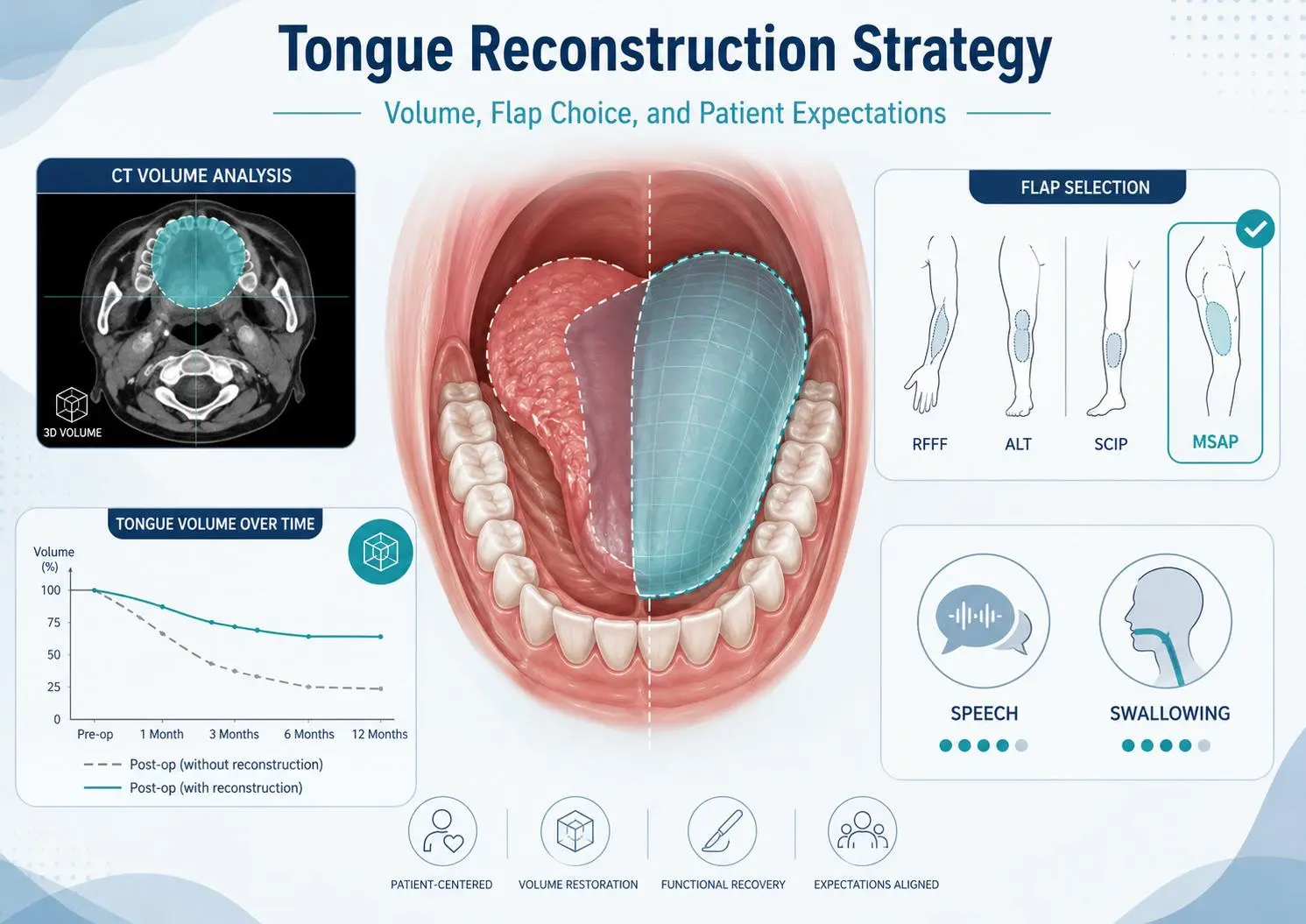
Дар ҷарроҳии саратони қисми ҳаракаткунандаи забон ҳадафи асосӣ танҳо хориҷ кардани омос нест. Албатта, бартараф кардани саратон бо ҳошияҳои онкологӣ бехатар ҳадафи аввалиндараҷа мебошад; аммо забон узвест, ки бевосита бо фурӯ бурдан, сухан гуфтан, хоидан, роҳнамоии ғизо дар дохили даҳон, ҳисси таъм, муоширати иҷтимоӣ ва намуди минтақаи рӯйу ҷоғи поён алоқаманд аст. Аз ин рӯ, вақте қисми назарраси забон хориҷ мешавад, масъалаи дуюми бузурги ҷарроҳӣ ба миён меояд: Забон чӣ гуна бояд бозсозӣ шавад?
Таҳқиқоти манбаъ ин саволро аз доираи approach-и классикии “интихоби flap аз рӯи андозаи defect” васеътар баррасӣ мекунад. Ба гуфтаи муҳаққиқон, reconstruction танҳо пур кардани ҷойи бофтаи хориҷшуда нест. Бояд бофтаи боқимондаи забон, ҳаҷми хориҷшаванда, ғафсии flap-и интихобшаванда, эҳтимоли аз даст рафтани ҳаҷми flap бо мурури вақт, сохтори бадани бемор, касб, интизориҳои эстетикӣ ва ниёзҳои суханронӣ ва фурӯбарӣ якҷо ба назар гирифта шаванд.
Беморе, ки дар маркази таҳқиқот қарор дорад, марде мебошад, ки бинобар саратони пешрафтаи қисми ҳаракаткунандаи забон type IIIb glossectomy гузаронидааст, body mass index-и баланд дорад ва ҳамчун drummer-и касбӣ ва омӯзгори мусиқӣ кор мекунад. Барои ин бемор қарори reconstruction махсусан мураккаб аст. Зеро бемор ҳам мехоҳад аз табобати саратон зинда монад ва ҳам бо назардошти касбаш мехоҳад function ва appearance-и upper extremities-ро ҳифз кунад. Навохтани барабан ва омӯзондани мусиқӣ ҳифзи function-и даст, forearm ва upper arm-ро боз ҳам муҳимтар мегардонад. Аз ин рӯ, интихоби donor site танҳо интихоби техникии ҷарроҳ нест, балки ба яке аз қарорҳои асосие табдил меёбад, ки бозгашти беморро ба ҳаёти касбӣ ва иҷтимоӣ муайян мекунад.
Чаро reconstruction дар ҷарроҳии саратони қисми ҳаракаткунандаи забон ин қадар муҳим аст?
Забон аз ҷиҳати анатомӣ узви мушакии хеле ҳаракатнок ва мураккаб мебошад. Мушакҳои extrinsic ва intrinsic якҷо кор карда, ташаккули овозҳои сухан, интиқоли луқма дар дохили даҳон, oral phase-и фурӯбарӣ ва тамосҳои дохили даҳонро танзим мекунанд. Вақте қисми зиёди забон хориҷ мешавад, танҳо бофта кам намешавад; coordination-и ҳаракат, ҳаҷм, сатҳи тамос ва қобилияти эҷоди фишор дар даҳон низ тағйир меёбад.
Аз ин рӯ, ҳадафҳои reconstruction-и забон бисёрқабатаанд:
- То ҳадди имкон ҳифз кардани function-и фурӯбарӣ,
- Нигоҳ доштани фаҳмоии сухан,
- Бозсозии ҳаҷм ва сатҳи тамоси забон дар дохили даҳон,
- Барқарор кардани floor of mouth ва oral competence,
- То ҳадди имкон кам кардани scar ва function loss дар donor site,
- Ба назар гирифтани интизориҳои иҷтимоӣ, касбӣ ва эстетикии бемор.
Дар source study таъкид мешавад, ки ҷарроҳии саратони забон метавонад муносибатҳои иҷтимоӣ ва quality of life-и беморонро амиқ таъсир диҳад. Dyslalia, яъне speech disorder, ва dysphagia, яъне swallowing difficulty, танҳо medical problem нестанд; онҳо communication-и шахс дар ҷомеа, confidence ҳангоми хӯрдан, professional performance ва psychological well-being-ро таъсир медиҳанд.
Бемори study кӣ буд ва clinical situation чӣ гуна буд?
Бемори пешниҳодшуда марди 50-сола, Caucasian, non-smoker, бе alcohol abuse, бе history of comorbidity ва дорои third-degree obesity буд. Body mass index-и ӯ 47,35 kg/m² гузориш шудааст. Бемор бо ulcerative lesion дар канори чапи mobile tongue, ки ба floor of mouth идома дошт, муроҷиат кардааст ва пас аз biopsy/examination ташхиси keratinizing infiltrative squamous cell carcinoma гирифтааст.
Дар contrast-enhanced whole-body CT дар минтақаи left hemitongue lesion бо anteroposterior extension, maximum diameter 37 mm ва radiological depth of invasion 16 mm муайян шудааст. Дар left neck levels I-II radiologically suspicious lymph nodes дида шуданд, distant metastasis ёфт нашуд. Clinical stage ҳамчун cT3 N2b M0 дода шудааст.
Бемор left compartmental hemiglossectomy, яъне wide tongue resection, ки дар study type IIIb classified шудааст, ва ipsilateral neck dissection гузаронидааст. Final pathological assessment pT4aN2b cM0 squamous cell carcinoma-ро тасдиқ кардааст. Tumor diameter 40 mm, depth of invasion зиёда аз 10 mm гузориш шудааст. Surgical margins disease-free буданд, яъне R0 resection achieved шуд. Дар neck dissection 44 lymph nodes хориҷ карда шуданд, аз онҳо чорто metastatic буданд ва extracapsular spread набуд. Дар T-N tract related to hypoglossal nerve extensive perineural invasion пайдо шудааст.
Ин details нишон медиҳанд, ки reconstruction simple patch ё small-tissue repair нест. Large-volume tongue resection, floor-of-mouth repair, neck dissection, adjuvant radiotherapy ва long-term functional expectation дар same clinical scenario якҷо омадаанд.
“Problem-solving” approach-и study чист?
Researchers reconstruction decision-ро бо four-step problem-solving structure шарҳ медиҳанд:
- Defining the problem: Ҳаҷми забон пас аз tumor surgery, speech-swallowing need, occupation, high BMI ва visible/functional donor-site concerns якҷо арзёбӣ мешаванд.
- Identifying possible solutions: RFFF, ALT, SCIP, MSAP ва pectoralis major myocutaneous flap options баррасӣ мешаванд.
- Selecting the alternative: Ғафсӣ, ҳаҷм, donor-site scar, technical suitability ва patient expectations барои ҳар flap ба назар гирифта шуда, MSAP flap интихоб мешавад.
- Monitoring the solution: Donor-site healing, neotongue volume, flap volume loss, swallowing, speech ва quality of life assessed мешаванд.
Problem-solving diagram-и study flow-ро аз patient characteristics то flap options, MSAP selection ва follow-up results ҷамъбаст мекунад. Дар problem side professional drummer/music teacher будан, хоҳиши надоштани functional/aesthetic impairment дар upper arms ва right leg, high BMI ва tongue-resection volume ҷой доранд. Possible solutions ҳамчун RFFF, ALT, MSAP, SCIP ва pectoralis major flap listed шудаанд. Chosen solution MSAP flap аст. Follow-up side no severe postoperative complication, no dysphagia, good speech, good donor-site healing ва no donor-site complication-ро ҳамчун goals нишон медиҳад.
Чаро patient expectations technical decision-ро тағйир доданд?
Дар reconstructive surgery баъзан option-и technically “suitable” метавонад аз perspective-и quality of life барои бемор suitable набошад. Дар study RFFF, яъне radial forearm free flap, initially first choice барои tongue reconstruction ҳисоб шудааст. Зеро forearm flap thin, pliable ва commonly used for small-to-medium intraoral defects мебошад. Аммо бемор ин option-ро рад кардааст.
RFFF disadvantages-и муҳим дорад. Donor site дар forearm аст ва дар everyday life easily visible мебошад. Барои closure of radial defect skin graft лозим шуда метавонад. Literature donor-site problems чун reduced grip strength ва superficial radial nerve paresthesia report мекунад. Барои professional drummer/music teacher, impairment of forearm function ё appearance танҳо aesthetic inconvenience нест, балки метавонад occupational capacity-ро affect кунад.
Аз ин рӯ, study нишон медиҳад, ки patient expectation secondary variable нест, балки central variable дар surgical planning мебошад. Occupation, social life ва acceptable donor-site risk-и бемор мисли technical flap criteria муҳим мешаванд.
Flap options чӣ гуна compare шуданд?
Study панҷ main reconstruction option-ро арзёбӣ кардааст:
- RFFF: Radial forearm free flap. Thin and pliable; commonly used in small-medium defects. Аммо visible forearm scar, need for skin graft, potential loss of grip strength ва sensory impairment risk сабаб шуданд, ки patient онро рад кунад.
- ALT: Anterolateral thigh flap. Can provide large amount of skin, fat, fascia and muscle. Has long reliable pedicle; аммо in high-BMI patient can be too thick and may create excess bulk limiting tongue mobility.
- SCIP: Superficial circumflex iliac artery perforator flap. Donor-site aesthetics can be good; аммо considered more suitable for low BMI and smaller intraoral defects. In this patient groin thickness made it unsuitable.
- MSAP: Medial sural artery perforator flap. Fasciocutaneous flap from calf that can be thin and pliable. Donor-site scar may be less visible than forearm and functional morbidity low.
- Pectoralis major myocutaneous flap: Pedicled option; аммо due to patient BMI considered weaker regarding volume and aesthetic/functional outcomes.
Possible donor-region thicknesses were measured on CT. Measurements: thigh 27,4 mm, forearm 6,8 mm, calf 11,9 mm, groin 64 mm, skin-to-fascia in pectoralis region 75 mm and pectoralis muscle 21 mm. Ин numbers нишон медиҳанд, ки flap selection cannot be based only on “which flap is generally used?” Same flap may have ideal thickness in lean patient but become too bulky for intraoral reconstruction in high-BMI patient.
Чаро tongue volume measured шуд?
Яке аз main contributions-и study emphasis on volume in tongue reconstruction мебошад. Researchers preoperative CT-ро истифода карда, tongue volume-ро бо Syngo.via software measured карданд. Patient’s oral tongue volume approximately 79,09 cm³ буд. Literature average tongue volume approximately 101,5 cm³ and range 52,5–166,6 cm³ медиҳад. Accordingly patient’s tongue considered about %25 smaller than average.
Ин information барои reconstruction critical аст. Because same flap volume may be adequate in patient with large tongue but excessive in someone with small tongue. Excess bulk can restrict mobility; insufficient bulk may fail to provide oral contact surface needed for swallowing and speech. Therefore personalized tongue-volume measurement helps choose flap volume more consciously.
Оё study formula дорад?
Source study mathematical equation as formula пешниҳод намекунад. Аммо барои interpreting volume changes basic relation-и following can be used to explain study logic:
\[ \%\,hacim\ değişimi=\frac{Başlangıç\ hacmi-Sonraki\ hacim}{Başlangıç\ hacmi}\times100 \]
Ин formula дар source study explicitly equation нест; here only used to explain reported volume-loss percentages. Ҳаҷми ибтидоӣ means first measurement value used for comparison; Ҳаҷми баъдӣ follow-up measured volume; % тағйири ҳаҷм percent reduction in volume.
For example, study reported flap volume postoperative 45,51 cm³ and follow-up after radiotherapy 26,26 cm³. These correspond to approximately %42 volume decrease. Total oral tongue volume was 67,75 cm³ postoperatively and 56,90 cm³ after radiotherapy. This is approximately %15 decrease from postoperative measurement.
Чаро MSAP flap интихоб шуд?
MSAP flap chosen as option balancing different needs of this patient. RFFF rejected by patient. ALT and SCIP excluded due to body habitus and measured tissue thicknesses. Pectoralis major flap considered weaker in terms of BMI and functional/aesthetic results.
Advantage of MSAP is providing tissue of suitable thickness for intraoral reconstruction without using forearm, a visible and occupationally critical region. Calf scar may be less visible in daily life than forearm scar. Also because right leg considered occupationally dominant, left MSAP chosen. Despite varicose veins and peripheral venous insufficiency signs in left leg, left side used to avoid function-loss risk in right leg important for occupation.
Surgically flap artery anastomosed end-to-end with left facial artery, venous drainage with branch of facial vein. Flap used to reconstruct tongue competence and part of anterolateral floor of mouth. Since primary closure not possible at donor site, zig-zag dermato-traction with Nelaton catheter was applied and traction system renewed every 48 hours.
Postoperative volume change чиро showed?
Study measured tongue and flap volumes postoperatively and after radiotherapy. Total oral tongue volume was 67,75 cm³ at postoperative T1 and 56,90 cm³ at T2 three months after radiotherapy. This is about %15 decrease from postoperative measurement. Compared with preoperative 79,09 cm³, T2 volume is about %29 lower.
Flap volume change was more pronounced. Flap volume was 45,51 cm³ at T1 and 26,26 cm³ at T2. This is approximately %42 loss. Study states that when using fasciocutaneous flaps, approximately %20–30 зиёдаандозакунӣ relative to defect should be considered during surgery. Recommendation aims to offset postoperative tissue atrophy, volume loss and scar contraction affecting long-term function.
This finding shows volume in tongue reconstruction is dynamic, not static. Even if surgeon creates suitable bulk at operation, radiotherapy, resolution of edema, fat atrophy, ischemic effects and scar tissue can reduce neotongue volume over time. If not anticipated, long-term speech and swallowing may be impaired.
Натиҷаҳои фурӯбарӣ чӣ гуна буданд?
Бемор postoperative swallowing rehabilitation гирифт ва 7 рӯз пас аз ҷарроҳӣ ба oral feeding гузашт. Four weeks after surgery ва three months after radiotherapy videofluoroscopic assessment бо different food consistencies анҷом шуд. Study мегӯяд evidence of penetration or aspiration набуд. Дар evaluation after radiotherapy anterior lingual-palatal contact in oral phase for all bolus types compared with pre-radiotherapy беҳтар шуд.
Аз рӯи performance scales, after three months normal-diet score 40/100, eating-in-public score 75/100 буд. M.D. Anderson Dysphagia Inventory score 57/70 ва mean 4,07 reported шуд. DIGEST assessment safety and efficiency grade G0 буд. These findings show favorable swallowing safety during observed follow-up, but as single-patient data should not be generalized.
Натиҷаҳои speech чӣ гуна буданд?
Oral diadochokinesis, яъне ODK, барои speech assessment истифода шуд. ODK measure-и speed and coordination of tongue motor function мебошад. Patient word “buttercup”-ро within one speech breath as fast and clearly as possible repeated кард. Measured ODK value 3,11 ҳиҷо/сония буд. General population reported mean 5,7 ҳиҷо/сония аст, therefore patient had reduced articulation speed and coordination.
Бо вуҷуди ин, therapist-rated speech intelligibility via Performance Status Scale for Head and Neck Cancer 100/100 reported шуд. These two findings should be read together. Patient may have slower, less coordinated articulation than general population, while speech intelligibility remained excellent clinically. This distinction is important: speech rate/coordination and understandability by listener are not same metric.
Donor-site ва aesthetic outcomes чӣ гуна буданд?
Patient mobilized on second postoperative day. Minimal dehiscence developed in upper third of left-leg donor site and closed by secondary healing within one month. Study reported no muscular or sensory sequelae in left leg.
Three months after radiotherapy flap shape and appearance were rated good, good lingual movement on protrusion and no static or dynamic asymmetry in lower third of face were noted. This is important relative to patient expectations. Patient particularly did not want visible scar/function loss in upper limbs; selected MSAP approach, as reported, provided donor-site outcome compatible with this preference.
Figures чӣ нишон медиҳанд?
First image group shows left hemitongue cancer in preoperative contrast CT sections. Tumor marked on sagittal, coronal and axial planes; surgical specimen image also shows extension to T-N tract associated with neck lymph nodes. Images demonstrate reconstruction was planned not for superficial oral defect but for broad tissue loss after advanced cancer surgery.
MSAP flap figures show donor-site marking on left leg, perforator-vessel markings, intraoperative flap elevation and anatomical schema. Images explain MSAP as tissue raised from calf based on perforator vessels and pedicle prepared for microsurgical reconstruction.
Problem-solving diagram visualizes main conceptual contribution. It shows occupation, high BMI, donor-site expectations and resection volume assessed alongside flap options, followed by MSAP selection and functional/aesthetic follow-up.
CT volume-measurement figures show preoperative tongue volume around 79,09 cm³ and reduction of total oral tongue and flap volumes during postoperative and post-radiotherapy follow-up. Colored segmentations emphasize tongue/flap volume as radiologically measured parameter, not rough estimation.
CT images of donor-site thickness show measurements in groin, thigh, calf, pectoral region and forearm. These measurements explain why flap thickness can be decisive for reconstruction in high-BMI patients.
Аҳамияти study аз гузашта, имрӯз ва оянда
Historically flap selection in tongue reconstruction was often based mainly on defect size and surgeon experience. RFFF and ALT have long been commonly used. This study shows algorithms based only on defect percentage may not be sufficient for every patient.
For current practice, study emphasizes patient-centered surgical planning. Success in cancer surgery is not limited to tumor removal. Ability to speak, swallow, eat, work, return to social life, tolerate appearance and avoid donor-site functional loss are also parts of treatment success. These factors are especially important in younger patients or those with longer life expectancy.
For future, study suggests more research on volume-based planning in tongue reconstruction. Three-dimensional CT measurements, personalized flap design, predictions of volume loss, post-radiotherapy atrophy estimates and structured integration of patient expectations could lead to more refined reconstruction models. Larger patient series, comparative studies and long-term functional follow-up are needed.
Таъсир ба ҳаёти ҳаррӯза чӣ гуна бояд фаҳмида шавад?
Main everyday-life message is that cancer surgery is not only process of removing disease but holistic recovery aimed at enabling person to return to life. For someone undergoing tongue-cancer surgery, speech, swallowing, eating, professional life, social conversation, appearance and body image are interconnected.
In this case patient is music teacher and drummer. Therefore avoiding scar or functional loss in occupationally important regions such as forearm or dominant leg became decisive for post-treatment quality of life. Study shows surgeon should think not only about “most common flap” but also patient’s real life.
However this result does not mean MSAP flap is best for every tongue-cancer patient. Message is more careful and personalized: reconstruction decision should weigh required oncologic surgery, tongue volume, flap properties, body habitus, donor-site expectations, occupation and long-term volume change together.
Ҷиҳатҳои қавии study
One strength is presenting reconstruction decision as structured problem-solving process, not merely technical surgical preference. This approach places patient expectations at center.
Second strength is quantitative CT measurement of tongue and flap volumes. “Adequate volume” is treated not just by surgical observation but as parameter followed in cm³.
Third strength is serious consideration of donor-site aesthetics and function. After mobile-tongue cancer surgery, return to social/professional life matters along with survival. Study shows this should not be neglected, especially in patients with long life expectancy.
Fourth strength is explicit discussion of flap-volume loss. A %42 decline over time strongly highlights need to account for future atrophy and scar contraction in operative planning.
Маҳдудиятҳои study
Main limitation is case-based approach with single patient. Findings are not statistically generalizable. Good outcome of MSAP in this patient does not mean same result in all patients.
Second, source text not peer reviewed. Thus method, volume recommendations and interpretations of functional outcomes may change after independent review.
Third, MSAP has its own technical challenges. As study notes, MSAP dissection requires intramuscular pedicle dissection and has longer learning curve. Patient position may also complicate simultaneous work with head-neck surgery and prolong operative time.
Fourth, MSAP may not provide enough volume for every large tongue defect. Particularly in compartmental tongue reconstruction, sural flap can be insufficient where greater bulk required. Therefore study presents MSAP as suitable option in selected cases, not universal solution.
Study чӣ мегӯяд ва чӣ намегӯяд?
Study says flap selection in mobile-tongue cancer reconstruction should not be based only on extent of removed tissue. Patient tongue volume, expected volume loss, donor-site thickness, body habitus, occupation, aesthetic expectations and functional priorities should be evaluated together. In this case MSAP used as solution consistent with patient expectations and anatomical measurements.
Study does not say MSAP is always superior to RFFF, ALT or SCIP. It does not propose standard algorithm for all mobile-tongue cancer patients. It provides no long-term multicenter outcome or randomized controlled comparison and does not establish generalizable functional superiority. Results should be viewed as detailed surgical decision-making and follow-up narrative in one patient.
Усул ва Натиҷаҳои Таҳқиқот
Усули study
| Method component | How used in study? | Purpose |
|---|---|---|
| Clinical case analysis | 50-year-old man with advanced mobile-tongue cancer analyzed. | To show patient-centered reconstruction decision process. |
| CT-based tumor evaluation | Left hemitongue lesion, tumor size, depth of invasion and neck nodes assessed. | To determine oncologic surgical need and reconstruction extent. |
| Tongue-volume measurement | Preoperative oral tongue volume measured with Syngo.via at approximately 79,09 cm³. | To personalize flap volume and reconstruction plan. |
| Donor-site thickness measurement | Thigh, forearm, calf, groin and pectoral-region thicknesses measured with CT. | To assess flap options for suitable intraoral volume. |
| Problem-solving flow | Problem, possible solutions, solution selection and follow-up steps defined. | To structure surgical decision with patient expectations, not anatomy alone. |
| Functional follow-up | Swallowing, speech, donor-site healing, flap and total tongue volume followed. | To assess long-term functional and social effect of reconstruction. |
Маълумоти асосии clinical patient
| Parameter | Value reported in study | Interpretation |
|---|---|---|
| Age and patient profile | 50-year-old man, professional drummer and music teacher | Occupational requirements directly affected donor-site choice. |
| BMI | 47,35 kg/m² | High BMI made some flap options excessively thick. |
| Clinical stage | cT3 N2b M0 | Wide surgery planned in advanced mobile-tongue cancer. |
| Pathological stage | pT4aN2b cM0 | Final pathology confirmed advanced disease. |
| Tumor diameter | 40 mm | Maximum tumor diameter reported pathologically. |
| Depth of invasion | >10 mm | Deep invasion is factor increasing reconstruction need. |
| Lymph-node status | 4 of 44 lymph nodes metastatic; no extracapsular spread | Important biological-risk factor for adjuvant treatment decision. |
| Perineural invasion | Extensive PNI in hypoglossal-nerve T-N tract | Presented as one rationale for adjuvant radiotherapy. |
Donor-site thicknesses ва flap selection
| Donor region / flap option | Measured thickness or feature | Decision in study |
|---|---|---|
| Forearm / RFFF | 6,8 mm | Initially considered technically, but patient rejected due to forearm scar and functional risk. |
| Thigh / ALT | 27,4 mm | Excluded as too thick for patient’s tongue volume and planned defect. |
| Calf / MSAP | 11,9 mm | Selected based on patient expectations and anatomical suitability. |
| Groin / SCIP | 64 mm | Considered unsuitable due to high thickness. |
| Pectoral region / pectoralis major flap | Skin-fascia 75 mm; muscle 21 mm | Excluded due to high BMI and weaker functional/aesthetic option. |
Volume measurements
| Measurement | Value | Interpretation |
|---|---|---|
| Preoperative oral tongue volume | 79,09 cm³ | Interpreted as approximately %25 lower than average tongue volume. |
| Postoperative total oral tongue volume, T1 | 67,75 cm³ | Early post-reconstruction measurement. |
| Post-radiotherapy total oral tongue volume, T2 | 56,90 cm³ | Approximately %15 reduction vs T1; approximately %29 lower than preoperative volume. |
| Postoperative flap volume, T1 | 45,51 cm³ | Early flap volume. |
| Post-radiotherapy flap volume, T2 | 26,26 cm³ | Approximately %42 flap-volume reduction. |
Functional and clinical follow-up findings
| Domain | Finding | Interpretation |
|---|---|---|
| Oral feeding | Oral feeding achieved 7 days after surgery. | Early oral intake possible after swallowing rehabilitation. |
| Videofluoroscopic swallowing | No evidence of penetration or aspiration. | Positive finding for swallowing safety in observed follow-up. |
| PSS-HNC normal diet | 40/100 | Shows limitation in normal-diet capacity persisted. |
| PSS-HNC eating in public | 75/100 | Better performance reported for eating in social settings. |
| MD Anderson Dysphagia Inventory | 57/70; mean 4,07 | Patient-reported swallowing quality of life assessed. |
| DIGEST | G0 | Presented as favorable safety and efficiency grade. |
| ODK | 3,11 ҳиҷо/сония | Reduced articulation speed and coordination vs general population mean 5,7. |
| Speech intelligibility | 100/100 | Speech intelligibility preserved according to therapist assessment. |
| Donor site | Minimal dehiscence healed secondarily within one month; no muscle or sensory sequelae. | Interpreted as low donor-site morbidity. |
Натиҷаи техникӣ
Technical conclusion is that flap selection in tongue reconstruction should not be determined only by defect percentage or conventional surgical algorithms. In this case patient had small tongue volume, high BMI, specific occupational expectations and prominent concern about visible donor sites. Therefore flap selection was presented as modulated surgical decision weighing tumor surgery, volume restoration, donor-site thickness, flap atrophy, post-radiotherapy change and patient expectations together.
Ёддошт оид ба Манбаъ ва Усул
Ин мақола дар асоси таҳқиқоти Rita De Berardinis, Gioacchino Giugliano, Marta Tagliabue, Francesca Ruju, Valeria Zurlo, Valentina Di Natale, Lorenzo Monticelli, Elisa Lazzari, Stefano Filippo Zorzi, Stefano Riccio, Roberto Bruschini, Fausto Maffini ва Mohssen Ansarin бо унвони “‘Problem-solving’ in surgical reconstruction for mobile tongue cancer: the role of tongue volume and patient expectations” таҳия шудааст. Study presented by authors from European Institute of Oncology IRCCS and related institutions.
Source text is an unreviewed preprint on SSRN and explicitly states “This preprint research paper has not been peer reviewed”. Therefore results should be read not as peer-reviewed, large-series clinical evidence but as surgical problem-solving approach and clinical case analysis based on one patient.
Content is based on clinical case, surgical decision flow, CT volume measurements, flap options, donor-site measurements, swallowing-speech assessments and follow-up findings in PDF. No claims of clinical-success guarantee, universal superiority of MSAP, standard treatment algorithm or definitive surgical recommendation not in PDF have been added.
Study follows one patient; therefore findings cannot be generalized. However it strongly illustrates that personalized planning, tongue-volume measurement, expectation of flap-volume loss and patient preferences should be included in mobile-tongue cancer reconstruction decisions. Larger series, comparative studies and long-term functional follow-up are required to define role of MSAP more clearly.
Шарҳ гузоред
Нишонии почтаи электронии шумо нашр намешавад. Майдонҳои ҳатмӣ бо * нишон дода шудаанд