

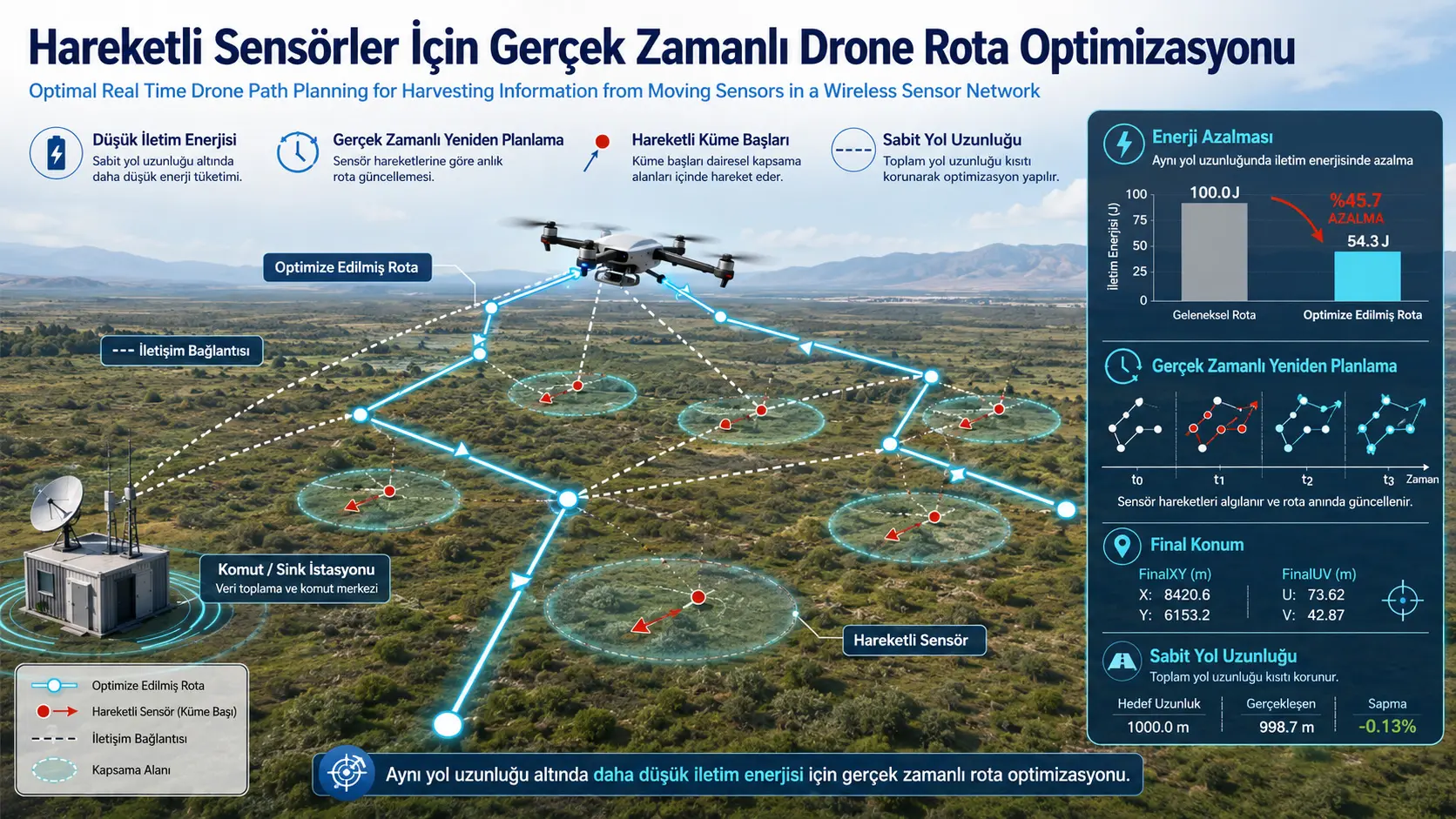
Ин таҳқиқот ҳадаф дорад масири як дронеро, ки аз cluster head-ҳои ҳаракаткунандаи wireless sensor data ҷамъ мекунад, тавре банақшагирӣ кунад, ки transmission energy-и sensor-ҳо ҳангоми communication кам шавад. Дар ҳоле ки total distance-и парвози дрон fixed нигоҳ дошта мешавад, кӯшиш шудааст communication distance байни дрон ва ҳар cluster head-и ҳаракаткунанда кам карда шавад. Researchers ин problem-ро бо vector-field differential equation, ки route-length constraint-ро нигоҳ медорад, ва heuristic methods бар асоси traveling-salesman problem, ки order-и боздиди cluster head-ҳоро аз нав ташкил мекунад, ҳал кардаанд.
Framework-и пешниҳодшуда ду problem-и ба ҳам вобастаро баррасӣ мекунад. Problem-и аввал муайян кардани point-ҳое мебошад, ки дрон барои given visit order бояд аз онҳо гузарад. Problem-и дуюм бошад муайян кардани он аст, ки cluster head-ҳои ҳаракаткунанда бо кадом order боздид шаванд, то communication cost камтар шавад. Барои fixed order negative objective gradient ба tangent plane-и route-length constraint projection мешавад; visit order бошад бо истифода аз predicted sensor positions ё optimized drone passage points пай дар пай rearrange мешавад.
Дар Monte Carlo simulations дар six scenario classes number of cluster heads, speed-и target-ҳо relative to drone ва allowed path length per cluster head тағйир дода шудаанд. Барои ҳар scenario ва method 100 simulation иҷро шудааст. Мувофиқи гузориши researchers, FinalXY ва FinalUV махсусан дар larger ва faster systems бештар lowest transmission costs тавлид кардаанд. Дар scenarios бо twenty moving cluster heads, cost-и best solutions аксаран аз yüzde 10-и cost дар initial fixed TSP order камтар, ва дар scenarios бо 40 cluster heads аз yüzde 5 камтар будааст. Ин values мутаносибан ба relative reduction-и тақрибан зиёда аз yüzde 90 ва yüzde 95 мувофиқанд.
Results ба physical energy measurement не, балки ба simulation objective function асос ёфтаанд, ки бо square-и distance байни drone ва cluster head proportional ҳисоб мешавад. Wind, obstacles, three-dimensional flight, packet loss, data-transfer duration, drone acceleration and turning constraints ва position-estimation errors model нашудаанд. Аз ин рӯ, study исбот намекунад, ки same energy gain дар real field ба даст меояд ё globally best route дар all conditions пайдо мешавад.
Аз нигоҳи Туркия: Proposed method метавонад ҳамчун research model барои ҷамъоварии data аз sensors-и ба moving livestock herds басташуда, monitoring-и large agricultural areas, forest ва fire-risk observation, sensor networks бо moving agricultural machinery ва hard-to-reach environmental monitoring regions дар Туркия adapt шавад. Пеш аз application, local terrain, wind, altitude, communication range, real sensor power curves, drone battery, obstacles ва airspace conditions бояд ба system илова шаванд. Algorithm бояд дар field trials бо real drones ва sensor nodes comparison шавад; energy дар joules, data-delivery ratio, mission duration ва route-recalculation latency чен шаванд. Аз study наметавон direct conclusion гирифт, ки дар Туркия yüzde 90–95 energy saving, regulatory compliance ё real-time safe field operation таъмин мешавад.
Таҳқиқот кадом problem-ро ҳал мекунад?
Wireless sensor networks дар remote ё hard-to-access areas одатан бо battery кор мекунанд. Direct sending of data аз sensors ба central station, махсусан бо зиёд шудани distance, метавонад high energy consumption ба вуҷуд орад. Дар study як drone аз назди moving cluster heads, ки data-и sensor groups-ро ҷамъ мекунанд, гузашта mobile data receiver мешавад.
Гузаштани drone exactly аз болои ҳар cluster head communication distance-и sensor-ҳоро кам карда метавонад; аммо drone battery ва mission duration total route length-ро маҳдуд мекунанд. Аз ин рӯ, main question чунин аст: Дар дохили fixed total flight distance drone бояд cluster head-ҳои moving-ро бо кадом order ва то чӣ андоза наздик шавад, то total transmission cost-и cluster heads ҳарчи камтар бошад?
Problem танҳо geometric routing problem нест. Азбаски cluster heads move мекунанд, arrival time-и drone ба target location-и target дар ҳамон вақтро муайян мекунад. Ҳар change дар previous route segments arrival times ба later targets ва ҳамин тавр later communication distances-ро низ тағйир медиҳад.
System чӣ гуна design шудааст?
Дар study sensors grouped into clusters ҳисоб мешаванд. Sensors дар ҳар cluster data-ро ба як cluster head медиҳанд; drone бошад на бо all sensors directly, балки бо ҳамин moving cluster heads communication мекунад. Figure 1 дар page 2 conceptually нишон медиҳад, ки drone multi-segment route аз назди moving targets мегузарад ва cluster heads data-ро ба drone мефиристанд. Figure system schematic аз previous source аст; simulation result нест.
Main assumptions-и model чунинанд:
- Time-dependent two-dimensional positions-и cluster heads пешакӣ known мебошанд.
- Drone constant-speed ҳисоб мешавад.
- Own energy consumption-и drone танҳо бо total flown distance represent мешавад.
- Maximum route length-и available to drone fixed аст.
- Ҳангоми receiving data аз cluster head, drone position approximately stationary ҳисоб мешавад.
- Transmission cost proportional to a power of distance байни drone ва cluster head аст.
Last assumption distance-dependent power loss дар radio communication-ро simplified represent мекунад. Дар simulations exponent p = 2 интихоб шудааст. Бинобар ин objective function ба sum of squared communication distances табдил мешавад.
Positions-и moving targets чӣ гуна ҳисоб мешаванд?
Time-dependent position-и cluster head-и рақами j чунин ифода мешавад:
\[ \bigl(X_j(t),Y_j(t)\bigr) \]
Passage point, ки drone data-ро аз ин cluster head мегирад, чунин аст:
\[ q_j=(u_j,v_j) \]
Drone аз starting point \(q_0=(0,0)\) move мекунад ва дар simulations ба same point бармегардад. Distance-и traveled before reaching passage point j:
\[ g_{j-1}(\vec{u},\vec{v}) = \sum_{k=0}^{j-1}\ell_k \]
ва length-и ҳар route segment:
\[ \ell_k= \sqrt{(u_k-u_{k+1})^2+(v_k-v_{k+1})^2} \]
мебошад. Вақте drone speed \(s_d\) аст, related arrival time:
\[ t_j=\frac{g_{j-1}(\vec{u},\vec{v})}{s_d} \]
ҳисоб мешавад. Ҳамин тавр cluster head position ҳангоми data transfer:
\[ x_j=X_j(t_j), \qquad y_j=Y_j(t_j) \]
мебошад. Тағйири як passage point метавонад на танҳо communication distance дар он point, балки later arrival times ва positions-и later cluster heads-ро низ тағйир диҳад.
Transmission-energy objective function чӣ гуна сохта шудааст?
Communication distance байни drone ва cluster head-и рақами j:
\[ d_j= \sqrt{(x_j-u_j)^2+(y_j-v_j)^2} \]
таъриф мешавад. Total transmission cost бо objective function-и зерин represent мешавад:
\[ f(\vec{u},\vec{v}) = \sum_{j=1}^{J} \left[ (x_j-u_j)^2+(y_j-v_j)^2 \right]^{p/2} = \sum_{j=1}^{J}d_j^p \]
Дар ин ҷо J number of cluster heads ва p distance-dependent path-loss exponent-ро нишон медиҳад. Real transmitter power, number of bits, channel coefficient ё joule conversion coefficient ба model илова нашудаанд. Аз ин рӯ f бештар relative communication cost барои comparison-и methods аст, на real energy measurement.
Total drone route length:
\[ g(\vec{u},\vec{v}) = \sum_{j=0}^{J}\ell_j \]
дода мешавад ва constraint-и зерин татбиқ мешавад:
\[ g(\vec{u},\vec{v})\leq L \]
Дар ин ҷо L maximum route length аст, ки бо drone battery ва mission conditions муайян мешавад. Mathematical problem:
\[ \min_{\vec{u},\vec{v}} f(\vec{u},\vec{v}) \quad \text{koşuluyla} \quad g(\vec{u},\vec{v})\leq L \]
шакл дорад.
Vector-field method route length-ро чӣ гуна нигоҳ медорад?
Direction, ки objective function-ро fastest кам мекунад, negative gradient \(-\nabla f\) аст. Аммо direct movement дар ин direction метавонад total route length-ро тағйир диҳад. Researchers negative objective gradient-ро ба tangent plane perpendicular to gradient-и route-length constraint project мекунанд.
Projected direction:
\[ -\nabla f+ \frac{\nabla f\cdot\nabla g} {\nabla g\cdot\nabla g}\nabla g \]
аст. Inner product-и ин direction бо \(\nabla g\) zero аст. Аз ин рӯ movement дар tangent direction-и route-length surface сурат мегирад ва equality \(g=L\) нигоҳ дошта мешавад.
Researchers барои numerical solution vector differential equation-и зеринро истифода мебаранд:
\[ \frac{d(\vec{u},\vec{v})}{d\tau} = -(\nabla g\cdot\nabla g)\nabla f + (\nabla f\cdot\nabla g)\nabla g \]
\(\tau\) дар ин ҷо real flight time-и drone нест. Он artificial ё pseudo-time мебошад, ки direction-и progress-и solution ҳангоми optimization-ро нишон медиҳад. Дар тӯли equation route length сақ мешавад ва objective function кам мешавад.
Method ба local minimum наздики given initial solution расиданро ҳадаф мегирад. Global best solution танҳо агар initial point дар suitable basin of attraction бошад, пайдо мешавад. Аз ин рӯ researchers additional ordering algorithms барои беҳтар кардани initial order ва passage points истифода кардаанд.
Initial route чӣ гуна сохта мешавад?
First visit order аз traveling-salesman problem гирифта мешавад, ки дар positions-и targets дар predicted time, ки study онро “mid-time” меномад, solve шудааст. Дар text ин time ҳамчун \(t_m=L/s_d\) defined шудааст. Азбаски ин value under constant-speed assumption ба total route duration баробар аст, mathematical meaning-и term “mid-time” sufficiently explained нашудааст.
Агар tour length, ки ҳамаи targets-ро visit мекунад, аз allowed L камтар бошад, drone data-collection points ба target positions гузошта мешаванд. Агар tour аз allowed length калон бошад, internal route points along lines between center of start/end points and cluster heads scale мешаванд. Scaling coefficient:
\[ k=\frac{L}{L_{\mathrm{tour}}} \]
интихоб мешавад ва initial route length ба allowed value оварда мешавад.
Чаро visit order муҳим аст?
Барои stationary targets short TSP tour метавонад good initial solution диҳад. Барои moving targets бошад location at arrival time муҳим аст. Target, ки initially close менамояд, метавонад то arrival-и drone дур шавад; target-и дигар, ки farther менамояд, метавонад ба route наздик шавад. Аз ин рӯ fixed order based only on initial positions метавонад large communication distances диҳад.
Study visit order-ро бо single exact mathematical method directly solve намекунад. Ба ҷои ин hybrid framework истифода мешавад, ки vector-field optimization барои fixed order ва order-changing methods-ро alternatingly иҷро мекунад.
FinalXY method чӣ гуна кор мекунад?
FinalXY аввал entire route-ро барои current visit order optimize мекунад. Баъд arrival time-и drone ба ҳар target ҳисоб шуда, predicted positions-и cluster heads дар ҳамон times муайян мешаванд. New TSP дар predicted target positions solved шуда, global visit order rebuild мешавад.
Агар new order аз previous order фарқ кунад, route бо истифода аз previous solution ҳамчун initial guess аз нав optimize мешавад. Process то вақте идома мекунад, ки previously seen ordering repeat шавад, ва lowest-cost solution дар ҳамаи iterations нигоҳ дошта мешавад.
Advantage-и method он аст, ки на only small part, балки entire visit sequence-ро restructure карда метавонад. Disadvantage он аст, ки repeated TSP solving computational load-ро зиёд карда метавонад.
FinalXY Greedy method чист?
FinalXY Greedy same iterative structure as FinalXY истифода мекунад, аммо барои new order ба ҷои exact TSP nearest-neighbor greedy approach истифода мекунад. Ҳадаф кам кардани computational cost аст.
Simulation results нишон медиҳанд, ки approach махсусан дар small systems with ten cluster heads competitive аст. Вақте target count, path length ё target speed зиёд мешавад, FinalXY ва FinalUV generally lower cost тавлид мекунанд.
FinalUV чӣ гуна фарқ мекунад?
FinalUV барои reordering ба ҷои predicted final positions-и moving targets optimized drone passage points-ро истифода мебарад. Ба ибораи дигар, new TSP дар \((u_j,v_j)\) points сохта мешавад, ки drone дар current solution data collection мекунад.
Дар баъзе scenarios method energy values наздик ба FinalXY дод, аммо fewer reorderings анҷом дод. Figure 10 дар page 21 нишон медиҳад, ки FinalUV дар different scenarios яке аз lowest reordering counts дорад.
Rolling-ordering methods чӣ гуна кор мекунанд?
Predicted Rolling аз beginning-и route ба end ҳаракат мекунад; вақте selected visit index расад, predicted positions-и not-yet-visited targets дар ҳамон time ҳисоб мешаванд. New TSP order барои remaining targets пайдо мешавад ва unfinished part-и route reoptimize мешавад. Already processed visits fixed нигоҳ дошта мешаванд.
Greedy Rolling same structure истифода мекунад, аммо remaining targets-ро бо nearest-neighbor approach ба ҷои exact TSP order мекунад. Азбаски ин ду methods local incremental changes мекунанд, метавонанд аз global reorderings faster бошанд; аммо дар study results онҳо аксаран self-crossing ва higher-cost routes produced карданд.
Чаро reverse-direction versions evaluated шуданд?
Forward ва reverse directions-и initial TSP tour метавонанд same geometric length дошта бошанд. Аммо moving targets дар ин ду order same arrival times ва same communication distances намедиҳанд. Аз ин рӯ ҳар one of five base methods separate with forward ва reverse initial order иҷро шудааст.
Researchers best solution аз combined forward/reverse versions-и same base method-ро ҳамчун “combined method” report карданд. Approach нишон медиҳад, ки trying additional initial solution local-minimum dependence-ро кам мекунад ё не.
Simulation scenarios чӣ гуна generated шуданд?
Initial points-и cluster heads бо Halton quasi-random sequences generated шуданд, то clustering кам ва area more evenly sampled шавад. Points дар circle of radius 1 kilometer around drone starting point distributed шуданд.
Speed-и ҳар cluster head аз uniform distribution between zero and defined maximum speed, direction-и movement аз uniform angular distribution интихоб шуд. Мувофиқи code description cluster heads linear with constant speed and constant direction ҳаракат мекунанд. Start/end point-и drone \((0,0)\), transmission-loss exponent бошад \(p=2\) мебошад.
Six scenarios тарҳрезӣ шудаанд, то effects-и target speed, number of cluster heads ва allowed route length separately evaluate шаванд. Дар ҳар scenario 100 simulations барои ҳар method иҷро шуданд.
Energy distributions чиро нишон медиҳанд?
Figure 2 дар page 13 distribution-и lowest objective value found among all methods in each simulation-ро нишон медиҳад. Дар low-speed scenario majority values near zero concentrated мешаванд; дар high-speed scenario distribution ба higher ва wider values shift мешавад. Ин нишон медиҳад, ки fast-moving targets finding suitable close-approach points барои drone-ро harder мекунанд.
Дар short-path scenario energy values нисбат ба baseline scenario higher мешаванд. Вақте available path to drone shorter мешавад, freedom to approach targets кам мешавад. Study text мегӯяд, ки effect аз increase in target speed маҳдудтар аст.
Дар large scenario with forty cluster heads total objective values unexpectedly lower distributed reported шуданд. Researchers result-ро report мекунанд, аммо why total energy value can decrease as number of targets increases-ро бо detailed mechanism ё normalization analysis explain намекунанд.
Кадом method бештар best result дод?
Figure 3 дар page 14 нишон медиҳад, ки ҳар method out of 100 samples чанд маротиба alone ё tied with others lowest cost produced кардааст. Дар small system FinalXY Greedy strong performance нишон дод. Дар baseline, high-speed ва large scenarios FinalXY ва reverse version among methods producing most best solutions мебошанд. FinalUV ва reverse version дар many cases close behind буданд.
Figure 6 дар page 17 forward ва reverse versions-ро under one method combine мекунад. Дар baseline, high-speed ва large systems combined FinalXY clearly highest win count дорад. Дар large system FinalUV ҳам strong second option мебошад.
Average transmission costs чӣ гуна changed шуданд?
Figure 4 дар page 15 mean, standard deviation ва yüzde 5–95 percentile range-и energy objective values-и methods-ро нишон медиҳад. FinalXY ва reverse version дар all six scenarios among lowest means мебошанд. FinalUV ҳам especially baseline, high-speed ва large systems results close to FinalXY дод.
Rolling methods дар баъзе scenarios higher means ва wider distributions доранд. Ин нишон медиҳад, ки same method дар different initial layouts consistently low cost тавлид карда натавонист.
Figure 7 дар page 18 comparison-и combined forward/reverse results-ро медиҳад. Дар low speed FinalUV, FinalXY Greedy ва FinalXY close мебошанд, аммо бо increase in target speed and system size advantage-и FinalXY more apparent мешавад.
Percentage improvements дар кадом level ҳастанд?
Дар study improvement ratio аз difference байни initial TSP ordering ва optimized solution ҳисоб мешавад:
\[ \text{İyileşme}(\%) = 100 \frac{E_{\mathrm{ilk}}-E_{\mathrm{son}}} {E_{\mathrm{ilk}}} \]
Figure 5 дар page 16 percentage-improvement distributions-и methods separately нишон медиҳад. Дар baseline scenario average improvements-и FinalXY ва FinalUV family above yüzde 90 мебошанд. Дар large scenario majority methods between yüzde 90–100 concentrated мешаванд.
Figure 8 дар page 19 combined forward/reverse results-ро нишон медиҳад. Дар baseline scenario FinalXY ва FinalUV improvements near yüzde 95 медиҳанд, дар large scenario results very close to yüzde 100 cluster мешаванд. Инҳо relative results computed from graph ва initial objective value мебошанд; percentages measured in actual sensor battery consumption нестанд.
Methods чӣ қадар вақт мегиранд?
Figure 9 дар page 20 runtimes-ро on logarithmic horizontal axis нишон медиҳад. Вақте number of cluster heads, target speed ва allowed path length increase мешаванд, method runtime ҳам меафзояд. Greedy methods дар most cases faster than FinalXY мебошанд.
FinalUV despite TSP-based being дар баъзе scenarios similar or shorter time than greedy methods анҷом ёфт. Researchers инро бо fewer reorderings in FinalUV explain мекунанд.
Simulations дар standard desktop computer бо Intel Core i5-10400, 2,9 GHz processor ва 12 GB RAM иҷро шуданд. Study reports best routes of systems with 40 cluster heads can be computed within seconds. Аммо ин duration only algorithm desktop-processing time аст; receiving sensor data, updating position, transferring to flight control ва communication latencies included нестанд.
Route visualizations чиро нишон медиҳанд?
Figure 11 дар page 22 routes-и all forward and reverse methods in one selected baseline sample comparison мекунад. FinalXY ва FinalUV paths more regular polygons form мекунанд, дар ҳоле ки Predicted Rolling ва Greedy Rolling more often self-crossing route segments доранд.
Researchers мегӯянд, ки self-crossing paths метавонанд with higher energy objective values linked бошанд. Аммо study relation-ро бо separate statistical test measure накардааст. Figure only one selected example нишон медиҳад ва geometric behavior-и all simulations-ро alone represent намекунад.
Main conclusions supported by study кадоманд?
- Барои moving cluster heads fixed TSP order based only on initial positions метавонад барои low communication cost insufficient бошад.
- Барои fixed visit order vector-field method метавонад objective function-ро locally decrease кунад while preserving route length.
- Alternating route optimization with visit-order updates relative improvements large compared with initial static order дод.
- FinalXY, especially in fast, long-route and many-target scenarios, among tested methods most frequently produced lowest cost.
- FinalUV дар баъзе cases performance close to FinalXY бо fewer reorderings дод.
- FinalXY Greedy метавонад дар small target sets бо lower computational load competitive бошад.
- Trying both forward and reverse initial orders метавонад better results than relying on single initial direction диҳад.
Study чиро исбот намекунад?
- Исбот намекунад, ки found routes globally best among all possible routes мебошанд.
- Нишон намедиҳад, ки transmission energy дар real sensor hardware same proportion кам мешавад.
- Field test of algorithm with real drone, radio module ё moving sensor пешниҳод намекунад.
- Safe flight in obstacle-filled, windy ё three-dimensional environments нишон намедиҳад.
- Нишон намедиҳад, ки same performance when targets change speed and direction in complex movement нигоҳ дошта мешавад.
- Robustness to position-measurement errors, communication outages ва packet loss measure намекунад.
- Flight-dynamics constraints мисли turn angle, acceleration, maximum bank angle ё minimum turn radius evaluate намекунад.
- Option of minimizing maximum individual cluster-head energy among two optimization objectives бо numerical experiments test нашудааст.
Strengths-и study кадоманд?
Main strength ин direct inclusion-и moving-target positions at arrival time into objective function аст. Ҳамин тавр target motion ҳамчун post-processing independent of route optimization не, балки as part of mathematical structure-и problem treat шудааст.
Differential equation, ки route-length constraint-ро inside vector field нигоҳ медорад, continuous improvement direction медиҳад instead of independently resolving constrained optimization at each numerical step. Gradients-и objective function ва route constraint дар study in detail derived шудаанд.
Six scenario classes try to separate effects-и target speed, target count ва route budget. Use of 100 samples per scenario prevents results from depending on single random layout. Sharing code in open GitHub repository reproducibility-ро support мекунад.
Main methodological limitations кадоманд?
- Optimization method барои fixed order local minimum медиҳад; global optimum guarantee нест.
- Visit order бо exact integrated optimization не, балки comparison of several heuristic methods муайян мешавад.
- Energy objective function physical units ё real radio-hardware coefficients надорад.
- Cluster heads дар two-dimensional plane бо constant-speed linear motion modeled шудаанд.
- Drone own energy consumption танҳо бо route length represent шудааст.
- During transmission drone assumed stationary or motion negligible аст.
- Although route-length problem initially defined as \(g\leq L\), vector-field implementation operates on equality surface \(g=L\).
- Value \(t_m=L/s_d\) used for initial TSP order is called “mid-time”; however this equals total route duration.
- Number of methods дар баъзе text sections “eight” ё code description “six” гуфта мешавад, while Figure 11 shows ten forward/reverse methods.
- Real-time claim танҳо ба desktop simulation runtime асос ёфтааст.
- Physical field experiment, independent reimplementation ё broad benchmark against other routing algorithms пешниҳод нашудааст.
Future validations чӣ гуна бояд бошанд?
Method аввал бояд бо energy consumption of real radio transmitters as function of distance, power level, data amount ва packet-delivery ratio calibrate шавад. Distance exponent in objective function бояд replaced with measured channel loss ва communication-protocol values шавад.
Then obstacles, three-dimensional altitude, wind, maximum speed, acceleration, turn radius, safe distance ва airspace boundaries бояд added шаванд. Scenarios where targets change direction, position measurements delayed or erroneous, ва data link interrupted separately test шаванд.
Performance-и FinalXY, FinalUV ва greedy methods бояд under same datasets and computational budget бо other dynamic TSP, model-predictive control, metaheuristic ва mixed-integer optimization approaches comparison шавад. Барои measuring local-minimum dependence more initial orders ва global lower bounds истифода шаванд.
Усул ва бозёфтҳои таҳқиқот
Non-experimental engineering validation
Study physical experiment не, балки mathematical model ва computer simulation истифода мекунад. Дар ҳар Monte Carlo sample initial positions ва speeds-и cluster heads regenerate шуда, all methods on same sample run шудаанд ва objective value, runtime ва reordering count comparison шудаанд.
| Feature | Value ё method used in study |
|---|---|
| Simulation area | Circle of 1 km radius around drone starting point |
| Initial positions | Halton quasi-random sequence |
| Cluster-head movement | Random speed and direction; code description says constant-speed linear motion |
| Drone start and end | (0, 0) |
| Drone speed | Constant; target speeds defined relative to drone speed. |
| Distance exponent | p = 2 |
| Number of repetitions | 100 per scenario and method |
| Number of scenario classes | 6 |
| Hardware | Intel Core i5-10400, 2,9 GHz, 12 GB RAM |
| Software | Python |
Six simulation scenarios
| Scenario | Description | Number of cluster heads | Maximum target speed / drone speed | Path length per cluster head | Total path length |
|---|---|---|---|---|---|
| 1 | Low speed | 20 | 0,1 | 0,4 km | 8 km |
| 2 | Small system | 10 | 0,2 | 0,4 km | 4 km |
| 3 | Short path | 20 | 0,2 | 0,3 km | 6 km |
| 4 | Baseline scenario | 20 | 0,2 | 0,4 km | 8 km |
| 5 | High speed | 20 | 0,4 | 0,4 km | 8 km |
| 6 | Large system | 40 | 0,2 | 0,4 km | 16 km |
Compared route-ordering methods
| Method | Reordering basis | Main characteristic |
|---|---|---|
| FinalXY | TSP on predicted arrival positions of targets | Globally rearranges entire visit order. |
| FinalXY Greedy | Nearest neighbor on predicted target positions | Greedy lower-compute version of FinalXY. |
| FinalUV | TSP on optimized drone passage points | Strong results with few reorderings in many scenarios. |
| Predicted Rolling | TSP on predicted positions of remaining targets | Updates order incrementally along route. |
| Greedy Rolling | Nearest neighbor on remaining targets | Greedy version of rolling structure. |
| Rev versions | Reverse of initial visit order | All five methods rerun from reverse initial order. |
Summary of main findings
| Examined condition | Observed result in study |
|---|---|
| Increasing target speed | Distribution of lowest objective values shifted upward and method differences became clearer. |
| Shorter allowed path | Drone had less freedom to approach targets and transmission cost increased. |
| Small system | FinalXY Greedy was one of methods most often producing best result. |
| Baseline scenario | FinalXY reached highest count of best solutions, followed by FinalUV. |
| High-speed targets | FinalXY and FinalUV outperformed greedy and rolling methods. |
| 40 cluster heads | FinalXY and FinalUV produced lowest costs; improvements over initial solution were mostly above yüzde 95. |
| Rolling methods | Selected route example showed more self-crossing and higher cost. |
| Runtime | Runtime increased with target count, route length and target speed; solutions computed on desktop in seconds. |
Correct interpretation of results
“Yüzde 90 improvement” does not mean optimized solution extends real sensor battery life by yüzde 90. It means relative difference between distance-based objective value in initial TSP order and optimized objective value.
Similarly “best method” should not be interpreted as method mathematically finding global optimum among all possible routes. FinalXY is method that most frequently found lowest objective value among tested algorithms and initial solutions.
“Real-time” result refers to route computation finishing within seconds on used desktop computer, not end-to-end latency of field system.
Code structure and reproducibility
| Python file | Main task |
|---|---|
| geometry.py | Route length, initial route and projection onto length constraint |
| kinematics.py | Constant-speed position and velocity functions of cluster heads |
| optimization.py | Objective and constraint gradients, vector field and numerical differential-equation solution |
| routing.py | TSP, greedy ordering, rolling and iterative routing methods |
| metrics.py | Route length and communication cost for moving targets |
| visualization.py | Route plots, comparison figures and animation |
| comparison.py | Running methods on same sample and collecting results |
| main.py | Example scenario setup and user entry point |
| montecarlo.py | Generating random scenarios and calculating aggregate statistics |
Sharing source code makes reimplementation easier. Аммо study specific software-version file, dependency lock, random seeds ё independent reproduction report намедиҳад. Therefore code availability alone does not guarantee all reported results reproduce identically on another system.
Ёддошти манбаъ ва усул
| Source identity field | Verified information |
|---|---|
| Full original study title | Optimal Real Time Drone Path Planning for Harvesting Information from Moving Sensors in a Wireless Sensor Network |
| Authors and order | 1. Sabrina Keller; 2. Christopher Thron |
| Co-first author | No equal contribution or co-first authorship information is provided. |
| Corresponding author | Christopher Thron |
| Institution | Texas A&M University–Central Texas, Killeen, Texas, USA |
| DOI | 10.2139/ssrn.6889819 |
| Journal | No peer-reviewed journal name is provided. |
| Publisher | No peer-reviewed journal publisher information is provided. |
| Publication platform | SSRN |
| Publication year | 2026 |
| SSRN upload date | 28 июни 2026 |
| Source type | Engineering preprint containing mathematical model and Monte Carlo simulations |
| Peer-review status | No information indicating peer review is provided. |
| Official source | Official SSRN study page |
| Source code | Python source-code repository |
| Funding | No funding statement is provided. |
| Conflict of interest | No conflict-of-interest statement is provided. |
Ин study SSRN preprint аст, ки publication дар peer-reviewed journal verified нашудааст. Results бояд бо ҳамин limitation evaluate шаванд. DOI SSRN study record-ро identifies мекунад ва набояд ҳамчун DOI of peer-reviewed journal article пешниҳод шавад.
Scientific content-и ин Verianla article танҳо ба uploaded study асос ёфтааст. External sources танҳо барои verification-и bibliographic identity information мисли study title, authors, institutional affiliation, SSRN record, DOI, upload date ва official links истифода шудаанд. No external experimental result ё additional scientific performance data absent from study илова нашудааст.
Main conclusion ин аст, ки for moving targets jointly and iteratively updating route geometry and visit order метавонад distance-based communication cost-ро нисбат ба initial static TSP order significantly reduce кунад. Аммо result limited to idealized simulation environment with two-dimensional, constant-speed, obstacle-free motion and complete position information аст.
Results набояд ҳамчун real battery life, energy in joules, safe flight, field communication reliability ё legal operability interpretation шаванд. Validation with independent implementation, physical drone and sensor experiments, and real channel and flight dynamics required аст.
Шарҳ гузоред
Нишонии почтаи электронии шумо нашр намешавад. Майдонҳои ҳатмӣ бо * нишон дода шудаанд