

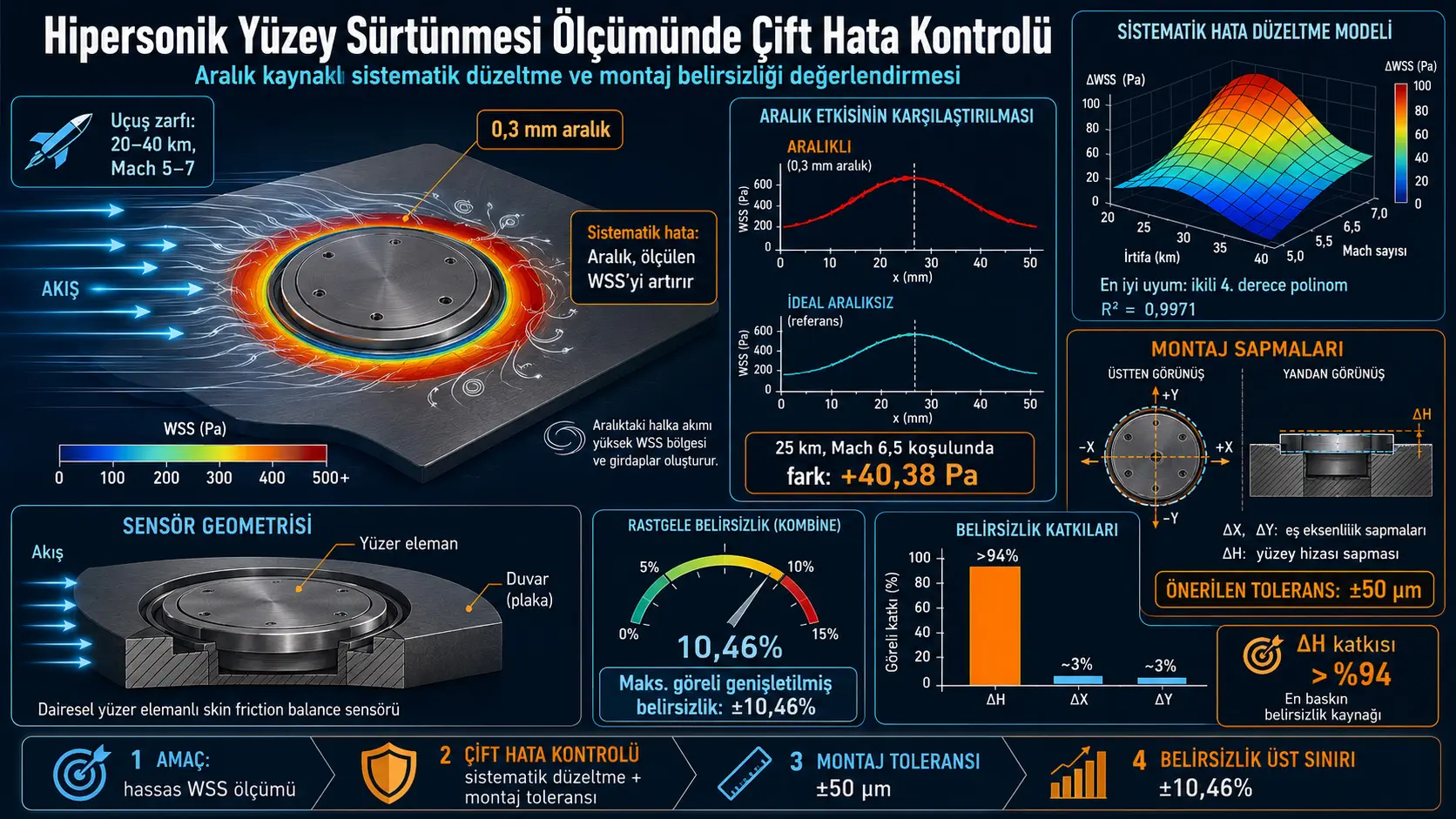
Ин таҳқиқот ду манбаи асосии хатогиро дар тарозуҳои соиши сатҳии дорои элементи шинокунанда, ки барои ченкунии мустақими shear stress-и девор дар ҷараёнҳои гиперсадоӣ истифода мешаванд, дар як усули ягона баррасӣ мекунад. Муҳаққиқон хатои систематикиеро, ки фосилаи сохтории 0,3 mm байни элементи шинокунанда ва девори гирди он ба вуҷуд меорад, дар 25 шароити ҳисобии ҷараён дар баландии 20–40 km ва Mach 5–7 модел кардаанд; инчунин deviations-и coaxiality дар самтҳои X ва Y ва deviation-и surface alignment дар самти H-ро, ки ҳангоми монтаж ба вуҷуд меоянд, бо усули Type B uncertainty арзёбӣ кардаанд. Модели беҳтарини хатои систематикӣ ҳамчун polynomial-и дутағйирёбандаи дараҷаи чорум муайян шуда, дар зери монтаж tolerance-и тавсияшудаи ±50 µm, highest relative expanded uncertainty дар тамоми flight envelope ±%10,46 ҳисоб шудааст. Бо вуҷуди ин, study preprint аст ва peer review нашудааст; натиҷаҳо дар ҳамон sensor дар real hypersonic wind tunnel experimentally validated нашудаанд ва coefficients-и correction polynomial дар published text дода нашудаанд.
Натиҷаҳои model нишон медиҳанд, ки gap-и гирди measurement element ҷараёнро ба cavity мекашад, recirculating cavity flow ташкил мекунад ва дар edge-и floating element ring-shaped high wall shear stress ба вуҷуд меорад. Дар 25 km altitude ва Mach 6,5, gap-и 0,3 mm wall shear stress-ро дар measurement point то 40,38 Pa зиёд карда, overestimation-и назаррас ба вуҷуд овардааст. Дар байни installation deviations critical component deviation-и ΔH мебошад, ки floating element-ро above or below wall plane нишон медиҳад; contribution-и он ба total random uncertainty дар examined conditions аз %94,44 то %98,46 тағйир ёфтааст.
Саволи асосии таҳқиқот чист?
Саволи асосӣ ин аст, ки оё structural-gap error ва measurement uncertainty аз installation deviations дар hypersonic skin-friction balances метавонанд дар як framework-и precision management идора шаванд. Study ду намуди хатогиро ҷудо мекунад:
- Хатои систематикӣ: Structural gap байни floating measurement element ва fixed wall ҷараёнро пайваста ва дар direction-и муайян тағйир медиҳад.
- Хатои тасодуфӣ ё uncertainty: Position deviations дар X, Y ва H ҳангоми sensor installation натиҷаи measurement-ро тағйир медиҳанд.
Systematic error метавонад бо subtraction-и correction value compensate шавад. Installation deviations бошад дар ҳар setup value-и якхела надоранд, бинобар ин study онҳоро на ҳамчун directly “corrected” error, балки ҳамчун component-и bounded by tolerance ва propagated into uncertainty budget баррасӣ мекунад.
Чаро wall shear stress муҳим аст?
Wall shear stress (WSS) қувваи friction-и fluid ба vehicle surface дар tangential direction барои unit area мебошад ва бо pascal ифода мешавад. Дар hypersonic vehicles, accurate determination-и ин quantity барои skin-friction drag, surface heating, boundary-layer behavior, range prediction ва drag-reduction design муҳим аст.
Indirect methods кӯшиш мекунанд WSS-ро аз velocity profile ё empirical correlations бароранд, floating-element friction balance бошад tangential force on surface-ро directly through mechanical structure ҳис мекунад. Аммо small gap, ки барои movement-и measurement element лозим аст, худи flow-и ченшавандаро тағйир медиҳад. Аз ин рӯ sensor танҳо passive measuring element нест; он geometry мебошад, ки ба local flow field дахолат мекунад.
Кадом gap дар literature ҳадаф гирифта шудааст?
Previous studies effects-и gap size, surface alignment deviation ё coaxiality error-ро аксаран separately омӯхтаанд. Баъзе studies гузориш доданд, ки floating element above wall метавонад measurement error-ро аз %100 зиёд кунад, дигар studies нишон доданд, ки бо widening of gap cavity suction ва measurement deviation зиёд мешаванд.
Ин study барои specific hypersonic friction-balance geometry ду deficiency-ро ҳадаф мегирад. Якум, systematic error-и structural gap на дар single flow condition, балки дар full altitude–Mach envelope correction мешавад. Дуюм, X ва Y coaxiality deviations бо H surface-alignment deviation jointly evaluated шуда, installation tolerance ва expanded uncertainty муайян мегарданд.
Numerical wind tunnel чӣ гуна сохта шудааст?
Дарозии three-dimensional computational domain дар flow direction 5000 mm, width ва height 1000 mm интихоб шудааст. Friction balance аз inlet boundary 2500 mm поёнтар ва аз leading edge-и mounting plate 500 mm қафотар ҷойгир шудааст. Ин layout барои developing boundary layer пеш аз расидан ба sensor интихоб шудааст.
Floating element diameter 20 mm, total balance height 70 mm ва gap байни element ва wall 0,3 mm аст. Барои systematic-error calculation ҳамин geometry дар ду шакл модел шудааст: 0,3 mm physical-gap model ва ideal no-gap model. Difference-и WSS байни ин ду solution ҳамчун gap-induced correction истифода шудааст.
Installation deviations дар се direction муайян шудаанд:
- ΔX: Horizontal position deviation-и floating element дар flow direction.
- ΔY: Coaxiality deviation дар horizontal direction perpendicular to flow.
- ΔH: Element above or below wall surface; яъне surface-alignment deviation.
Дар баъзе sections барои ΔH term-и “flatness”, дар дигар sections “flushness” истифода шудааст. Diagrams ва physical explanations нишон медиҳанд, ки variable vertical position-и floating element relative to wall plane-ро ифода мекунад.
Кадом flight conditions омӯхта шудаанд?
Base flight envelope 25 condition-ро дар бар мегирад, ки аз combination-и altitudes 20, 25, 30, 35 ва 40 km бо speeds Mach 5, 5,5, 6, 6,5 ва 7 сохта шудааст. Atmospheric pressure ва temperature values аз NRLMSIS 2.0 atmospheric model гирифта шудаанд.
| Баландӣ | Static pressure | Static temperature |
|---|---|---|
| 20 km | 5357,25 Pa | 211,6 K |
| 25 km | 2433,95 Pa | 219,1 K |
| 30 km | 1138,74 Pa | 231,1 K |
| 35 km | 544,61 Pa | 235,1 K |
| 40 km | 269,47 Pa | 243,2 K |
Wall ҳамчун no-slip ва constant 300 K муайян шудааст, outlet boundary pressure outlet мебошад. Solutions бо steady implicit solver иҷро шудаанд ва temperature-dependent viscosity бо Sutherland law ҳисоб шудааст.
Turbulence ва mesh чӣ гуна баррасӣ шудаанд?
Hypersonic boundary layer ва WSS distribution бо k–ω SST turbulence model ҳисоб шудааст. Height-и first mesh layer nearest wall 2 × 10⁻⁵ m интихоб шуда, dimensionless wall distance тақрибан \(y^+ \approx 1\) нигоҳ дошта шудааст. Ин value барои resolving near-wall velocity gradient бе excessive dependence on wall functions истифода шудааст.
Барои capture-и sharp velocity ва pressure changes дар gap region unstructured mesh ва local refinement истифода шудааст. Supplementary Figure S1 нишон медиҳад, ки бо increasing cell count WSS values дар gap ва no-gap models баъд аз density-и муайян танҳо changes-и хурд доранд. Researchers mesh-и plateau region-ро ҳамчун compromise байни computational cost ва result stability интихоб кардаанд.
Validation бо reference-temperature method
WSS prediction-и no-gap model бо reference-temperature method барои high-speed boundary layers муқоиса шудааст. Дар study wall ё recovery temperature чунин ҳисоб мешавад:
\[ T_{\omega}=T_e\left(1+r\frac{\gamma-1}{2}Ma^2\right) \]
Дар ин ҷо \(T_{\omega}\) wall ё recovery temperature, \(T_e\) free-stream static temperature, \(r\) recovery coefficient, \(\gamma\) specific-heat ratio ва \(Ma\) Mach number мебошанд. Study барои \(r\) тақрибан 0,85 ва барои air \(\gamma\) тақрибан 1,4 истифода кардааст.
Reference-temperature relation:
\[ \frac{T^*}{T_e}=1+0.039Ma^2+0.5\left(\frac{T_{\omega}}{T_e}-1\right) \]
\(T^*\) reference temperature аст, ки properties мисли density ва viscosity дар он evaluated мешаванд. Reference Reynolds number:
\[ Re_L^*=\frac{\rho^*U_eL}{\mu^*} \]
\(\rho^*\) density at reference temperature, \(U_e\) free-stream velocity, \(L\) characteristic length ва \(\mu^*\) dynamic viscosity at reference temperature мебошанд.
Reference friction coefficient:
\[ C_f^*=\frac{0.664}{\sqrt{Re_L^*}} \]
Final expression барои WSS:
\[ \tau_{\omega}=\frac{1}{2}\frac{\rho^*}{\rho}\frac{\mu^*}{\mu}C_f^*\rho U_e^2 \]
Дар ин ҷо \(\tau_{\omega}\) wall shear stress бо pascal, \(\rho\) ва \(\mu\) actual flow density ва dynamic viscosity мебошанд.
Дар 25 km ва Mach 6 numerical model 62,94 Pa ва reference-temperature method 64,93 Pa WSS додааст. Difference-и тақрибан %3,05 ҳамчун basic validation indicator барои no-gap model пешниҳод шудааст.
Comparison-и friction coefficient
Барои кам кардани effect-и different free-stream dynamic pressures dimensionless skin-friction coefficient истифода шудааст:
\[ C_f=\frac{\tau_{\omega}}{\frac{1}{2}\rho U_e^2} \]
Дар 25 km ва Mach 6 calculated value \(C_f=1.56\times10^{-3}\) мебошад. Supplementary table reported values барои similar turbulent hypersonic conditions-ро дар levels-и \(1.16\times10^{-3}\), \(1.69\times10^{-3}\) ва approximately \(1.7\times10^{-3}\) нишон медиҳад. Current calculation within this range мемонад.
Дар paper зери Equation 7 variable-и \(q_e\) ҳамчун “dynamic pressure” таъриф шудааст, вале mathematical expression exactly formula-и \(C_f\)-ро такрор мекунад:
\[ q_e=\frac{\tau_{\omega}}{\frac{1}{2}\rho U_e^2} \]
Ин expression dimensionless ratio медиҳад, дар ҳоле ки unit-и dynamic pressure бояд pascal бошад. Аз ин рӯ байни Equation 7 ва following text symbol/equation inconsistency-и равшан вуҷуд дорад. Ба ҷойи silent correction, ин technical issue бояд дар interpretation-и results ба назар гирифта шавад.
Gap чӣ гуна systematic error ба вуҷуд овард?
Streamlines дар 25 km ва Mach 6,5 нишон медиҳанд, ки portion-и main flow аз сабаби pressure difference ба 0,3 mm gap кашида мешавад. Flow дар cavity зери floating element recirculating structure месозад ва аз opposite side боз ба main flow мепайвандад.
Ин cavity flow дар атрофи element ring-shaped high-WSS region ба вуҷуд овард. Дар Figure 2 highest parts-и ring бо red ва yellow, lower-stress area дар center-и element бо blue shades нишон дода шудаанд. Difference байни gap ва no-gap solution дар measurement location 40,38 Pa аст. Ин positive difference sensor-ро водор мекунад, ки real wall friction-ро overestimate кунад.
Systematic error чӣ гуна таъриф шудааст?
Gap-induced absolute error чунин:
\[ \Delta WSS=WSS_{\mathrm{meas}}-WSS_{\mathrm{true}} \]
\(WSS_{\mathrm{meas}}\) аз 0,3 mm-gap sensor model ва \(WSS_{\mathrm{true}}\) аз ideal no-gap model гирифта мешавад. Researchers absolute difference in pascal-ро, на error ratio-ро, modeled кардаанд. Сабаб ин аст, ки real WSS бо altitude ва Mach number хеле тағйир меёбад ва relative error дар small true values artificially magnified шуда метавонад.
Чаро fourth-degree polynomial интихоб шуд?
Барои modeling nonlinear combined effect-и altitude ва Mach number ба gap error, bivariate third-, fourth- ва fifth-degree polynomials муқоиса шудаанд.
| Model | Шумораи terms | R² | Adjusted R² | RMSE | AIC | BIC |
|---|---|---|---|---|---|---|
| Bivariate third degree | 10 | 0,9914 | 0,9862 | 1,5987 Pa | 43,46 | 55,65 |
| Bivariate fourth degree | 15 | 0,9971 | 0,9931 | 0,9212 Pa | 25,90 | 44,18 |
| Bivariate fifth degree | 21 | 0,9322 | 0,5932 | 4,4804 Pa | 116,99 | 142,58 |
Fourth-degree model highest R² ва adjusted R², lowest RMSE ва lowest information criteria дод. Дар fifth-degree model, despite more terms, adjusted R² то 0,5932 поён ва RMSE то 4,4804 Pa боло рафт; ин ҳамчун overfitting interpretation шуд.
Model ба ғайр аз 25 base conditions бо four validation points: 22 km–Mach 5,2; 26 km–Mach 5,8; 33 km–Mach 6,2 ва 37 km–Mach 6,7 санҷида шудааст. Дар Figure 3 validation points near surface ва residuals around zero нишон дода шудаанд.
Аммо uploaded version 15 coefficients-и bivariate fourth-degree polynomial-ро намедиҳад. Бинобар ин reader cannot independently reproduce reported correction surface using only altitude and Mach number. Performance metrics model selection-ро support мекунанд, вале missing coefficients reproducibility-ро маҳдуд мекунанд.
Measurement model барои installation deviations
Installation-induced changes бо general model:
\[ \tau=f(X,Y,H)=\tau_0+C_XX+C_YY+C_HH+C_{XY}XY+C_{XYH}XYH \]
\(\tau_0\) WSS дар no-installation-deviation condition аст. \(C_X\), \(C_Y\) ва \(C_H\) sensitivity of WSS ба unit position change дар respective directions мебошанд. \(C_{XY}\) ва \(C_{XYH}\) interaction terms ҳангоми simultaneous deviations мебошанд.
Text unit-и ҳамаи interaction coefficients-ро “Pa/mm” мегӯяд. Аммо \(XY\) term dimension-и mm² ва \(XYH\) term mm³ дорад. Аз ин рӯ dimensions-и \(C_{XY}\) ва \(C_{XYH}\) бояд separately explained шаванд; current version ин dimensional distinction-ро намедиҳад.
Type B standard uncertainty чӣ гуна ҳисоб шудааст?
Ҳар installation deviation assumed шудааст, ки байни \(-a\) ва \(+a\) uniform distribution бо equal probability дорад. Standard uncertainty:
\[ u(X)=u(Y)=u(H)=\frac{a}{\sqrt{3}} \]
Дар ин ҷо \(a\) half-width of installation tolerance in micrometers аст. Масалан, барои ±50 µm tolerance \(a=50\) µm.
Sensitivity coefficients бо partial derivatives муайян шудаанд:
\[ C_X=\frac{\partial \tau}{\partial X},\qquad C_Y=\frac{\partial \tau}{\partial Y},\qquad C_H=\frac{\partial \tau}{\partial H} \]
\[ C_{XY}=\frac{\partial^2\tau}{\partial X\partial Y} \]
\[ C_{XYH}=\frac{\partial^3\tau}{\partial X\partial Y\partial H} \]
Single-direction standard uncertainty components:
\[ u_X(\tau)=|C_X|u(X),\qquad u_Y(\tau)=|C_Y|u(Y),\qquad u_H(\tau)=|C_H|u(H) \]
Interaction components:
\[ u_{XY}(\tau)=|C_{XY}|u(X)u(Y) \]
\[ u_{XYH}(\tau)=|C_{XYH}|u(X)u(Y)u(H) \]
Combined standard uncertainty бо root-sum-of-squares:
\[ u_c(\tau)=\sqrt{u_X^2+u_Y^2+u_H^2+u_{XY}^2+u_{XYH}^2} \]
Барои approximately %95 coverage \(k=2\) қабул шуда, expanded uncertainty:
\[ U=k\,u_c(\tau) \]
Result чунин report шудааст:
\[ \tau=\tau_0\pm U\qquad(k=2) \]
Дар 30 km ва Mach 6 кадом deviation таъсирноктарин аст?
ΔH аз X ва Y хеле stronger effect нишон дод. Positive ΔH floating element-ро above wall мебардорад ва protrusion дар leading edge-и boundary layer месозад. Flow around this protrusion accelerates ва measured WSS markedly increases. Negative ΔH element-ро below wall plane мебарад ва small depression месозад; local deceleration ва recirculation метавонанд WSS-ро кам кунанд.
Negative ΔX leading edge-и element-ро upstream мебарад, boundary layer-ро earlier disturbs ва larger error than positive ΔX медиҳад. Effect-и Y deviation аз сабаби geometric symmetry дар positive ва negative directions якхела assumed шудааст.
Барои keeping single-direction error approximately within ±%10, ±50 µm installation tolerance барои all directions тавсия шудааст. Дар ин condition, барои 30 km ва Mach 6 expanded uncertainty ±4,94 Pa ва relative expanded uncertainty ±%9,63 ҳисоб шудааст.
Оё deviations-ро independent ҳисобидан мумкин аст?
Дар 30 km ва Mach 6 maximum coupling strength-и X–Y coaxiality interaction %8,75 ва maximum coupling байни coaxiality ва H surface alignment %6,61 report шудааст. Researchers ин levels-ро weak coupling interpretation карда, uncertainty components-ро бо root-sum-of-squares based on linear sensitivities combine кардаанд.
Ин маънои zero interaction надорад. Claim ин аст, ки interaction terms дар examined tolerance ва flight conditions аз main single-direction effects хурдтаранд. Барои larger installation errors ё different sensor geometries validity-и ҳамин assumption нишон дода нашудааст.
Uncertainty дар full flight envelope
Recommended ±50 µm tolerance дар three representative conditions — low-altitude/high-speed, medium condition ва high-altitude/low-speed — detailed evaluated шудааст.
| Condition | Altitude ва speed | Calculated WSS | Expanded uncertainty | Relative uncertainty |
|---|---|---|---|---|
| 1 | 20 km, Mach 7 | 204,67 Pa | ±21,41 Pa | ±%10,46 |
| 2 | 30 km, Mach 6 | 51,32 Pa | ±4,94 Pa | ±%9,63 |
| 3 | 40 km, Mach 5 | 18,06 Pa | Тақрибан ±1,52 Pa | Тақрибан ±%8,42 |
Дар ҳамаи conditions highest single-direction installation error %8,83 буд. Highest total relative uncertainty дар 20 km–Mach 7, ки dynamic pressure higher ва boundary layer thinner аст, пайдо шуд.
Coupling strength дар boundary conditions то %15,41 дар low-altitude/high-speed ва то %9,52 дар high-altitude/low-speed report шудааст. Дар low altitude ва high speed small geometric deviations local flow field-ро stronger тағйир медиҳанд, бинобар ин coupling афзудааст.
Кадом direction дар uncertainty budget dominates?
| Flight condition | ΔX contribution | ΔY contribution | ΔH contribution |
|---|---|---|---|
| 20 km, Mach 7 | %2,40 | %3,16 | %94,44 |
| 30 km, Mach 6 | %1,73 | %0,53 | %97,74 |
| 40 km, Mach 5 | %1,49 | %0,05 | %98,46 |
Ин distribution нишон медиҳад, ки critical control ҳангоми installation нигоҳ доштани floating element дар same plane as wall мебошад. X ва Y coaxiality adjustments набояд ignore шаванд, аммо дар examined geometry ва tolerance range қисми асосии total uncertainty аз ΔH меояд.
Ҷиҳатҳои қавии study
- Systematic gap error ва installation uncertainty-ро дар single measurement-accuracy framework якҷо кардааст.
- Parametric flight envelope бо 25 conditions дар 20–40 km ва Mach 5–7 истифода шудааст.
- Gap ва no-gap geometries directly compared шудаанд.
- Mesh бо \(y^+\approx1\) near wall, local refinement ва mesh-independence study истифода шудааст.
- Numerical results ҳам бо reference-temperature method ва ҳам published turbulent wind-tunnel/CFD results муқоиса шудаанд.
- Polynomial degree на танҳо бо R², балки adjusted R², RMSE, AIC ва BIC интихоб шудааст.
- Directional contributions of uncertainty components separately calculated шуда, installation priority муайян шудааст.
Маҳдудиятҳо
- Study preprint аст ва peer review нашудааст.
- Proposed system дар ҳамон sensor бо physical hypersonic wind-tunnel experiment validated нашудааст.
- Correction model танҳо ба 0,3 mm gap, 20 mm floating element ва specific geometry тааллуқ дорад.
- Bivariate fourth-degree polynomial coefficients дода нашудаанд, бинобар ин correction function independently reusable нест.
- Дар Equation 7 definition of dynamic pressure бо written mathematical expression мувофиқат намекунад.
- Units-и sensitivity coefficients барои product terms dimensionally detailed нашудаанд.
- Wall isothermal at 300 K assumed шудааст; effect-и aerodynamic-heating-induced wall-temperature changes ба measurement error арзёбӣ нашудааст.
- Steady RANS ва k–ω SST истифода шудаанд; transition, shock–boundary-layer interaction, time-dependent vibrations ва model-form uncertainty separately accounted нашудаанд.
- Type B calculation assumes uniform distribution of installation deviations; real manufacturing ва installation distributions measured нашудаанд.
- Type A statistical uncertainty аз repeated physical measurements арзёбӣ нашудааст.
- Literature comparisons similar, вале not identical sensor, geometry ва free-stream conditions мебошанд.
Study чиро дастгирӣ мекунад?
Study support мекунад, ки дар specific floating-element hypersonic friction balance 0,3 mm circumferential gap метавонад WSS-ро systematically overestimate кунад. Simulations ҳамчунин нишон медиҳанд, ки ±50 µm installation tolerance метавонад single-direction installation errors-ро approximately within ±%10 дар examined envelope нигоҳ дорад ва main component of uncertainty budget ΔH surface-alignment deviation аст.
Study ҳамчунин нишон медиҳад, ки systematic-error correction метавонад ҳамчун nonlinear surface dependent on altitude ва Mach number modeled шавад ва random installation uncertainty бо Type B approach ба measurement result илова шавад.
Study чиро исбот намекунад?
Research исбот намекунад, ки recommended ±50 µm tolerance барои all skin-friction sensors universal аст. Results directly transferable нестанд ба different element diameters, gap sizes, cavity geometries, laminar flows ё conditions beyond Mach 7.
Study инчунин нишон намедиҳад, ки total measurement error дар real wind-tunnel installation definitely below ±%10,46 мемонад. Reported value expanded uncertainty аст, ки зери numerical model, uniform-distribution assumption, identified sensitivity coefficients ва only examined installation components ҳисоб шудааст. Other error sources мисли sensor electronics, temperature drift, vibration, calibration, material behavior ва repeatability дар current calculation нестанд.
Аҳамияти эҳтимолӣ барои Туркия
Method-и study барои research groups дар Türkiye, ки hypersonic wind tunnels, high-speed aerodynamic test systems, micro-force sensors, MEMS measurement elements ва missile ё spacecraft surface tests таҳия мекунанд, transferable approach медиҳад. Important transferable result specific ±50 µm value нест, балки numerical mapping-и systematic error аз sensor geometry ва determining installation tolerance together with uncertainty budget мебошад.
Барои applying same method ба local sensor design, real sensor geometry developed in Türkiye, real gap value ва wind-tunnel operating envelope бояд remodelling шаванд. Numerical correction surface баъд аз physical calibration experiments validated шуда, метавонад ба measurement software ё post-test data-processing chain ворид шавад.
Усул ва бозёфтҳои таҳқиқот
| Method component | Applied condition | Main result | Interpretation limit |
|---|---|---|---|
| Computational domain | 5000 × 1000 × 1000 mm three-dimensional domain | Sensor 2500 mm from inlet, 500 mm behind plate leading edge | Specific flat plate ва sensor placement |
| Sensor geometry | 20 mm floating element, 70 mm total height, 0,3 mm gap | Gap ва ideal no-gap models compared | Not directly generalizable to other gaps/elements |
| Flow envelope | 20–40 km, Mach 5–7, 25 base conditions | Error surface dependent on altitude/Mach created | Outside envelope not tested |
| Flow model | Steady RANS, k–ω SST, Sutherland viscosity law | Hypersonic turbulent boundary layer ва WSS calculated | Transition/time-dependent effects separately not modeled |
| Wall ва outlet | No-slip, 300 K isothermal wall; pressure outlet | Standardized numerical wind tunnel | Aerodynamic-heating wall behavior not represented |
| Mesh resolution | First layer 2 × 10⁻⁵ m, \(y^+\approx1\), local refinement | Stable WSS after mesh independence | Does not remove model-form error |
| Basic validation | 25 km, Mach 6 | 62,94 Pa CFD; 64,93 Pa reference method; %3,05 difference | Not physical experiment on same sensor |
| Gap effect | 25 km, Mach 6,5; 0,3 mm gap | +40,38 Pa systematic difference at measurement point | Condition-specific |
| Correction model | Bivariate fourth-degree polynomial | R² 0,9971; adjusted R² 0,9931; RMSE 0,9212 Pa | Polynomial coefficients absent |
| Installation tolerance | ±50 µm for ΔX, ΔY ва ΔH | Single-direction error max %8,83 across envelope | Depends on uniform distribution/specific geometry |
| Mid-condition uncertainty | 30 km, Mach 6 | 51,32 ± 4,94 Pa; relative ±%9,63 | Only selected installation components |
| Maximum uncertainty | 20 km, Mach 7 | 204,67 ± 21,41 Pa; relative ±%10,46 | Low-altitude/high-speed condition |
| Error priority | Directional contributions in three conditions | ΔH contribution %94,44–%98,46 | May change for other geometries |
Муҳимтарин engineering implications
- Gap around floating element is not only mechanical necessity, but flow geometry that directly interferes with measurement.
- Gap error should be treated not as one fixed percentage but as correction surface dependent on altitude and Mach number.
- Tightest installation control should be applied in ΔH direction to keep floating element flush with wall.
- Numerical correction model should not be transferred directly to production measurement system without real wind-tunnel calibration and open polynomial coefficients.
- Electronics, thermal, calibration ва repeatability uncertainties should also be added to total measurement budget.
Ёддошти манбаъ ва усул
Номи аслии study: An Integrated Dual-Error Control Method for Hypersonic Skin Friction Balance: Gap-Induced Systematic Correction and Installation Uncertainty Evaluation
Муаллифон ва тартиби дуруст: Xiaohan Liao, Hongxiao Chao, Xuefeng Chen, Diao Yang, Xiaosong Wang, Xiaohu Zhang, Yong Zhou, Yong He, Yongcai Guo.
Equal first author: Equal first authorship ё co-first authorship нишон дода нашудааст. “equal” expressions дар author-contribution table specific contribution roles-ро нишон медиҳанд, not equal-first-authorship declaration.
Corresponding authors: Yong He ва Yongcai Guo.
Institutional affiliations:
- Key Laboratory of Optoelectronic Technology and Systems of the Education Ministry of China, College of Optoelectronic Engineering, Chongqing University, Chongqing, China.
- Northwest Institute of Mechanical and Electrical Engineering, China.
Publication/preprint platform: SSRN.
Official source:SSRN study page
Journal: Peer-reviewed journal publication not verified.
Original publisher: Separate peer-reviewed journal publisher вуҷуд надорад. Study дар SSRN preprint platform аст; final published version not verified.
Publication year: 2026.
Peer-review status: Study preprint аст ва peer reviewed нашудааст.
Source type: Engineering preprint бо three-dimensional numerical flow modeling, systematic-error correction ва Type B uncertainty evaluation.
Funding: National Natural Science Foundation of China, grant 92471207 ва Fundamental Research Funds for Central Universities, grant 2024CDJGF020.
Conflict of interest: Authors report no financial conflict of interest.
Data status: Authors state supporting data are in article and supplementary files. Аммо uploaded version selected fourth-degree correction-polynomial coefficients ва detailed solver input files-ро надорад.
Ин шарҳи тоҷикӣ аз uploaded 33-page study, text, equations, figures, tables, mesh-independence study, validation comparisons ва uncertainty results омода шудааст. Scientific findings absent from study илова нашудаанд. External checking танҳо барои title, DOI, SSRN record ва publication identity истифода шудааст.
Main limits: peer review нашудааст, experimental hypersonic validation on real sensor вуҷуд надорад, polynomial coefficients missing, Equation 7 dynamic-pressure inconsistency, incomplete units for interaction coefficients ва uncertainty calculation only selected installation deviations-ро covers мекунад.
Results барои same sensor geometry ва computational envelope methodological value доранд. Proposed correction model ва ±50 µm tolerance бояд бе experimental validation ба different friction balances ё real flight systems directly transferred нашаванд.
Шарҳ гузоред
Нишонии почтаи электронии шумо нашр намешавад. Майдонҳои ҳатмӣ бо * нишон дода шудаанд