

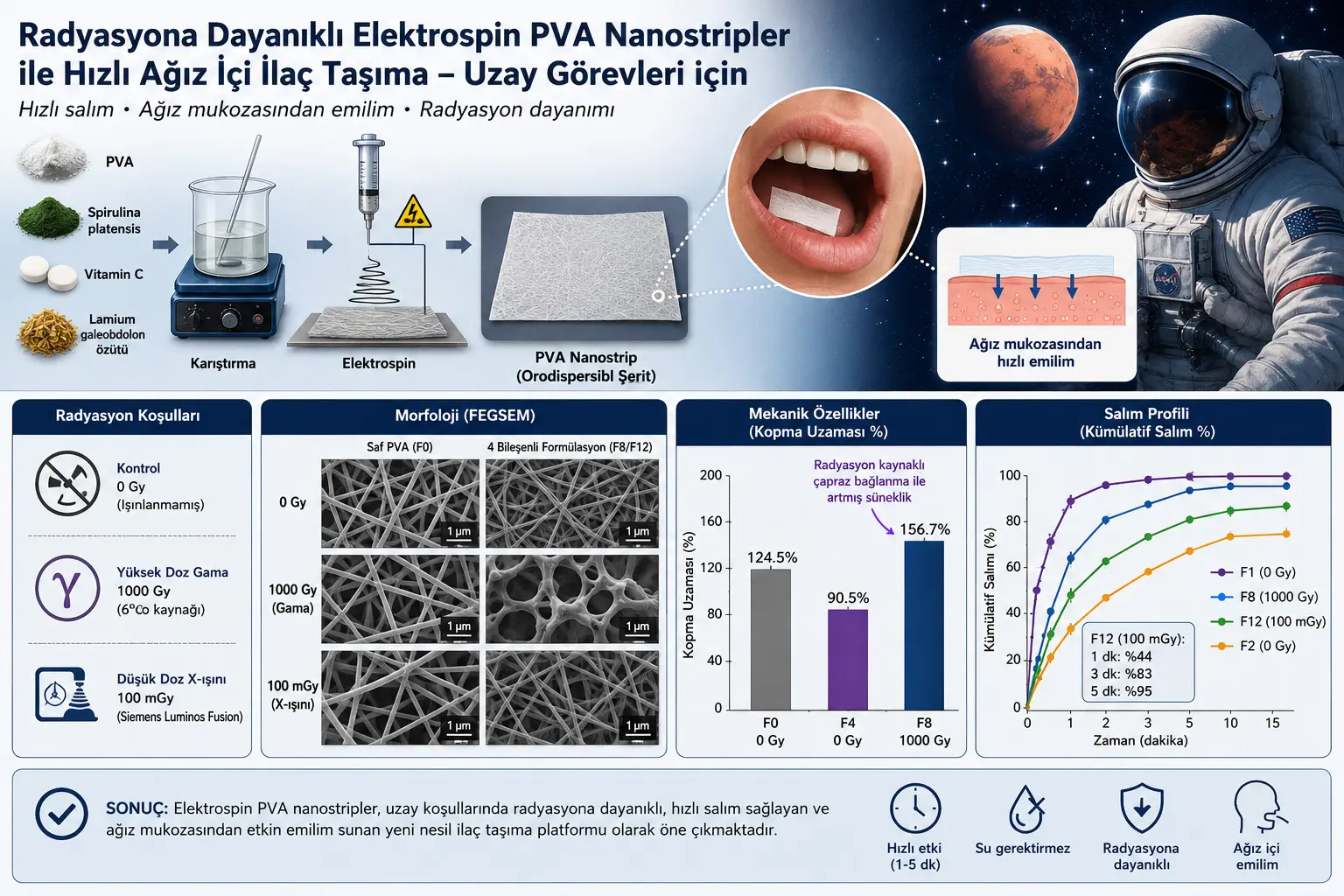
Ин мақола бар таҳқиқоти preprint-и Gulseren Sakarya, Erdi Bulus, Ahmet Umit Sahin, Okan Sar, Caglar Sivri ва Adnan Corum бо унвони “Radiation-Induced Structure-Duct Decomposition in Electrospun PVA Nanostrips for Rapid Intraoral Drug Delivery in Deep Space Missions” асос ёфтааст. Таҳқиқот аз ин идея оғоз мекунад, ки дар long-duration space missions gastrointestinal dysfunction ва cumulative ionizing radiation метавонанд reliability-и classic oral drug administration-ро кам кунанд; аз ин рӯ он ҳадаф дорад nanostrips-и very rapidly dissolving таҳия кунад, ки directly through oral mucosa absorb шуда тавонанд.
Дар research як orodispersible nanostrip system дар асоси poly(vinyl alcohol), яъне PVA, бо electrospinning истеҳсол шудааст ва барои rapid dissolution in mouth пешбинӣ шудааст. Ба strips ҳамчун biologically active components vitamin C, Spirulina platensis ва extract-и Lamium galeobdolon илова шудаанд. Formulations under three conditions evaluated шуданд: nonirradiated control group, low-dose 100 mGy X-ray group ва extreme-stress-test 1000 Gy gamma radiation group.
Most striking result ин аст, ки under high-dose gamma radiation баъзе nanofiber strips бо вуҷуди severe morphological deterioration unexpected mechanical flexibility нигоҳ доштанд. Specifically four-component gamma-irradiated F8 formulation, despite collapse of fiber structure, reached elongation at break of %156,7; this exceeded both pure PVA level of %124,5 ва nonirradiated version F4 of same formulation with %90,5. Researchers relate this to radiation-induced cross-linking occurring alongside chain scission.
Another important finding is that formulations containing Spirulina appeared more resistant to gamma radiation. Microstructural analyses suggest Spirulina-containing systems preserved fiber architecture better than pure PVA, possibly because phycocyanin and other antioxidant components in Spirulina scavenged free radicals. In release kinetics, low-dose X-ray-exposed four-component F12 stood out: it reached cumulative release of дар 1 дақиқа %44, дар 3 дақиқа %83, and дар 5 дақиқа %95.
This study is an experimental materials/carrier investigation proposing a radiation-resistant, rapidly dissolving intraoral drug-delivery platform for extreme conditions such as deep-space missions, completely bypassing the gastrointestinal system. Therefore findings are not direct evidence of clinical use; in vivo efficacy in humans, dose validation and long-term space-simulated stability have not yet been completed.
Дар long-duration space missions transporting medicines ва maintaining reliable efficacy may not always be solved with classic pharmacy logic used on Earth. Study starts from two fundamental problems. First, gastrointestinal functions in astronauts may be disrupted under microgravity; second, ionizing radiation encountered in deep space may gradually degrade pharmaceutical formulations.
Source study emphasizes that during long missions problems such as changed gastric motility, reduced splanchnic blood flow and disrupted gut microbiota can reduce bioavailability of classic oral drugs. Even if tablet or capsule is swallowed, it may not dissolve at expected speed, absorption may be delayed or vary between individuals. In emergencies during space missions such delay can be serious.
Second problem is radiation. During deep-space missions drugs and drug-delivery systems may be exposed to ionizing radiation for long periods. Study notes cumulative dose during roughly three-year Mars mission may be around ~1 Gy. Researchers also used a much higher dose, 1000 Gy, as an extreme “worst-case” stress test. Aim was not only to mimic realistic mission doses, but to reveal structural and mechanical limits of material.
Чаро ин problem important аст?
In space medicine, not only drug content but also carrier, delivery speed and absorption route become critical. Astronaut may have difficulty drinking water, swallowing or gastrointestinal absorption may change, and in emergencies minutes matter. Therefore buccal systems that dissolve rapidly without water and absorb directly through cheek mucosa can offer major advantages.
Main advantages of such system include:
- Absorbing drug through oral mucosa without sending it through gastrointestinal tract,
- Partially avoiding first-pass metabolism,
- Providing basis for effect within very short 1–5 minute period,
- Requiring no water,
- Offering ease of emergency use in difficult environments such as microgravity.
Thus study is not only developing a new polymer material; it tests a delivery form that could alter drug-use paradigm in space missions. It evaluates this not only for rapid dissolution, but also for structural resistance to radiation.
Scientific gap addressed by research чист?
According to study, knowledge about behavior of PVA-based electrospun nanofibers under radiation is limited and contradictory. Specifically, it is unclear whether gamma irradiation produces mainly chain scission or cross-linking in PVA, how this changes with dose, and how morphology, mechanical behavior and drug release in nanofibrous structure respond.
Study also notes lack of systematic evaluation of whether antioxidant or biologically active additives such as vitamin C, Spirulina and plant extract can modulate radiation effects. Authors emphasize especially this point: A nanofiber system may look morphologically damaged but still remain highly flexible and functional mechanically. In other words, visual collapse and mechanical performance are not always the same thing. This is one of the most novel claims of study.
System-и developed чист?
System developed is a PVA-based orodispersible nanostrip, a rapidly dissolving nanofiber strip in mouth. PVA is biocompatible, hydrophilic, rapidly soluble and suitable for electrospinning. Because electrospinning produces very fine fibers, surface area is large, supporting rapid dissolution and release.
Biologically active components used in strips are:
- Vitamin C
- Spirulina platensis extract
- Lamium galeobdolon, or Yellow Archangel, extract
These components were added to PVA matrix in single, double, triple and quadruple combinations. Formulation names in paper range from F0 to F12. F0 is pure PVA. F1/F5/F9 contain vitamin C. F2/F6/F10 contain Spirulina. F3/F7/F11 contain vitamin C + Spirulina. F4/F8/F12 are four-component systems containing vitamin C + Spirulina + Yellow Archangel.
Electrospin production чӣ гуна анҷом шуд?
Base polymer solutions in all samples were prepared as %10 (w/v) PVA. Purified water used as solvent. Bioactives added at %1 (w/v). Mixtures homogenized at 60–65°C under continuous magnetic stirring at 500 rpm for approximately 60–65 дақиқа.
Electrospinning used İnovenso NS24XPro system. Needle-to-collector distance kept fixed at 15 cm. Flow rate and voltage adjusted by formulation. For pure PVA, flow rate 2,5 mL/соат, voltage 31 kV; for loaded systems flow rate mostly 3,0 mL/соат, voltage 30–32 kV. Production conditions approximately 25 ± 1°C and %50 ± 5 намии нисбӣ.
Importance of these parameters is that electrospun fiber diameter, porosity, continuity and surface regularity directly depend on voltage, flow, needle-collector distance and solution viscosity. Study shows each additive changes conductivity and viscosity of solution and this is reflected in fiber morphology.
Radiation protocol чӣ гуна сохта шуд?
Study has three main experimental groups:
- Control group: Nonirradiated F0–F4 samples, i.e. 0 Gy.
- Gamma-irradiated group: F5–F8 samples exposed to 1000 Gy using ⁶⁰Co source.
- X-ray group: F9–F12 samples exposed to 100 mGy with Siemens Luminos Fusion.
Gamma irradiation performed at dose rate 5,2 kGy/соат. Authors specifically stress that 1000 Gy was not selected to literally simulate a Mars mission. It is an extreme stress test used to distinguish formulations that might retain function even under severe damage.
Low-dose X-ray protocol represents diagnostic imaging level. Here aim is to determine whether low doses analogous to clinical or in-space biomedical imaging cause notable damage to nanostrip structure. Dose verification performed with TLD-100 thermoluminescent dosimeters and homogeneity verified within ±%5.
Кадом analysis methods истифода шуданд?
Study did not rely on a single test; structure, thermal behavior, morphology, mechanical properties and release kinetics were evaluated together:
- FTIR: Chemical bonds and functional groups.
- DSC: Melting behavior and crystallinity.
- TGA: Thermal degradation and residual mass.
- FEGSEM: Fiber morphology, fiber diameter and network integrity.
- Tensile test: Apparent tensile strength and elongation at break.
- UV-Vis release test: Cumulative release behavior over time.
This multi-layered approach is important because simply saying “it dissolved quickly” is insufficient. Questions of chemical degradation under radiation, fiber collapse, loss of flexibility, thermal weakening and whether release still continues are all addressed together.
FTIR results чиро showed?
Expected characteristic bands of pure PVA were observed: broad O–H stretching around 3280 cm⁻¹, C–H stretching around 2940 cm⁻¹ and C–O stretching peak around 1090 cm⁻¹. For Spirulina, amide I and II bands indicating proteins and polysaccharides were observed around 1650 cm⁻¹ and 1540 cm⁻¹. Yellow Archangel extract showed phenolic/flavonoid-related bands around 1600 cm⁻¹ and 1400 cm⁻¹.
Most important finding was absence of significant new peaks indicating new covalent bond formation or clear chemical degradation products across nonirradiated, 100 mGy X-ray and 1000 Gy gamma groups. Researchers therefore argue morphological collapse seen at high dose is related not to complete chemical destruction of backbone, but mainly physical chain scission, rearrangement and thermal softening.
This is an important distinction. “Shape is damaged” does not mean “chemically completely decomposed.” Study demonstrates chemical stability and morphological stability as distinct dimensions.
DSC analysis чиро told?
DSC analysis performed on selected four formulations: F0, F2, F4 and F8. All showed single endothermic melting peak corresponding to crystalline-amorphous transition of PVA. For pure PVA F0, melting temperature 224,5°C, melting enthalpy 52,4 J/g and degree of crystallinity %37,8.
With bioactive addition these values decreased. For example in nonirradiated four-component F4, melting temperature 219,8°C, melting enthalpy 40,2 J/g and crystallinity %29,0. This suggests vitamin C, Spirulina and Yellow Archangel disrupt regular crystalline regions of PVA through hydrogen-bond interactions.
In contrast, high-dose gamma-exposed F8 crystallinity increased from %29,0’dan %31,4’e. Study explains this by radiation-induced cross-linking. Interesting point is chain scission and cross-linking can occur simultaneously. At high dose initial chain scission may dominate, but generated free radicals can later recombine and contribute to more ordered regions. Researchers argue this molecular rearrangement may increase flexibility even when morphology deteriorates.
TGA results чӣ гуфтанд?
For pure PVA F0, degradation onset temperature was 252°C, maximum degradation-rate temperature 348°C and residual mass at 800°C approximately %9,8. Addition of bioactives reduced thermal stability but increased residual mass.
For example, degradation onset in vitamin-C-containing F1 decreased to 231°C. Spirulina systems showed two-stage degradation: first proteins/polysaccharides, second PVA backbone. Four-component F4 had lowest onset temperature 212°C.
Nevertheless, residual mass at 800°C was %9,8 in pure PVA and %17,6 in F4. Authors attribute this to mineral/pigment residues in Spirulina and phenolic-derived char products in plant extract. Such residues may create thermal-barrier effect. Thus system begins degrading earlier yet leaves more residue at high temperature.
FEGSEM ва fiber-diameter analysis чиро showed?
Pure PVA F0 uniform, bead-free, cylindrical and homogeneous nanofiber network нишон дод. Mean fiber diameter 245 ± 22 nm буд. In vitamin-C-added F1 fiber diameter slightly decreased to 232 ± 31 nm. Study relates this to increased solution conductivity due to ascorbic acid and stronger electrostatic stretching.
In Spirulina-containing F2 fiber diameter increased to 258 ± 42 nm, thought to be associated with increased solution viscosity. In vitamin C + Spirulina F3 mean diameter was 240 ± 29 nm, close to control and interpreted as good compatibility. Four-component F4 had diameter 265 ± 51 nm and more complex network with local fiber fusion.
Within gamma group, most severe deterioration occurred in F5 and F8. Mean fiber diameter was 312 ± 68 nm for F5 and 345 ± 85 nm for F8. FEGSEM showed severe melting, loss of fiber integrity and large voids. In contrast, Spirulina-containing F6 and F7 preserved morphology better. Researchers associate this with radical-scavenging capacity of phycocyanin, chlorophyll derivatives, carotenoids and polyphenols in Spirulina.
In 100 mGy X-ray group, F9–F12 fiber diameters and morphology remained close to nonirradiated counterparts. This suggests low diagnostic-level X-ray dose did not meaningfully damage nanofiber-network integrity.
Mechanical properties чиро showed?
Pure PVA F0 apparent tensile strength was 8,45 ± 0,42 MPa and elongation at break %124,5 ± 8,2. With bioactive addition tensile strength generally decreased. For example apparent strength of F4 decreased to 4,60 ± 0,23 MPa. This was interpreted as weakening of hydrogen bonds between PVA chains.
However the most striking result was elongation at break. Nonirradiated four-component F4 had elongation %90,5, while its 1000 Gy gamma counterpart F8 reached %156,7. Moreover F8 fiber network looked morphologically collapsed. Thus visually “worse” material became mechanically more ductile.
This result points to what researchers call “structure-ductility decoupling,” meaning separation between structural appearance and mechanical ductility. In simple terms, even if fiber architecture breaks down, polymer network may reorganize at molecular scale through cross-links so that material stretches more before breaking. This can be important for flexible drug-delivery systems.
There is also a technical caveat. Paper notes that thickness measurements of electrospun membranes may overestimate true dense-polymer cross-sectional area due to pores. Therefore absolute strength values in MPa are “apparent” values. Researchers stress that more reliable comparison is through elongation at break (%) and force-based interpretations.
Release kinetics чӣ гуна буд?
Release tests performed in PBS at 37 ± 1°C. 1×1 cm strip samples examined at 0, 1, 2, 3, 5, 10 and 15 minutes. UV-Vis used for measurement. Because spectral overlap existed among three bioactives, total integrated release profile was reported rather than absolute individual concentrations. Researchers state they also used different wavelengths and Folin-Ciocalteu test for cross-validation.
All formulations showed biphasic behavior: rapid release in first 1–3 minutes followed by plateau around 5–10 minutes. Vitamin-C-only systems showed fastest release; for example F1, F5 and F9 reported about %68–82 release at 1 minute. Spirulina-only systems were slower, with around %22–30 at 1 minute.
Formulation highlighted for application was F12. It contains %10 PVA + %1 vitamin C + %1 Spirulina + %1 Yellow Archangel and received 100 mGy X-ray. F12 release values were:
- 1. дақиқа: %44 ± 4
- 3. дақиқа: %83 ± 6
- 5. дақиқа: %95 ± 7
This profile was considered compatible with “emergency feeding/application targets.” It provides rapid but balanced release over several minutes rather than excessively abrupt burst release. This is considered useful for emergency intraoral supplementation or drug delivery during space missions.
Муҳимтарин чизе, ки study мегӯяд, чист?
Main contribution is not one result but a layered set of observations:
- PVA-based electrospun nanostrips are suitable for rapid intraoral release.
- Low-dose X-ray does not noticeably disrupt their structure.
- High-dose gamma may cause morphological collapse, but this does not necessarily mean complete loss of mechanical function.
- Spirulina-containing systems may preserve structure better against radiation.
- Four-component low-dose-X-ray formulation F12 stands out as best candidate balancing rapid release and structural stability.
Taken together, study argues for a new-generation drug-delivery platform for extreme environments such as deep space: rapidly dissolving, more radiation-resistant, water-free and bypassing the gastrointestinal tract.
Аҳамияти study аз гузашта, имрӯз ва оянда
Historically oral drug-delivery systems were designed for Earth physiology: tablet reaches stomach, absorption occurs in intestine and storage conditions are relatively stable. Space missions challenge these assumptions. Therefore space medicine must reconsider classic pharmaceutical technologies.
Today study shows that space-specific drug-delivery systems are no longer merely theoretical curiosity but practical need. As deep-space missions lengthen, every material carried for astronaut health must be optimized for radiation, volume, waste, ease of use and speed of effect.
For future, similar systems may be interesting not only for space but also for difficult conditions on Earth. Examples include emergencies without water, need for rapid intraoral drug delivery, patients with impaired gastrointestinal absorption or portable drug systems under extreme environmental conditions. However this does not mean study has proven efficacy in these settings; these are logical future application directions.
Ҷиҳатҳои қавии study
One strength is multi-characterization rather than relying on single parameter. FTIR, DSC, TGA, FEGSEM, mechanical testing and release analysis together allow deeper interpretation.
Second strength is comparing low-dose X-ray and extreme high-dose gamma stress on same platform. Thus both clinical/diagnostic level and worst-case stress level were assessed.
Third strength is demonstrating possible decoupling of morphological collapse from mechanical ductility. This is genuinely interesting for material selection because SEM appearance alone might lead researchers to classify material as “failed,” whereas this study argues that may not always be correct.
Fourth strength is discussion of Spirulina’s radioprotective potential in structural preservation. Better fiber-network preservation in Spirulina-containing samples under high dose suggests biological antioxidant additives may play not only nutritional but also material-protective roles.
Маҳдудиятҳои study
Despite importance, study has limitations. First, system evaluated at in vitro level. Absorption through real oral mucosa, saliva flow, mechanical friction, user comfort, actual drug loading and bioavailability remain unproven.
Second, ingredients are not a licensed drug formulation optimized for specific active-drug dose in conventional sense; rather, work is proof-of-concept for a functional, rapid-release, radiation-resistant carrier platform. Therefore it should not be interpreted as “ready-to-use astronaut product.”
Third, 1000 Gy is far above real mission dose. This is useful for boundary stress testing, but not direct representation of actual space conditions. Structural events observed here may occur at lower magnitude or differently in realistic missions.
Fourth, release tests were interpreted using integrated release of total UV-absorbing species. Researchers state additional tests supported this, but more advanced analytical methods may be needed for precise individual release profiles of each bioactive.
Fifth, study has not undergone peer review. Findings should be read cautiously, especially mechanistic interpretations and future-use claims, and strengthened through independent validation.
Study чӣ мегӯяд ва чӣ намегӯяд?
Study says PVA-based electrospun nanostrips containing vitamin C, Spirulina and Lamium galeobdolon can be evaluated under space-like radiation stress; some formulations remain structurally and mechanically remarkable, and F12 is strong candidate for rapid release.
Study does not conclude platform is safe and effective in humans. It provides no clinical-use approval. It does not demonstrate actual astronaut bioavailability, nor prove product is ready for Mars missions. It also does not establish disease-specific dose or clinical outcome. Therefore work should be viewed as promising experimental material platform, not completed medical product.
Усул ва Натиҷаҳои Таҳқиқот
Formulations used
| Formulation | Content | Irradiation condition |
|---|---|---|
| F0 | %10 PVA | 0 Gy |
| F1 / F5 / F9 | %10 PVA + %1 vitamin C | 0 Gy / 1000 Gy / 100 mGy |
| F2 / F6 / F10 | %10 PVA + %1 Spirulina | 0 Gy / 1000 Gy / 100 mGy |
| F3 / F7 / F11 | %10 PVA + %1 vitamin C + %1 Spirulina | 0 Gy / 1000 Gy / 100 mGy |
| F4 / F8 / F12 | %10 PVA + %1 vitamin C + %1 Spirulina + %1 Yellow Archangel | 0 Gy / 1000 Gy / 100 mGy |
Electrospin production parameters
| System | Needle-collector distance | Flow rate | Voltage |
|---|---|---|---|
| F0 | 15 cm | 2,5 mL/соат | 31 kV |
| F1/F5/F9 | 15 cm | 3,0 mL/соат | 30 kV |
| F2/F6/F10 | 15 cm | 3,0 mL/соат | 30 kV |
| F3/F7/F11 | 15 cm | 3,0 mL/соат | 32 kV |
| F4/F8/F12 | 15 cm | 3,0 mL/соат | 32 kV |
Radiation conditions
| Group | Radiation source | Dose | Purpose |
|---|---|---|---|
| Control | None | 0 Gy | Nonirradiated reference comparison |
| Gamma-irradiated group | ⁶⁰Co gamma source | 1000 Gy | Extreme stress test to reveal structural and mechanical limits |
| X-ray group | Siemens Luminos Fusion | 100 mGy | Low-dose diagnostic/monitoring radiation simulation |
Thermal parameters determined by DSC
| Formulation | Melting temperature Tₘ (°C) | Melting enthalpy ΔHₘ (J/g) | Crystallinity (%) | Interpretation |
|---|---|---|---|---|
| F0 | 224,5 ± 0,3 | 52,4 ± 1,2 | 37,8 ± 0,9 | Most ordered crystalline structure of pure PVA |
| F2 | 221,3 ± 0,4 | 44,6 ± 1,1 | 32,2 ± 0,8 | Spirulina addition reduces crystallinity |
| F4 | 219,8 ± 0,5 | 40,2 ± 1,3 | 29,0 ± 0,9 | Multiple bioactives further disrupt crystalline order |
| F8 | 218,5 ± 0,4 | 43,5 ± 1,2 | 31,4 ± 0,9 | Crystallinity increase after 1000 Gy interpreted in favor of cross-linking |
Degradation parameters determined by TGA
| Formulation | Degradation onset Tₒₙₛₑₜ (°C) | Maximum degradation Tₘₐₓ (°C) | Residue at 800°C (%) | Interpretation |
|---|---|---|---|---|
| F0 | 252 ± 2 | 348 ± 3 | 9,8 ± 0,5 | Pure PVA reference |
| F1 | 231 ± 2 | 340 ± 3 | 11,5 ± 0,6 | Earlier degradation with vitamin C |
| F2 | 228 ± 2 | 335 ± 3 | 14,2 ± 0,6 | Increased residual mass with Spirulina |
| F3 | 222 ± 3 | 330 ± 4 | 15,8 ± 0,7 | Dual-additive system less thermally stable |
| F4 | 212 ± 3 | 325 ± 4 | 17,6 ± 0,8 | Lowest onset temperature but highest residual mass |
FEGSEM fiber diameter and morphology findings
| Sample | Mean fiber diameter (nm) | Morphological interpretation |
|---|---|---|
| F0 | 245 ± 22 | Uniform, smooth, bead-free fiber network |
| F1 | 232 ± 31 | Mild interfiber fusion |
| F2 | 258 ± 42 | Thicker fibers, partial flattening |
| F3 | 240 ± 29 | Homogeneous and well-distributed structure |
| F4 | 265 ± 51 | Complex network, local fusion |
| F5 | 312 ± 68 | Severe melting, structural collapse |
| F6 | 268 ± 41 | Network partially preserved |
| F7 | 258 ± 38 | Morphology largely preserved |
| F8 | 345 ± 85 | Dense deterioration and large voids |
| F9 | 235 ± 34 | Structure preserved under low-dose X-ray |
| F10 | 260 ± 45 | Stable fiber network |
| F11 | 242 ± 30 | Regular porous structure |
| F12 | 268 ± 48 | Fibrous organization preserved |
Mechanical results
| Sample | Apparent tensile strength (MPa) | Elongation at break (%) | Interpretation |
|---|---|---|---|
| F0 | 8,45 ± 0,42 | 124,5 ± 8,2 | Pure PVA reference, high strength and good ductility |
| F4 | 4,60 ± 0,23 | 90,5 ± 6,3 | Loaded but nonirradiated system |
| F8 | 4,95 ± 0,25 | 156,7 ± 9,8 | Highest elongation; very high ductility despite morphological collapse |
| F12 | 4,25 ± 0,21 | 85,2 ± 6,0 | Balanced candidate for release after low-dose X-ray |
Important numerical release-kinetics results
| Formulation | 1-min release (%) | 3-min release (%) | 5-min release (%) | Interpretation |
|---|---|---|---|---|
| F1 | 68 ± 5 | 98 ± 8 | 100 ± 8 | Vitamin-C-only systems provide fastest early release |
| F2 | 22 ± 3 | 72 ± 6 | 90 ± 7 | Spirulina-only system is among slowest |
| F5 | 82 ± 6 | 99 ± 8 | 100 ± 8 | Rapid release becomes even faster after 1000 Gy |
| F8 | 48 ± 4 | 85 ± 7 | 96 ± 7 | Rapid but more balanced four-component profile after gamma |
| F12 | 44 ± 4 | 83 ± 6 | 95 ± 7 | Presented as most suitable candidate due to balance of rapid controlled release and structural stability |
Main ideas from figures and graphs
Electrospinning-device image and production flow diagram show PVA and bioactives mixed into solution and converted to fine-fiber membranes by electrospinning. This makes clear the work developed a practical manufacturing platform, not only theoretical formulation.
FTIR graphs show broadening of O–H bands between pure PVA and loaded systems, suggesting physical hydrogen-bond interactions with PVA network. Absence of new covalent-product peaks supports preservation of basic chemical backbone even after radiation.
DSC graph visually supports decreasing melting behavior/crystallinity with additives and partial rise in F8 crystallinity after gamma, consistent with authors’ cross-linking interpretation.
TGA curves show degradation starts earlier with additives but more residue remains at high temperature, supporting thermal-barrier-like effect of bioactives.
FEGSEM images show severe fiber-network damage especially in F5 and F8, while gamma samples containing Spirulina preserve architecture better. These images complement numerical fiber-diameter table.
Stress-strain curves clearly show F8 has very high elongation despite relatively low strength. This graphically supports study’s most original claim of structure-mechanics decoupling.
Release graph shows all systems rise rapidly in first few minutes and then plateau. When table and graph are read together, F12 gives balanced profile in 3–5 minute target window.
Умумии technical result
Overall technical conclusion is that PVA-based electrospun nanostrips developed for rapid intraoral drug delivery can show promising structural and functional performance under appropriate bioactive combinations and radiation conditions. F12 under low-dose X-ray stands out for balance of rapid release and structural integrity; F8 under high-dose gamma challenges assumption “if shape collapses function ends” by retaining very high ductility despite morphological collapse.
Ёддошт оид ба Манбаъ ва Усул
Ин мақола дар асоси таҳқиқоти Gulseren Sakarya, Erdi Bulus, Ahmet Umit Sahin, Okan Sar, Caglar Sivri ва Adnan Corum бо унвони “Radiation-Induced Structure-Duct Decomposition in Electrospun PVA Nanostrips for Rapid Intraoral Drug Delivery in Deep Space Missions” таҳия шудааст. Study examines PVA-based electrospun nanofiber strips for rapid buccal drug delivery under space-related radiation conditions.
Source text is preprint research paper on SSRN and explicitly states “This preprint research paper has not been peer reviewed”. Therefore results should be read as experimental materials-science/drug-delivery research, not validated clinical-product development or proven treatment platform in humans.
Explanations here rely only on experimental setup, tables, graphs and results in PDF. No claims of clinical efficacy, human safety, approved use in space missions, commercialization or disease-specific treatment guarantee not in PDF have been added.
Study is in vitro. The 1000 Gy gamma dose is not actual Mars-mission dose; it was chosen as extreme stress test. 100 mGy X-ray was used as low-dose diagnostic-level simulation. Paper itself emphasizes need for future in vivo evaluation, real oral-mucosal absorption tests and long-term space-simulated stability studies.
Шарҳ гузоред
Нишонии почтаи электронии шумо нашр намешавад. Майдонҳои ҳатмӣ бо * нишон дода шудаанд