

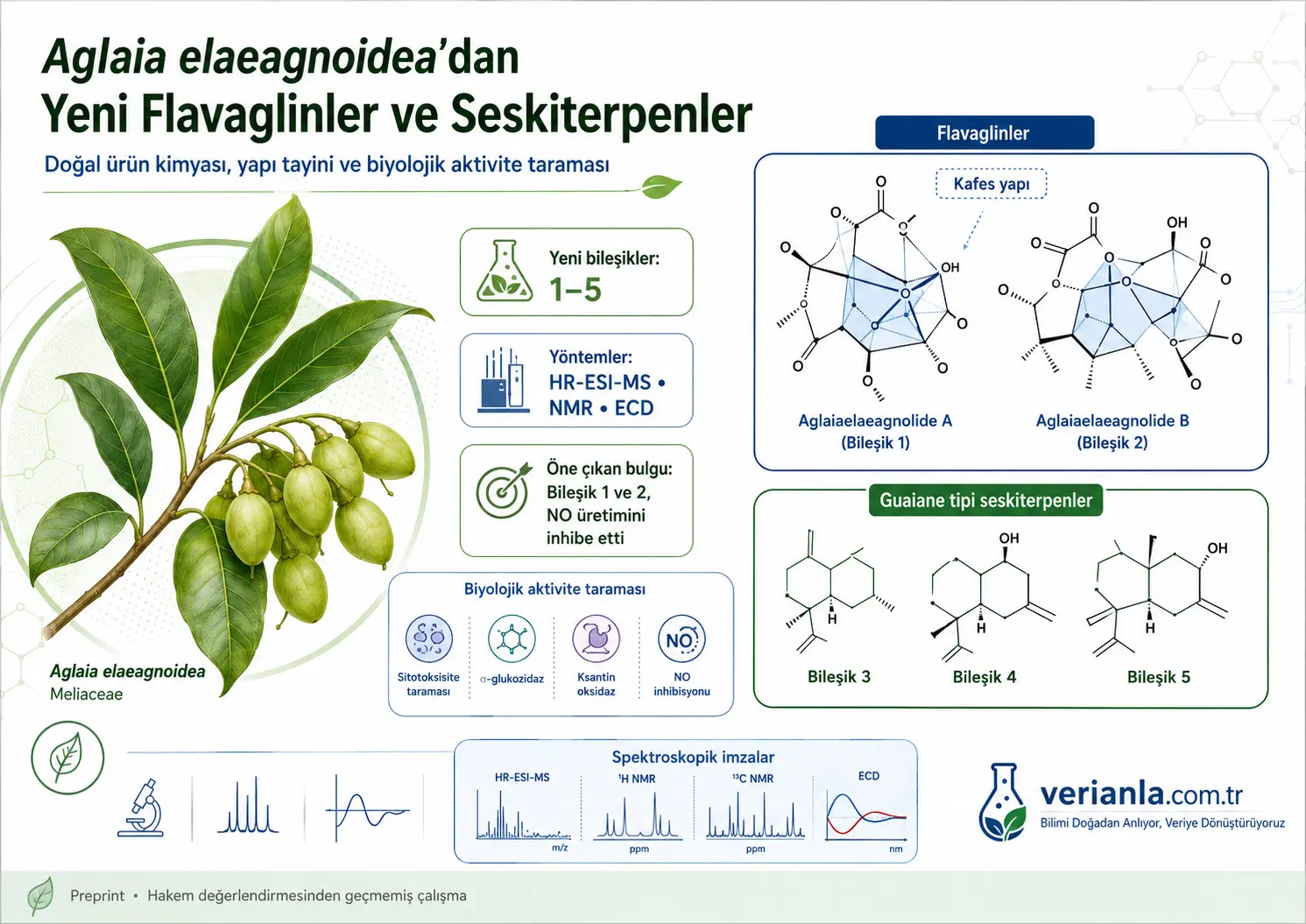
Масъалаи асосии ин таҳқиқот фаҳмидани гуногунии химиявии метаболитҳои дуюмдараҷа дар растаниҳои ҷинси Aglaia ва потенсиали фаъолияти биологии ин молекулаҳо мебошад. Aglaia ҷинси растаниҳои оилаи Meliaceae буда, дар минтақаҳои тропикӣ ва субтропикӣ, махсусан атрофи Ҷазираҳои Уқёнуси Ором, шимоли Австралия ва Осиёи Ҷанубу Шарқӣ васеъ паҳн шудааст. Тибқи таҳқиқот, ин ҷинс бинобар истифодаи анъанавии тиббӣ ва гуногунии бойи метаболитҳои дуюмдараҷа солҳои зиёд барои кимиёи маҳсулоти табиӣ, medicinal chemistry ва pharmacology ҷолиб мебошад.
Яке аз хусусиятҳое, ки намудҳои Aglaia-ро аз ҷиҳати илмӣ муҳим мекунанд, синфи махсуси маҳсулоти табиӣ бо номи flavaglin ё rocaglate analogues мебошад. Flavaglins молекулаҳоеанд, ки одатан ring systems-и мураккаб доранд ва бинобар biological activity potential таваҷҷуҳ ҷалб мекунанд. Дар study гуфта мешавад, ки ин синф бо доираи васеи pharmacological activities, аз ҷумла anticancer, antiviral, anti-inflammatory ва insecticidal effects алоқаманд дониста шудааст. Аммо як нуқтаи эҳтиёткорона муҳим аст: ин study clinical research нест ва таъсири therapeutic-и ин molecules-ро дар humans нишон намедиҳад. Он study-и natural-product chemistry аст, ки structures of compounds isolated from plant-ро муайян ва activities-и онҳоро дар баъзе laboratory assays screen мекунад.
Aglaia elaeagnoidea растании марказии study мебошад. Research мегӯяд, ки leaves, roots, bark ва fruits-и ин plant historically in contexts associated with inflammation, skin disease, fever ва microbial infections истифода шудаанд. Previous phytochemical studies аз ин species flavaglins, terpenoids ва limonoids ҷудо кардаанд. Ин study махсусан fruits-ро таҳқиқ намуда, five previously undescribed compounds report мекунад.
Scientific gap ҳамин аст: гарчанде A. elaeagnoidea previously chemically investigated шудааст, diversity of fruit-derived compounds ва especially flavaglin analogues with unusual architectures пурра маълум набуд. Researchers барои пур кардани gap fruit material-ро extract карданд, ба fractions ҷудо карданд, pure compounds-ро chromatographic methods isolate намуданд ва structures-ро бо advanced spectroscopic and computational methods тасдиқ карданд.
Five compounds prominent мебошанд:
- Compound 1: New cage-like cyclohexenone flavaglin named Aglaiaelaeagnolide A.
- Compound 2: Aglaiaelaeagnolide B, structurally similar to compound 1 but containing an extra oxygen atom and hydroxy/hemiketal character at C-10.
- Compound 3: Guaiane-type sesquiterpene identified as (1S,4S,5S,7S,10R) 1,5-epoxy-4,11-dihydroxyguaiane.
- Compound 4: Stereochemically different guaiane-type sesquiterpene identified as (1S,4R,5S,7S,10R) 1,5-epoxy-4,11-dihydroxyguaiane.
- Compound 5: Third guaiane-type sesquiterpene identified as (1R,4R,5R,7S,10R) 1,5-epoxy-4,11-dihydroxyguaiane.
Most striking compounds are 1 and 2. They show architecture beyond classical expectation within benzopyran flavaglin framework. According to study, ring A loses aromatic character and becomes cyclohexenone. In addition there is a lactone bridge between C-11/C-5a and ether bridge between C-10/C-1a. These two bridges give the molecule cage-like three-dimensional rigidity. In simple analogy, imagine two connecting arches placed over a flatter molecular skeleton; these connections lock the molecule into a more fixed, complex three-dimensional shape.
Such complex structures matter in natural-product chemistry because three-dimensional molecular shape can strongly affect interaction with biological targets. However, study does not establish precisely how these structures bind to biological targets. It focuses on structure determination and activity screening in selected cell/enzyme assays. Therefore no definitive therapeutic-mechanism or drug-development claim can be made from this study alone.
HR-ESI-MS data were used for mass/charge signals and molecular-formula determination. Molecular formula for compound 1 was:
\[ C_{26}H_{22}O_{8} \]
Here C means carbon, H hydrogen and O oxygen. Formula indicates compound 1 contains 26 carbon, 22 hydrogen and 8 oxygen atoms. Study states this corresponds to 16 degrees of unsaturation. Degree of unsaturation is a concept used to understand total structural complexity contributed by rings and multiple bonds. High degree suggests many rings, double bonds or carbonyl characteristics.
Molecular formula for compound 2 was:
\[ C_{26}H_{22}O_{9} \]
Compound 2 contains one more oxygen atom than compound 1. Study says this suggested that compound 2 might contain an additional hydroxy or ether function; NMR correlations supported an additional hydroxy group related to C-10. Marked downfield/chemical-shift character of C-10 carbon also supported hemiketal-carbon interpretation.
Compounds 3, 4 and 5 have same molecular formula:
\[ C_{15}H_{26}O_{3} \]
Despite same atom counts, compound 3 and the other two compounds have different stereochemical arrangements. Bond connectivity is largely similar, but spatial orientations differ. This is particularly important in chemistry because right-left-like three-dimensional arrangement can change behavior in biological systems. Study reports compounds 3–5 are guaiane-type sesquiterpenes and stereochemistry could not be determined solely with NOESY, so computational 13C-NMR and optical-rotation analyses were also used.
Figure 1 shows chemical structures of the five isolated compounds. It compares more complex and oxygen-rich flavaglin-based structures of compounds 1 and 2 with guaiane-type sesquiterpene skeletons of 3–5. Rings A, B and C and bridged cage architecture are evident in 1 and 2, whereas 3–5 show a more compact terpenoid ring system. This visual is central for understanding the chemical core of study: work reports not only bioactivity but first of all “previously undescribed chemical architectures”.
Figure 2 shows HMBC and COSY correlations. COSY traces connections between neighboring protons; HMBC shows correlations between protons and more distant carbons to establish how atoms connect within molecule. In compounds 1 and 2 these correlations were used to position phenyl group, para-methoxyphenyl group, cyclohexenone region, ketone carbonyl, methoxy groups, hydroxy groups and bridge connections. For 3–5, spin systems such as H2-2/H2-3 and H3-14/H2-9/H2-8/H-7/H2-6 together with HMBC supported construction of guaiane skeleton.
Figure 3 shows NOESY correlations. NOESY provides information through spatial proximity rather than through-bond connections, especially useful for stereochemical arrangement. In compound 1, H-4, 3-phenyl group and bridged C-10 region were inferred to lie close on same spatial face, helping establish relative configuration. In 3–5, NOESY correlations served as complementary evidence supporting computational results.
Figure 4 compares experimental ECD spectra of compounds 1 and 2 with TD-DFT computational curves. ECD is powerful spectroscopy for determining absolute configuration of chiral molecules. For compound 1 positive Cotton effects were reported at 203 nm, 229 nm and 304 nm, with negative effect at 254 nm. Compound 2 similarly had positive effects at 202 nm, 229 nm and 305 nm, and negative effect at 251 nm. Agreement between experimental and calculated spectra supported assignment of absolute configurations of 1 and 2.
Figure 5 shows linear regression between experimental 13C-NMR chemical shifts and GIAO-STS calculated 13C-NMR values for compounds 1 and 2. Graph shows extremely high agreement between calculated and experimental data. For compound 1 and compound 2 study reports:
\[ R^{2} = 0.9993 \]
Here R2 is coefficient of determination showing how well calculated values explain experimental values. Being very close to 1 indicates very strong agreement.
Error values for compound 1:
[ MAE = 0.75 \, ppm ]
[ RMS = 0.97 \, ppm ]
Error values for compound 2:
[ MAE = 0.80 \, ppm ]
[ RMS = 1.03 \, ppm ]
MAE means mean absolute error and RMS root mean square error. ppm is “parts per million”, unit for NMR chemical shifts. Low values show calculated structural assignment matches experimental NMR data well. Important point is researchers did not rely only on visual interpretation of spectra; they combined experimental and computational data to support complex molecular structures more reliably.
Biological testing was carried out under four main headings: cytotoxicity against HepG2 and SK-LU-1 cells, α-glucosidase inhibition, xanthine oxidase inhibition, and inhibition of nitric oxide production in LPS-stimulated RAW 264.7 macrophages. These assays screen how molecules behave in different biological systems. None provide proof of clinical effect. For example cytotoxicity in HepG2 or SK-LU-1 cell lines does not mean “cancer treatment”; it is an activity signal measured at cell-culture level.
IC50 values were used to assess biological activity. IC50 means concentration needed to produce 50 percent effect. Generally lower IC50 indicates stronger activity under test condition. But IC50 alone does not prove safety, selectivity, clinical effectiveness or drug-candidate status.
Compounds 1 and 2 markedly inhibited nitric oxide production. LPS stimulation of RAW 264.7 macrophages increases inflammation-related nitric oxide, a common laboratory model for screening potential anti-inflammatory activity. NO inhibition IC50 was 28,6 µM for compound 1 and 11,4 µM for compound 2. Positive control L-NMMA was 29,8 µM. Thus compound 2 in particular showed strong NO-production inhibition under these conditions.
However study does not resolve detailed molecular mechanism for this effect. Reduced NO production may signal potential anti-inflammatory activity, but inflammation biology is complex; without mechanistic studies, toxicity analyses, selectivity tests, animal research and clinical evaluation, it should not be translated directly into therapeutic effect.
For cytotoxicity, compounds 1–5 had IC50 values in 16,7–66,0 µM range against HepG2 and SK-LU-1. Positive control ellipticine was 1,3 µM for HepG2 and 1,4 µM for SK-LU-1. Thus isolated compounds showed cytotoxic activity but were weaker than positive control. Compound 1 was relatively strongest with 16,7 µM for HepG2 and 17,3 µM for SK-LU-1.
In α-glucosidase inhibition compounds gave IC50 66,1–153,5 µM; positive control acarbose was 46,4 µM, so compounds were weaker. In xanthine oxidase inhibition guaiane-type sesquiterpenes 3–5 were more apparent but still limited versus positive control: 75,3 µM for 3, 50,6 µM for 4 and 53,7 µM for 5, while flavaglins 1 and 2 were reported inactive with IC50 above 100 µM. Allopurinol positive control was 3,0 µM.
These results give two central messages. First, compounds 1 and 2 are chemically very distinctive and show notable NO-production inhibition. Second, compounds 3–5 look more active than flavaglins in some enzyme assays, especially xanthine oxidase, but remain much weaker than allopurinol. Main contribution is therefore not “an immediately usable treatment molecule”, but identification of new natural molecules, detailed structural verification and preliminary biological activity screening.
Historically, study strengthens place of Aglaia species in natural-products chemistry. Flavaglins, terpenoids and limonoids had already been isolated from this genus. This work adds an apparently previously unreported structural example in benzopyran flavaglin framework with cyclohexenone-modified A ring and cage architecture. Today its importance is demonstration that natural-product discovery still generates chemical diversity. In future compound 1 and compound 2 structures may serve as starting points for anti-inflammatory, cytotoxicity or structure-activity studies, but advanced biological and pharmacological validation is required.
Everyday-life impact should not be interpreted as direct drug, supplement or treatment recommendation. Even though molecules were isolated from a plant, study does not say the plant should be consumed, used therapeutically or is safe. Real impact of natural-product chemistry is indirect: understanding molecular diversity in nature, finding clues to biological mechanisms, offering new scaffolds for chemical synthesis and drug discovery, and converting traditional-use claims into scientifically testable questions.
One strength is multi-evidence structure determination. HR-ESI-MS supported molecular formulas; NMR revealed connectivity and functional groups; HMBC and COSY showed atom connections; NOESY supported spatial proximity; ECD and TD-DFT were used for absolute configuration; GIAO-STS computational 13C-NMR strengthened complex stereochemical assignments. This combination adds reliability in defining complex natural-product structures.
Limitations are also clear. First, text is explicitly non-peer-reviewed preprint. Second, biological assays are at cell and enzyme levels; no clinical study, animal study or human safety assessment is provided. Third, NO inhibition appears strong but mechanism is not deeply resolved. Fourth, cytotoxicity and enzyme-inhibition results are generally weaker than positive controls. Fifth, isolation amounts are limited: 15,1 mg for compound 1, 16,0 mg for compound 2, 60 mg for compound 3, 30 mg for compound 4 and 17,5 mg for compound 5. These are typical in natural-product work but advanced applications may require more material, synthesis or semisynthesis.
In conclusion, study reports five previously undescribed compounds from fruits of Aglaia elaeagnoidea. Aglaiaelaeagnolides A and B offer unusual cage architecture in flavaglin chemistry and notable inhibition of nitric oxide production. Findings should be read as preprint-level laboratory biological screening data, not clinical efficacy or treatment guarantee.
Усул ва Натиҷаҳои Таҳқиқот
Experimental workflow consists of plant-material collection, extraction, fractionation, chromatographic purification, spectroscopic structure determination, computational confirmation and biological activity screening. Fruit samples were collected in Quang Tri, Vietnam in September 2022. Scientific identification was made by Dr. Nguyen The Cuong and voucher specimen NCCT-P137 stored at Institute of Chemistry, Vietnam Academy of Science and Technology.
| Марҳила | Approach used in study | Scientific meaning |
|---|---|---|
| Plant material | Aglaia elaeagnoidea fruits, Quang Tri, Vietnam, September 2022 | Provides biological source of chemical investigation. |
| Extraction | 1,3 kg dried fruit powder extracted ultrasonically three times with MeOH at room temperature; each extraction used 4 L MeOH for 60 minutes. | Transfers organic compounds from plant tissue into solvent. |
| Initial extract | 98 g MeOH extract obtained. | Shows starting amount of crude chemical mixture. |
| Partitioning | Extract suspended in water and separated with n-hexane, methylene chloride and ethyl acetate. | Compounds separated into fractions by solubility and polarity. |
| Fractions | n-hexane fraction 5 g, methylene chloride fraction 47 g, ethyl acetate fraction 9 g. | Isolated compounds were obtained particularly from processing methylene chloride and ethyl acetate fractions. |
| Chromatography | Silica gel, reversed-phase C18 column and semipreparative HPLC used. | Mixture molecules purified by physicochemical properties. |
| Pure compound amounts | Compound 1: 15,1 mg; compound 2: 16,0 mg; compound 3: 60 mg; compound 4: 30 mg; compound 5: 17,5 mg. | Shows natural-product compounds obtained at low-milligram levels. |
Основные analytical methods used for structure determination were:
| Method | Use in study | Information provided |
|---|---|---|
| HR-ESI-MS | High-resolution mass spectra of compounds obtained. | Molecular formulas and ion signals determined. |
| 1H NMR and 13C NMR | Proton and carbon chemical shifts measured. | Information on functional groups, carbon types, aromatic rings, methoxy groups, hydroxy groups and ring systems. |
| HSQC | Direct proton-carbon connections examined. | Helped identify which proton is attached to which carbon. |
| HMBC | Long-range proton-carbon correlations analyzed. | Used to build molecular skeleton and determine attachment positions of phenyl and methoxyphenyl groups. |
| COSY | Proton-proton spin systems examined. | Traced neighboring proton sequences, especially in sesquiterpene skeleton. |
| NOESY | Spatial-proximity correlations evaluated. | Supported relative configuration. |
| ECD and TD-DFT | Experimental ECD spectra compared with calculated spectra. | Contributed to determination of absolute configurations of compounds 1 and 2. |
| GIAO-STS 13C-NMR calculation | Experimental carbon NMR data compared with computational chemical shifts. | Especially supported complex stereochemical assignments. |
| Optical rotation calculation | Experimental and calculated optical rotation values compared for compounds 3–5. | Supported absolute configurations of sesquiterpenes where ECD information was limited by lack of strong UV chromophore. |
Compound 1: Aglaiaelaeagnolide A. Compound 1 isolated as white amorphous powder. HR-ESI-MS data showed m/z 463,1392 [M+H]+ in positive-ion mode and m/z 461,1250 [M-H]- in negative-ion mode, supporting molecular formula C26H22O8. Formula corresponds to 16 degrees of unsaturation. 1H NMR and HSQC showed phenyl group, para-disubstituted benzene ring, olefinic proton, oxygenated methine, hydroxyl proton, neighboring methine protons, methylene group and two methoxy groups.
HMBC correlations showed phenyl group attached at C-3 and para-methoxyphenyl group at C-2. Highly oxygenated nature of C-5 and C-10 supported oxygen-bearing centers. In ring A, structures including C-8 ketone carbonyl, C-6/C-7 double bond and C-1a/C-10 ether bridge were assigned. Lactone bridge between C-11 and C-5a and ether bridge between C-10 and C-1a create cage architecture. ECD comparisons assigned absolute configuration as (1aS,2S,3R,4S,5aR,5R,10S).
Compound 2: Aglaiaelaeagnolide B. Compound 2 also isolated as white amorphous powder. HR-ESI-MS supported C26H22O9. This is one extra oxygen relative to compound 1. NMR showed close structural analogy but additional hydroxy group associated with C-10. C-10 carbon at δC 113,2 supported hemiketal character. NOESY and ECD allowed relative and absolute configuration to be assigned similarly to compound 1.
Compounds 3–5: Guaiane-type sesquiterpenes. These three compounds share molecular formula:
\[ C_{15}H_{26}O_{3} \]
For compound 3, NMR showed sesquiterpene with four methyl groups, four oxygenated tertiary carbons and saturated carbons. COSY and HMBC supported guaiane skeleton. C-1, C-4, C-5 and C-11 were oxygenated; NMR re-recorded in DMSO-d6 showed 4-OH and 11-OH protons. Remaining oxygen atom was assigned as C-1/C-5 epoxy bridge. Thus gross structure was 1,5-epoxy-4,11-dihydroxyguaiane.
Compounds 4 and 5, with same molecular formula and similar NMR patterns as compound 3, were interpreted as diastereomers. Although five stereogenic centers exist, rigidity from C-1/C-5 epoxy bridge allowed computational analysis of eight relative-configuration possibilities. STS algorithm indicated compound 3 most compatible with 3e configuration at %96,84 probability, compound 4 with 3h at %95,97, and compound 5 with 3a at %85,87. However, because optical-rotation sign of compound 5 was opposite calculated value, researchers concluded compound 5 had enantiomeric configurations of 3a.
| Compound | Name / structure type | Molecular formula | Key structural feature |
|---|---|---|---|
| 1 | Aglaiaelaeagnolide A; cage-like cyclohexenone flavaglin | C26H22O8 | Cyclohexenone-modified A ring, C-11/C-5a lactone bridge, C-10/C-1a ether bridge |
| 2 | Aglaiaelaeagnolide B; cage-like cyclohexenone flavaglin | C26H22O9 | Extra oxygen relative to 1; C-10 hydroxy/hemiketal character |
| 3 | (1S,4S,5S,7S,10R) 1,5-epoxy-4,11-dihydroxyguaiane | C15H26O3 | Guaiane-type sesquiterpene; C-1/C-5 epoxy bridge; 4-OH and 11-OH |
| 4 | (1S,4R,5S,7S,10R) 1,5-epoxy-4,11-dihydroxyguaiane | C15H26O3 | Diastereomer of compound 3; different C-4 orientation |
| 5 | (1R,4R,5R,7S,10R) 1,5-epoxy-4,11-dihydroxyguaiane | C15H26O3 | Guaiane-type sesquiterpene; configuration supported by optical-rotation comparison |
Biological activity findings are summarized below. All IC50 values are in µM. Lower IC50 indicates stronger activity under test conditions.
| Compound | HepG2 cytotoxicity | SK-LU-1 cytotoxicity | α-Glucosidase inhibition | Xanthine oxidase inhibition | Nitric oxide production inhibition |
|---|---|---|---|---|---|
| 1 | 16,7 ± 1,2 | 17,3 ± 1,3 | 153,5 ± 3,9 | >100 | 28,6 ± 2,5 |
| 2 | 22,8 ± 1,9 | 20,1 ± 1,5 | 128,7 ± 4,4 | >100 | 11,4 ± 1,4 |
| 3 | 64,2 ± 2,9 | 51,8 ± 1,6 | 71,3 ± 3,0 | 75,3 ± 3,4 | >100 |
| 4 | 50,9 ± 2,0 | 57,3 ± 1,7 | 85,0 ± 2,8 | 50,6 ± 1,6 | >100 |
| 5 | 52,5 ± 3,1 | 66,0 ± 2,4 | 66,1 ± 2,5 | 53,7 ± 2,3 | 82,3 ± 3,9 |
| Positive control | 1,3 ± 0,1 | 1,4 ± 0,1 | 46,4 ± 1,9 | 3,0 ± 0,5 | 29,8 ± 2,8 |
Positive controls were ellipticine for cytotoxicity, acarbose for α-glucosidase, allopurinol for xanthine oxidase, and NG-Methyl-L-arginine acetate salt, L-NMMA, for nitric oxide production. These comparisons provide context for activities of isolated compounds against known references.
Main technical findings:
- Compounds 1 and 2 contain cyclohexenone A ring and cage architecture reported as previously undescribed within benzopyran flavaglin framework.
- Structures of 1 and 2 were supported by HR-ESI-MS, NMR, HMBC, COSY, NOESY, ECD and TD-DFT calculations.
- Experimental 13C-NMR and GIAO-STS computational data for 1 and 2 showed very high agreement, R2 = 0,9993 for both.
- Compounds 3–5 are guaiane-type sesquiterpenes with same molecular formula; stereochemistry supported by GIAO-STS, NOESY and optical rotation calculations.
- Compounds 1–5 showed cytotoxicity, but positive control ellipticine had much lower IC50.
- α-Glucosidase inhibition was weaker than acarbose.
- For xanthine oxidase, compounds 3–5 were more active than 1 and 2, but allopurinol was much stronger.
- Compounds 1 and especially 2 were notable for nitric oxide inhibition; compound 2 had IC50 of 11,4 ± 1,4 µM.
- Results are laboratory cell/enzyme screening, not clinical therapeutic effects.
Key chemical expressions at formula level are molecular formulas and bioactivity metric. Basic molecular formulas can be summarized as:
\[ C_{26}H_{22}O_{8} \]
This formula belongs to aglaiaelaeagnolide A and means 26 carbon, 22 hydrogen and 8 oxygen atoms.
\[ C_{26}H_{22}O_{9} \]
This formula belongs to aglaiaelaeagnolide B and contains one extra oxygen relative to A.
\[ C_{15}H_{26}O_{3} \]
This formula is common to compounds 3–5. Despite identical formula, compounds differ in three-dimensional stereochemical arrangements.
Basic notation used for biological activity is IC50:
\[ IC_{50} \]
IC50 is concentration required for 50 percent biological effect. Values are given in micromolar, µM. A compound with lower IC50 is considered more active under the same experimental conditions. However IC50 does not mean clinical safety, selectivity, body distribution or treatment success.
Ёддошт оид ба Манбаъ ва Усул
Ин мундариҷа дар асоси таҳқиқоти Nguyen Huy Hoang, Nguyen Viet Dung, Duong Thi Hai Yen, Phan Thi Thanh Huong, Duong Thi Dung, Nguyen The Cuong, Do Thi Trang, Dan Thi Thuy Hang, Pham Hai Yen, Nguyen Phuong Thao, Phan Van Kiem ва Bui Huu Tai бо унвони “Undescribed flavaglines and sesquiterpenes from Aglaia elaeagnoidea” таҳия шудааст.
According to text, source is preprint research paper and explicitly not peer reviewed. Therefore results should be read as preprint data, not finalized peer-reviewed findings. DOI or final journal acceptance could not be verified from text.
Narrative is based on methods, findings, figures, tables and conclusions in PDF. No claims not in PDF about clinical efficacy, treatment success, human safety, commercial application, field success or definite drug-candidate status have been added. Study is not clinical; it includes no patient group, randomized clinical trial or treatment protocol. Biological activity is based on laboratory cell and enzyme assays.
Five previously undescribed compounds were isolated from fruits of Aglaia elaeagnoidea. Structure determination used HR-ESI-MS, NMR, HMBC, COSY, HSQC, NOESY, ECD, TD-DFT, GIAO-STS 13C-NMR calculations and optical-rotation comparisons. Biological testing covered cytotoxicity against HepG2 and SK-LU-1, LPS-stimulated nitric oxide production in RAW 264.7 macrophages, α-glucosidase and xanthine oxidase inhibition.
Strongest contribution is that aglaiaelaeagnolides A and B have cage-like cyclohexenone architecture described as previously unreported in benzopyran flavaglin framework and show notable nitric oxide-production inhibition. These results do not replace advanced mechanistic validation, toxicity/selectivity analysis, animal studies or clinical trials, so work should be understood in natural-products chemistry and preliminary bioactivity-screening context.
Шарҳ гузоред
Нишонии почтаи электронии шумо нашр намешавад. Майдонҳои ҳатмӣ бо * нишон дода шудаанд